Home Blog Page 1747

Shiba Inu Issues New Statement on SHIB Burns

0

Shiba Inu’s lead developer, Shytoshi Kusama, has addressed concerns regarding SHIB burns once again.

Shytoshi Kusama, the pseudonymous lead developer of Shiba Inu, has provided an update on SHIB burns. Kusama took to one of Shiba Inu’s official Telegram groups to address community members expecting “magic burns” for SHIB.

During the conversation, Kusama highlighted how boosting Shiba Inu utility can contribute immensely to ongoing burn efforts.

“BURNS will only come through utility and use,” Kusama stated in a Telegram chat shared by Shiba Inu marketing specialist Lucie.

No Burns Without Real Use 

Kusama noted that many enthusiasts expect the team to implement upgrades that will drive SHIB burns. However, he emphasized that there will be no “burns” if Shiba Inu does not have real use.

“So I focus on use and put burns in,” he added.

Shiba Inu Adoption Decline Due to FUD Attackers 

Meanwhile, Kusama highlighted the damage caused by malefactors who spread Fear, Uncertainty, and Doubts (FUDs) about Shiba Inu. Per Kusama, these attackers drive users away with malicious reports about SHIB, leading to low adoption of Shiba Inu projects.

Community Makes Fresh Demand for SHIB Burns  

Kusama’s remarks come a few hours after he introduced Shib Name Service (SNS). This feature gives Shibarium users human-readable addresses instead of the complex sequence of numbers and letters.

Following SNS launch, several SHIB enthusiasts took to X, questioning how the recently-launched service could support ongoing burn efforts.

Another user hoped that the team could burn SHIB using the revenue generated from the service.

Reacting, the Shiba Inu lead reiterated that there is no way to bolster SHIB burns other than increasing utility.

Burns Are Not Enough to Boost SHIB Price 

Many Shiba Inu enthusiasts believe that the enormous circulating supply of SHIB has contributed negatively to the asset’s price. Consequently, they see burns as the major way to reduce the asset’s supply and increase price.

Responding, Kusama emphasized that burns alone are insufficient to boost SHIB’s price. He noted that adoption and burns will need to go hand-in-hand to cause the asset’s price to spike.

SHIB Burns

So far, 410,661,963,667,285 (410.66 trillion) SHIBs have been burned from the supply.

Most of these tokens were burned by Ethereum co-founder Vitalik Buterin in May 2021. Recall that in what appears to be a marketing stunt in 2021, the Shiba Inu team gifted Butein 50% of SHIB’s supply.

Instead of keeping the tokens to himself, Buterin sent over 410 trillion SHIB, representing 90% of his Shiba Inu holdings, to a dead wallet.

Following the move, other Shiba Inu enthusiasts have been contributing to the burn program by voluntarily sending some amounts of SHIB to the address. 

According to data from Shibburn, 7,929,666 (7.9 million) SHIB tokens were incinerated in 24 hours. However, the Shiba Inu burn rate is down 32.48% in the past day.

Cardano IOG Takes Over Popular Wallet, Nami, With 200,000+ Users

0

Input Output Global has become the official guardian of Nami Wallet, a popular browser-based wallet solution for the Cardano ecosystem.

One of the most popular wallets within the Cardano ecosystem has a new steward. On November 1, Input Output Global (IOG), Cardano’s research and engineering arm, added Nami Wallet to its family of products.

Nami Wallet is a browser-based wallet extension that enables users to transfer ADA, stake assets, and connect with Cardano-based applications. Since launching in 2021, Nami Wallet has become a popular choice within the Cardano space, gathering over 200,000 users.

However, Nami Wallet’s creator, Alessandro Konrad (more popularly known as Ales), notes that the application he built to solve a pressing need within the Cardano ecosystem at the time “surpassed” his expectations. The wallet has grown to a stage where it has become difficult for a sole creator to manage it.

Ales revealed he was caught between turning Nami Wallet into a venture or finding a capable steward for it. He decided to go with the latter choice.

“I couldn’t be happier with Nami finding its new home under IOG’s guidance. They possess the necessary resources and expertise to provide Nami with the support it has long needed,” Ales said in the official announcement.

IOG Outline Plans for Nami Wallet

Following the latest takeover by Input Output Global, Cardano’s engineering arm confirmed that Nami Wallet users currently do not have to take any action. Instead, they will continue to enjoy the same user-friendly features that they have come to love in the wallet.

IOG further disclosed plans to integrate Nami Wallet across its other products to make it more valuable to the Cardano community. The exact nature of the integrations is unknown at this stage. Notably, IOG described its Nami Wallet acquisition as “a new chapter.”

Cardano Community Worried About Monopoly

Although transferring Nami Wallet to IOG is logical for the product, given Ales’ concerns, many in the Cardano community expressed concern that the move would further centralize the ecosystem. 

With IOG being a key leader within Cardano and offering its own wallet solutions, such as Daedulus and Lace, adding Nami Wallet creates a “monopoly,” according to X user Dave. IOG will have less competition following the acquisition, depriving the Cardano ecosystem of more wallet options.

Given other similar cries of centralization with Input Output Global’s involvement within the Cardano ecosystem, the community will remain keen to see Nami Wallet’s evolution under the oversight of its new steward. 

XRP Google Searches on Rise: Google Trends Reveals Greater Enthusiasm Among Americans for XRP Over Ethereum

0

Data has shown that Americans are exhibiting a greater degree of enthusiasm toward XRP compared to Ethereum (ETH).

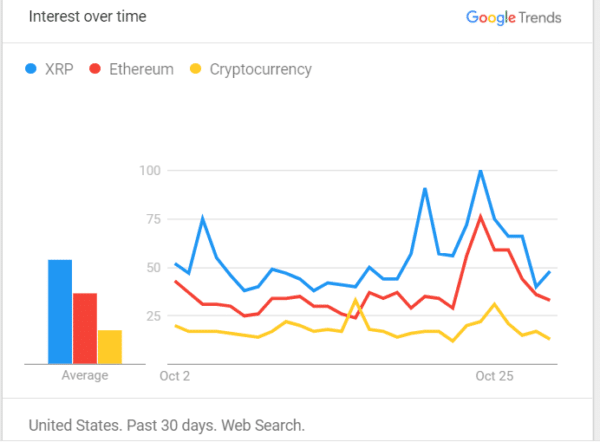
Specifically, Google Trends data reveals that XRP commands a significantly higher search volume among Americans than ETH and blanket terms like ‘cryptocurrency.’ Over the past 30 days, XRP consistently ranked higher in search volume by a considerable margin.

XRP ETH Google Search Volume
XRP, Ethereum, Cryptocurrency Google Search Volume in US

Google search volume for XRP from the United States peaked on October 24. Interestingly, the date coincided with when the firstborn crypto, Bitcoin, broke out significantly from its passive trend to over $34k for the first time in more than 15 months.

Ordinarily, crypto enthusiasts would expect that ETH, the closest rival to Bitcoin, would have taken the spotlight as Bitcoin led the market.

However, such a scenario failed to materialize. Instead, XRP emerged as the center of attention, with more people from the U.S. showing interest in the asset, as evidenced by Google search data.

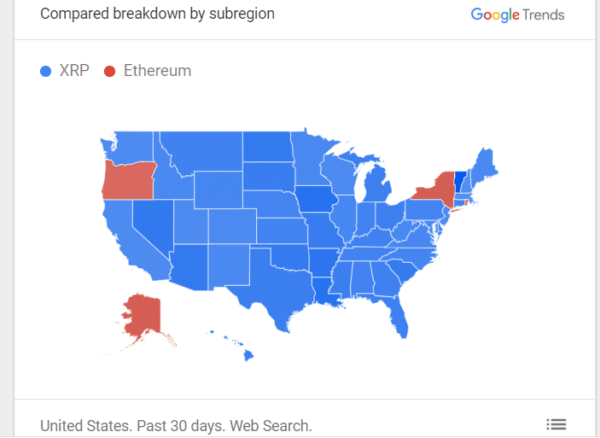
Furthermore, Google Trend data indicates that the interest of Americans in XRP is evenly distributed rather than concentrated in a few specific regions across the country. As depicted in the map below, more than 90% of Americans are interested in XRP than Ethereum.

XRP Eth googe
U.S. regions search Vol for XRP and Ethereum

Notably, the regions in the United States leading the ranking of XRP search volumes include Iowa, West Virginia, Louisiana, Montana, and Delaware. Moreover, XRP similarly trumped Ethereum in search interest year-to-date (YTD).

XRP and Ethereum Search Interest Worldwide

While XRP defeated Ethereum in search interest from Americans, both in the last 30 days and YTD metrics, the battle becomes close on a worldwide scale.

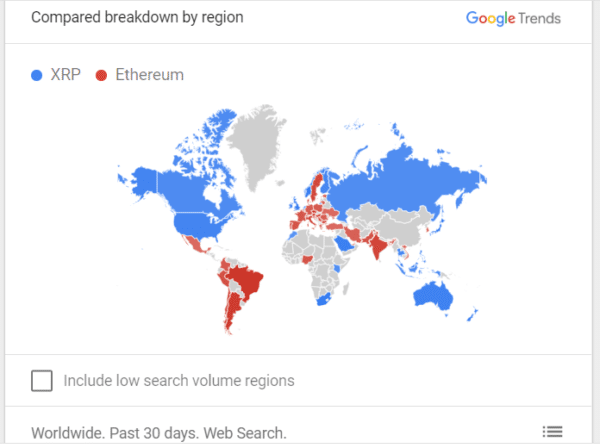
Globally, the search interest for XRP and Ethereum has been neck and neck in the last 30 days, with no decisive winner. However, when delving into regional breakdowns, it becomes evident that more countries exhibit interest in XRP than Ethereum.

XRP Ethereum Worldwide
XRP and Ethereum 30-day Search Worldwide

The regions with the highest search volume for XRP include Japan, South Africa, the Philippines, the United Kingdom, and Australia. Meanwhile, on a YTD scale, Ethereum slightly towers above XRP despite ETH being about seven times bigger than XRP in market valuation.

Peter Brandt Predicts Ethereum Rally to $1,993 Upon Breakout of Right-Angled Expanding Triangle

Peter Brandt, a veteran trader with over 40 years of experience, has set a target of $1,993 for Ethereum (ETH) following the asset’s breakout of a recently formed right-angled expanding triangle.

Brandt made this projection yesterday during his latest analysis of Ethereum’s recent price movements. The trader shared a daily ETH chart on X, identifying the formation of a right-angled expanding triangle pattern, which was completed on Oct. 23.

A right-angled expanding triangle, or a right-angled broadening wedge, features an upper trendline and a lower trendline, with both lines expanding apart. The pattern can either signal a potential continuation of the previous trend or a reversal.

Data from Brandt’s chart suggests that the beginning of this pattern dates back to Aug. 17. Notably, ETH collapsed 6.76% on the day, dropping to a low of $1,683.5. However, this massive red candlestick formed the base of the right-angled expanding triangle.

Ethereum ETH 1D Chart Peter Brandt

Amid Ethereum’s swings and lows since Aug. 17, the asset formed the broadening triangle, as it continued to trade within its confines until Oct. 23. Brandt’s analysis emphasizes that ETH completed the formation of the triangle on Oct. 23 amid a 6.17% increase that day.

ETH Forms Flag Pattern, Poised to Rally 8.6%

Interestingly, ETH broke above the upper trendline of the triangle, signaling a potential continuation of an uptrend that began on Oct. 12. However, after the breakout, Ethereum formed a flag pattern that lasted for nine days, from Oct. 24 to Nov. 1.

Brandt identified this flag pattern in his analysis. According to him, ETH recently completed the flag pattern, which is a further re-confirmation of the right-angled expanding triangle, which the asset completed on Oct. 23.

Notably, flags are typically consolidation patterns that suggest a brief pause in the prevailing trend before a potential resumption of that trend. Since breaking above $1,800, ETH has consolidated between $1,744 and $1,865, but with an upward trajectory.

The asset has now completed the nine-day flag, and a bullish continuation of the uptrend is expected. Brandt’s chart suggests a target of $1,993 for when Ethereum engineers another massive run. ETH would need to appreciate 8.5% from its current price to hit $1,993.

Ethereum trades for $1,836 as of press time, per CoinMarketCap data. The asset is up 1.76% over the past 24 hours, with its eyes set on conquering the $1,874 resistance. Impressively, ETH’s trade volume has increased 71.30% to a current value of $11.6 billion, ranking it third in volume.

Ripple Locks 800M XRP Back to Escrow, 200M XRP Remains Liquid

0

Ripple locks back 800 million XRP within 24 hours after releasing 1 billion coins from its escrow accounts.

In a strategic move to maintain stability within the XRP market, Ripple has returned 800 million units of XRP to its escrow account. The leading blockchain company performed the transaction less than 24 hours after it unlocked 1 billion XRP from its escrow accounts.

According to data retrieved by The Crypto Basic from Whale Alert’s X handle, the 800 million XRP were re-locked in two different transactions, with each containing 400M XRP apiece.


Ripple Re-Locks 800M XRP in Escrow

A closer look at data from XRP Scan provided insight into how Ripple put back the 800M XRP coins in escrow.

Notably, the first 400M XRP coins were locked in escrow by one of Ripple’s addresses tagged as ‘Ripple 10.’ This came after the address received 400M XRP from two other addresses, Ripple 22 and Ripple 23, respectively.

Furthermore, the other 400 million XRP were sent from ‘Ripple 23’ to ‘Ripple 11’ and locked in the company’s escrow account. At the time of the transactions, the total value of the 800M XRP locked was around $476.86 million.

200M XRP Remains Liquid

With 800M XRP put back in escrow from the 1B coins unlocked yesterday, Ripple sent the remaining 200 million XRP from Ripple 22 to Ripple 1.

The 200M XRP, worth $120.8 million at press time, will remain liquid and be spent by Ripple for the day-to-day running of its business.

Ripple Now Holds 40.9B XRP in Escrow

Following the re-lock of 800M XRP, Ripple now holds approximately 40.9 billion XRP in escrow. The leading blockchain company disclosed in its recently published Q3 report that it held about 41.3 billion XRP in escrow as of September 30.

So far, Ripple has released 200 million XRP each for October and November 2023, respectively. As a result, the blockchain company currently has 40.9 billion XRP in escrow.

It is worth mentioning that the escrow system was established in December 2017, with 55B XRP locked in the system. The company programmed the escrow to release at least 1B XRP in 55 months.

However, Ripple usually takes a more conservative approach by returning 800M XRP from every 1 billion coins released from the escrow.

Putting back 800M XRP in escrow had a positive impact on the coin’s price. At press time, XRP was up 4.1% over the past 24 hours to $0.605, according to CoinGecko data.

Despite Concerns, Ripple CTO Supports Xahau Burn2Mint: “It’s a Source of XRP Demand”

0

The Chief Technology Officer (CTO) of Ripple, David Schwartz, has drummed support for the Burn2Mint approach from Xahau, admitting that it could be a source of demand for XRP.

Xahau, a sidechain on the XRP Ledger (XRPL) to enable smart contracts, recently launched with its native token, XAH. XRPL Labs, the team behind Xumm, is also behind the project, pushing it as an early access to Hooks.

However, there have been reservations among some users regarding the requirement to permanently burn their XRP tokens in exchange for XAH, in a process termed Burn2Mint. It’s important to note that this process is irreversible, resulting in the permanent loss of XRP.

Ripple CTO Explains the Rationale Behind Burn2Mint

Amid these concerns, David Schwartz, one of the XRPL’s original architects, has publicly endorsed Xahau’s Burn2Mint approach. Taking to X, Schwartz highlighted the rationale and benefits of the method. He also clarified that it is not the primary means of acquiring XAH.

According to Schwartz, the primary sources for acquiring XAH will include airdrops, rewards for mints, initial grants, airdrops centralized and decentralized exchanges. Burn2Mint is a contingency option to ensure that individuals with XRP can also obtain XAH early in a decentralized and secure manner.

Schwartz also argued that Burn2Mint will establish a minimum price for XAH, preventing users from paying more for XAH than they would for burning XRP. Additionally, he posited that Burn2Mint mitigates potential challenges that could hinder Xahau’s launch, such as a shortage of XAH supply or liquidity issues.

Furthermore, the Ripple CTO explained why Xahau opted for Burn2Mint over a two-way bridge solution. A two-way bridge would necessitate a custodian entity to hold bridged assets on the XRPL, introducing technical and legal complexities and associated risks. Burn2Mint circumvents these complications.

Schwartz also addressed concerns of XRP holders who may hesitate to commit their tokens to acquire XAH. He noted that if Burn2Mint remains unused, it will not impact them. However, if implemented, it will diminish the supply of XRP and create a demand for it, potentially benefiting these holders.

“As an XRP holder, you should be pretty happy about it. If Burn2Mint is not used, it doesn’t really affect you. To the extent it is used, it reduces the supply of XRP and is a source of demand for XRP. Why should you object to that?” Schwartz remarked.

Schwartz concluded by emphasizing that his views are personal and may not align with those of the Xahau team. He acknowledged the possibility of misunderstanding or errors in his assessment of certain aspects of the project. Notably, XRPL Labs founder Wietse Wind endorsed his explanation.


Xahau and Its Effects on XRP Supply

Xahau is one of the first sidechains to launch on the XRPL, promising to enhance functionality and scalability. The project asserts its capability to deliver swift, cost-effective, and secure transactions while allowing users to leverage Hooks for smart contracts.

Meanwhile, amid the Burn2Mint commentaries, Krippenreiter, a community figure, predicted that not many market participants would leverage the mechanism. According to him, users might only burn less than 1% of XRP’s supply to procure XAH.

“The reason for this is that ordinary users/investors (like me & you) have no real incentive to b2m our XRP for XAH right now & will most likely trade on a CEX or DEX instead of burning coins in the future,” he stressed.

In a subsequent remark, he cited data from onledger.net, highlighting a 44,742 XRP burn on Nov. 1, with just 0.0177 of XRP supply burned.

Interestingly, a user burned 40,000 XRP in a single transaction yesterday, presumably to procure XAH. Currently, the easiest way to burn XRP for XAH is through Bitrue.

Forbes: Global Wartime Inflation Could Make XRP Price Boom

0

In a recent report, Forbes weighed in on the possibility of Bitcoin becoming a $1 million value asset with far-reaching consequences for other digital assets like XRP.

The Forbes report was titled: “Global Wartime Inflation —Shock $25 Trillion Predicted Fed Flip To ‘Trigger’ A $1 Million Bitcoin, Ethereum, XRP And Crypto Price Boom.”

Notably, the $1 million Bitcoin discussion emerged amid the global conflict currently at play.

Global Wartime Inflation Shooting BTC to $1M

Forbes senior contributor Billy Bambrough argued that the war-induced inflation and U.S. central bank $25 trillion ‘shock’ would heighten the appeal of cryptocurrencies. According to Bambrough, it could lead to significant changes in financial markets, with cryptocurrencies like Bitcoin and XRP playing a prominent role.

Notably, Bambrough cited Arthur Hayes, the co-founder of crypto derivatives platform BitMex, as the originator of the Bitcoin $1 million outlook. Forbes noted that Hayes anticipates the onset of what he calls “global wartime inflation.”

According to him, it will be a catalyst for a massive bull run in Bitcoin, with a target of $1 million. The crypto expert expounded on this prediction in a recent blog post. He highlighted the possibility of an escalation in the ongoing Israel-Hamas conflict and its impact on the U.S. military budget.

According to Hayes, the surge in military spending will increase government borrowing, opening the door to vast amounts of capital poured into the war effort. In his words:

“America’s military budget is set to truly explode – especially if Hamas’ allies, such as Iran, respond by entering the fray via its proxies. This will increase future government borrowing, and the sky’s the limit when it comes to the sums of capital a war can waste.”

In such an environment, Hayes argued that traditional long-term U.S. bonds may no longer be deemed a haven by investors. He believes investors will turn to alternative investments like Bitcoin amid genuine concerns about wartime inflation.

As a result, Hayes boldly predicts that the price of Bitcoin could skyrocket to $1 million in such a scenario.

Position of XRP with Bitcoin Reaching $1M

Notably, crypto experts and market participants unanimously agree that Bitcoin drives the entire crypto market. In the bull run of 2021, many digital assets attained new all-time highs as Bitcoin climbed above $67k.

As a result, Bitcoin growing over 2,700% from its current point to $1,000,000 could see XRP engineer a bullish trajectory. Bambrough confirmed this possibilty in his report. Notably, should XRP grow by a similar 2,700% rate would see it trading above $16.

Here Are 3 Potential Scenarios for Cardano (ADA) Path to $0.5 

0

With ADA experiencing a massive surge in recent times, this article highlights three potential scenarios for the eighth-largest cryptocurrency in the short term. 

Cardano (ADA) has been recording significant gains recently, surging over 20% in the past two weeks. ADA’s recent upward trajectory has left many holders anticipating a potential rally towards the $0.50 price level. 

ADA Shows Bullish Divergence

Data from its chart shows that ADA is showing bullish divergence, as seen in the Relative Strength Index (RSI) and moving averages. 

While it is possible that ADA’s RSI could result in a potential pullback due to external factors, the indicator could pave the way for bulls to regain control of the market again. 

The eighth-largest cryptocurrency by market capitalization aims to surpass the long-term resistance trendline. 

3 Potential Scenarios for ADA

With a current price of $0.291, ADA faces three potential scenarios, given its fundamental and technical outlooks.

Bullish Scenario

Cardano’s growing TVL could bolster the price of ADA, helping the coin to break out above the $0.5 level in the short term. Additionally, another major factor that could propel ADA to the $0.5 mark is a potential introduction of a major upgrade by the Input Output Global (IOG) team.

Neutral Scenario

For the neutral scenario, ADA could continue to trade around its current price of $0.29. To reach the $0.5 mark, ADA would require a major catalyst linking to the crypto asset.

Bearish Outcome

ADA could plunge to its previous levels of around $0.24 due to a broader market pullback or negative news related to the project.

However, this seems highly unlikely out of the three potential price actions for ADA due to the coin’s fundamental and technical outlooks, as well as Cardano TVL growth.

ADA Surges Over 1% in 24 Hours 

At press time, ADA was changing hands at $0.291, up 1% over the past day. The coin is currently ranked as the eighth-largest crypto asset with a market cap of $10.26 billion. 

Cryptocurrency traders have been showing significant interest in ADA, as reflected in its 24-hour trading volume, surging above 18% to $290.6 million, according to CoinMarketCap data. 

ADA Price Correlates with Cardano TVL

It bears mentioning that Cardano’s recent price surge correlates with the ecosystem’s total value locked (TVL). Data from DeFiLlama shows that the network’s TVL currently stands at $197 million, up 27.94% over the past two weeks.

Notably, Minswap and Indigo rank as the two largest DeFi projects on Cardano. Both platforms account for $92.36 million of the entire $197.13 million worth of assets locked on the network.

The rapid spike in Cardano’s TVL suggests a growing confidence and adoption of Cardano. With Cardano enthusiasts locking more assets on the network, ADA could continue its rally toward the $0.5 mark.

DWF Labs Received 120M TOKEN From Floki: Here are Possible Connections

0

Data from the crypto analytics platform Spot on Chain revealed that DWF Labs, a Web3 investment firm, received 120 million TOKEN from Floki.

The transfer of TOKEN to DWF Lab’s controlled wallet came in two tranches of 60,000,000 (60 million) TOKEN each. According to Spot on Chain, Floki transferred the assets from its Multisig wallet.

DWF Labs and Floki Alliance: The Connection

The receipt of 120,000,000 TOKEN by DWF Labs has many possible explanations, mostly shrouded in complications. One of the most plausible explanations is that the firm received these assets as one of its seed investors.

Floki branded TokenFi as a platform set to capture the tokenization industry projected to hit a $16 trillion valuation in 2030. With the introduction of this platform about a week ago, there is a likelihood DWF Labs helped in seeding the development in which case, a bet that might have entitled it to some TOKEN allocation. 

Though this is the norm in the crypto ecosystem, the move fits DWF Labs’ profile as an investor in the industry. Notably, the vesting model for TOKEN casts doubts on the potential of this first thesis. However, this remains a speculation and is not yet verified.

Another possible explanation is that DWF Labs in its capacity is facilitating Over-The-Counter (OTC) trades to help the team meet liquidity demands. In a week since its emergence, Floki has recorded an altercation with Bitget Exchange over alleged liquidity manipulation. 

While the Floki team has debunked the claims, it does not negate the need to provide the liquidity necessary to stabilize the meteoric rise of TOKEN on both centralized and decentralized exchanges where it trades.

TOKEN Driving Impressive Milestones

The launch of TOKEN already spelled a great omen for the asset and FLOKI. First, the sentiments that accompanied it pushed FLOKI into the top 100 listed crypto projects last week, underscoring the enthusiasm TOKEN brought with it.

The launch and the accompanying introduction of Staking has also showcased massive milestone with over 1.5 trillion FLOKI staked in just three days.

Binance Burns 760M Terra Classic, Bringing Total LUNC Burn to 39.5 Billion

0

Binance has burned a whopping 760 million Terra Classic (LUNC) for its 15th monthly burn, bringing total LUNC burn to 39.5 billion amid the sustained campaign.

The exchange’s latest burn exercise occurred today at 05:37 (UTC), involving exactly 760,419,955 (760.4 million) LUNC, currently worth $47,465 against prevailing rates. The amount burned represents 50% of fees collected by Binance for Terra Classic trades on its platform in October.

This indicates that a 100% fee burn, as Binance carried out at the initial stage of its contribution, would have amounted to 1.52 billion LUNC worth $94,930. Recall that the exchange made the decision to reduce its contribution to 50% of fees in November 2022 following concerns it raised about the reminting of burned tokens.

Binance had to halt its contribution until the Terra Classic community rectified the issue. However, Binance resumed burns in March after the community implemented the necessary changes in Terra Classic v1.1.0. Nonetheless, the exchange’s decision to reduce burns to 50% of fees stood.

Binance Sustains Support for LUNC Burn

Binance has continued to support the burn campaign since then, with the previous burn amounting to 1.01 billion LUNC. Interestingly, despite the exchange’s sustained support, burns have decreased with each month. This is possibly due to a reduction in fees, as investor interest declines.

However, Binance remains the biggest contributor to the LUNC burn movement. The exchange’s latest transaction brings its total burns to 39.57 billion LUNC, per data from community-driven analytical resource Luncmetrics. These 39.57 billion tokens are currently worth $2,470,060 ($2.47 million).

The exchange’s burns represent a massive 52% of the total burns for the campaign. Interestingly, the campaign has witnessed the incineration of 76 billion LUNC since it gained steam last May. Protocols such as DFLunc, LUNCDAO and Cremation Coin have continued to make their contributions.

Binance’s continued support represents its dedication to the community. As a result, the community has not been scared to ask the exchange to also extend its burn support to TerraClassicUSD (USTC), the ecosystem’s embattled stablecoin. A proposal for this request recently passed.

Terra Classic and USTC Down

Amid the latest developments, LUNC and USTC are currently down despite the bullish sentiments in the broader crypto market. LUNC has dropped 1.93% over the past 24 hours, changing hands at $0.00006267 at the time of reporting.

LUNC records a decline in 24-hour trade volume amid reduced interest, with volume dropping to $207 million. The asset maintains a market cap of $363,243,751 ($363.2 million), per data from CoinMarketCap.

Meanwhile, USTC is observing a worse decline in price, with a 3.17% slump in value over the last 24 hours. LUNC currently trades for $0.01173, with a discouraging trade volume of $3.35 million.