Home Blog Page 1849

Pro-XRP Lawyer Says Ripple Could Have Prevented SEC Lawsuit If It Did This

0

Attorney Deaton says Ripple could have averted the SEC’s lawsuit if the blockchain company hired Jay Clayton’s law firm.

In a recent tweet, Crypto-Law founder John Deaton highlighted the move Ripple could have taken to prevent the SEC lawsuit.

Attorney Deaton said Ripple Labs could have prevented the December 2020 lawsuit if it hired former SEC Chair Jay Clayton’s law firm Sullivan & Cromwell, just like Ethereum’s co-founder Joseph Lubin did.

Per Deaton, if Ripple hired Sullivan & Cromwell, Clayton would have recused himself from voting in support of an enforcement action against one of his law firm’s clients.

He added that the blockchain company did not hire Sullivan & Cromwell’s services. Consequently, the blockchain company has incurred over $200 million in legal fees fighting the SEC’s enforcement action.

“But they didn’t, and now we are $200 million later, with more to go,” Deaton said.

How Ethereum Averted SEC Enforcement Action

Attorney Deaton recounted a smart move Lubin made by hiring Sullivan & Cromwell to represent ConsenSys. He noted that Lubin hired the law firm right after Clayton was appointed SEC chairman.

Deaton said although several XRP holders were furious at him for stating that Lubin acted brilliantly, he believes the move guaranteed Clayton would not go after Ethereum.

“Although I may hold other things against Lubin, no one can blame him for being smart and hiring Sullivan & Cromwell,” Attorney Deaton added.

According to Deaton, Clayton swore in a Congressional hearing that he would recuse himself and not vote against an enforcement action involving his firm’s clients.

He added that the SEC chair kept his word and never supported an enforcement action against Ethereum. Instead, Clayton supported an enforcement action against his client’s biggest competitor- Ripple Labs.

Two Important Deadlines in SEC v. Ripple Case

Meanwhile, the SEC v. Ripple case could be heading to an appeal. The SEC recently filed a motion requesting Judge Torres to certify an interlocutory appeal.

Notably, Ripple is expected to file its response to the SEC’s request on September 1. Furthermore, the SEC has a deadline of September 8 to address Ripple’s response.

Shiba Inu Burn Rate Up 800% as Community Burns 1,000,000,000 SHIB in 24 Hours

0

Shiba Inu’s burn rate skyrockets over 800 percent as the Community set fire to 1,000,000,000 (1) billion SHIB in the past 24 hours.

The Community-led burn initiatives have eliminated 1,013,502,366 (1.01 billion) SHIB from circulation forever through twenty-four separate transactions in the past 24 hours.

This figure showcases a notable 853.43% increase compared to the previous day, where the Community burned 106,300,211 (106.30 million) SHIB via twenty-three individual transactions.

0xShibarium AI, Koyo Token (KOY), and MARSWAP (MSWAP) emerge as the top SHIB burners of the day.

0xShibarium AI

0xShibarium AI, a newly-launched token, transferred 418,719,732 (418.71 million) Shiba Inu tokens to the dead wallet in one transaction, marking the most substantial SHIB burn of the day. Per Etherscan.io data, the gigantic burn occurred precisely at 06:36:59 PM +UTC on August 21.


Koyo Token

Shortly after, Koyo Token, a community-driven token, put a match to 331,507,457 (331.50 million) SHIB in a single transaction.

Koyo Token reignited its burn frenzy after about two months of pause. On June 21, the project eliminated 252,873,213 (252.87 million) SHIB from circulation in one significant transaction.

As of press time, Koyo Token has burned 9,493,893,373 (9.49 billion) SHIB.

MARSWAP (MSWAP)

MARSWAP, a native token of MARSWAP DEX, also contributed significantly to the SHIB burn over the last day. The project sent 179,281,557 (179.28 million) SHIB to the Inferno address via seven distinct transactions.

MARSWAP is showing unwavering commitment to burning SHIB since its inception in May. The project has burned over 4.5 billion SHIB in the past three months.

The intense burn activity failed to lift Shiba inu prices. As of writing this report, Shiba Inu is trading at $0.000007972, down -4% over the last day, with a 24-hour trading volume of $180,647,437 ($180.64 million).

Shibacals Team To Issue Free Gifts To Buyers of Shiba Inu Hoodies

0

Shiba Inu Shibacals hoodie sales continue to improve, with the team set to give future buyers of the limited edition SHIB-branded clothing unique gifts. 

Introduced in June, the Shibacals Collaboration Studio is the latest physical product related to the Shiba Inu community.

A recent update showed that Shibacals‘ Shiba Inu Hoodies, available on Champion Garments, have received massive patronage from community members. 

Amid the remarkable patronage, the Shibacals team took to X to further remind community members of the hoodie, giving them extra motivation to grab their copies.

On Tuesday, the team introduced an epic marketing strategy to increase the sales of the Shiba Inu hoodies. 

In particular, the team submitted that community members who purchase the limited edition Shiba Inu-branded outfit would be given a free tote bag. “All purchases now include a Shiba tote bag,” the Shibacals Collaboration Studio said on Sunday. 

“Now get a free tote bag with every hoodie, making your style complete,” the Shiba Inu team confirmed in the post. Starting today, every Shiba Inu hoodie purchase will be accompanied by a free tote bag.

The team added that there are several designs of the Shiba Inu hoodie, urging users to explore Shibacals’ store and buy to show support for the SHIB project.

These remarks from the Shiba Inu team came in response to the hoodie sales update from Shibacals.  

Hundreds of Shiba Inu Hoodies Sold

It bears mentioning that the Shiba Inu hoodies on Champion Garment landed on the market earlier this month, as reported by The Crypto Basic.

The latest update from Shibacals Collaboration Studio revealed that several Shiba Inu proponents have bought the hoodie. 

Particularly, Shibacals noted that sales have been very quick. It added that hundreds of the fashion wear had been sold within two weeks of launch. 

Notably, these hoodies are available in seven designs and over 20 colors. Moreover, they can be authenticated via Near Field Communication (NFC) technology.  

Recall that Shibacals Collaboration Studio — which translates digital NFTs into cherished physical treasures — tested the Shiba Inu hoodies market in June.

At the time, the team produced and authenticated 30 of these exclusive hoodies to stage a prototype special giveaway.

Legal Expert Says SEC Appeal in Ripple Case Was a “Strategic Blunder”

0

Attorney Beuke believes the SEC made a strategic blunder by filing a motion to certify an interlocutory appeal in the Ripple case.

The SEC’s recently-filed motion to certify an interlocutory appeal in the Ripple lawsuit has stirred up debate among lawyers.

Recall that the SEC recently filed a motion requesting that Judge Analisa Torres certifies an interlocutory appeal. The SEC wants a review of the judge’s decision on Ripple’s programmatic sale of XRP and other distributions, which were declared non-securities.

As expected, several legal experts have been reacting to the SEC’s motion to certify an interlocutory appeal. While some lawyers think the SEC is right to seek an interlocutory appeal, others believe the move is a mistake.

SEC Misunderstands Court’s Ruling

In a recent tweet, prominent immigration lawyer Greg Beuke asserted that the SEC made a mistake by filing for an interlocutory appeal.

According to Beuke, the securities regulator “fundamentally misunderstands” Judge Torres’ ruling. He noted that the judge never ruled that programmatic sales of XRP on digital exchanges cannot be investment contracts.

“She only ruled the SEC failed to meet its burden of proof that a reasonable retail investor would believe they were relying on Ripple’s efforts for profits,” Attorney Beuke said.

Beuke added that the SEC only built its theory around “cherry-picked” statements from Ripple and selected employees but failed to provide any evidence to support its claim.

Per Beuke, the SEC did not provide evidence of any XRP holders who relied on Ripple’s efforts to make gains. Furthermore, the regulatory agency did not attempt to refute the affidavits gathered by Attorney John Deaton from XRP holders.

It bears mentioning that the affidavits played an essential role in Judge Torres’ ruling regarding Ripple’s programmatic sales on exchanges.

SEC Interlocutory Appeal Was a Mistake

Beuke further described the SEC’s move for an interlocutory appeal as a “huge strategic mistake.”

He explained that it would have been more beneficial to the SEC if it appealed the case’s final ruling instead of requesting an interlocutory appeal (a type of appeal filed when there are still pending issues in the case).

Per Beuke, appealing the final ruling will enable the party to interpret the order in a way that will help its case. Another benefit of appealing a final ruling is that the court that gave the verdict will not have the opportunity to explain its motive behind the decision.

However, the SEC has lost this privilege by filing for an interlocutory appeal. According to the legal expert, the SEC has given Judge Torres a chance to clarify that her ruling was due to the agency’s failure to meet its burden of proof.

SEC Is Stuck With Nothing on Appeal

Furthermore, Beuke pointed out that no party, including the SEC, can add new evidence or argument during an appeal.

“The SEC is stuck with the record and will have scant evidence to point to on appeal about reasonable retail purchasers,” he added.

Beuke argued that even though the Second Circuit agrees with the SEC’s theory, it will still point to Judge Torres’ ruling being based on an “undisputed factual record.”

Notably, the SEC must show that retail XRP purchasers were aware of Ripple and relied on the company’s direct efforts to make profits. However, the SEC is stuck with nothing on appeal, he added.

SEC Costs Ripple and XRP 3 Years of Adoption: Details

0

Reacting to Coinbase’s stake acquisition in Circle, pro-XRP attorney John Deaton claims the SEC’s lawsuit against Ripple cost the firm and XRP years of adoption.

Cryptocurrency litigation expert and XRP supporter John Deaton has aimed at the U.S. Securities and Exchange Commission (SEC), asserting that its actions have cost XRP years of potential adoption.


While drawing attention to the recent integration of USDC into the Coinbase financial ecosystem, the lawyer highlights Coinbase pro-actively engaged SEC attorneys in January 2019 before listing XRP in February of that year. 

In a post today, John Deaton gives the impression that Coinbase would have probably acquired a stake in Ripple instead of Circle if XRP did not face legal challenges resulting from the lawsuit from the SEC.

Coinbase listed XRP and Circle’s USDC around the same time in 2018 and 2019, with transaction speeds of 3-5 seconds and 10-12 seconds, respectively. 

John Deaton highlighted his criticism against the SEC in light of today’s Coinbase acquisition of a stake in Circle, in a partnership that will see Circle’s USDC stablecoin launch on six new blockchains.

While the press release did not mention the actual six blockchains or the value of the stake, a previous circular by Circle hinted at the adoption of Polkadot, Cosmos, Near, and Optimism by the end of 2023.

Deaton further highlighted the fact that MoneyGram started using XRP after six months of Coinbase listing.


Coinbase Due Diligence in 2019 before Listing XRP

To remain on the safe side of regulations, the exchange sought a meeting with SEC where they walked through reasons why XRP was a digital asset and not a security.

In the meeting, Coinbase clarified that it would list XRP as long as the commission was okay with it.

According to Deaton, Coinbase fulfilled its responsibility as a diligent company since it was committed to avoiding any conflicts with the SEC, considering its preparations for an upcoming IPO.

Notably, SEC lawyers did not object to XRP during their discussions with Coinbase Exchange.

Deaton underlines that the “SEC not discouraging Coinbase was reasonable given that 6 months earlier, the commission had analyzed XRP against all factors of the Howey test and concluded XRP was not a security.”

It bears mentioning that had XRP not satisfied all requirements of the Howey Test; the SEC would have recommended a cease or desist. Coinbase listed XRP a month later, on February 25, 2019, without any hindrance.

In the following months, Deaton says Coinbase ardently promoted both XRP and a stablecoin it had listed in the previous year, USDC.

According to the litigation expert, the exchange introduced both digital assets as game-changing solutions at a time when bank transfers took days to process. 

In a surprising turn of events and despite SEC’s prior stance that XRP was not a security, former SEC chairman Jay Clayton filed a lawsuit against Ripple, in a filing that claimed XRP tokens constituted illegal securities. 

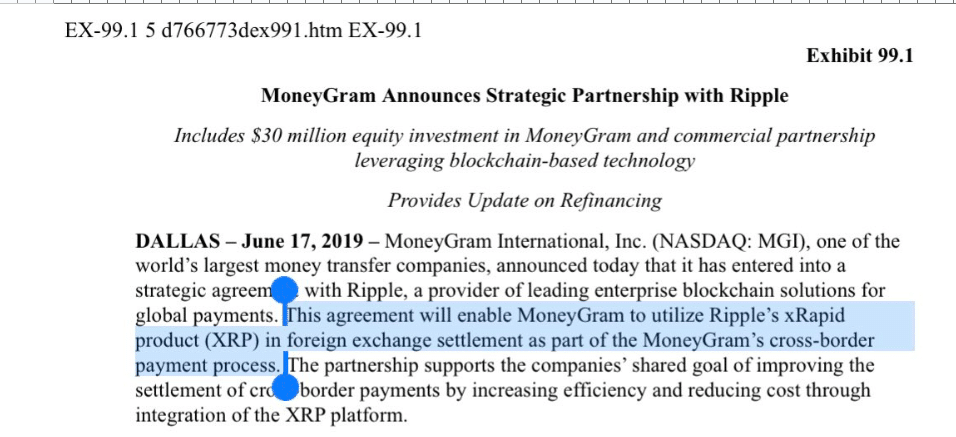
This was despite the commission giving MoneyGram International Inc the green light to utilize XRP in its cross-border payments system 18 months before the lawsuit. See below:

Money Gram XRP Ripple
Money Gram, Ripple

According to Deaton, “the potential advantages that would have materialized had XRP not faced legal challenges cannot be underestimated.”

Expert Explains How Bank of America Can Leverage XRP Using Ripple Liquidity Hub

0

Linqto COO details how the Liquidity Hub from Ripple can help large financial institutions navigate large XRP transactions.

In an interview, Joseph Endoso, the Chief Operating Officer at Linqto, provided insights into how large financial institutions could leverage XRP through Ripple’s Liquidity Hub.

Endoso cited specific examples using the Bank of America (BoA). He highlighted the strategic intent behind Ripple introducing the Liquidity Hub product and its suitability for institutions seeking seamless transactions.

XRP influencer Digital Asset Investor shared a snippet of Endoso’s interview with the crypto community on X.

In the interview, Endoso proposed that Ripple consider integrating Liquidity Hub into the existing RippleNet product.

He believes doing so would allow RippleNet users, including BoA, to seamlessly tap in Liquidity Hub. The ultimate result will be that institutions can efficiently manage XRP positions required for executing transactions via On-Demand Liquidity (ODL).

Furthermore, the Linqto COO described Ripple Liquidity Hub as a smart router engine. He highlighted that Ripple connected the hub to accounts across numerous global liquidity venues. It includes virtually all exchanges with a depth of liquidity. 

BoA Transacting with XRP

The Linqto COO explained that institutions like BoA can effectively navigate large XRP transactions by being a Liquidity Hub user. He cited an instance where an institution needed to carry out a translation involving one billion XRP.

Endoso noted that the platform would intelligently break down the amount into smaller fractions. Afterward, it would route them across multiple exchanges to ensure optimal execution and the best average price for XRP. 

Moreover, Endoso detailed the utility of Liquidity Hub in facilitating the buying and selling of XRP for institutions. He mentioned that after using XRP for ODL purposes, an institution could employ the Hub to reverse the process. In his words:

“I have that same smart engine route my sell order and go back to cash if that’s what I want —to sell the xrp across all the venues to get the optimal price for Bank of America.”

Notably, Endoso stressed that at no point would institutions engaging Liquidity Hub have recourse to seek XRP directly from Ripple. According to him, Ripple’s role would be to monitor the continuous availability of XRP across the multiple transacting exchanges. 

BIS Project Mariana Does Not Use XRP or Ripple Technology: Details

0

Speculations have emerged that the BIS’ Project Mariana leverages Ripple and XRP for cross-border payments, but how valid are these claims?

The Bank for International Settlements (BIS), an institution dedicated to facilitating collaboration between central banks, recently introduced a noteworthy initiative called Project Mariana.

Unveiled in June, this endeavor seeks to streamline the international transfer of wholesale central bank digital currencies (wCBDCs) by leveraging automated market-makers (AMMs).

Notably, Project Mariana is the result of a cooperative proof of concept (PoC) undertaken by the Innovation Hub of the BIS in partnership with public financial institutions, including the Bank of France, the Monetary Authority of Singapore, and the Swiss National Bank.

Claims of Ripple and XRP Involvement

Interestingly, some XRP community members are now speculating on the potential involvement of Ripple’s technology or XRP, the native cryptocurrency of the XRP Ledger (XRPL), in Project Mariana.

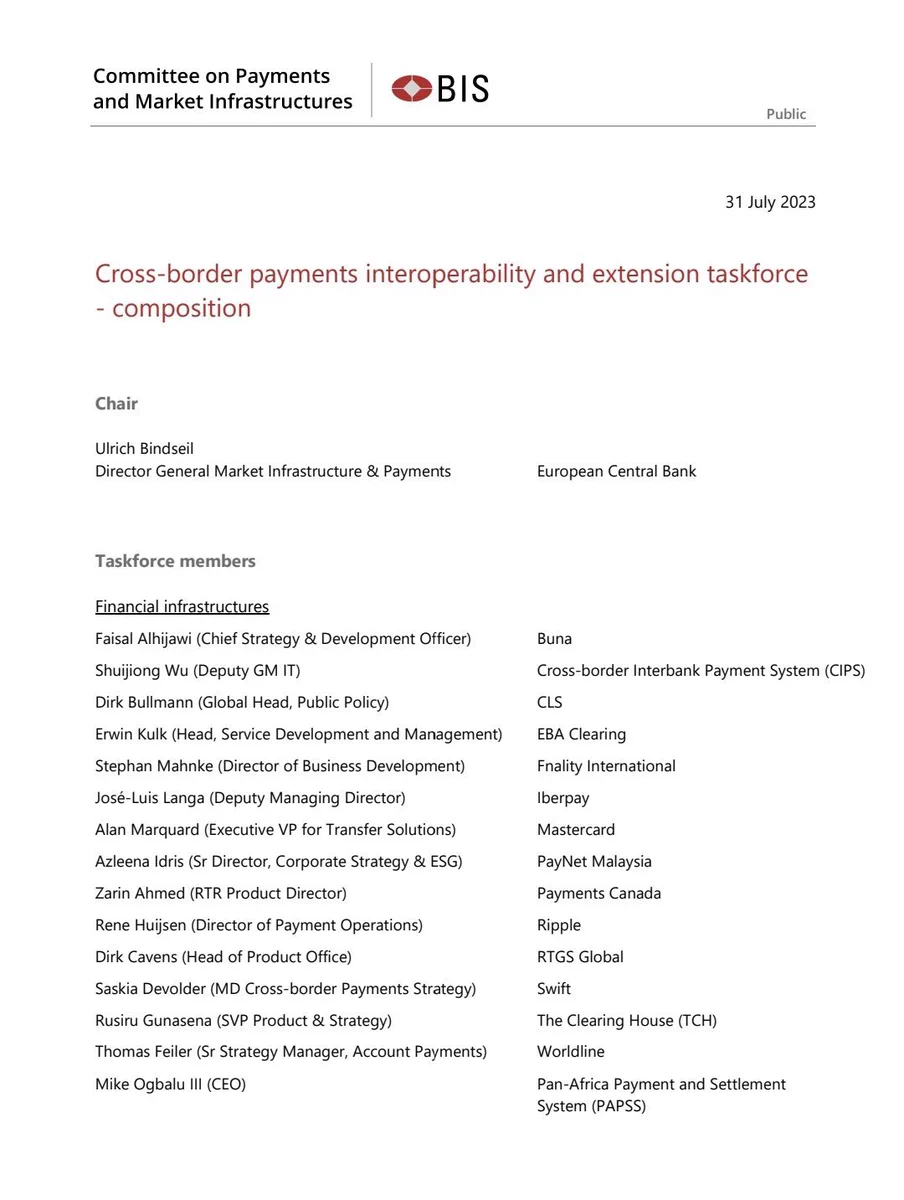
One of the catalysts triggering these speculations is Ripple’s membership in the BIS cross-border payments interoperability and extension (PIE) task force, a role disclosed by the BIS in a report this month.

The PIE task force plays a crucial role within the overarching G20 cross-border payments initiative, which aims to enhance the efficiency, security, and transparency of cross-border transactions on a global scale.

Edward Farina, a prominent XRP community figure and CEO of Alpha Lions Academy, called attention to Ripple’s inclusion in the PIE task force. However, some proponents misinterpreted this as the involvement of Ripple in the Mariana Project.

BIS and Ripple
Image Source: https://twitter.com/edward_farina/status/1692952010033643576

Furthermore, another contributing factor to these conjectures is a report published by the Atlanta Federal Reserve. As The Crypto Basic highlighted in May, the Atlanta Fed brought attention to Project Mariana, Ripple, and XRP within the article.

Although the Atlanta Fed report emphasized Ripple’s capacity to enable frictionless cross-border payments, it didn’t explicitly suggest that the Mariana Project would leverage Ripple or XRP. However, this side-by-side presentation has prompted speculations in that direction.

Examining the Facts

Nonetheless, a thorough examination of Project Mariana’s interim report promptly dismisses the idea that Ripple’s technology, or XRP, is pivotal in the initiative. Instead, the project relies on Ethereum and Curve Finance.

The interim report highlights that Project Mariana harnesses Ethereum’s resilient distributed ledger technology (DLT) to create and transfer wCBDC tokens. These tokens conform to the widely embraced ERC-20 standard for interchangeable tokens on the Ethereum network.

Moreover, the project utilizes bridging mechanisms to facilitate smooth interoperability across diverse blockchain networks, effectively connecting Ethereum with Arbitrum.

Furthermore, Curve Finance, a prominent figure in the DeFi landscape, assumes a central role in Project Mariana, acting as the designated automated market maker (AMM) solution to streamline the procedures involving the exchange of wCBDCs.

The evidence unequivocally points out that Project Mariana diverges from employing Ripple’s technology or XRP, opting instead for Ethereum and Curve Finance.

Deaton Says SEC Lawyers Learned Nothing From Ripple Lawsuit

0

Attorney Deaton slams the SEC for constantly shifting its arguments and abandoning its previous claims.

In a recent tweet, pro-XRP lawyer John Deaton said the United States Securities and Exchange Commission (SEC) learned nothing from its legal tussle with Ripple Labs.

Attorney Deaton made this known while reacting to a recent motion filed by Gemini to dismiss the SEC’s lawsuit against it.

It bears mentioning that the US-based crypto exchange Gemini is urging a federal judge to dismiss the SEC lawsuit because the regulatory agency failed to establish a clear case to prove that it was selling unregistered securities. 

Deaton Highlights SEC Litigation Tactics 

Deaton quoted a part of the motion in his recent tweet, which read: 

“The fact that the SEC cannot decide what is the security at issue only underscores the weakness of its position. It also violates fundamental fairness and the requirement of fair notice.”

Attorney Deaton said the SEC is fond of establishing new arguments while disregarding its previous stance.

“That, my friends, sums up the SEC and its approach to litigating crypto cases,” he added.

SEC’s Shifting Arguments in Ripple Case

Attorney Deaton explained that the SEC was transactional and constantly shifting its theory in the Ripple case. Per Deaton, during the legal tussle for the Hinman document, the SEC first argued that the speech was William Hinman’s personal opinion and not guidance to the market.

However, the SEC changed its position after Judge Sarah Netburn ordered the agency to surrender the documents. This time, it argued that Hinman was the director of SEC’s Corporation Finance during the speech. Thus, he gave the remark as a guide and opinion of the Corporation Finance division.

Furthermore, Attorney Deaton also recounted the SEC’s shifting stance in the Ripple case during the argument on what constitutes the common enterprise.

Firstly, the agency claimed Ripple was a common enterprise. Interestingly, the SEC abandoned the argument after Ripple successfully argued that investors did not receive any interest from the company by merely holding XRP. 

The SEC changed its position and argued that the entire XRP ecosystem was the common enterprise. Deaton noted that the entire XRP ecosystem includes all XRP holders globally, crypto exchanges supporting XRP trading, and all businesses and vendors using the coin.

Notably, the SEC changed its position again and argued that XRP itself represents the common enterprise.

SEC “Nonsensical” Argument

Attorney Deaton described the SEC’s argument as “nonsensical” after the regulator claimed that XRP represents the second and third factors of the Howey test. 

The pro-XRP lawyer said the SEC’s shifting stance was so bad in the Ripple case that a federal judge called out the regulator’s hypocrisy. Deaton said the judge also slammed the SEC’s lawyers for lacking faithful allegiance to the law.

According to Deaton, SEC chair Gary Gensler and SEC lawyers are unbothered that a federal judge called them hypocrites because they believe they are bigger than the law. 

Pundit More Elated to See XRP as World Reserve Currency Over Anticipated $25 Price

0

Prominent XRP community figure Dig Perspectives is more excited to see XRP as a world reserve currency over a potential $25 price target surge.

Several analysts have projected ambitious price targets for XRP, citing favorable price movements. Amid these projections, prominent XRP community figure Dig Perspectives is more excited to see XRP as a world reserve currency.

In a recent post on X, Dig Perspectives set sights beyond the long-term price targets of $10 to $25 for XRP. The influencer disclosed this while responding to Edward Farina, Head of Social Adoption at XRP Healthcare.

While he confirmed that he could revel in profit-taking trades if XRP rallies to $10 or $25, Dig Perspectives emphasized that he would be more elated to see XRP assume the position of world reserve currency.

XRP as World Reserve Currency?

This vision of XRP as a world reserve currency, a role traditionally held by established fiat currencies, challenges the conventional discourse surrounding cryptocurrencies. 

Dig Perspectives’ remarks show that he is placing paramount importance on XRP’s broader utility and significance. 

Farina’s original post, featuring a screenshot of a Google search result projecting XRP as a future world reserve currency, set the stage for the optimistic outlook. However, this projection is not recent and doesn’t originate from Google itself.

The idea that XRP could evolve into a world reserve currency was initially put forth by Mark R. Philips, a director at the National Defense University, in a 2019 LinkedIn post. 

Philips’ argument hinged on the escalating global debt crisis, which he posited could prompt the emergence of a new reserve currency. Yet, skepticism persists among experts about the practicality of this transformative shift. 

Given the complexities of the global financial landscape, the notion of XRP assuming the mantle of a world reserve currency is both thought-provoking and speculative. While the enthusiasm is undeniable, the road to such a change features uncertainties.

Ripple CTO’s Opinion

Despite the skepticism, Ripple CTO David Schwartz’s position on the matter is more optimistic than most.

As The Crypto Basic reported earlier this month, Schwartz confirmed that he believes digital assets could challenge the US Dollar’s dominance as the world reserve currency. 

While Schwartz did not specifically mention XRP, the asset fits the description along with other cryptocurrencies.

Schwartz confirmed that he believes multiple currencies can coexist as significant reserve assets. This would signify a paradigm shift in global finance.

In addition to the vision of XRP as a world reserve currency, the prospect of XRP reaching price targets of $10 or $25 is equally audacious.

Presently trading for $0.5178, a surge to $10 would require a 1,831% increase. Similarly, for XRP to hit $25, it must surge by a massive 4,728%.

Shiba Inu: 7,569,587 BONE Staked on Shibarium as Wallets Surpass 10,000,000

0

Shiba Inu Official Highlights Shibarium Huge Adoption, Cites Staked BONE.

SHIB marketing specialist comments on Shibarium adoption and staked BONE tokens, submitting that Shiba Inu’s development team wrongly estimated the adoption of the layer-2 solution.

Market participants have continued to drop their take on Shibarium following the drawbacks encountered by the project. Lucie, a prominent Shiba Inu official, recently took X to comment on the developments surrounding Shibarium. In particular, she highlighted the huge adoption Shibarium has received from Shiba Inu investors.

This unexpectedly high engagement led to the temporary halt of Shibarium as the network’s capacity was overstepped. In this regard, Lucie noted that the Shiba Inu development made the mistake of wrongly projecting the expected adoption of Shibarium.

She added that Shiba Inu proponents were largely interested in Shibarium as it promised to ensure effective and low-cost transactions. “They didn’t understand how much the SHIBARMY wanted to be on Shibarium,” she remarked, citing total staked BONE.


As reported by The Crypto Basic, more than 160 million compute units were recorded on the L2 network within 30 minutes. Likewise, a total of 600,000 BONE tokens and 1,000 ETH tokens were deposited in 15 minutes. Notably, the team secured only 400 million compute units per month. This implied that they expected a moderate engagement on the layer-2 network.

Staked BONE and Shibarium Wallet Increases

As disclosed by the top influencer, staked BONE tokens increased amid the escalating FUD targeted at Shibarium. Per the shared snapshot, 7,569,587 Bone Shibaswap tokens were staked on Shibarium at the time of the update. Shibarium designated explorer Puppyscan further showed that wallets connected to Shibarium eclipsed 10,430,893 at press time.

PuppyScan Wallets above 10M
PuppyScan

In her statement, the SHIB marketing specialist praised Shytoshi Kusama for upholding his promises. Recall that the Polygon-based scaling solution was launched during the Blockchain Futurist Conference, as announced by Kusama.

Reacting to the falling prices of BONE, SHIB, and LEASH, Lucie noted the Shiba Inu ecosystem tokens are performing in line with the overall market conditions. On the whole, the SHIB marketing specialist noted that the issues encountered by Shibarium would soon become a joke. It bears noting that Shibarium is currently live in private mode. As earlier published, deep testing is being executed by developers to ensure a stable network before the public relaunch.