Home Blog Page 1997

Ripple and Coinbase Chief Legal Officers Meet, XRP Listing Coming?

0

Many XRP community members have been reacting to the recent meeting between the chief legal officers of Ripple and Coinbase.

In a tweet today, Coinbase Chief Legal Officer Paul Grewal thanked Ripple’s General Counsel Stuart Alderoty for hosting him. Grewal, who noted that the duo needed to meet more often, attached a photo of him and Alderoty, probably taken after the meeting.

Reacting to the tweet, Alderoty thanked Grewal for coming over and chatting with Ripple’s legal team at the company’s offsite.

Pro-XRP Lawyers React 

Pro-XRP lawyers, including CryptoLaw founder John Deaton and Australian-based lawyer Bill Morgan, have reacted to the development. 

Attorney Deaton, who represents thousands of XRP holders as a friend of the court (amicus curiae) in the SEC v. Ripple lawsuit, said the picture shows two great General Counsels leading the front line in battle. The founder of CryptoLaw said he “tipped his cap” as a show of respect to Grewal and Alderoty. 

The development seemed exciting for Deaton, who recommended in March that crypto companies facing enforcement actions from the SEC need to share ideas and develop coordinated strategies to defend themselves against the commission. 

Apparently, Coinbase and Ripple paid attention to Deaton’s call and chose to meet.  

Attorney Morgan also reacted to the meeting between Coinbase and Ripple’s Chief Legal Officers. Attorney Morgan states that nothing is better than teamwork against a common foe. 

It bears mentioning that the United States Securities and Exchange Commission has targeted both Ripple and Coinbase. While the SEC had already charged Ripple and two of its execs with offering unregistered securities back in 2020, the securities regulator issued a Wells Notice to Coinbase in February. 

For context, a Wells Notice is a formal notice from the SEC informing the recipient that the commission plans to take enforcement action against them due to possible violation of securities laws. 

In a bid to know what was discussed at the meeting, Attorney Morgan asked whether Ripple plans to file an amicus curiae brief in Coinbase’s petition for a Writ of Mandamus. 

Recall that Coinbase sued the SEC last month to force the regulator to respond to a petition for a rulemaking specific to cryptocurrency. 

XRP Enthusiasts Ask Coinbase to Relist XRP 

Meanwhile, some XRP enthusiasts used the opportunity to call on Coinbase to relist XRP. 

“[…] Now relist XRP,” said Jon Mann, an XRP community member. 

Another XRP enthusiast asserted that Ripple could only help Coinbase defeat the SEC when the San Francisco-based exchange relists XRP.   

At the time of writing this line, there is still no information about what was discussed in the meeting. The companies could be sharing ideas on how to defend themselves against the SEC’s adverse enforcement actions. 

XRP to $27: Expert Reveals Key Factors Driving Price Target

0

Notable analyst Egrag highlights the opportunities and challenges XRP would face on its journey to an ultimate price target of $27.

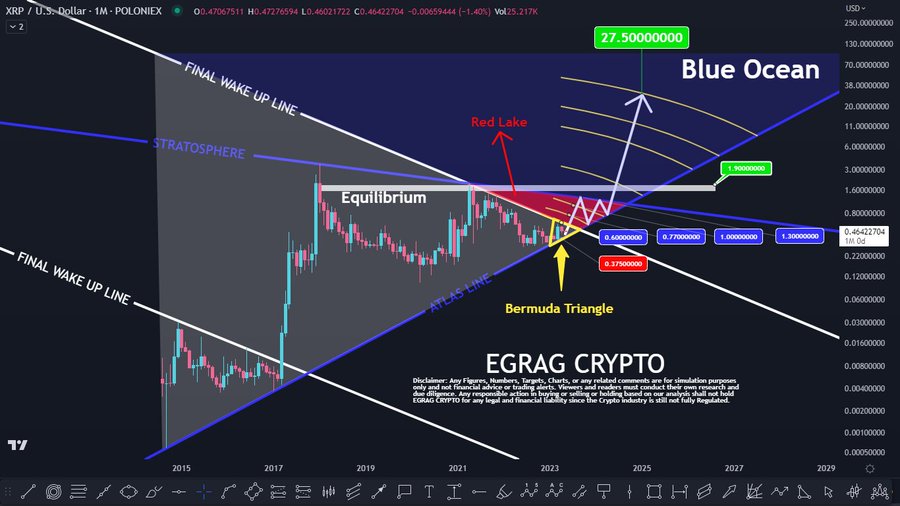
Egrag Crypto, a prominent crypto analyst, has continued to uphold his narrative of a $27 price target for XRP. The notable chartist recently compiled several analyses he had previously made to highlight the opportunities and challenges XRP will face on its journey to the price target.

The analyst sought to identify these factors in a composite analysis dubbed “The Bermuda Triangle Chart.” He highlighted seven crucial points in XRP’s journey to $27 in the coming days. These points had been addressed in past analyses.

XRP to $27
Image source: @egragcrypto, https://twitter.com/egragcrypto/status/1652935530928041984


The Seven Arcs, Equilibrium Price, and Atlas Line

Egrag highlighted the seven arcs, which represent seven Fibonacci price targets. These arcs are drawn around important price levels, particularly resistance points. Notably, the first arc is set at $0.60, the third arc at $1, and the seventh arc at $27. XRP would need to conquer each of these arcs to hit $27.

The analyst also put XRP’s market-clearing price at $1.90. A market-clearing price is at which the number of people willing to sell XRP equals the number of people willing to buy XRP. At this price, there is no excess supply or demand for XRP, and the market for XRP would be in equilibrium.

Moreover, Egrag called attention to the atlas line, a diagonal line that has been serving as support for XRP whenever the asset faces a sharp drop. He noted that XRP needs to tower above this line by all means. This can only happen with a price surge, as observed between 2015 and 2017 as well as between 2017 and 2022.

The Final Wake-up Line and the Red Lake

He further highlighted a point called the final wake-up line, which he believes would lead XRP to a fierce zone dubbed “the red lake.” Notably, the final wake-up line currently sits at $0.60, which is the point of the first arc. Once XRP conquers this point, it will slip into the red lake.

The red lake is one of the most decisive regions in XRP’s journey to $27, as it represents an area where the bears (sellers) and the bulls (buyers) will struggle to take control of the XRP’s next price point. The second and third arcs are within the red lake.

The Stratosphere and Blue Ocean Regions

According to him, towering over the red lake would bring XRP to a region Egrag calls the stratosphere, which will either propel XRP’s price higher or prevent it from rising for several months. 

However, once XRP conquers the stratosphere region, it would skyrocket to the blue ocean region where “sharks and whales will start coming to swim.” This possibly refers to a point when XRP will see demand from mid-sized investors (sharks) and deep-pocketed investors (whales). Notably, four arcs are found within the blue ocean zone, including the $27 arc.

Meanwhile, XRP is changing hands at $0.464 as of press time, up 1.34% in the past 24 hours. The asset has continued to defend the $0.46 point despite occasional dips, looking to leverage it for the next run.

New Xumm Partnership Allows Users To Buy & Sell XRP With 40+ Fiat Currencies

0

The partnership with Guardarian gives Xumm users more options to pick from when buying XRP with their fiat or selling XRP for fiat.

Xumm, a leading self-custodial XRP Ledger (XRPL) wallet, has partnered with Guardarian, a non-custodial fiat on/off-ramp provider, to allow users seamlessly buy XRP with 40 fiat currencies and also easily sell their crypto assets for fiat without leaving the Xumm app.

The partnership was announced today by Xumm in an official press release and further called to attention through its Twitter handle.


As a fiat-to-crypto gateway, Guardarian supports up to 40 fiat currencies, including USD, EUR, GBP, TRY, ZAR, KRW, INR, AUD, and numerous others.

The integration with Guardarian allows Xumm users to purchase XRP without worrying about the security of their assets outside of the ecosystem, as they can make these purchases without leaving the Xumm app. It also allows them to sell XRP for fiat and deposit it directly to their local bank account.

A quick look into the Xumm app shows that Guardarian has already been integrated as a xApp at the time of reporting. The gateway charges a flat fee of $2.2 or it’s equivalent in any currency regardless of the amount of XRP the customer wishes to buy or sell. While users can purchase XRP with numerous fiat currencies, they can only sell XRP for EUR and GBP.

To buy XRP with Guardarian on Xumm, users can carry out the following steps:

  • Open your Xumm wallet.
  • Head to the “Buy/Sell XRP” option.
  • Select the Guardarian xApp as your desired provider.
  • Enter the fiat equivalent of the amount of XRP you wish to buy.
  • Confirm the quote by clicking on “Buy.”
  • You’ll be directed to the Guardarian checkout point, which allows you to pay with your Visa/Mastercard or Google Pay account.

Xumm Continues to Extend XRP On/Off-Ramp Options

Guardarian joins the three other external fiat-to-crypto providers already integrated into Xumm in addition to Xumm’s native fiat on/off-ramp for its Pro users. However, Guardarian is the first gateway to allow an on-ramp and off-ramp solution across several continents.

Notably, Stably only supports users in the United States. While Banxa supports several countries in different continents, it does not allow users to sell XRP for fiat. BTC Direct allows for buying and selling of XRP, but it only supports the European Union. Guardarian is the first external all-encompassing fiat on/off-ramp.

The integration with Guardarian comes one month after Xumm partnered with Stably to provide a seamless on/off-ramp solution for its US-based users, as reported by The Crypto Basic last month. Xumm also extended its native on/off-ramp service to UK users earlier this year.

Shiba Inu Most Popular In US, India Beats PEPE & Babydoge

0

Shiba Inu’s popularity continues to spike across various parts of the world. 

Leading cryptocurrency aggregate platform, CoinGecko has shared new data showing a growing interest in the meme-based token Shiba Inu this year.

The data was obtained from a study conducted by CoinGecko to determine the most popular meme-based token by the top 10 countries and regions with high interest in meme coins.


Shiba Inu Popularity Seen in US, India, and the Philippines

According to CoinGecko’s report today, Shiba Inu is the most popular meme coin in the United States, representing 60.78% of the country’s interest in meme-based cryptocurrencies beating PEPE, which garnered 11.8% in the US.

In a similar development, Shiba Inu ranked as India’s most popular meme coin, generating 55.8% of the country’s interest in meme coins. Furthermore, Shiba Inu garnered 18.3% of the Philippines’ interest in meme coins, making it the second-most popular meme-based cryptocurrency in the country. 

Shiba Inu Ranks Ahead of BabyDoge

Per CoinGecko, people are far more interested in Shiba Inu this year than any other meme coin. CoinGecko explained that Shiba Inu accounted for 46.7% of interest among the top meme coins in 2023.

Other meme coins, like Baby DogeCoin (BabyDoge), Pepe (PEPE), Floki Inu (FLOKI), and Bonk (BONK), are far behind Shiba Inu in the ranking. Notably, BabyDoge has attracted 12.3% of interest in meme coins this year. Pepe got 9.4%, Floki Inu had 8.6%, and Bonk recorded 8.2% from top 10 countries that lead the meme coin craze.

Explaining the methodology used in the study, Coingecko examined the total number of page views year to date (YTD) for the top 15 largest meme coins on its platform.  

The growing interest in Shiba Inu is also reflected in different areas, including the number of Shiba Inu followers on Twitter, which recently spiked to 3.7 million. 

Notably, interest in Shiba Inu has exceeded the number of pages views the cryptocurrency gets on CoinGecko.

What’s Fueling Shiba Inu’s Popularity 

Unsurprisingly, Shiba Inu ranked as the most popular meme coin in CoinGecko’s latest ranking. Shiba Inu has been in the news for the right reason since the beginning of the year. Despite the ongoing bear market, Shiba Inu has surged 22.3% year to date. 

The spike comes from numerous positive developments in the cryptocurrency ecosystem. Interestingly, The Crypto Basic has reported most of these developments. 

Earlier this year, Shiba Inu launched the beta version of Shibarium, a layer-2 scaling solution. The project has seen widespread adoption since its debut in March. 

Data from PuppyScan shows that more than 14.05 million wallets have been connected to the network, with a total transaction of 4.71 million recorded so far. Shibarium Beta has a total block of 655,506 and an average block time of five seconds. 

Furthermore, Shiba Inu’s ongoing burn campaign has continued to gain momentum, as millions of SHIB tokens keep getting burned daily. Yesterday, a new mysterious wallet burned a massive 2.005 billion SHIB tokens. In April alone, the Shiba Inu community burned 3.26 billion SHIB in different transactions.

The Crypto Basic has reported that crypto whales have continued to purchase huge amounts of SHIB regularly. As reported today, one of the Shiba Inu Whale Added 221 Billion SHIB, 348B in 7 Days.

Based on these positive developments, cryptocurrency investors worldwide are closely monitoring Shiba Inu.

This Cardano (ADA) Killer Is Expected To Gain 1000% After Raising More Than $15 Million

0

The cryptocurrency world is constantly evolving, and as new technologies emerge, investors are always looking for the next big thing. Cardano (ADA) has been a top contender for a while, but a new player is entering the game and is quickly gaining traction as the potential Cardano killer.

RenQ Finance (RENQ) is a promising new DeFi platform that is raising eyebrows in the industry after a highly successful presale, with experts predicting it could see gains of up to 1000%.

RenQ Finance: An Introduction

RenQ Finance is a DeFi platform that aims to connect all isolated blockchains and establish a cross-chain asset exchange network. By doing so, it provides all necessary underlying support for the DeFi ecosystem, allowing digital asset holders to experience a safe, free, and transparent DeFi service.

The platform offers a fast, secure, and low-cost trading platform, combined with its versatile order book and liquidity aggregator, making it a compelling choice for traders and investors alike.

Furthermore, RenQ Finance offers a range of innovative features that make it stand out from other DeFi tokens. One of the most notable features is its unique staking mechanism, which allows users to earn passive income by staking their RENQ tokens. This mechanism incentivizes users to hold onto their RENQ tokens, which in turn increases demand and drives up the token’s value.

RenQ Finance Presale: A Resounding Success

RenQ Finance has had an impressive start to its journey, with its ongoing presale raising over $15.5 million. The presale was divided into several stages, each with a different price per token, and each stage was quickly sold out. As of writing, RenQ Finance is in its final presale stage, and it’s scheduled to launch 2 months earlier than expected showcasing the high demand for the platform.

The presale was open to anyone interested in investing, and the tokens were available for purchase using USDT and ETH. RenQ Finance had a public sale of 500 million RENQ tokens during its presale phase, with varying prices throughout the stages. The final stage of the presale is currently ongoing, with the token priced at $0.055. This presents a final opportunity for savvy investors to potentially make a gain of 25x or more as RenQ Finance prepares for its launch.

RenQ Finance (RENQ) vs. Cardano (ADA)

Cardano (ADA) has been a top contender in the cryptocurrency world for a while now, but its time at the top may be coming to an end. While Cardano has its strengths, it also has some notable weaknesses, which RenQ Finance aims to address.

One major issue with Cardano is its scalability. Cardano’s current network can only handle around 15 transactions per second, which is significantly lower than what other blockchains can handle. RenQ Finance, on the other hand, has designed its platform to handle a higher volume of transactions, making it a more scalable option.

Another issue with Cardano is its reliance on proof-of-stake (PoS) consensus. While PoS is a popular consensus algorithm, it does have some limitations. For example, it can lead to centralization, as wealthier investors have more control over the network. RenQ Finance, on the other hand, uses a hybrid consensus algorithm that combines PoS and proof-of-work (PoW), providing a more decentralized and secure platform.

RenQ Finance also offers a range of features that set it apart from Cardano, including a versatile order book, a liquidity aggregator, and a fast, secure, and low-cost trading platform. With its potential for growth and strategic partnerships, RenQ Finance could provide investors with a promising alternative to Cardano.

Conclusion

RenQ Finance is a promising new DeFi platform that has been gaining traction in the industry and for a good reason. With its impressive presale success, it is clear that investors are excited about the platform’s potential.

RenQ Finance aims to address some of the issues facing Cardano, making it a potential Cardano killer.

Click Here to Buy RenQ Finance (RENQ) Tokens.

Visit the links below for more information about RenQ Finance (RENQ):

Website
Whitepaper

TREAT and SHI Not Out Yet As Shiba Inu Leader Warns of Fake Tokens

0

Some community members recently called attention to projects claiming affiliation with the Shiba Inu team and its ecosystem tokens.

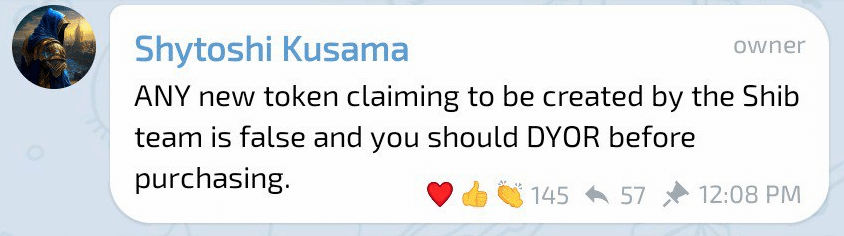
Amid a sudden spike in scam projects claiming affiliation with the Shiba Inu team, Shytoshi Kusama, the Shiba Inu lead developer, has warned investors. According to Kusama, any new token claiming to have been created by the Shiba Inu team is fake, as the team has not yet released the TREAT and SHI tokens.

Kusama recently sounded this warning through the community-driven Telegram group dedicated to Shibarium. The Shiba Inu project lead also cautioned investors to always carry out due research on any project before purchasing tokens issued by the project.

Shiba Inu leader warns of fake tokens

Notably, TREAT and SHI are upcoming tokens set to be released by the Shiba Inu ecosystem developers. The tokens will join other assets such as Shiba Inu (SHIB), DogeKiller (LEASH), and Bone ShibaSwap (BONE) as the official tokens in the Shiba Inu ecosystem. This will bring the total number of official tokens to five.

Kusama introduced TREAT and SHI in a blog post last July. TREAT is expected to serve as the rewards token within the ecosystem, while BONE will function as the gas token for Shibarium. Meanwhile, SHI will serve as the ecosystem stablecoin.

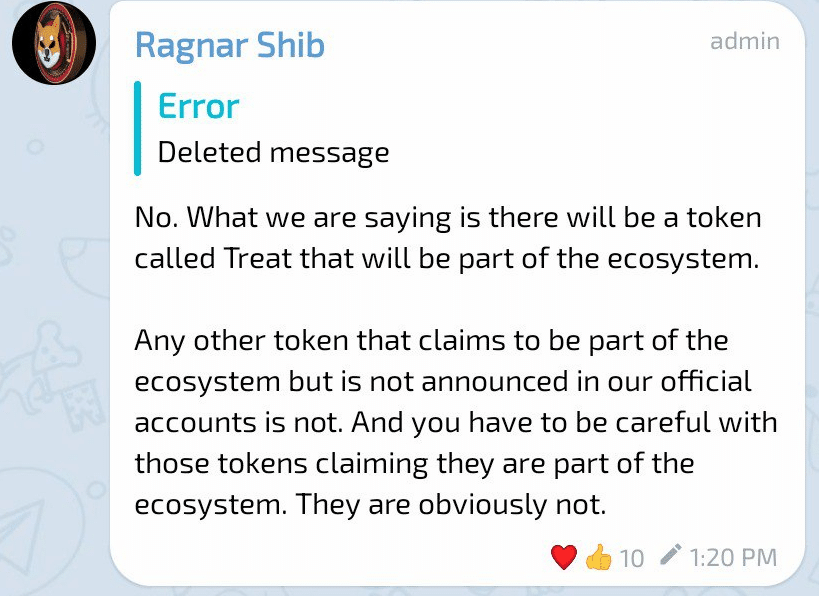
However, neither TREAT nor SHI has been released as of press time despite a proliferation of copycats within the crypto scene. In February, Kusama confirmed that TREAT would not necessarily be released at the same time as the Shibarium mainnet. Besides Kusama, other admins within the Shibarium Telegram group have persistently clarified that the tokens have not been released.

Ragnar Shib, a pseudonymous community member and Shibarium group admin, reiterated this yesterday, emphasizing that any token that claims to be part of the Shiba Inu ecosystem but was not officially announced by the team is fake. 

Shiba Inu leader warns of fake tokens 2
Shiba Inu leader warns of fake tokens

Shiba Inu Investors Advised to be Cautious 

Due to the nascence of the crypto scene, the industry has been plagued by scams and fraud schemes, with a recent surge in their prevalence. Shiba Inu investors are advised to remain cautious of new projects and always do their due diligence before committing funds to a project.

The Crypto Basic previously called attention to a fake Shibarium website placed as an ad on Google. A SHIB community influencer disclosed that several investors had reported a loss of funds to such scams recently. She implored community members to follow “@susbarium,” a Twitter handle dedicated to identifying these scams.

SUI Token Launches Mainnet As Trading Goes Live On Binance

0

SUI Launches on Mainnet, Token  Drops 30% As Trading Debuts On Binance.

SUI, a new cryptocurrency network, finally launched on the mainnet today, sparking the interest of investors and traders alike.

SUI was today listed on Binance, with the token surging as high as $2.07 before recoiling back to $1.52 at press time, reflecting a 32% drop per Coinmarketcap. The token also gained some traction, with trading volumes surging by 22.15% to tap $887,702. Besides Binance, SUI was initially listed on four exchanges: KuCoin, Poloinex, OKX, and Bybit.

According to Colin Wu, the SUI team requested the above five exchanges not to list perpetual futures contracts for its token.


To attract users, Binance announced that SUI/USDT trading pair traders would enjoy zero maker feed “until further notice.”

What Is SUI?

As per its website, SUI is described as a first-of-its-kind “layer 1 blockchain that redefines asset ownership”. In a statement, the SUI Foundation, an independent organization responsible for the network’s development, noted that the network boasts extremely fast transaction speeds (just 480 milliseconds) and rich on-chain assets due to its unique architecture. 

It also supports a wide range of applications and scalability capabilities factors that could endear it to more users, pitting it against competitors such as  APTOs and Cardano.

Will LUNC Reach $1 As Kim Introduces New Way To Burn Terra Classic

0

AI integration could boost Terra Classic (LUNC) prices.

Terra Classic is set to integrate Block Entropy, an Artificial Intelligence (AI) powered application chain which could potentially revolutionize the chain.

Recently, Edward Kim, a key developer of the Terra classic blockchain, shared images of a partially complete whitepaper for the product, noting that the product was still under development.


LUNC Block Entropy

Block Entropy is an AI app building atop Terra Classic, allowing for the creation of a new AI-powered blockchain that can facilitate a plethora of AI-based applications. Once it’s ready, the product will support a limited number of “machine-learning inference tasks.” Kim noted they plan to add support for distributed training, fine-tuning, python APIs, and SNARK verification.

On the launch timelines, the pundit further noted he expects the testnet for Block Entropy to go public “sometime in mid-May.” Notably, whereas the product is still under development, its testnet will be capable of accommodating only a limited range of ML inference tasks, including AI image diffusion, text language models, and music generation.

However, it is important to note that access to the testnet will not be free.

“To obtain TestNet tokens, you will have to send real LUNC to the burn address and enter the transaction hash into the TestNet faucet,” Kim wrote.

Kim also highlighted the development of the Interchain Accounts (ICA) module, a crucial element in the development that has already been completed. The ICA is currently undergoing testing on the LUNC L1 TestNet. According to him, once testing is done, the module must go through a governance proposal approval process before being incorporated into LUNC.

LUNC to $1?

Integrating AI into the LUNC platform is a major development for the network as more crypto firms tap into AI to improve their businesses and user experiences. As LUNC gains more utility with time, with burns and staking decreasing the circulating supply, the coin can reach $1.

This new development would also help boost Terra Classic (LUNC) prices as the cryptocurrency gains traction due to its usage of AI products. At press time, LUNC was trading at $0.0001056, up 0.61% in the past 24 hours.

SEC v. Ripple: Pro-XRP Lawyer Says Judge Torres Had Previously Ruled Against SEC 

0

Attorney Jeremy Hogan says Judge Torres previously ruled against the SEC on an issue, and the Appellate Court upheld the decision.

As XRP community members continue to anticipate the final verdict of the ongoing legal battle between the United States Securities and Exchange Commission (SEC) and Ripple, attorney Jeremy Hogan, a pro-crypto lawyer and partner of Hogan & Hogan, has shared an interesting update about the case. 

SEC v. Rio Tinto

In a tweet today, attorney Hogan revealed that Judge Analisa Torres had previously ruled in a case involving the U.S. SEC and leading global mining group Rio Tinto. According to the pro-crypto lawyer, Judge Torres ruled against the Securities and Exchange Commission on a pertinent issue.


The Securities and Exchange Commission appealed Judge Torres’ ruling on the issue, hoping to get a different outcome. However, attorney Hogan said the appellate court upheld Judge Torres’ decision on the matter.

He attached a page from Morrison Foerster’s 2022 article, where the case was cited. According to the report, Judge Torres ruled that scheme liability does not exist when alleged misrepresentation or omissions are the sole basis of such claims

“In Rio Tinto, Judge Torres found, all of the alleged ‘actions’ and ‘conduct’ forming the basis for scheme liability were misstatements or omissions, so no scheme liability claims could proceed,” an excerpt of the article read. 

Furthermore, the SEC asked Judge Torres to reconsider her ruling in light of the Supreme Court’s 2019 decision on its case against Lorenzo. However, Judge Torres refused, explaining that “while Lorenzo made clear that the ‘dissemination’ of false information provides a basis for scheme liability, it should not be read to mean that misstatements without more are sufficient to trigger liability.”

XRP Enthusiasts React

XRP enthusiasts seemed excited that Judge Torres had previously ruled against the SEC. Some XRP community members hope she also rules against the securities regulator in the Ripple lawsuit.

Meanwhile, some XRP community members asked pertinent questions about the ongoing SEC v. Ripple lawsuit. An XRP community member asked whether Coinbase will immediately relist XRP if Judge Torres rules in Ripple’s favor and the SEC appeals the decision. 

Attorney Hogan said Ripple would move forward with its business if Judge Torres grants summary judgment in its favor. However, he could not tell whether Coinbase will relist XRP because the exchange has “not been very consistent” recently. 

Furthermore, attorney Hogan asserted that the SEC would not appeal Judge Torres’ decision if Ripple gets an outright win. 

Ripple South Asia MD: We Use Only XRP for RippleNet, But Tech is Neutral

0

According to Navin Gupta, for the time being, Ripple only leverages XRP when facilitating cross-border settlements with RippleNet.

Navin Gupta, the Managing Director for South Asia and MENA at Ripple Labs, has confirmed that the California-based financial technology company currently leverages XRP to facilitate cross-border settlements with its payment solution RippleNet.

Gupta disclosed this while speaking with host Arjun on a Couchonomics episode titled: “Solving Cross-Border Payments with Ripple and the Future of Blockchain.” Gupta highlighted the mode of operation of RippleNet as he sought to share insights on how Ripple makes cross-border payments more efficient.


Gupta noted that cross-border settlements are costlier and less effective because of the complications that come with them. He pointed out that for a bank to facilitate payment in another currency, the bank would need a nostro account. A nostro account is a bank account that a bank holds in a foreign country, denominated in the currency of that country.

However, as Gupta highlighted, cross-border payments are expensive because the bank needs to cover the cost of bearing the capital cost of the assets deposited in the nostro account. The bank also seeks to cover any losses that may arise from foreign currency depreciation. 

RippleNet Addresses this with XRP

To address these issues, Gupta emphasized that RippleNet exchanges the sender’s currency to its equivalent in XRP and then re-converts the XRP to the recipient’s currency within seconds and deposits the target currency in the desired account.

Speaking on the modus operandi, Gupta explained: “Exactly what is going to happen is, GBP in real-time will get converted to XRP. XRP, within two seconds, will travel to [the] Philippines; and, in [the] Philippines, it will get converted to Philippine peso and the payout will happen.”

Responding to this, Arjun asked Gupta if money is only converted to XRP when Ripple seeks to move it within RippleNet. Gupta noted that Ripple doesn’t necessarily “convert” but rather uses order books from exchanges, such as Bitstamp in the UK and Coins. Ph in the Philippines.

Arjun then asked: “So if you use those open order books to do the conversion, you only do it into XRP?”

“Currently, we only do it in XRP, but the technology itself is neutral. As more cryptocurrencies evolve and they have enough liquidity pairs, then we would use many other things,” he remarked.

At the start of the interview, Gupta confirmed that other assets such as Ethereum and USDC could be used to exchange one foreign asset for another, just like XRP is used, and financial institutions are free to use any asset they prefer when sending money to another institution on RippleNet in a peer-to-peer fashion.

For instance, institution A could convert GBP to USDC, send the USDC from the UK to the Philippines, and then convert the USDC to PHP (peso) in the Philippines. However, Gupta further said: “The reason XRP is used is that it is more suitable for payment: because it takes two to three seconds, it’s extremely fast, and it’s uniquely suited for cross-border payments.”