Home Blog Page 2042

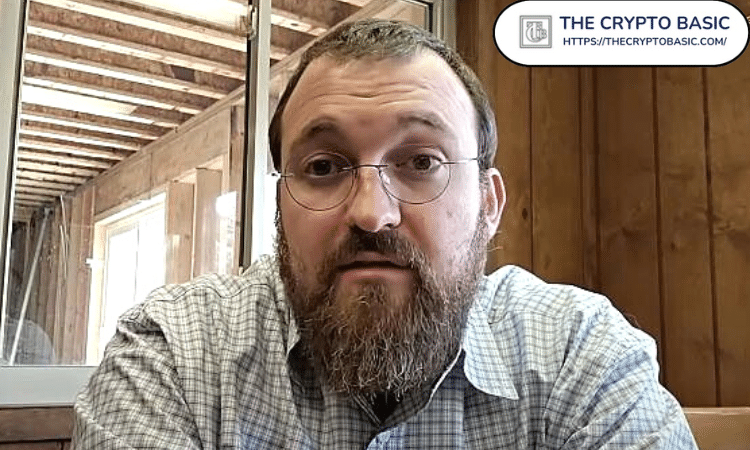
Cardano Founder Excited About Release of New Cardano Magazine

0

The Cardano founder says the magazine is pretty cool.

Cardano enthusiasts have launched a new quarterly magazine to drive the widespread adoption of the leading blockchain. The magazine, dubbed “The Cardano Solution,” is focused on highlighting the network’s potential and how it can be used to “change the world.”

The first segment of the magazine was launched on March 13, 2023. For the first edition, Cardano Solution magazine concentrated on different Cardano-related topics, including ADA whales’ accumulation, onboarding more developers to the network, etc. It also gave insight into Cardano’s algorithmic Djed stablecoin (DJED), launched earlier this year. A magazine copy is sold for $15.65 on the American self-publishing platform Blurb.

Cardano Founder Applauds the Initiative

In a recent tweet, the author of the magazine known as Gotterdammerung asked Charles Hoskinson, the founder of Cardano if he had gotten a copy of the publication.

The author noted that he sent a signed copy to the Cardano boss last week. Hoskinson seemed pleased with the initiative behind the magazine launch.

Following Hoskinson’s tweet, many ADA enthusiasts have shown interest in getting a copy of the magazine. It bears mentioning that the magazine is available in soft and hard copies.

Cardano Solution is a network of passionate individuals who believe blockchain tech, especially Cardano, can change the world by providing positive real-world solutions. Despite starting its first meeting with only two ADA enthusiasts, Cardano Solution has grown to become a massive network for the Cardano community. The group has recorded tremendous membership growth in recent times. It currently has more than 1,200 members. 
XRP Ledger Sidechains Now Available for Testing on New Devnet

0

Developers can now explore the new XRPL sidechains design. 

XRP Ledger sidechains are now available for testing on a new developers network (Devnet), as disclosed by RippleX in a tweet yesterday.

It comes as developers have completed documentation for the new sidechains design.

“After testing and reviewing community feedback from the preview, the implementation, spec and documentation of that design (XLS-38d) are now complete and ready for review and testing,” Mayukha Vadari wrote on behalf of Ripple developers. “A new Devnet is also available for sidechains-related testing.”

Consequently, with the launch of the new Devnet, RippleX has urged interested developers to join the discussion on GitHub, review the documentation, and explore the Devnet.

XRPL sidechains allow developers to customize the XRPL for their desired use cases. It can also be used as a sandbox to test new features that could be implemented on the main network (mainnet). The groundbreaking feature could see increased XRP adoption as interested businesses could customize the XRPL for private needs.

Ripple’s Chief Technology Officer and one of the original architects of the XRPL, David Schwartz, first proposed the idea of federated sidechains for the XRPL in 2021. However, developers opted to redesign the feature in 2022 to factor in feedback from a months-long preview period. 

Notably, developers replaced the “federator” – a software intended to connect one or more sidechains to the XRPL – with “witness.”

“Witness servers introduce more simplicity for developers wanting to get started with sidechains,” developers said in a September blog post.

It moves developers from a system where “servers depend on a shared global state between servers to one where servers act independently,” they added. Consequently, the new design is touted as more robust as it promises to simplify the process of testing and debugging.

Sidechains is one of the many projects the team dedicated to building infrastructure and tools for the XRPL is working on. As often highlighted in reports, RippleX is also working on a native automated market maker (AMM) and an Ethereum Virtual Machine (EVM) compatible sidechain for the XRPL. All of these are already available for testing.

Ripple and Algorand to Sponsor CM University Blockchain Summit

0

The summit will be held on May 8 and 9, featuring brief talks from seasoned blockchain experts.

Ripple and the Algorand Foundation are the seed sponsors of the Carnegie Mellon University Secure Blockchain Summit set to hold in May 2023. The summit’s objective is to offer comprehensive insights into the prospects and evolution of blockchain technology.

Carnegie Mellon CyLab, CMU’s cybersecurity and privacy research center, recently disclosed the development through their official Twitter handle. They also revealed that additional sponsorship opportunities for entities interested in contributing to the program are still available.


Carnegie Mellon University (CMU), established in 1900 by Andrew Carnegie, is a private research university in Pittsburgh, Pennsylvania. CMU boasts a strong reputation in technology, business, the arts, and social sciences and is currently ranked in the top 25 universities in the United States.

In response to the increasing adoption of blockchain technology, CMU has integrated several blockchain courses into its curriculum. It is now organizing the Secure Blockchain Summit to promote understanding and knowledge of the nascent technology.

This year’s event will mark the first summit, with Ripple and Algorand serving as inaugural sponsors. Other sponsorship opportunities are still open. The summit is part of the Secure Blockchain Initiative, which CMU describes as “a multi-year, interdisciplinary research program.”

Scheduled for May 8 and 9, this year’s summit will present discussions by seasoned blockchain experts and CMU professors. Topics will cover crypto-economics, applied cryptography, and programming language. The summit is open to the public, and those interested are encouraged to complete the dedicated Google Form.

Ripple’s Contributions to Blockchain Initiatives

CMU’s increasing focus on blockchain technology reflects the rising global adoption of this technology, and Ripple has positioned itself as a primary financial supporter for institutions interested in exploring blockchain. Recall that CMU’s CyLab announced last April that Ripple is the inaugural sponsor of the Secure Blockchain Initiative.

Moreover, last month, Ripple was unveiled as the latest sponsor of the FinTech at Cornell program, an initiative introduced by the Cornell SC Johnson College of Business in New York. The technology firm has made these contributions despite its long-standing legal battle with the U.S. SEC.

Deaton Reacts to Report Highlighting “Ripple & XRP Aren’t Interchangeable”

0

CryptoLaw founder attorney John Deaton expressed surprise over CoinDesk’s recent publication about XRP.

According to an excerpt in a CoinDesk article published yesterday, the media outlet noted that “Ripple and XRP are not interchangeable.” It went a step further to state the function of each.

“While Ripple is a fintech company focused on building a global payments network, XRP is an independent digital asset used for things like online payments and currency swaps,” an excerpt of the article read.

Deaton Reaction

This shocked many, including attorney Deaton, given that the media outlet is known for spreading Fear, Uncertainty, and Doubt (FUD) about Ripple and XRP.

In reaction to the report, attorney Deaton said, “times are changing.”


However, many XRP community members do not think the media outlet has learned from its previous misinformation regarding the sixth-largest cryptocurrency.

In the first paragraph, CoinDesk described “Ripple Labs as the company that issued the XRP tokens.” Reacting to the comment, an XRP influencer said:

“Your generalism/investigative skills need adjusted or you are doing this for political purpose. Stop writing false articles & fake narratives against XRP & Ripple do the right thing & fix it. Ripple did NOT issue XRP nor did they create it. It was gifted to them.”

It bears mentioning that XRP is one of the crypto assets that suffered from misinformation in its early days. Several crypto community members previously used Ripple and XRP interchangeably while referring to crypto. This stems from a series of misconceptions about the coin. However, XRP enthusiasts, including Deaton, have embarked on a voluntary task to correct these misconceptions. 

Brief XRP History

For context, XRP is the native cryptocurrency of the XRP Ledger (XRPL), a decentralized, public blockchain led by a vibrant global developer community. Three engineers, David Schwartz, Arthur Britto, and Jed McCaleb, began the development of XRPL in 2011.

The team launched the blockchain the following year. In September 2012, Chris Larsen and the group that started Ripple (formerly named NewCoin) joined the XRPL team. The partnership resulted in XRPL’s founders gifting 80 billion units of XRP to Ripple. The Silicon Valley tech company proceeded to lock a huge chunk of the crypto asset in escrow to protect its market value.

DalliPay to Revolutionize Payments for SMEs Using XRP Ledger

0

DalliPay wants to revolutionize payments for SMEs by leveraging the benefits of the XRPL, and the solution just received an update.

Despite the United States Securities and Exchange Commission (SEC) claims about Ripple, XRP, and the XRP Ledger, it bears mentioning that the blockchain has become a hotbed for developing interesting real-world solutions.

One such solution, DalliPay, has just received an update. For the uninitiated, DalliPay is a solution developed by radynamics that allows small and medium-sized enterprises (SMEs) to leverage the XRPL’s speed and low cost to facilitate payments within existing accounting software that support ISO 20022.

“My vision and immediate goals are quite simple: Enable cheap, global real-time payments for SMEs (small & medium enterprises),” radynamics founder Reto Steimen said in an exclusive interview with The Crypto Basic.

“We don’t want to reinvent the wheel,” he added, noting that the goal of DalliPay is to make payments as easy as possible for customers.

Per the GitHub release, the latest upgrade to v1.4.0 will bring about seven major changes to DalliPay as well as minor fixes to improve the overall experience. Some of the major changes include the ability of users to edit the destination tag in the payment detail form when sending payments. DalliPay will now also show Xumm wallet aliases where available. Additionally, there is now a German translation.

Unsurprisingly, the solution is beginning to receive recognition within the XRPL community. Prominent XRP community influencer WrathofKahneman (@WKahneman) shared the news of the update in a tweet today.

DalliPay is one of the recipients of Ripple’s Wave 4 XRPL Grants, receiving $100,000 in funding.

Terra Classic L1 Releases Q2 Roadmap. LUNC’s journey to $1

0

The roadmap includes plans to launch Terra Classic v.2.0.0, open the IBC channel to Kujira and launch Classic Station with fiat on-ramp capabilities.

The Terra Classic Joint L1 Task Force has released the roadmap and required funding for its work on the Terra Classic blockchain for Q2 2023. The roadmap includes notable projects that could help bolster LUNC’s price action on its ultimate journey to $1.

The Q2 Roadmap and Funding proposal were unveiled on Agora by LuncBurnArmy, the project manager for the L1 team.


Development Work

The Terra Classic roadmap for the second quarter focuses on work dedicated to a few notable projects, including extensive testing of the Terra Classic v.2.0.0 and its launch on the mainnet, deployment of v.2.1.0, and establishing a connection for Terra Classic to work in parity with other Cosmos networks such as Kujira. Notably, v.2.0.0 will be released on the testnet on March 31.

The team also plans to provide technical and development support for the Ziggy USTC re-peg plan, but this will be contingent on regulatory and legal requirements in addition to community governance. They plan to work alongside an L2 team to develop a Classic Station with on-ramp capabilities. This will also depend on a separate proposal.

In April, the team will focus on conducting further testing on v.2.0.0. After successful tests; the team will schedule for the mainnet launch. Afterward, they will look into some unfinished work and then make changes to the L1 team community oversight team.

In May, the team will begin work on testing v.2.1.0, after which they will schedule to launch it on the mainnet. They will also support the Ziggy USTC re-peg project and open up an Inter Blockchain Communication (IBC) channel to Kujira, a blockchain ecosystem domiciled on Cosmos.

In June, the L1 team will release a two-year roadmap outlining plans from Q3 2023 to Q3 2025. They will also work on finalizing further Q2 development work and test on-ramp technologies to be leveraged for Classic Station. The team will then prepare the Q3 budget and set up proposals.

These development works remain on track to support the LUNC revitalization plan. In addition to token burns and staking, the community continues to make conscious efforts to support LUNC’s goal of hitting $1.

Funding

The L1 team is soliciting the release of $139.5K to fund the Q2 work. The fund is split among 1 full-time developer, Tobias “Zaradar” Andersen ($13.88K × 3 months), and 3 part-time developers ($6.88K × 3 developers × 3 months).

LuncBurnArmy will also get $6.88K for 3 months. Moreover, 2 junior developers will receive $1.25K for 3 months. The team is also demanding $9K in total OPEX funding. It bears mentioning that Edward Kim is not included in the team for Q2 2023.

Shiba Inu: Shibarium Surpasses 100K Wallet Milestone

0

Shibarium Public Beta Testnet continues snowballing with Over 100K Wallets and 194K Transactions.

The beta testnet for Shibarium, Puppynet, has experienced a surge in adoption, with over 100,122 wallet addresses now hosted on the network. The network has also processed over 194,158 transactions, with a daily transaction count of 41,688 and total blocks of 150,765.

Lucie, a prominent member of the Shiba Inu community, highlighted the impressive growth in the network’s metrics today.

This growth is even more impressive, considering Puppynet achieved these milestones just six days after being relaunched with a revised Chain ID. The testnet was redeployed on March 24th, following a FUD campaign that targeted Shibarium amid speculations that the network is a clone of the Rinia testnet. The Chain ID was changed from 917 to 719 to address these concerns.

Despite having its statistics reset following the redeployment, most metrics have now surpassed previous highs, a testament to the network’s rapid growth and robustness.

Shibarium Validators

In addition to the impressive growth, Shibarium is gaining significant attention among validators. In a recent telegram chat, Shytoshi Kusama, the head developer of Shiba Inu, revealed that 500 validators had expressed their interest in joining the network.

Wallet

Moreover, the Unification Foundation, responsible for developing the Shibarium network, is busy creating an innovative wallet for the Shibarium. The wallet will provide various services, such as easy asset transfers and storage.

Shib Burn

Furthermore, Shibarium Documents have revealed that the network will use 70% of each base transaction fee to buy and burn Shiba Inu tokens, reducing its supply and potentially increasing its value.

SEC Employees’ Salaries Twice as Much as Other US Government Employees

0

SEC’s average employee salary is over 100% higher than the average earning of other government and federal agencies’ staff.

Ripples General Counsel Reacts to SEC Funding Request for Fiscal Year 2024 as the budget testimony of Gary Gensler, SEC Chair, in the House Appropriations Subcommittee on Financial Services and General Government, has continued to spark reactions.

Fox Business Journalist Reacts

A few hours before the testimony, Fox Business journalist Eleanor Terrett shared a copy of SEC’s budget for Fiscal Year 2024, with emphasis on the agency’s employees’ salaries.

According to the document, the head of the SEC requested a whopping $2.43 billion to pay employees’ salaries and other benefits for Fiscal Year 2024.

Terret noted that out of the SEC’s total funding request, $1.6 billion would be used to pay the salaries of 5,473 employees of the commission. 

“A whopping $1.6B for 5,473 people in fact,” she said. 

Terret considers the request a bit over the top, especially when compared with the earnings of employees in other federal agencies. To shed more light, Terret disclosed that the average SEC employee salary for Fiscal Year 2022 was $156,458.

According to Terret, the average SEC employee salary last year was 115.9% higher than the national average for other federal agency staff and 125.6% higher than the earnings for other government employees.

Alderoty Asks How Much Is Budgeted for Rulemaking

Aside from Terret, Ripple’s general counsel Stuart Alderoty also commented on Gensler’s funding request for the Securities and Exchange Commission. In a tweet yesterday, Alderoty focused on employees’ salaries in the SEC’s Enforcement division.

“The SEC’s $2.2B funding request includes $680M for 1,500 enforcement staff,” said Alderoty. 

He questioned how much the SEC intends to allocate to provide clear rules for crypto compared to spending on enforcement actions for Fiscal Year 2024.

“So how much of this is for rulemaking to provide actual guidance vs. more enforcement actions that stretch theories (and the SEC’s jurisdiction) far past any faithful allegiance to the law?” 

Alderoty is known for always speaking against the SEC’s regulation tactics. For Alderoty, the SEC would regulate the crypto space through enforcement to protect its turf instead of providing clear rules.

He believes the SEC is using the tactic to “bully and bulldoze” crypto innovation out of the US. In a recent report, Alderoty described the SEC’s claim that crypto companies could “come in and register” as a switch and bait trap, adding that the agency knows there is no path to registration.

“Kiss of Death” For Ripple and XRP As Cramer Says SEC May Lose to Ripple

0

XRP community members are concerned as Cramer says Ripple might win the SEC case.

The XRP community has been riding on a high in recent weeks. XRP’s price soared as confidence in a Ripple victory in the United States Securities and Exchange Commission (SEC) case appeared to be at an all-time high. 

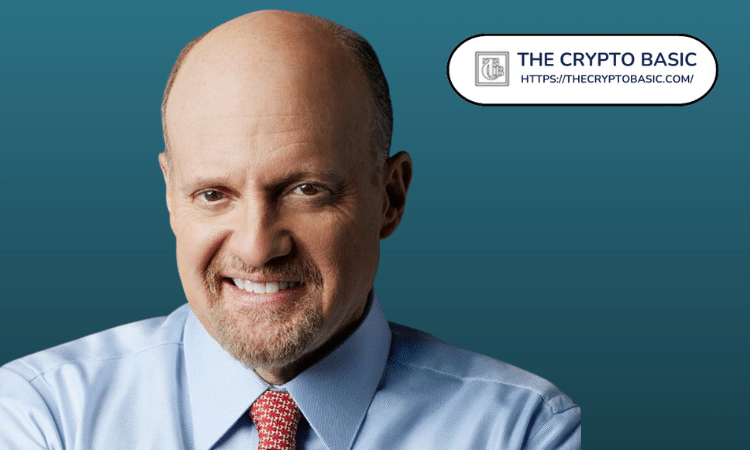
However, the community may have now been given a reason to be concerned as CNBC Mad Money host Jim Cramer has said the SEC may lose in its case against Ripple.

“SEC says look they’re creating securities day after day after day there’s a Ripple case they may not even win the Ripple case but the Binance is very very different,” Cramer said in the clip that has made the rounds on crypto Twitter. 

For context, it is worth noting that the pundit has earned his place as an inverse indicator, with outcomes often going in the opposite direction of his predictions in traditional and crypto markets. One reason is that he encourages viewers to buy at the top and sell at the bottom, albeit unwittingly. 

His most recent gaffes include a vote of confidence on Silicon Valley Bank and First Republic Bank. The former collapsed earlier this month and is being purchased by First Citizens. Conversely, the latter has a $12 billion hole in its balance sheet that it is trying to cover before it can again look for a buyer.

Until now, the XRP community has had little reason to worry about “Inverse Cramer,” as he has often called the cryptocurrency a scam.

‘The Kiss of Death’? XRP Community Members React

Attorney John E. Deaton, who represents thousands of XRP holders as a friend of the court in the SEC case against Ripple, claimed that XRP’s latest price correction began when Cramer expressed that Ripple could win the SEC case.

Deaton’s statement prompted one community member to describe Cramer’s support as “The Kiss of Death.”

XRP is down 1.39% in the last 24 hours at the time of writing after several days of recording double-digit percentage gains.

Another user quoting the proverb “even a broken clock is right twice a day” prayed that Cramer’s prediction in the Ripple would be one of the few times the pundit would be correct.

Another asserted that this instance does not count as the pundit did not say it with his usual conviction. However, he still described it as a close call.

What Do the Charts Say?

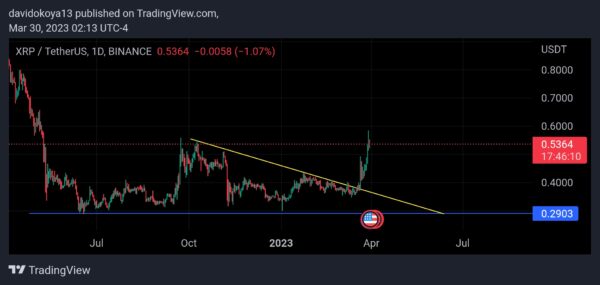
Ignoring the social media chatter and looking at the price chart, it appears to be another case where the pundit has unwittingly called the local top.

Notably, XRP’s latest price rally resulted from the breakout of a descending wedge pattern on the daily chart. For context, a breakout of this chart pattern tends to see the market push as high as the beginning of the pattern or at least 90% of the way before starting a big price correction that could see the market continue to push higher or reverse direction. 

It remains to be seen which route XRP would take as it has tapped the beginning of this chart pattern. 

TradingView Screenshot 1680156831823
Chart by TradingView

Recall that, as reported yesterday, veteran trader Peter Brandt tapped the asset to exceed the $3 price point if it fulfills its compound fulcrum bottom pattern.

Cardano Adds 49K+ Wallets In March, Resulting in 4 Million Wallet Milestone

0

The recent growth in the total number of wallets coincides with an impressive surge in ADA’s price.

Cardano (ADA) has welcomed over 49,000 wallet addresses since the start of March, as it recently reached the milestone of 4 million wallets. This impressive increase in the total number of wallets underscores the growing demand pumped into ADA.

Cardano began the month with 3,962,583 wallets when ADA’s price hovered around the $0.36 territory. Notwithstanding, the total number of wallets saw an exponential increase despite a steep decline in ADA’s price, which plummeted to a 2-month low of $0.3022 on March 10.

Following a relentless surge in the number of wallets, Cardano’s total wallets finally crossed the 4 million wallet threshold on March 21. At a current total of 4,011,653 wallets, Cardano has welcomed 49,070 wallets since the beginning of March. 

This number continues to increase. It bears mentioning that Cardano saw an addition of up to 54,050 wallets in February and 63,639 wallets in January, per data from Cardano Blockchain Insights. Overall, the network has welcomed 166,759 wallets so far this year.

Cardano Price Action

Shortly after the 4 million wallet milestone was reached, crypto analyst Alexander Legolas highlighted why the feat is significant for ADA’s price action.


Legolas pointed out that Ethereum and BNB experienced their respective bull runs shortly after their wallet addresses crossed the 4 million thresholds in July 2017 and February 2021, respectively. He highlighted that both networks hit the milestone during a market-wide bull run and at a time when their DeFi ecosystems were coming alive.

Cardano’s DeFi ecosystem is seeing a massive upgrade due to the demand triggered by several protocols. As a result, its TVL has reached 421 million ADA, nearly overtaking the ATH value of 424 million ADA last March. Cardano is reaching these heights despite the prevalent bear market.

Considering this, Legolas posited that ADA could follow ETH and BNB, shooting to an ATH price in the next market-wide bull run. Moreover, as previously reported, ADA has shown some modest decoupling signs as it registers massive gains.

The asset has gained 7.66% in the past 24 hours, currently trading for $0.3835 as of press time. It is currently the second biggest gainer on the top ten list of largest assets, only behind XRP.