Home Blog Page 2055

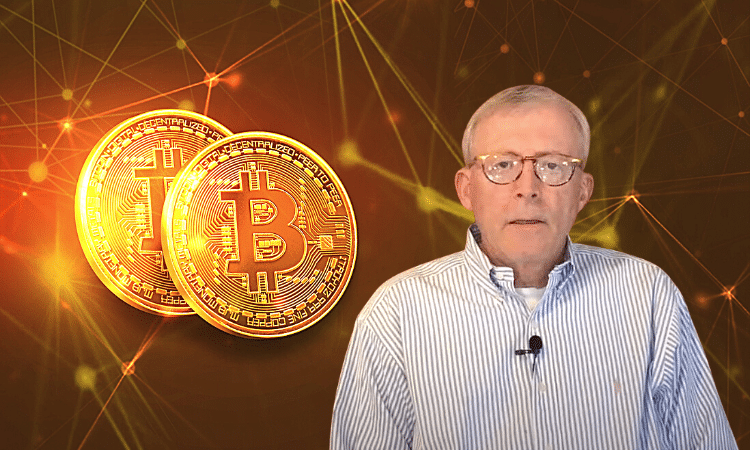
Peter Brandt Challenges Bitcoin CME Traders To “Go Short”

0

Bitcoin has formed two successive gaps on the derivatives platform.

Veteran trader Peter Brandt appears to have taken a jab at Bitcoin traders who make decisions based on Bitcoin Chicago Mercantile Exchange (CME) gap formations alone.

The classical chartist did this in a tweet today, pointing out that Bitcoin has formed two successive gaps on the derivatives platform; he tweeted:

“Two huge unfilled gaps. I encourage you hot shot young guns to go short.”

What is the CME Gap?

To understand what the CME gap is, one must first understand how the CME operates. It is worth noting that while crypto can be traded round the clock on crypto exchanges, CME closes on the weekend and parts of the day. 

Hence, while the futures price on the CME is fixed during this break, Bitcoin’s price continues to move on spot exchanges. A gap is formed to catch up to the spot price when the CME opens. This gap is what is known as the CME gap. Consequently, the gaps identified by Brandt are the result of Bitcoin’s impressive rallies over the last two weekends.

Notably, traders are often wary of these gaps, as they tend to fill, implying a potential correction or reversal. However, as even Brandt points out in the comments, this is not always true. 

“The dirty little secret is that some gaps may never be filled,” Brandt tweeted.

Consequently, the CME gap, like every other indicator, is probabilistic, and taking trading decisions off of that alone may be foolhardy. In addition, gaps that fill could take weeks or months and would likely still follow overall price action.

Price Action Amid a 45% Rally

It is worth noting that Bitcoin has formed a significant close above the weekly horizontal resistance level. It indicates the fulfillment of the inverted head and shoulders chart pattern identified by Brandt last week. 

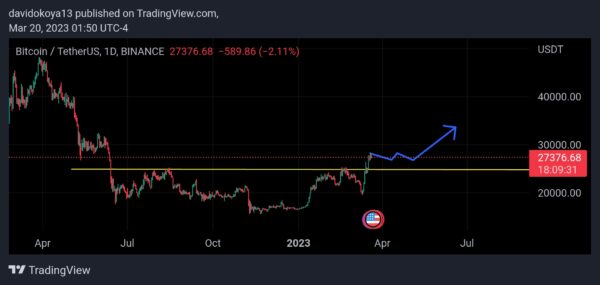
How high the price would go from here remains to be seen. In truth, there are several possibilities. The Bitcoin price could continue its impulsive move up while forming small corrective patterns.

TradingView Screenshot 1679291429648
Chart by TradingView

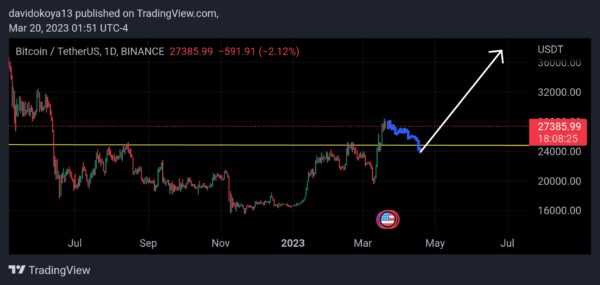
It could also retest the neckline before further continuation, preferably in the form of a steep bull flag. 

TradingView Screenshot 1679291496126
Chart by TradingView

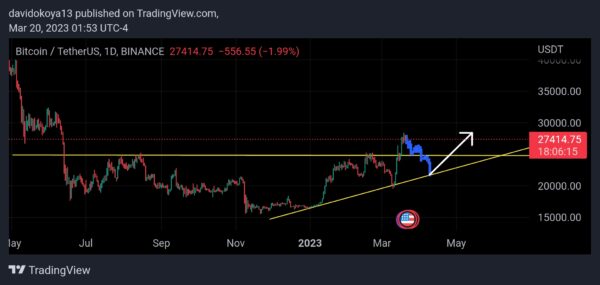
Another possibility is that it could form a steeper correction to confirm a trend line formation.

TradingView Screenshot 1679291626196
Chart by TradingView

Bitcoin investors appear super bullish as uncertainty surrounding banks has given rise to speculation of a pause in Fed rate hikes. Notably, the leading digital asset is up 45% since the Silicon Valley Bank collapse, as highlighted by Galaxy Research’s Alex Thorn yesterday.

5 Innovative NFT Metaverse Projects For 2023

0

One of the latest exciting development in the blockchain sector has been the emergence of NFT and metaverse projects, attracting substantial backing from large companies and prominent investors.

Since then, several crypto projects have fused playable NFTs with the metaverse using blockchain technology to introduce several mind-blowing use cases to investors. As a result, the most innovative NFT collections are those that offer metaverse experiences.

However, in 2023, evaluating and finding the best NFT metaverse projects can be challenging for any investor. To help, this article reviews five innovative NFT metaverse projects for 2023.

The Sandbox

The Sandbox is among the world’s most popular play-to-earn (P2E) metaverses. It is a user-created-experience platform, and users are given the resources they need to create non-fungible items within the ecosystem. This means the players support the game’s economy, and more cosmetic items will be added over time.

As a result, almost anything is possible – from interactive games to metaverse casinos to events and structural designs and even wearables. This gives The Sandbox enhanced replayability (replay value) and provides more reasons for users to invest in SAND, the Sandbox’s utility token.

To incentivize the platform, creators can sell their creations on the game’s marketplace to earn SAND, which can be exchanged for fiat. Overall, the Sandbox is more than a game, as users can create anything. And with thousands of NFTs in the ecosystem, it is evident that the project is and will remain popular with players.

Looking Glass Labs

Looking Glass Labs (LGL) is a Web3 platform focusing on NFT architecture, immersive metaverse environments, play-to-earn tokenization, and virtual asset royalty streams. The company aims to build the next-generation social metaverse, bringing to life Web3 metaverse experiences.

Its flagship brand, House of Kibaa (HoK), creates and curates a next-generation metaverse for 3D assets, enabling the simultaneous existence of functional art and collectibles across several NFT blockchain platforms.

In May 2021, HoK launched its limited Genesis NFTs (only 809 Genesis NFTs), selling at $500/Genesis NFT. Early adopters were given access to private sales of NFT collectibles created by the project. Within four weeks, HOK’s membership sales totaled $490,000. After the membership launch, HOK made an additional $305,000 in royalties as the memberships were resold to collectors.

Furthermore, GenZeroes, one of the successful digital assets released by HoK, sold out in just 37 minutes for CAD 6.2 million ($4.5 million), plus a perpetual 5% royalty stream on secondary market sales.

In addition, the HOK management team is working to create a cross-chain ecosystem for 3D digital assets that will enable NFTs to retain their functionality and exist simultaneously across various NFT blockchain environments. The HOK utility token will be the exchange medium across LGL platforms, allowing users to earn, trade, swap, and spend within the LGL metaverse.

Socios.com/Chiliz

Socios.com, a blockchain startup, is among the top suppliers of sports fan tokens. Fan tokens, sometimes referred to as fan coins, are digital assets representing a holder’s ownership of a voting right in a particular organization. This grants them access to special incentives and experiences associated with the organization.

The Malta-based firm has partnered with soccer teams such as Juventus, FC Barcelona, Manchester City, and PSG. For example, In June 2020, FC Barcelona issued its first $BAR token and generated $1.3 million from the sale of 600,000 tokens which sold out within two hours.

Also, In 2022, the PSG token reached a sales volume of $15 billion, driven by the club’s real-world success and the acquisition of legendary player Lionel Messi. In addition, Socios.com also partnered with UFC in the 2021 Summer to launch the $UFC fan token. This allowed UFC to join a strong network that already featured several major global sports properties.

The fan tokens are minted on the blockchain platform, Chiliz, Socios.com’s sister organization. This has propelled Chiliz’s native token, CHZ, into the top 100 cryptocurrencies in the world.

Sorare

With 135 fully licensed clubs, including Real Madrid, Bayern Munich, Liverpool, and Paris Saint-Germain, Sorare is a leading NFT platform for soccer. The Paris-based firm has attracted investments from notable personalities, including entrepreneur Gary Vaynerchuk and football players Gérard Piqué and Antoine Griezmann.

Unlike other soccer NFT platforms, Sorare is a fantasy game. Users, posing as managers, pick virtual teams of five soccer players from blockchain cards. Like other fantasy soccer games, the virtual teams are ranked and awarded points based on the real-world performance of their players.

In addition, some cards (rare, super-rare, and unique) are licensed and tradable digital collectibles that can be sold on the Sorare marketplace. In January 2022, a unique 2021-22 Erling Haaland card was sold for $678,680 on the marketplace, becoming the most expensive card sold on the platform.

Pooky

Polygon-based Pooky is a unique blockchain gaming platform for predicting soccer matches. Pooky’s main goal is to allow users to predict football matches from the world’s top leagues and tournaments.

Traditional Web2 betting platforms always offer high risk, high reward, and no risk, no reward wagers for their free-to-play modes, which often see many users lose significant funds. So stop losing, don’t go broke, predict smarter with Pooky. Pooky is different, introducing a model where players bear no risk of losing and always win something. Everyone wins on Pooky!

Pooky gives players ownership of digital collectibles (3D Pookyballs) that allow them to make predictions, earn rewards, win Experience points (PXP), and battle for top spots on the Pooky Leaderboards. The best part is that predictions don’t need to be 100% correct to win. As players rise through the ranks, they can level up, customize, craft, and increase the value of their Pookyballs to earn additional rewards.

In February 2023, Pooky launched its Genesis Collection Pookyball NFTs to provide users early access to its gamified, risk-free alternative to soccer betting.

Pooky’s risk-free model promotes a healthy alternative to traditional sports betting while enabling global reach. Pooky supports social interaction and entertainment while building communities on and off the platform. The platform aims to return to the fundamentals of sports prediction—challenging friends and showcasing your in-depth knowledge of the world’s most beautiful game.

Wrap Up

In this article, we’ve reviewed five innovative metaverse projects for 2023. Although each project has unique prospects, two stood out in particular.

While Looking Glass Labs (LGL) is an exciting Web3 project that combines NFT ownership and play-to-earn tokenization with metaverse environments, Pooky has the potential to revolutionize the soccer prediction industry with its no-risk model. Both projects also have great teams behind them and a clear roadmap.


Quick-Thinking Poolz Finance Takes Swift Action To Frustrate Hackers & Protect Its Community

0

Decentralized fundraising platform Poolz Finance has just become the poster child for how DeFi protocols should respond to hacking incidents.

This week, within minutes of being hacked, it implemented a series of measures that not only helped to contain the damage and prevent it from spreading, but almost certainly stopped the hacker from profiting from his or her ill-gotten gains.

Poolz Finance is a decentralized swapping protocol that aims to provide a way for crypto startups and project owners to bootstrap liquidity. It works by making it simple for project owners to launch and manage liquidity auctions that investors can easily discover and participate in.

Although it’s a relatively new protocol, Poolz Finance has seen some success already, making it a target for the individual who discovered a vulnerability within the smart contract governing its POOLZ token vesting system. On March 15, the hacker managed to exploit this vulnerability and make off with an undisclosed number of POOLZ tokens that had been allocated to public buyers. The BscScan blockchain explorer shows that some of these tokens were rapidly sold on DEXs or exchanged through the cryptocurrency mining service Tornado Cash.

Unfortunately for the hacker, he or she didn’t move fast enough. Poolz Finance reacted by creating a response team that moved quickly to ensure that no POOLZ tokens could be traded on any exchange, while implementing other measures to prevent the incident from happening again.

One of the very first steps was to identify the hacker’s address and flag it on multiple blockchain explorers. At the same time, Poolz Finance worked with the Uniswap and PancakeSwap DEXs to remove all liquidity from their exchanges and protect their users, while also notifying centralized exchanges and its wider community to halt activity on all POOLZ trading pairs. Meanwhile, a freeze was imposed on all POOLZ porting on the ChainPort.io bridge.

The rapid reaction from Poolz Finance was likely more than just quick thinking on the team’s part. Clearly, the protocol had a plan of action in place prior to the security incident, enabling it to move extremely fast and frustrate the ambitions of the hacker. As a result, he or she was only able to swap a small fraction of the amount stolen before running out of avenues to funnel them through. In less than two hours, the hacker’s plans fell apart.

By far the most dramatic step taken, however, was the decision to remove the POOLZ token from circulation altogether and replace it with a brand new token, called POOLX. This will ensure that the hacker is left holding thousands of now useless tokens. What’s more, Poolz Finance said it intends to continue pursuing the hacker and bring them to justice.

The new token, which is currently being audited by ArcadiaGroup, CertiK and ChainPort, will go live once a new smart contract has been deployed. All POOLZ token holders prior to the hack will be compensated 1:1 with newly minted POOLX tokens, with new liquidity pools established based on the existing POOLZ exchange rate, as it was prior to the hack. Poolz Finance also said it’s developing a compensation model that will reward the community for its patience. The supply of POOLX will therefore be increased by 10% to support these ecosystem rewards.

Poolz Finance said it launched a flash fundraising campaign in the immediate aftermath of the hack that raised $600,000 in less than 12 hours. The money will be used to implement and distribute the new POOLX token and strengthen its security, Poolz said.

Liam Cohen, founder of Poolz Finance, said he is proud of his team’s swift and effective response to the hacking incident, and that its main priority is to protect its community.

“Despite this setback, we’ll come out stronger with our new token, POOLX, which is currently undergoing an audit,” he said. “Our treasury is unaffected, and we remain financially stable. We’re dedicated to our community and DeFi and we thank you for your support.”

Ripple Lawyer Reacts as Reports Say Signature Bank Buyer Must Drop Crypto Clients

An FDIC spokesperson has refuted these claims.

In a tweet on Thursday, Ripple General Counsel Stuart Alderoty reacted to reports that indicate regulators want potential Signature Bank buyers to drop crypto businesses at the bank.

Recall that New York bank was closed over the weekend with regulators citing “a significant crisis of confidence in the bank’s leadership.” However, Barney Frank, a Signature Bank board member and a former congressman speaking with CNBC on Monday, suggested it was “a very strong anti-crypto message.”

The last few weeks have been tumultuous for the American banking sector. However, the fact that all banks closed by regulators in the last few weeks are considered crypto-friendly has raised eyebrows within the crypto community, with some speculating that it is a coordinated effort to cut off the nascent market from the banking sector. Recall that Nic Carter, a pro-crypto venture capitalist, had alluded to this in a February blog post asserting, “Operation Choke Point 2.0 Is Underway, And Crypto Is In Its Crosshairs.”

A Reuters report denied by the Federal Deposit Insurance Corporation (FDIC) on Thursday, citing two unidentified sources, has only fueled this narrative. Notably, per the initial report, prospective buyers of the bank had to agree to drop all crypto business. For context, crypto businesses accounted for 25% of Signature Bank deposits by the end of September.

Alderoty, responding to the reports, asserted that any such demand from the FDIC would violate constitutional due process, citing a 2015 ruling in the Community Financial Services Association of America v. FDIC, Federal Reserve, OCC case. Notably, the ruling found that through informal guidelines, regulators had unduly coerced banks to deprive the plaintiffs of their rights to a bank account, contravening due process.

Per the Reuters report, bids for the bank were scheduled to end yesterday. Recall that the attorney had previously urged crypto startups to build outside the United States in light of the uncertain regulatory climate.

Korea’s Biggest Exchange to Support Airdrop For XRP Holders

0

UpBit became the latest exchange to declare support for the xCORE airdrop to XRP and SOLO holders.

UpBit, South Korea’s largest crypto exchange, has declared support for the xCORE airdrop aimed at XRP holders. The airdrop, which will also be sent to holders of Sologenic (SOLO), was unveiled by the Coreum team last December.

The UpBit team announced its support for the airdrop in a recent press release. Citing information from the official Coreum announcement last year, the press release noted that the snapshot for the airdrop would occur on March 24, 13:00 (KST) or 04:00 (UTC).

The airdrop, which consists of 25 million xCORE for XRP holders and 25 million xCORE for SOLO holders, will be distributed to UpBit users according to the amount of XRP and SOLO tokens they hold as of the time of the snapshot.

Although Coreum has set a fixed distribution date of May 15, UpBit disclosed that the distribution date, as well as the snapshot date, is subject to change contingent on new developments and updates from the Coreum team.

The exchange revealed that they would suspend XRP and SOLO deposits and withdrawals on March 24, from 11:00 (KST) or 02:00 (UTC). However, the team has not given a fixed time to lift the suspension, noting that the time will be announced separately when the airdrop support is completed, and the network is stable.

UpBit further emphasized that any XRP or SOLO deposits made to an UpBit account during the suspension period will not be considered for the airdrop distribution, imploring users to deposit their XRP and SOLO tokens before the suspension.

The Coreum Mainnet Launch and Airdrop

The Sologenic Development Foundation unveiled the Coreum layer-1 enterprise blockchain in December 2021. Following a series of development efforts, the Foundation has scheduled the mainnet launch for this month.

To commemorate the launch, the Sologenic team will release a round of airdrops for holders of CORE, SOLO, and XRP. Note that the Sologenic project initially began on the XRP Ledger but will be transitioning to the Coreum blockchain because, according to the team, XRPL does not support some functionalities the project needs.

This round of airdrops will feature 100 million CORE tokens for holders of CORE, 25 million xCORE tokens for holders of SOLO, and 25 million xCORE tokens for holders of XRP. While all snapshots will occur on March 24, the xCORE distribution will be carried out at once on May 15, while the CORE distribution will occur in four batches of 15% from April 1 to Nov. 1.

xCORE is an option token for CORE, the native token of the Coreum blockchain. CORE is currently trading for $2.07. As the snapshot date for the airdrop draws closer, leading global exchange MEXC also announced support for the airdrop on Wednesday.

Shiba Inu To Be Presented At WEB 3 ‘Outer Edge-Los Angeles’ Event

0

This year’s event is scheduled to be held from March 20 to 23 across several locations in Los Angeles.

Marcie Jastrow, Shiba Inu’s Metaverse Advisor, will be present at this year’s Outer Edge Los Angeles (LA) event set to commence the following Monday. Jastrow will join numerous other Web3 and crypto industry players as an esteemed speaker in the crypto-focused event.

She disclosed the information in a recent tweet, expressing her excitement over the development. Jastrow also implored members of the Shiba Inu community to purchase tickets for the occasion with her discount code “Marcie10,” touting the event as the “ultimate Web3 experience.”


Outer Edge | LA, formerly called NFT LA, is an annual event seeking to facilitate the gathering of thousands of industry players in the Web3 scene in Los Angeles. This year’s event is the second gathering and will be held from March 20 to 23 across several locations in Los Angeles, including LA Convention Center, Downtown LA, and Famecast Santa Monica.

Notably, Shytoshi Kusama, Shiba Inu’s lead developer, called public attention to Jastrow’s position as one of the speakers, commenting with an expression that he habitually uses to highlight optimistic developments in the Shiba Inu ecosystem.

Marcie Jastrow as Shiba Inu’s Metaverse Advisor

Marcie Jastrow was appointed on contract as the Metaverse Advisor for SHIB: The Metaverse in May 2022. As the ecosystem’s Metaverse Advisor, Jastrow looks to identify and recommend patterns to ensure that the Metaverse project is a success. The accomplished industry veteran brings a wealth of experience to the Shiba Inu ecosystem, having worked at Technicolor for a decade before leaving in December 2019.

In general terms, a typical Metaverse Advisor role involves understanding the needs of stakeholders, identifying key challenges, and defining goals and objectives for the project. The Metaverse Advisor works closely with different teams to manage the project’s development process, identify technical and design requirements, and ensure it meets its goals.

The Shiba Inu community considers the recent disclosures from Jastrow particularly bullish, as the meetings could eventually lead to notable collaborations that would bolster the success of the Metaverse. Recall that Jastrow recently had a meeting with Ted Schilowitz, the futurist at Paramount Pictures and ViacomCBS, at this year’s SXSW festival in Texas.

Meanwhile, the Shiba Inu Metaverse project remains on track under Jastrow’s guidance, as Kusama recently unveiled a new website and branding for the project, disclosing a scheme to enable users seamlessly purchase Metaverse lands.

The first of 36 Flare (FLR) Drops Goes Live

0

The network will automatically destroy unclaimed tokens 67 days after distribution.

Flare Networks has announced the successful distribution of the first of 36 planned FLR airdrops to wrapped token holders.

Flare disclosed the successful distribution of the rewards in a tweet yesterday, noting that the first distribution, dubbed FlareDrop.01, as promised, made 676 million tokens claimable to WFLR holders as part of the first drop. The team also reminded users that 24.2 billion tokens would be distributed over 36 months.

As explained in a previous report, with the passing of the first Flare Improvement Proposal (FIP.01), WFLR holders would be entitled to FLR drops every month for the next 36 months. It bears mentioning that before the introduction of this proposal, the original plan was to distribute the remainder of the 28,524,921,372 FLR tokens from the 15% tokens distribution event to XRP holders at a time of December 2020 screenshot to these holders in 36 tranches with no further action required on their part. 

However, Flare Networks introduced FIP.01 to make the drop more inclusive, arguing that the project now has a broader vision. Consequently, as highlighted in previous reports, the drop is now more akin to staking rewards that accrue to WFLR holders every month.

To be eligible for the FlareDrop, users must hold WFLR for 23 days before each claim day. Notably, the network chooses three random blocks within this specified holding period to get an average of the WFLR tokens held by each wallet. Each holder’s rewards are calculated as a percentage of the wallet’s average WFLR holdings to all WFLR in circulation. As previously highlighted, the first 35 drops would consist of a little over 676 million tokens, while the final drop would be about 584.76 million FLR. The network will automatically destroy unclaimed tokens 67 days after distribution.

Notably, the next drop will occur on April 16 per a guide attached to yesterday’s tweet.

Shibarium-Based DogPad Invests $50K in BONE

0

The team behind the launchpad disclosed that they plan to keep investing more funds into BONE.

DogPad Finance, a launchpad ecosystem set to migrate to Shiba Inu’s Shibarium network, recently invested $50,000 in Bone ShibaSwap (BONE), the governance token of ShibaSwap. The investment comes from BONE’s underperformance in the recent market-wide rally due to the latest Shibarium FUD.

In a recent tweet, the DogPad team emphasized that they will continue to support Shibarium and ShibArmy, the Shiba Inu community. They noted that the $50,000 BONE investment is one of the ways through which they aim to communicate their solidarity with Shytoshi Kusama and the Shiba Inu ecosystem.


A shared snapshot of the investment call shows that the DogPad team traded 30 ETH, worth an estimated $50,335 at the time, for 40,282 BONE tokens. Recall that BONE is expected to serve as the gas token for Shibarium. The token will also function as the DogPad Finance liquidity pool token once the launchpad migrates to Shibarium.

The team noted that the DogPad ecosystem understands the importance of BONE to the launchpad and is committed to supporting its growth. One of the ways they plan to do this is by pumping more investments into BONE in every dip. This should help bolster demand and support the asset’s price action.

DogPad Finance is a crypto ecosystem that aims to simplify creating and managing tokens on the Shibarium network. Its flagship feature is the LaunchPad, which provides an interface for managing initial DEX offerings (IDOs), fundraising, and token distribution.

Besides LaunchPad, DogPad offers additional tools and services to streamline the token creation process. Although it has its native token, DOGPAD, the ecosystem will use BONE as the dedicated liquidity pool token in the wake of the migration to Shibarium.

Meanwhile, BONE is fighting against the bears following a massive dip recently triggered by the latest FUD surrounding Shibarium, which has been addressed. With an 18.70% decline in the past week, BONE is securing the highest loss for any asset on the top 150 list. Nonetheless, the token has gained by 4.91% in the past 24 hours, trading for $1.33.

Terra Classic Zaradar Bashes User Says L1 Team is Not Anonymous

0

A community member alleges that developers are unprofessional.

Tobias Andersen, aka Zaradar, a full-time senior developer on the Terra Classic Joint Layer 1 Task Force, has taken a jab at a community member for allegedly not doing his research, asserting that most members of the core development team are doxed and not anonymous developers.

Zaradar did this in a tweet yesterday in response to a community member who called out developers for using cartoon Twitter profile pictures and aliases. According to the community member, it is unprofessional and drives away potential investors.

However, Zaradar, in response, called out the community member for failing to do his research.

“Everyone in the L1 team, except for one person, is more or less doxed if you actually bothered  to do more research then what you read on Twitter,” Zaradar tweeted.

Recall that the Joint Layer 1 Task Force was formed in December with a plan to carry out necessary maintenance upgrades on the Terra Classic network. The community earmarked over $141k in community pool funds to fund the team’s operations in Q1 2023.

Per a tweet from Zaradar in February, the team includes himself, Edward Kim, Fragwuerdig (@frag_dude), The Vinh Nguyen (@TheVinhNguyen4), LuncBurnArmy (@LuncBurnArmy), Zorro Rebelde (@elzorrorebelde) real name Jorge Araya Navarro, Ragepiee (@Ragepiee) real name Frank, and the biggest enigma “Superman.” 

Despite Zaradar’s assertions, it is worth noting that not much is known about some team members, with the biggest enigma being Superman, as there is no social media presence at all. In a January tweet, Zaradar described him as the primary Cosmos developer of the team. 

At the same time, despite the assertions from the community member, it appears that businesses are open to working with the Terra Classic chain. As reported this week, businesses are looking to integrate a Terra Classic software development kit that will allow them to accept Terra Luna Classic (LUNC) payments.

As reported in January, Joint Layer 1 Task Force developers are already ahead of schedule for their Q1 targets. The team has rolled out at least two major maintenance upgrades in the last two months.

Shiba Inu Lead Developer Labels All Community Members As Defense Team

0

Kusama Says all Shiba Inu community members are SHIB defense team against FUDs.

Shiba Inu lead developer Shytoshi Kusama has now categorized all community members as part of the Shiba Inu Defense Breed amid a growing FUD campaign launched against the project. The label highlights the need for all community members to do their part in defending the Shiba Inu project against orchestrated propaganda.

Following speculations that the Shibarium code is a clone of the Rinia blockchain’s existing code, a coordinated FUD campaign crept into the Shiba Inu community as the drama unfolded. Amid the propaganda, Kusama has been soliciting solidarity among community members, emphasizing the critical role of collective support for the project.

To effectively communicate this message to the community, Kusama has utilized his Twitter biography, which he frequently modifies to convey essential points.

In one instance, Kusama underscored the importance of commitment to the project’s mission, stating, “if you fly the shib flag, it shouldn’t be reversible.” This suggests that members of the Shiba Inu community should remain steadfast in supporting the project’s goals.

Collective Community Support Needed

Subsequently, Kusama disclosed that he now considers all members of the Shiba Inu community to be part of the Shiba Inu Defense Breed, thereby placing a shared responsibility on the entire community for the tasks previously assigned solely to the original Defense Breed.

“You All are the new Defense Breed.”


The Defense Breed, initially composed of twelve individuals from the Shiba Inu community, was entrusted with the responsibility of supporting the SHIB ecosystem by scrutinizing SHIB-related projects, debunking false rumors, and disseminating factual and critical information to members of the community and the public, among other functions.

In the second installment of his Shibarium blog series, Kusama praised the accomplishments of the Defense Breed and explained that they were disbanded because their exceptional efforts were no longer restricted to a “defense” team, having achieved remarkable success in securing several partnerships for the Shiba Inu project.

The situation with the Rinia code propaganda has been addressed by Shiba Inu developers, with a Rinia developer confirming that the Shibarium team did not copy the Rinia code but only utilized the same ChainID.

Despite the clarification provided and the efforts made to resolve the situation, Kusama’s recent labeling of all community members as Defense Breed underscores the need for every member to diligently scrutinize any future speculations and play an active role in dispelling false rumors surrounding the project. This collaborative effort is essential to protect the integrity of the community’s work and ensure its continued success.