Home Blog Page 2057

KoyoToken Burns Nearly 1 Billion Shiba Inu in One Go

0

Nearly 1 Billion Shiba Inu (SHIB) burned in a record transaction.

In an unprecedented move, the Community-led burn initiatives collectively have set fire to a massive 934,428,791 (934.42B) SHIB through fifty-seven transactions in the past 24 hours.

KoyoToken, a newly emerged token played a significant role in the record-breaking burn event by eliminating a staggering 924,150,949 (924.15B) SHIB, from circulation in just one transaction. Per Shibburn.com data, the major burn event occurred about 2 hours ago from press time.

KoyoToken continues to make a record Shiba Inu burn since March 10th. Currently, the Community-driven token has destroyed a humungous 4,631,179,336 (4.63B) SHIB through multiple transactions.

KoyoToken Contibution to Shiba Inu Burn
KoyoToken Contribution to Shiba Inu Burn

This major burn event has caused Shiba Inu’s burn rate to skyrocket by 10,960.22%

Shiba Inu Burn Rate Skyrockets Over the Past 24 Hours

Shytoshi Kusama, the Shiba Inu supreme leader, expressed his excitement by saying, “Woof.”

Following the major burn event, Shiba Inu’s price has surged by 2.56% to $0.00001066. The most popular canine-themed cryptocurrency has also seen a significant trading volume of $237,237,610 ($237.23M) in the past 24 hours.

Elon Musk Joins Crypto Twitter to Dunk on CNBC’s Jim Cramer

0

For the uninitiated, the self-proclaimed investment expert has built a reputation for making horrendously wrong calls on his show and Twitter.

Billionaire Elon Musk has swiped at CNBC Mad Money host Jim Cramer.

The Twitter boss did this in a tweet today in response to a likely sarcastic comment from Dogecoin co-creator Billy Markus. Markus, in a tweet, joked that the CNBC analyst is good at his job, to which Musk referencing the “Star Wars” franchise, responded:

“The Force is strong with inverse Cramer.” 

Unsurprisingly, the tweet has sparked a flurry of responses from crypto community members who joined in on the jibes. For the uninitiated, the self-proclaimed investment expert has built a reputation for making horrendously wrong calls on his show and Twitter.

Notably, the Mad Money host has grabbed headlines again in recent weeks, as is usually the case, not for reasons he would probably prefer, as his calls on banks and the performance of Tuttle Capital’s Inverse Cramer Exchange Traded Fund (ETF) with the ticker SJIM have come to the fore.

Recall that, as highlighted in a report last week, a month ago, the CNBC host had encouraged viewers to invest in the now-failed Silicon Valley Bank. Ripple Chief Technology Officer David Schwartz described it as “possibly the worst possible investment.” In addition, last Friday, amid the bank crisis, Cramer tapped Federal Republic Bank as a “very good bank.” Just days later, it was revealed that the bank was in troubled waters, with its stock price tanking over 70%, requiring a $30 billion rescue from the country’s biggest banks yesterday. 

It does not help that recent reports indicate that SJIM outperformed the stock market by as much as 5% in its first week of launch. The prospectus explains that it works by shorting stocks the analyst recommends on Mad Money and Twitter. These positions are typically held for five trading days but can be longer if the pundit continues championing buys.

The analyst has recently expressed a bullish stance on the NASDAQ, implying that shorting the latest rally was a shortcut to getting wrecked in the markets. The analyst’s view is likely informed by recently expressed confidence that the Fed would no longer opt for a 50 basis points rate hike next week in light of recent bank collapses. While most spectators also held these views, following Cramer’s commentary, some have been given pause for thought, as evidenced in comments to his tweet.

Will Polygon (MATIC) Hit $3 In 2023? RenQ Finance (RENQ) Will Breach $3 Earlier, Reckon Analysts

0

Polygon (MATIC) and RenQ Finance (RENQ) are two promising cryptocurrency platforms that have been gaining popularity in the crypto market. In recent times, they have shown significant growth and their value has been increasing steadily. However, the question that most investors are asking is whether these platforms will hit $3 in 2023.

To answer this question, we must take a closer look at the individual platforms, their current performance, and future growth prospects.

Polygon (MATIC)

Polygon, formerly Matic Network, is a Layer 2 scaling solution built on the Ethereum network. The platform is designed to offer faster and cheaper transactions to solve Ethereum’s scalability issues. Polygon has a strong developer community and is backed by major investors such as Mark Cuban and Binance.

In recent times, Polygon has shown significant growth, with its price increasing from $0.01 in early 2021 to a peak of $2.62 in May 2021. However, the price has since experienced a dip and is currently trading at around $1.21 at the time of writing.

Will Polygon (MATIC) hit $3 in 2023?

In the world of cryptocurrency, Polygon (MATIC) has been gaining a lot of attention recently due to its growth prospects. The platform has made significant progress in the DeFi space, attracting major projects like Aave and Curve Finance to launch on its network. Moreover, Polygon has announced partnerships with major companies like Google Cloud, which could boost its adoption and growth further.

Experts predict that in 2023, the minimum cost of Polygon will be $1.36, and the maximum level that MATIC price can reach is $1.66. Additionally, the average trading price is expected to be around $1.40. These predictions are based on technical analysis and market trends.

Polygon (MATIC) is among the active cryptocurrencies that have been maintaining a bullish state. This suggests that if the current trend continues, the price of Polygon (MATIC) could reach $3 shortly. However, it is important to note that these are just predictions, and several factors could impact its future price, including market volatility, regulatory changes, and adoption rates.

BUY RENQ TOKENS HERE

RenQ Finance (RENQ)

RenQ Finance is a relatively new DeFi platform that has been gaining significant attention in the crypto market. The platform is built on the Ethereum network and aims to provide a decentralized, transparent, and secure platform for users to participate in DeFi. RenQ Finance has a strong team of developers and has already passed the Certik audit, which gives investors confidence in its security and reliability.

RenQ Finance has shown impressive growth, with its price increasing from $0.02 in early 2023 to a peak of $0.025 in February 2023. The platform has also shown strong performance in its presale, with the first two stages raising $2.35 million in just a few weeks.

Will RENQ breach $3 earlier?

Analysts predict that RenQ Finance could reach $3 earlier than Polygon, potentially by the end of 2023.

This is due to its strong performance in its presale and its innovative approach to DeFi. Additionally, the platform has been gaining attention from major investors cryptocurrency whales, which could further boost its growth and adoption.

Conclusion

While both Polygon (MATIC) and RenQ Finance (RENQ) have shown significant growth and have several growth prospects, it is difficult to predict with certainty whether they will hit $3 in 2023.

However, analysts predict that RenQ Finance could breach $3 earlier than Polygon, potentially by the end of 2023. Investors should always do their research and make informed decisions based on their risk tolerance and investment goals.

Click Here to Buy RenQ Finance (RENQ) Tokens.

Visit the links below for more information about RenQ Finance (RENQ):

Presale
Whitepaper

Coinbase Legal Officer Outlines Steps for XRP Relisting

0

According to Paul Grewal, even if the judge rules in favor of Ripple, Coinbase will still need to make some assessments before relisting XRP.

Paul Grewal, Chief Legal Officer (CLO) at Coinbase, recently outlined conditions on which Coinbase will relist XRP, Ripple’s native token. Coinbase suspended trading for the asset shortly after the genesis of the Ripple vs. SEC case and has kept it suspended ever since despite calls for it to review the decision.

Grewal made his latest remarks on the issue in an interview today with Thinking Crypto, a crypto-focused YouTube podcast channel. The comments were further highlighted on Twitter by Crypto Law, a legal news media outlet for digital assets founded by attorney John Deaton.


Responding to an inquiry from Thinking Crypto host Tony Edward, Grewal revealed that Coinbase might resume XRP trading if the judge makes a ruling in Ripple’s favor. Still, the decision will depend on several factors, which include:

  • the Judge’s legal reasoning for delivering the judgment,
  • the basis for the ruling,
  • and Coinbase’s assessment of the situation to know whether the decision will be repealed or affirmed by the appeal court.

Speaking further, Grewal added, “A lot is going to depend on the particulars of how that court rules. I know that’s not going to be terribly satisfying to some, but we do have a responsibility as a publicly listed company to tread carefully in this area and with respect to any token that’s a subject of federal court litigation.”

Recall that Coinbase announced on Dec. 28, 2020, that it plans to suspend trading for XRP on its platform, citing the SEC’s lawsuit against Ripple, which began on Dec. 26 of that year. Despite the dynamics of the 2-year litigation, Coinbase has not resumed trading for XRP, although the asset can still be found on the platform.

During the Thinking Crypto interview, Grewal commended Ripple’s efforts at mounting a strong defense against the SEC’s charges. He noted that Coinbase had to file its amicus brief in Ripple’s favor last year because he was completely persuaded by the Ripple defense’s argument.

Grewal further mentioned that he hopes the court sees that the SEC has some holes in its theories. Notwithstanding, he asserted that the case could last for much longer because whoever loses will take up the judgment in the appeal court. Coinbase has also had its legal run-ins with the SEC as the agency classifies some of its listed assets as securities.

Solana (SOL) Will Eventually Be Below RenQ Finance (RENQ) In Terms of Market Cap, Here’s Why

0

As the cryptocurrency market continues to evolve, experts are constantly analyzing and comparing different projects to determine which ones have the greatest growth potential.

One such comparison is between Solana (SOL) and RenQ Finance (RENQ). While SOL has been a popular investment option, some experts believe that RENQ will eventually surpass SOL in terms of market capitalization.

BUY RENQ TOKENS HERE

In this article, we’ll explore the reasons behind this prediction and why RENQ may be a worthwhile investment for those looking to capitalize on the potential of the cryptocurrency market.

What is Solana (SOL)?

Solana is a high-performance blockchain that was created to enable decentralized applications (dApps) and provide a scalable infrastructure for the cryptocurrency ecosystem. It was designed to process over 65,000 transactions per second (tps), which is much faster than most other blockchain networks, including Ethereum. Solana aims to address some of the key issues that have plagued other blockchain networks, such as slow transaction times and high fees.

Why is Solana’s market cap currently high?

Solana’s market cap has been growing steadily since its launch, and it has gained a lot of attention in recent months due to its fast transaction times, low fees, and growing ecosystem of dApps. Many investors see Solana as a promising blockchain project that could potentially compete with Ethereum in terms of its ability to support decentralized applications.

As of writing, Solana’s market cap is currently $8,040,490,199. Solana’s market cap has also been boosted by the overall bullish sentiment in the cryptocurrency market.

The market has been experiencing a bull run since the start of the year, with many cryptocurrencies reaching new all-time highs. This has led to increased demand for cryptocurrencies, including Solana, which has contributed to its high market cap.

BUY RENQ TOKENS HERE

Why could RenQ Finance (RENQ) surpass Solana’s market cap?

While Solana’s market cap is currently high, some experts believe that it may eventually be surpassed by RenQ Finance (RENQ). RenQ Finance is a decentralized finance (DeFi) platform that enables users to access a range of financial services, including lending, borrowing, and trading, on a secure and decentralized network.

One of the reasons why RenQ Finance is considered a potential challenger to Solana’s market cap is because it offers unique features that are not available on other DeFi platforms. This creates new opportunities for investors to gain exposure to these assets without having to own them directly.

RenQ Finance also has a strong team of developers and advisors who have experience working in the cryptocurrency and finance industries. This gives the platform credibility and could help attract more users and investors over time.

In addition, RenQ Finance (RENQ) has been performing well in its presale, selling out two stages within a few weeks of its launch. Moreover, the platform has passed the robust Certik audit, which has also attracted Solana cryptocurrency whales to the platform. This could potentially lead to a decrease in Solana’s market cap and an increase in RenQ Finance’s market cap.

Finally, RenQ Finance has a relatively low market cap compared to Solana, which means that there is more potential for growth in the future. As more investors become aware of RenQ Finance and its unique features, its market cap could increase significantly.

Conclusion

While Solana is currently a popular cryptocurrency with a high market cap, it may eventually be surpassed by RenQ Finance, which offers unique features and has a strong team of developers and advisors.

However, it’s important to remember that the cryptocurrency market is volatile and unpredictable, and it’s impossible to predict with certainty which projects will be successful in the long run. Investors should always conduct their research and consider their risk tolerance before investing in any cryptocurrency.

Click Here to Buy RenQ Finance (RENQ) Tokens.

Visit the links below for more information about RenQ Finance (RENQ):

Presale
Whitepaper

Ripple Invests in Blockchain Founders Fund To Support Web3 Startups

The funding would go towards accelerating the global adoption of blockchain solutions.

Blockchain payments company Ripple has invested in Blockchain Founders Fund (BFF), a Singapore-based Venture Capital Fund for Web3 startups.

Ripple and BFF confirmed this in a press release today. Per the written statement, the investment would support “high-potential early-stage” startups building blockchain-related products. 

With the funding, BFF would invest in promising Web3 founders and support the over 100 existing startups in its portfolio, the press statement reveals. Some companies on BFF’s portfolio include Splinterlands, Dogami, Krayon, Altered State Machine, Magna, and LunarCrush.

“It’s clear that blockchain technology can transform industries,” Ripple Senior Vice President and Managing Director Brooks Entwistle said, commenting on the investment. “We want to see startups unlock the potential of blockchain technology, and are excited to partner with Blockchain Founders Fund to accelerate startups that are creating world-class products with real-world utility for the global market.”

Notably, Ripple’s investment is part of BFF’s Fund II fundraising round, which raised a total of $75 million from companies including Polygon, Ripple, Octava, NEO Global Capital (NGC), Appworks, GSR, LD Capital, Metavest Capital and individuals such as Sebastien Borget The Sandbox’s chief operating officer. BFF announced the close of the round in a press release at the end of last month.

The VC Fund, which said it had made 50 investments in early-stage Web3 startups in the past 12 months through its Managing Partner Aly Madhavji, revealed that the latest round of funding would likely be spread across 200 companies in the next 12 months in a Cointelegraph interview.

Recall that last week, Ripple Chief Executive Officer Brad Garlinghouse asserted that the firm remained strong financially. Notably, the Ripple chief disclosed this in response to concerns about the company’s exposure to failed Silicon Valley Bank.

It is worth noting that the firm has continued to expand abroad despite regulatory uncertainties at home.

‘They Didn’t Copy The Code,’ Rinia Dev Responds to Shibarium FUD

0

Claims that Shibarium is a Rinia clone fall flat.

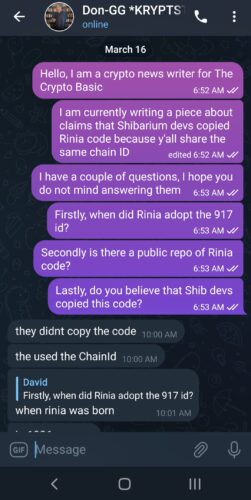
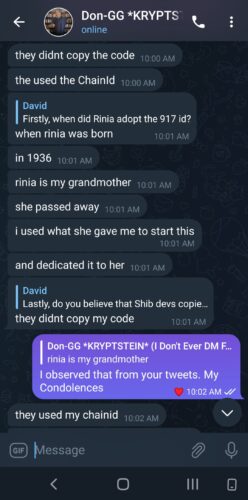
KRYPSTEIN (@MrDonGG), the Firechain and Rinia testnet developer, has refuted claims that developers of Shiba Inu’s Ethereum Layer 2 protocol, Shibarium, stole or cloned his code.

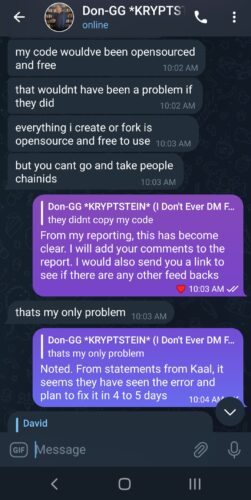
“they didnt copy the code,” the developer wrote in a Telegram message in response to inquiries from The Crypto Basic. “the [they] used the ChainId.”

“my code wouldve been opensourced and free,” he added. “that wouldnt have been a problem if they did. everything i create or fork is opensource and free to use.”

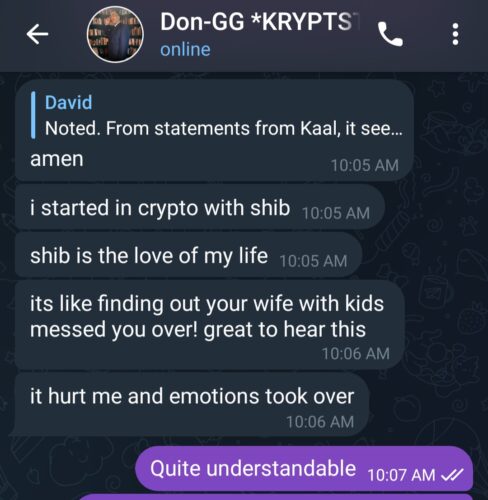
According to the self-professed Shiba Inu lover, his only gripe is that Shibarium developers used his chain ID, which he explains is a tribute to his late grandmother, who he named the Firechain testnet after.

It bears mentioning that tweets from the developer also back this up as complaints have only been about the chain ID and never that Shibarium developers cloned his code.

See the exchange between The Crypto Basic and the Rinia developer below:

20230316 111949

20230316 112016

20230316 112036

20230316 112121

For context, a chain ID is one of two identifiers for Ethereum chains. It is used in transaction signatures and should be different for each chain. This is because if two chains have the same ID, transactions signed on one would also execute on the other.

While chain IDs are automatically generated when a blockchain is deployed, it bears mentioning that developers can change this default ID when they like.

Recall that, as reported today, a member of the BONE Discord had accused Shibarium developers of cloning the code for the Rinia testnet. He supported this claim by highlighting that Shibarium’s recently launched beta public testnet had the same chain ID as Rinia, which had launched last year.

As highlighted in the report, Shiba Inu lead developers Shytoshi Kusama and Kaal Dhairya refuted these claims. In addition, Kaal, in a Twitter thread, noted that it was an oversight on his part for failing to check if the randomly chosen chain ID had already been registered. Consequently, Kaal revealed plans to redeploy Puppynet with a new chain ID in the coming days.

As explained in the previous report, chain ID is one of many things that make a blockchain unique.

‘Judges Will Be Forced To Call the SEC Out,’ Says Pro-XRP Lawyer

A bankruptcy judge has bashed regulators for failing to create clear rules for the nascent market.

Attorney John E. Deaton has asserted that judges would be forced to draw attention to perceived lack of allegiance to the law, overreach, and inconsistent statements from the United States Securities and Exchange Commission (SEC) in its crypto enforcement actions.

The pro-XRP attorney and CryptoLaw founder expressed this in a tweet yesterday. It came in response to a Twitter thread from Coinbase’s Chief Legal Officer Paul Grewal, highlighting a recent ruling in the Voyager bankruptcy proceeding.

In the ruling, Judge Michael E. Wiles called out regulators for fueling uncertainty in the nascent market. Judge Wiles bashed regulators for failing to create clear rules for the nascent market and their constant tussle for control, further fueling uncertainty in the market.

“If the current regulatory environment can be characterized as uncertain, the future regulatory environment can only be characterized, in my mind, as virtually unknowable,” the judge surmises.

Responding to the thread, Deaton asserts that the regulator is losing in court. According to Deaton, the law is not on the SEC’s side.

“As I said in @CryptoLawUS’s livestream, the SEC is losing in Court,” Deaton tweeted. “The truth is, the SEC does not have the law on its side. Then when you couple the SEC’s overreach along with its inconsistent statements and behavior, Judges will be forced to call the SEC out.”

It is worth noting that the regulator has taken several losses in court in recent weeks. As highlighted by Ripple’s Chief Executive Officer Brad Garlinghouse last week, the agency had racked up losses in rulings in three separate cases at the beginning of last week alone.

As recently reiterated by Deaton, Judge Sarah Netburn called out the SEC in the Ripple case last July for “adopting its litigation positions to further its desired goal and not out of a faithful allegiance to the law.”

This year, the SEC has ramped up its crypto enforcement efforts, going after Gemini, Genesis, Kraken, and Paxos in two months. Meanwhile, as highlighted in a recent report, it appears the regulator has no immediate plans of applying the brakes on its crypto enforcement efforts, as FOX Business reporter Eleanor Terrett disclosed the agency’s emphasis on crypto enforcement in its latest budget proposal.

Shiba Inu Social Media Activity Reaches Three Month High

0

Shiba Inu Goes Viral: LunarCrush Reports Record-Breaking Social Activity Amid Shibarium Public Beta Launch.

LunarCrush, a platform that provides insights on various assets, recently published a report stating that social activity around Shiba Inu has reached its highest level in the last 90 days, with over 50,000 people actively participating in daily discussions on social media.

The increased engagement is attributed to several developments within the Shiba Inu ecosystem, the most significant being the launch of Shibarium Public Beta, which aims to help identify and fix bugs before the mainnet launch. The beta phase is expected to last for 2 to 4 months, as per lead Shiba Inu developer Shytoshi Kusama.

According to recent reports, the Shiba Inu team is presently working on creating Shibarium Documents that will offer comprehensive guidance on how to access the Shibarium beta. However, earlier reports from The Crypto Basic stated that the Shibarium beta Puppyscan page was temporarily inaccessible, fueling speculations among Shiba Inu enthusiasts that the much-awaited Shibarium beta documentation may be released soon.

Amid the current situation, Shibarium Public Beta has already processed 2,163 transactions, with up to 388,462 total blocks, and the network sees an average of 541 transactions daily. Despite the growing number of transactions, the average block time has remained stable at 5 seconds.

Additionally, Shytoshi Kusama, the lead developer of Shiba Inu, recently launched a new website and branding for SHIB: The Metaverse, featuring the WAGMI Temple Alpha preview, allowing supporters to purchase Metaverse lands seamlessly during the first land sale phase.

Furthermore, Shiba Inu has achieved the top position on Certik’s top 10 watchlisted NFT projects, surpassing major projects such as ApeCoin (APE), The Sandbox (SAND), and Decentraland (MANA) after the launch of Shibarium Public Beta.

Shiba Inu Lead Developer Bashes Bitboy as Shibarium FUD Gains Momentum

Shibarium developers fend off Rinia fork claims.

Shytoshi Kusama, Shiba Inu’s anonymous volunteer lead developer, has taken a jab at popular crypto Youtuber Ben Armstrong, aka Bitboy Crypto.

“Hey @Bitboy_Crypto how are those T-shirt sales on your Shib videos?” Shytoshi wrote in a tweet today. “Good? Great. Make sure you bring receipts okay?”

In a tweet today, the latter promised to unveil the identity of Ryoshi, the mysterious Shiba Inu founder, in response to recent claims that Shibarium developers copied the Shibarium code from Firechain’s Rinia testnet, an upcoming project. The supporting argument is that both projects share the same chain ID, 917.

It is worth noting that the identity of the SHIB creator remains one of crypto’s biggest mysteries that has again dominated discussions in recent weeks. As reported about a week ago, a Coinbase director had drawn links between the anonymous founder and Sam Bankman-Fried’s Alameda Research. 

In tweets today, Bitboy asserts that Sam Bankman-Fried was involved in the project but is not the founder.

“Sam was involved early on once the two co-founders split,” the controversial influencer writes. “One left and made his own chain. The main founder worked with Sam as the project got off the ground.”

Is Shibarium A Rinia Fork?

Did Shibarium developers, after over a year of supposed development and potentially millions in funding, just copy the code from another project? This is potentially the question on the minds of several SHIB supporters.

In a statement on the Shibariumtech Telegram, Kusama dismissed the latest claims as a ploy to get holders to dump their BONE holdings. Relaying information from Kaal Dhairya, the lead developer on the Shibarium project, Kusama asserted that both projects having the same chain ID was not a problem as they were both in a testing phase, pointing out that multiple testnet works would be deployed in the future in response to any discovered bugs.

In a recent Twitter thread, Kaal gives more insight into the issue, noting that developers had randomly picked chain ID since the chain was deployed. The lead developer disclosed that 417 was the ID at launch, while developers chose 517 for staging and 917 for the beta. According to Kaal, these IDs were not taken at the time. However, he says he failed to re-check before launching Puppynet. Hence he did not realize that Firechain’s Rinia already took the ID.

Consequently, Kaal has said that developers would be redeploying a new version of the Testnet with a different ID. While Kaal says such deployments would be rare in the future, he notes that it is possible as they are still in the beta phase. In response to inquiries, Kaal noted that redeployment would take 4 to 5 days, asserting that they would release the project documentation at the same time. 

What is Chain ID?

There are two identifiers for Ethereum chains. These are the network ID and chain ID. They often have the same value generated automatically when the chain is deployed. However, developers can change this default ID if they choose to.

The chain ID is used in the transaction signature process. This means that if two chains have the same chain ID, transactions signed on one would also execute on the other. Hence the reason for the chain ID concept.

Before Kaal’s tweets, to get to the bottom of the recent claims, The Crypto Basic reached out to key insiders, including Kusama, Ringoshi Toitsu, a Unification validator, and Firechain’s lead developer KRYPSTEIN (@MrDonCG).

At the time of writing, only Toitsu responded. Toitsu shared the Shibarium GitHub repository, which confirms Kaal’s statement that the developers had changed the chain ID twice from 417 to 517 and finally to 917 on Feb. 16.

The Crypto Basic also found and looked through the Rinia GitHub. We found that the network’s default chain ID was 529. However, it was changed to 917 in December. It is unclear when Firechain registered the ID but first disclosed its listing on ChainList on Feb. 27. Notably, Rinia developers claim to have chosen the ID to honor the lead developer’s grandmother.

In addition, complaints about the shared ID only surfaced five days ago when Shibarium beta launched. Notably, there is no mention of Shibarium developers stealing Rinia’s code.

As recently as Feb. 20, the Firechain developer can be seen expressing his love for Shiba Inu. 

Consequently, barring any further evidence, it all appears to be a coincidence. 

More importantly, it bears mentioning that chain ID is not the only thing that makes a chain unique. Other things must be considered, including consensus rules and digital signatures. At the time of writing, there is no evidence that these are the same.