Home Blog Page 2196

Here’s Why Aptos (APT) Is Falling After Launch

0

Aptos has had a rocky few days as the token price continues to fall.


Aptos (APT) is currently trading at the $7.59 price point. Data from CoinGecko shows that it is down 44.7% in the last 24 hours from a high of $13.73.

Notably, this is not the launch many expected, as Aptos was touted as the most scalable and secure Layer 1 blockchain. Consequently, many would have expected the price to pump following the launch of trading activities via listing on leading crypto exchanges. However, the reverse has been the case.

In a tweet today, Wu Blockchain shares the possible reason why. According to the Twitter crypto news outlet, Aptos launched an airdrop without strong protections against a Sybil attack. Consequently, some users who received huge amounts of the token in airdrops were allowed to sell the token on exchanges immediately after receiving them. 

Wu Blockchain cites an example of a user selling over 189k APT in a single transaction, which immediately dropped the price from $15 to less than $13.


It is worth noting that Aptos had chosen to reward participants in its testnet with airdropped tokens at the mainnet launch yesterday. 

As previously reported by The Crypto Basic, the mainnet launch was marred by concerns within the crypto community over the project’s tokenomics and several issues faced with the blockchain. Notably, the delayed breakdown of the allocation of the 1 billion APT supply revealed a concentration of 51%, with developers and Venture Capitalists sparking concerns that they intended to dump on retail investors.

In addition, the blockchain failed to deliver on its scalability promise of 100k transactions per second (TPS), averaging only 4, which is even less than Bitcoin. Consequently, as reported, some popular traders have declared their intent to dump the token.

However, it is not all bad for the token, as it managed to leapfrog over 2000 places to rank 52nd among crypto projects by market cap. It currently boasts a market cap of about $969 million.

Binance Reduces Terra Classic (LUNC) Tax Burn From 1.2% To 0.2%

0

Binance Declares Support for Terra Proposal to reduce LUNC and USTC Tax Burn Parameters.


The exchange has continued to foster its support for the Terra Classic project.


Binance, the world’s largest exchange by trade volume, has announced that it will comply with the recent proposal 5234 passed by the Terra community to reduce the tax burn for LUNC and USTC on-chain transactions.

As reported by The Crypto Basic, the proposal to reduce the tax burn for all LUNC and USTC on-chain transactions from 1.2% to 0.2% was passed yesterday and will be implemented today at 12:50 UTC. Based on this, Binance will also implement the changes for all LUNC and USTC deposits and withdrawals on its platform.

The world’s largest exchange noted that it would reduce the consolidation fee for all Terra classic tokens to 0.2% from its previous parameter of 1.2%. Furthermore, the consolidation fee for USTC and LUNC withdrawals will also be reduced from 1.2% to 0.2% once the proposal is implemented.

Binance added that both deposits and withdrawals of Terra classic tokens will still incur the exchange’s normal fees.

Move to Boost Terra Classic Volume

Recall that the Terra Classic community passed proposal 5234 yesterday following a week of voting. The proposal was launched based on the massive USTC and LUNC trading volume decline. Members of the Terra Classic community believed the 1.2% tax burn levied on all on-chain transactions for LUNC and USTC contributed to pushing many investors away from the assets.

Many believe reducing the tax for LUNC and USTC will boost the cryptocurrency’s trading volume and increase the number of tokens burnt by exchanges.

As revealed in the proposal, 10% of the 0.2% tax burn for LUNC and USTC on-chain transactions will be allocated to the community pool to fund development activities. The announcement marks the latest support Binance has made to the Terra Classic community.

XRP Holder Calls SEC A “Disgrace” for Sealing Its Reply to Ripple’s Summary Judgment Motion

0

XRP holders slam the SEC for sealing its response to Ripple’s summary judgment motion.


Crypto Law, a legal and regulatory news platform, reported today that the Securities and Exchange Commission filed its reply to Ripple’s summary judgment motion. The SEC’s recent filings included some essential documents, such as the agency’s Memorandum of Law to Ripple’s summary judgment motion, Rule 56.1 statements, and declarations made by different professionals. 

However, the documents were filed under seal, and the public will be given limited access to a selected few later this month.

Deaton commenting on the matter said that “Monday of next week, 10-24, the public will get to read limited redacted versions of the oppositions only. Unfortunately, the public will not be able to read the 56.1 statements, counter statements, exhibits deposition testimony, etc., until late December or January.”

Ripple Community Reacts

Meanwhile, members of the XRP community have expressed anger over the sealing of the SEC’s response to Ripple’s summary judgment motion. 

A Twitter user named “Bill” took time to react to the SEC’s recent filing. According to Bill, the SEC’s recent filing is a continuation of the agency’s effort to seal essential materials from XRP investors who are harmed by the lawsuit.

Bill said the SEC has been sealing “critical” documents from XRP investors due to claims that some of its experts were harassed by the Ripple community. The evidence to this claim is still sealed to date, making it difficult for the community to ascertain its authenticity, Bill added.

He called the Securities and Exchange Commission and the ongoing lawsuit a disgrace due to how the agency has conducted itself throughout the case. 

“The SEC is a disgrace, the lawsuit is a disgrace, and this level of sealing is a disgrace,” Bill said. 

Growing Frustration

Bill’s comment reflects the growing frustration among XRP holders. These investors watched the value of their XRP holdings take a massive plunge since 2018, when the SEC started building its case against Ripple.

To make matters worse, the SEC has continued to employ different delay tactics to stall the lawsuit’s proceedings from reaching a logical conclusion.

XRP holders have been the major victims of the lawsuit, which prompted attorney Deaton to file a class action suit against the SEC to help XRP investors to get justice.

Here’s How To ADD/Hold Your XRP On MetaMask With The EVM Sidechain Bridge

0

Peersyst releases a guide to help users who want to transfer their XRP to Metamask as testing of the EVM Sidechain begins.


As reported by The Crypto Basic yesterday, XRP holders can now create XRP accounts on Metamask and hold their tokens there. In a tweet on Tuesday, Peersyst Technologies revealed a quick guide showing how it is done.

Peersyst Technology shared a thread detailing all steps necessary to add XRP to Metamask. Notably, the steps are broken down into four broad processes.

The first step is to create a Devnet account. Next, users must connect the created Devnet account to the Xumm wallet.

How to hold XRP in metamask 1

After the first steps, you are ready to use the bridge. Before doing this, download Metamask and create an account.

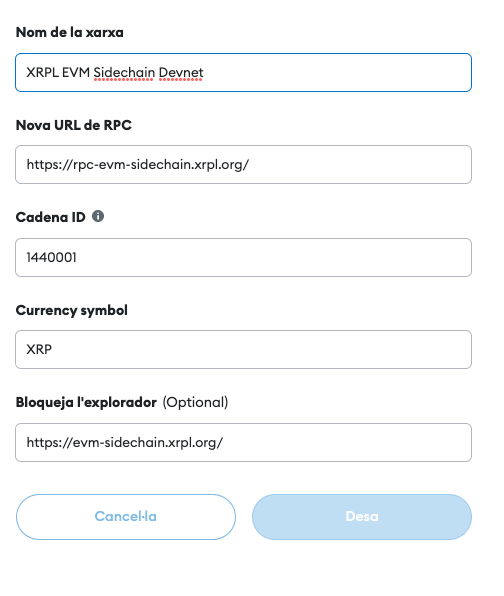
Users can click here to access the bridge and connect their Xumm and Metamask wallets. Users can add the new side chain via the bridge or the Metamask interface below.

How to add XRP to Metamask
Image source: https://twitter.com/Peersyst/status/1582439969813311488

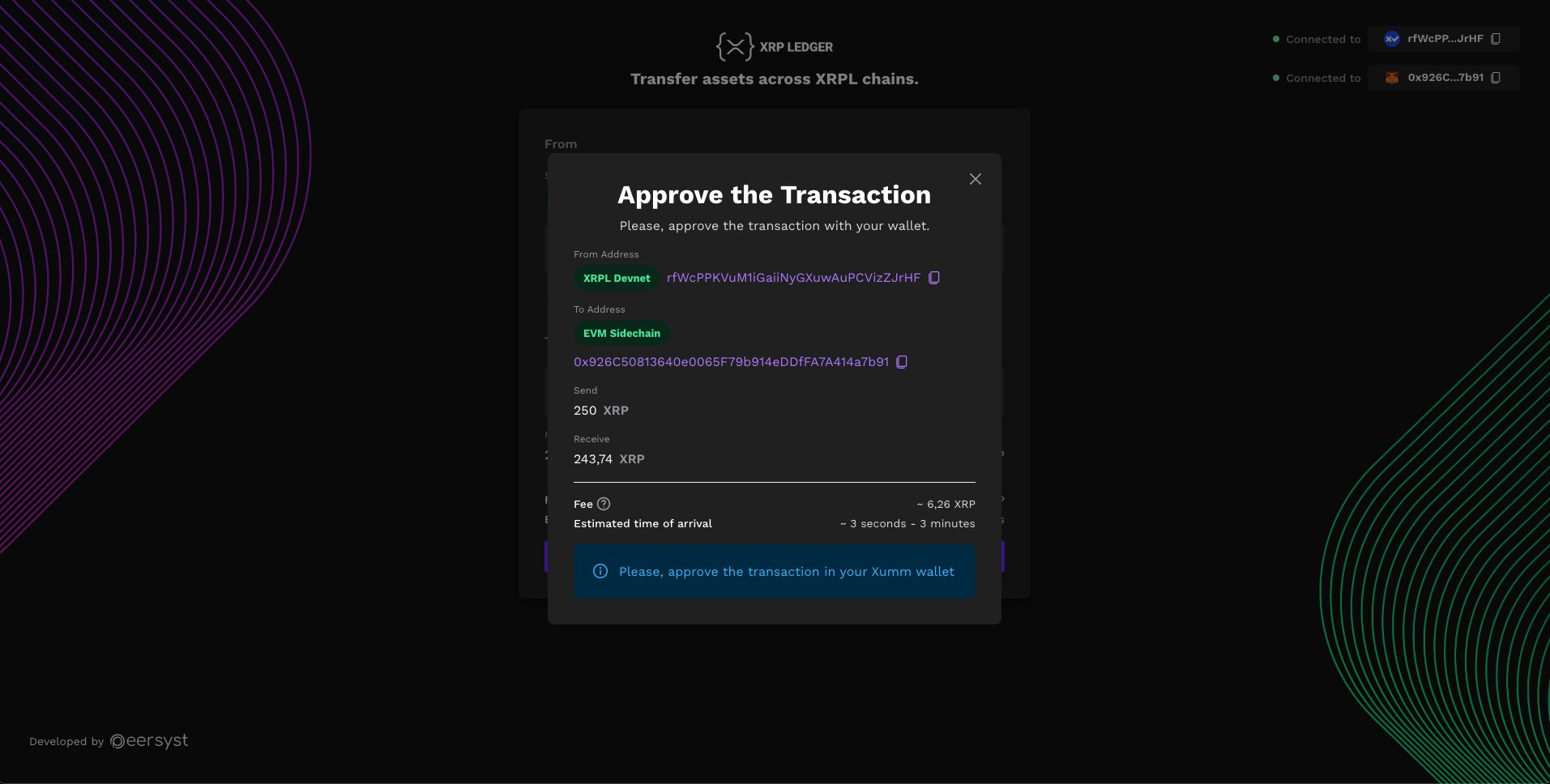
After connecting both wallets, send the desired amount of XRP to your sidechain address through the bridge. The transaction takes only a few seconds.

Holding XRP in Metamask
image source: https://twitter.com/Peersyst/status/1582439977103020032

Now you can see your XRP coins in Metamask.

Holding XRP in Metamask
Image source: https://twitter.com/Peersyst/status/1582439984380116992

Users Response

So far, the tweet has been met with positive responses from users who completed the process with little difficulty.

Meanwhile, another user cautioned users not to link the bridge to their main wallets. It comes as crypto bridges have often been at the center of exploits in the past.

It bears mentioning that the latest development comes as the XRP Ledger (XRPL) starts testing its EVM-compatible side chain, combining the XRPL’s scalability with the robustness of Ethereum’s smart contracts. As a result, it promises to offer users access to a rich ecosystem of decentralized finance (DeFi) and decentralized apps (DApps). 

As previously reported, testing is expected to extend till at least Q1 2023 with no clear date for the mainnet launch. There is little doubt that the EVM side chain will usher in even more XRP adoption in addition to its On-Demand Liquidity use case (ODL).

Notably, developers are also working to bring NFTs to the chain with the XLS-20 amendment, with implementation believed to be just months away. Combining all of this, XRP may quickly develop to become a strong Ethereum competitor.

Chamber of Digital Commerce And Blockchain Association Now Legally Support Grayscale Bitcoin Lawsuit Against SEC

0


Four Crypto Groups, including the Chamber of Digital Commerce and Blockchain association, Legally Support Grayscale in Its Spot Bitcoin ETF Lawsuit Against the SEC.


Grayscale gets support from three groups in its spot Bitcoin ETF legal battle against the SEC.

Three digital currency-related groups have filed an amicus curiae brief in support of Grayscale Investment’s lawsuit against the SEC for refusing to approve its Spot Bitcoin exchange-traded fund (ETF) application. 

Bloomberg Law reported that the amicus brief was filed by the Blockchain Association, Chamber of Digital Commerce, Chamber of Progress, and Coin Center. The brief, filed in Washington Federal Appeals Court, noted a growing demand for Bitcoin spot ETF in the United States. However, the groups argue that all efforts to grant investors exposure to the top asset class via a spot Bitcoin ETF have been denied by the Securities and Exchange Commission.

SEC’s Double Standard?

The associations accused the SEC of applying a double standard when considering applications to offer spot Bitcoin ETFs. According to the trade groups, the SEC had approved multiple riskier products that hold Bitcoin derivatives in the past, especially future-based BTC exchange-traded products.

“The agency has even shown this commitment to similar crypto innovations through their approval of multiple future-based bitcoin ETPs. Yet, this spot Bitcoin ETP would be demonstrably safer, more stable, and easier to understand than products currently available to investors,” the groups added.

In brief, the groups are confused as to why the SEC has refused to approve spot Bitcoin ETFs even though these funds meet all regulatory requirements to earn a listing on a securities exchange.

“The SEC should immediately reconsider this action and approve Grayscale’s spot Bitcoin ETP for public use,” the association added.

SEC Rejects Spot Bitcoin ETFs Applications

Meanwhile, the SEC’s refusal to approve a spot Bitcoin ETF has been a major topic of discussion in the industry. Several crypto stakeholders have pondered why the SEC has refused to approve a spot Bitcoin ETF, which would give institutional investors indirect exposure to the world’s largest cryptocurrency.

Grayscale has been pushing to have a spot Bitcoin ETF approved by the United States SEC. However, all efforts to get this done did not yield positive results. The investment company got fed up in June after the SEC rejected its application to convert its Grayscale Bitcoin Trust (GBTC) into a spot BTC ETF. Based on this, Grayscale sued the SEC, calling the regulator’s rejection “discriminatory.”

Some stakeholders have lashed out at the SEC for rejecting all spot Bitcoin ETFs applications. Messari founder Ryan Selkis described the SEC’s decision as a fraud committed against U.S. investors, who have lost billions of dollars following the regulators’ refusal to approve the spot Bitcoin ETF.

Aptos Trading Goes Live On Central Exchanges, Is It The Next Shitcoin, Or Will It Be The Solana Killer?

0

After a rocky launch, Aptos trading goes live, and the token is already seeing double-digit losses.


As reported by The Crypto Basic yesterday, several leading crypto exchanges like Binance, FTX, and Coinbase had announced that they would be listing Aptos (APT) just about 24 hours after it went live on the mainnet. Notably, trading is live, and the token is already printing double-digit losses.

APT Struggles To Find Its Footing After A Rocky Launch

As per CoinMarketCap data, APT is trading at the $7.42 price point. It has tanked by 11.57% in the last 24 hours. Its total volume on central exchanges stands at about $723.5 million, with Binance pairs commanding nearly 53% of this volume.

It is worth noting that the current price action is unsurprising, considering the rocky launch that the perceived “Solana killer” had yesterday. The first sign that something was not right was that fewer than 24 hours before the token made its way to exchanges, users still had no idea how the 1 Billion APT tokens would be distributed. Notably, the eventual tokenomics release further soured the minds of retail investors as it showed 51% in combined allocations to developers and Venture Capital investors.

To make matters worse, several users disclosed that despite being promised airdrops from the “incentivized testnet,” they had received nothing. Moreover, as a user highlighted, the chain that touted itself as the most scalable Layer 1 blockchain was anything but that. As per the data, Aptos was averaging a transaction speed comparable to Bitcoin at around four transactions per second (TPS), nowhere near the 100k TPS promised. 

A thread was created by the user sharing these concerns and more.

As popular crypto trader Mac noted, the launch, if anything, looked rushed as the network was not working properly.

Traders’ Outlook

So far, the sentiment around the token on crypto Twitter has not been positive. Traders have openly expressed the intent to dump the token. One such trader is Jay FTX, who shared a meme describing the project as a scam and the token as a shitcoin.

Others, like Mac, have opted to wait it out and let the initial turbulence die down to get a clearer picture.

Meanwhile, reports from Wu Blockchain have sparked speculation that the Aptos team is worried about exchanges starting futures or perpetual trading. As per the reports, the team will prefer futures trading of the token to be restricted for the first two weeks of trading.

While the possible reason for this is unclear, it may be an attempt to ward off traders interested in shorting with size till they iron out their issues. Whatever it is, we may never know as exchanges like Binance, OKX, and FTX have all opted to launch spot and futures trading simultaneously.

Aptos raised $350 million in funding from Andreessen Horowitz (a16z) and FTX alone. Before launch, it was valued above Uniswap Labs, the number 1 DeFi protocol, at $4 billion.

Anonymous Whales Move 170M Ripple (XRP), Here’s What May Be Behind the Transactions

0

Ripple whale investors have shuffled huge amounts of XRP 

Whale Alert, a cryptocurrency data platform that tracks large cryptocurrency transfers, has been reporting the movement of Ripple (XRP) by high net worth investors. 

Over the past 24 hours, a total of 170,388,591 (170.38 million) were moved by Ripple whale investors. At the current XRP exchange rate of $0.47, the fund is valued at around $157.68 million. 

According to the whale tracking service, an anonymous whale moved 60 million XRP from an unknown wallet to Bitstamp. The transaction, which took place earlier today, was worth $28.93 million at the time. 

Other Large XRP Transfers

Whale Alert also tracked yet another large XRP transaction involving an address on the Bitstamp cryptocurrency exchange. A total of 64,088,591 (64.08 million) XRP were transferred to an unknown wallet from Bitstamp. 

According to data from Whale Alert, the fund was worth $30.81 million at the time of the transaction. 

In a similar development, a total of 22.3 million XRP coins ($10.71 million) were sent to an unknown wallet from an address on Bitso. 

Furthermore, an anonymous Ripple whale withdrew 24 million XRP worth $11.29 million from Bitstamp. 

Rising Demand in Ripple’s ODL

In this latest round of large XRP transfers, Bitso and Bitstamp were the only cryptocurrency exchanges involved. It is worth mentioning that both crypto trading platforms are official partners of Ripple’s On-Demand Liquidity (ODL) service, a payment solution that uses XRP as a bridge currency. 

Interests in Ripple’s ODL have been on the increase in recent times, as different payment giants adopt the solution to bypass the issues associated with the traditional financial system. Several clients have used both crypto trading platforms to purchase XRP in order to meet their ODL needs.  


Bulls and Bears Currently Have Low Interest in Bitcoin (BTC)

0

Investors’ interest in cryptos has been low since last month. 

CryptoQuant, a cryptocurrency data analytics platform, has stated that spot and derivative cryptocurrency markets have experienced lower trading volumes since early last month. The cryptocurrency data analytics platform noted that it has been observing the development since last month. 

“From about September 9, 2022, it is pretty clear that the volumes in both the spot crypto market and the derivative crypto market are essentially sideways,” CryptoQuant noted in a recent report. 

CryptoQuant asserted that interests in cryptocurrencies have been on the decline, as there have not been “pronounced peaks and throughs […] which indicates that interest [in Bitcoin] from both bulls and bears is low.”

There have been reports of market capitulation, as stablecoin is considered a safe haven for many investors. Stablecoin adoption soared earlier this year as the asset class was used as a shield from massive price fluctuations. 

Crypto Prices Dip Spread Panic

Investors’ interest in cryptocurrencies plunged tremendously, which was caused by several unfortunate events that rocked the year. Many crypto traders stepped into 2022 with the expectation that the November 2021 rally would continue this year. 

However, political and economic events cut short their expectations, plunging the value of the total crypto market valuation. To make matters worse, the collapse of the Terra ecosystem also succeeded in wiping away a huge amount of value from the crypto market, and further causing panic among many investors. 

Furthermore, the United States Federal Reserve has continued to hike interest rates to curb inflation. On Year-to-Date (YTD), Bitcoin (BTC) is down 58.9%, Ethereum has plunged 64.5%, while Binance Coin (BNB), Ripple (XRP), and Cardano (ADA) are down 47%, 44%, and 73%, respectively.   

CryptoQuant’s analysis is backed by Ali Martinez, a cryptocurrency analyst. Martinez stated that there is a declining interest in Bitcoin among institutional investors. According to Martinez, the number of daily Bitcoin transactions worth $100,000 has reduced. 

“The daily number of #Bitcoin transactions with a value greater than $100,000 continues to trend lower, showing a lack of institutional $BTC players’ and #BTC whales’ activity,” Martinez said. 

Data Shows How Badly Terra Classic Volume Affected After 1.2% Burn Tax Implemented

0

Analysis of Terra Classic Data Sheds Deeper Insight on Effects of 1.2% Burn Tax on LUNC Volume.


A LUNC proponent and software developer has shared deeper insight on the effects of the introduced 1.2% tax burn on Terra Classic (LUNC) volume.

The Terra community had shown renewed interest in the 1.2% tax burn proposal as the campaign for the revival of Terra Classic (LUNC) gained steam. The community solicited support from several exchanges, and their fervency was rewarded with cooperation from top exchanges, including the world’s largest, Binance.

Notwithstanding, the community has noticed that LUNC volumes appear to suffer due to the 1.2% tax burn mechanism. This has been prompted by reluctance from investors to subject their assets to burns, contributing to a dearth of interest in the asset. 

Despite these speculations, a proper in-depth analysis of the effects of the tax burn mechanism on LUNC volumes has not surfaced until now. Software developer and LUNC proponent StrathCole recently indulged the community in that regard.

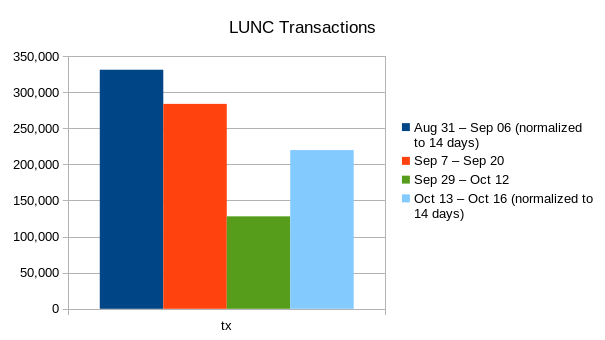
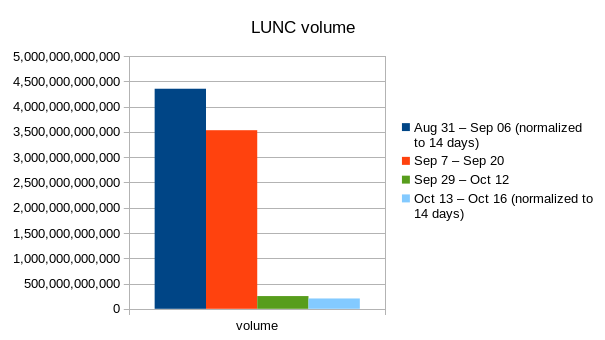
In an analysis on Medium, StrathCole assessed LUNC volumes in four periods, including before and during the implementation of the 1.2% tax burn mechanism. He moved to exclude data from certain periods, as trade volumes than were affected by other factors besides what is considered normal.

The first period was between September 7 and 20; the second period, between September 29 to October 12; the third period which ranged from August 31 through September 6 was introduced to validate the first period; the fourth period was between October 13 and 16.

Data from the third period (August 31 to September 6) revealed LUNC volumes that surpassed 4 trillion LUNC, making way to the 4.4 trillion LUNC territory. However, the first period (September 7 to 20) saw a 20% decline from the fourth, as volumes dropped to a cap of 3.5 trillion LUNC.

The second period (September 29 to October 12) witnessed the most massive decline in LUNC volume, with data revealing a volume collapse below the 500 billion mark, as the volume decreased by over 90%. The fourth and final period (October 13 to 16) was still declining from the second, as volume hit below 250 billion LUNC.

In addition to the volume, LUNC transactions also saw massive declines during this time, but not as much as the volume. Although there was a slight recovery at first, the volume still suffered regardless. StrathCole asserted that the transaction count did not decline as much as the volume due to the average transaction size.

It bears mentioning that this analysis excluded data from notable Binance transactions pre-tax that would’ve contributed to higher volume data if included in the analysis. 

As a conclusion of his analysis, StrathCole highlighted that the tax burn mechanism has really contributed to a dearth of investor interest in LUNC. “In addition, the tax hurts those the most that bring the most value to the chain (contracts/dApps and their users). That is not how it should be, I think,” he added.

Recall that the community noticed this drop in LUNC volume, which sparked several debates. As a consequence, the community passed a new proposal to reduce the 1.2% tax burn to 0.2% as a way to reintroduce interest in the asset, as recently reported by The Crypto Basic. 

StrathCole mentioned that his analysis cannot accurately assess the effect of the reduction of the tax burn to 0.2%, as there isn’t much data on that proposal yet. However, he noted that he doesn’t expect an immediate recovery in LUNC volume following its implementation.

“This is mainly because of the fact that CEXs will not necessarily change their current way of handling their on-chain wallets. But I think it is the right step to do now,” StrathCole concluded.

He further mentioned that he understands the point of view of the proponents who believe it is too early to reduce the tax burn rate. Notwithstanding, he added that he doesn’t envision any improvement in the LUNC volume data, as transactions are still s

Horse Racing In The Metaverse Gallups Ahead

0

The number of applications for non-fungible tokens (NFTs) is growing all of the time, and one of the most recent innovations to catch on is virtual horse racing in the metaverse.

The rise of the internet gave birth to the idea of online gambling, where people can place their bets on real-life sporting events, including horse races, from anywhere, without needing to stop by their local bookie or actually go to the races. Now, with the metaverse becoming a reality, it has become possible to do a lot more than just place your bets from any location. Players can actively participate in highly realistic simulations of the horse racing world, setting up their own stables, buying, breeding and training race horses, and then sending them off to the races to earn real-life rewards in the shape of cryptocurrencies.

Horse racing is a rapidly emerging use case for the metaverse and it’s one that has huge potential. It’s an ancient sport that’s popular all over the world and typically attracts thousands of spectators, many of whom are prepared to stake thousands of dollars on the outcome of the races.

In 2019 the global horse racing market was valued at more than $278 billion, according to Zion Market Research. What’s more, it’s a market that’s expected to keep on growing, with one recent forecast cited by the metaverse horse racing game DeRace showing that the industry will grow at a compound annual growth rate of 9% from 2020 to 2024.

So can metaverse-based virtual horse racing carve out a slice of that pie? There’s reason to think it can do so by utilizing concepts around “GameFi” and play-to-earn gaming mechanisms that have already proven to be hugely popular with traditional video games.

One of the hottest virtual horse racing projects to date is Derby Stars, a metaverse game that’s built on Polygon, the Ethereum scaling network. With it, players can acquire NFT-based horses, train them, breed them, level them up and then participate in races against the horses of other users.

NFTs and play-to-earn are key components of Derby Stars, and enable numerous kinds of interactions between users that combine to create a unique, in-game economy. There’s multiple aspects to the game, with players required to manage their stable of horses by training them regularly, breeding them to create new horses, and then take part in live races that can be viewed in real-time, with big prizes on offer for the winners. Players can bet on the outcome of these races too, and they’ll need to cooperate with others to train and breed their horses more efficiently.

Derby Stars isn’t the only game in this new metaverse genre. Other titles include DeFi Horse and MetaRace. All three games share common themes, and opportunities exist for players to earn rewards for their efforts, such as entering and winning races, selling horses and hosting their own race tournaments.

A key advantage of horse racing in the metaverse is that it eliminates one of the biggest problems in the physical race horse world. The horse racing industry is notoriously corrupt, with doping and bribing jockeys to fail races having become commonplace in every country. Race fixing is the norm, and the industry also provides an easy way for criminals to launder money and avoid taxes. With metaverse horse racing, this kind of corruption is no longer possible, with the outcome of horse races determined by the skill of the horse alone.

In Derby Stars for example, the developers claim it’s actually possible for any horse to win the race if the trainer puts in the required effort and strategically applies their horse’s skills to the conditions of the race. Another popular metaverse horse racing game, DeRace, applies genetic algorithms and RNG technology to create unpredictability, leading to endless possibilities within each individual race, which are decided based on the player’s actions. It all adds up to an unforgettable and adrenaline-fueled experience that ensures bettors and trainers alike are enthralled in the action.

For those who care about animals, the metaverse also gives them a way to enjoy the races without any feelings of guilt. Fact is, horse racing is a brutally unforgiving sport, with many horses that suffer injuries being put down rather than being given the chance to recover. This is a serious concern, with data from the British Horseracing Authority Modern showing that modern steeplechase races have an average of just over 4 equine fatalities for every 1,000 horses taking part. The annual Grand National in the U.K. saw seven horse fatalities out of 439 horses that took part between 2000 and 2010. With virtual horses, the questions of animal cruelty are left aside, as there’s no way to “put down” an NFT.

Metaverse horse racing solves another problem too, as the blockchain technology that powers it enables bets to be settled immediately. When betting at the races or online, players may have to wait a long time to be able to deposit their funds and withdraw their winnings. There’s also a significant verification process involved that must be completed before one can start betting.

The real appeal of metaverse horse racing is not so much the rewards however, but more about the overall experience it provides. Horse racing enthusiasts are no longer restricted to betting alone – rather, they must embark on a journey with their racehorses to achieve success. It involves putting in both the time and the energy to create a special bond with their tokenized equine friends.

The way this is going, it’s only a matter of time until people from all over the world are breeding virtual horses, taking part in the races and reaping the rewards that only a combination of hard work, nurture and dedication can bring. NFT-based horse racing is out of the gates, but the finish line remains a long way off.