Home Blog Page 2222

Ripple Whales Move 226 Million XRP in Four Transactions  

0

Massive amounts of XRP have continued to be shuffled by Ripple whale investors. 

Whale Alert, a platform that tracks large cryptocurrency transfers, has observed yet another movement of hundreds of millions of Ripple (XRP) over the past 24 hours. The transactions were made by unknown whales. 

In the past 24 hours, these unknown whales transferred a total of 226,378,630 million XRP worth $180.77 million, at the current exchange rate. 

Nine hours ago, Whale Alert observed the movement of 26 million XRP ($10.98 million) from an unknown wallet to Ripple’s On-Demand Liquidity (ODL) partner Bitstamp. 

A total of 60,378,630 (approximately 60.38 million) XRP were also transferred from Bitstamp to an unknown wallet earlier today. The funds were worth $27.11 million at the time of the transaction. 

An anonymous whale transferred 60 million XRP to the Bitstamp exchange a few moments later, with the funds valued at around $26.94 million. 

A Ripple whale also moved a massive amount of XRP to an unknown wallet from the FTX exchange in the early hours of today. According to blockchain data, the anonymous user withdrew the sum of 80 million XRP from the exchange. The funds were evaluated at roughly $35.56 million. 

XRP Price Dips 2% in 24 Hours

The latest round of XRP transfers comes when the price of XRP has started losing gains from last week’s rally. Recall that XRP spiked to a 4-month high of $0.53 last week. 

XRP gained momentum after it was speculated across various social media platforms that Judge Analisa Torres would likely rule in favor of Ripple in its ongoing lawsuit with the Securities and Exchange Commission (SEC). 

At press time, XRP is currently changing hands at $0.43, down 2.5% in the last 24 hours, according to data from cryptocurrency aggregator platform Coingecko. 
 

This Divergence Shows Bullish Sign For Ethereum

0

The number of new Ethereum addresses spiked amid the price decline.


There has been a growing interest in Ethereum since the leading blockchain network transitioned from a Proof-of-Work (PoW) algorithm to Proof-of-Stake (PoS). 

New investors indicate interest in the asset class, with blockchain data from IntoTheBlock showing a spike in the number of new Ethereum addresses created daily. 

Ali Martinez, a popular cryptocurrency analyst, shared the development today on Twitter, saying:

“The number of new $ETH addresses created per day is actually increasing. I was able to confirm this on @intotheblock,” Martinez said.

ETH Price Down Despite Growing Investors’ Interest

According to data from IntoTheBlock, the number of new Ethereum addresses created daily is currently around 1,640. The development suggests a growing adoption of Ethereum while the price of the cryptocurrency continues its downward movement.

ETH has been on a downward slide since Ethereum launched the Merge upgrade, where the network switched from its previous PoW consensus algorithm to the energy-friendly PoS.

Since Ethereum’s PoS transition, the price of the project’s native cryptocurrency has been down 15.6%. At the time of writing this line, Ethereum is currently changing hands at $1,323, down 0.2% in the last 24 hours.

Martinez said the divergence, Ethereum price going down, while the growing number of addresses created on the network indicates a bullish signal for the ETH.

“This divergence (price going down while the network grows) is a bullish sign for ETH,” Martinez noted.

It is noteworthy that a couple of new developments have been reported for Ethereum since the Merge upgrade went live. Top exchange Gemini launched a staking service for the second-largest cryptocurrency. However, the initiative has not stopped Ethereum investors from selling huge volumes of the asset class.

TheCryptoBasic reported that a whopping 250,000 Ethereum coins were sent to Binance in one single transaction. At the same time, another 20,000 ETH were transferred to an address on the FTX exchange a few days before.

JPMorgan Puts Bitcoin Projected Excess Return at 38.1%, More Than Equities, Govt Bonds, and Real Estate

0


Investment banking giant J.P. Morgan believes Bitcoin’s projected excess return sits at a massive 38.1%.


Bitcoin has grown massively to secure its position as one of the most sought-after risk assets in today’s financial scene. The asset class, which previously attracted disdain at inception, has caught the attention of governments across the globe. Recently, a J.P. Morgan report posited that BTC has an expected excess return greater than any risk asset.

Ryan Selkis, CEO and founder of crypto intelligence products provider Messari, disclosed the J.P. Morgan report. “Bitcoin is the TINA trade of the next few years. Highest projected excess return asset class according to JPMorgan,” Selkis said in a tweet Wednesday as he shared a shot of the report.


According to the report, Bitcoin has a projected excess return rate of 38.1%, making it the asset with the highest expected excess return on the list. Additionally, per the report, Bitcoin’s benchmark weight sits at 0.1%, with a massive volume of 83.6%. 

Other asset classes on the list include global equities with a rate of 20.1%; private equity which has a rate of 21.0%; hedge funds, having a rate of 10.4%; private debt, with a rate of 5.6%. Amongst all asset classes assessed, global government bonds have the lowest projected excess return, which sits at a meager 2.1%.

J.P. Morgan noted that its assessment of return volatilities had been based on the asset classes’ monthly annualized volatility since 2015. Additionally, the investment bank based its benchmark weight on the valuation weights of the asset classes.

The projected excess return rate posits the rate at which the return on investment of an asset class is likely to exceed the return expected by most investors and analysts in the market.

JPMorgan’s Stance on Bitcoin

While several JPMorgan reports have revealed massively bullish metrics for Bitcoin, the CEO of the investment banking giant Jamie Dimon has not been the biggest fan of Bitcoin and cryptocurrencies. In June – when the markets were heading to the worst stage of the cycle yet – Dimon noted that he saw a major dip for top crypto assets.

Furthermore, Dimon is known for his regular swipes at Bitcoin and other crypto assets and has created the image of a crypto critic over the years. As previously reported, Dimon called Bitcoin worthless last year in a comment that sparked reactions within the community.

The 66-year-old American billionaire businessman dubbed Bitcoin “a terrible store of value” in 2014 when the asset was trading at the $700-mark. Despite Bitcoin’s meteoric rise since then, Dimon has not changed his opinion. Speaking at a Congressional hearing last week, he asserted that crypto assets such as Bitcoin is “decentralized Ponzi schemes.”

Despite Dimon’s comments, JPMorgan as an institution is seemingly bullish on Bitcoin. Sometime in June, following the coldest points of the Crypto Winter, JPMorgan strategists forecasted a soon-to-be end to the crypto bear market.

List of Projects Building on Terra Classic (LUNC) See Growth in Just Few Days

0


Terra Classic welcomes more projects, as the list of projects supporting the LUNC shows growth in a few days.


Terra Classic (LUNC) has had to battle a negative outlook emanating from the Terra collapse and the effects of the persistent bear market. A third factor that impedes the asset’s growth is the recent untoward macroeconomic atmosphere. Despite these inhibiting factors, LUNC has seen massive growth, with projects showing support increasing by the day.

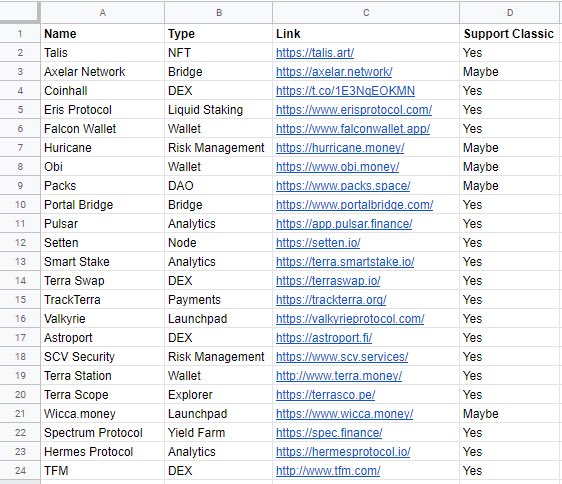
A crypto Twitter handle ‘Classy,’ dedicated to LUNC shared the update in the late hours of Tuesday. “Here’s the UPDATED list of $LUNC supported projects! This list is getting WAY bigger than it was a few days ago” the handle noted as a dashboard highlighting the projects was shared.


The dashboard shows 23 projects on the Terra network, either indicating outright support for LUNC (Yes) or considering support for the asset (Maybe). 

Out of the 23 projects, only five noted that they are considering support for Terra Classic. On the other hand, a massive number of 18 projects have already declared unmitigated support for LUNC.

The list of the supporting projects includes notable ones such as decentralized analytics platform and data feed, Coinhall; decentralized aggregator Fantom; liquid staking platform Eris Protocol; dApp activation protocol, Valkyrie; and suchlike.

Notwithstanding, protocols considering support for LUNC include risk management platform Hurricane, blockchain bridge Axelar Network, and DAO management platform Packs, among others. The increase in projects willing to support LUNC underscores the surging interest in the asset.

As reported by The Crypto Basic, one of the top Play-to-Earn (P2E) games announced its launch on the Terra Cassic blockchain to boost LUNC adoption.

LUNAtics have been witnessing some victories with LUNC as support for the asset and community proposals regarding its future sees growth. Binance recently declared support for the LUNC 1.2% tax burn on spot and margin trades using trading fees.

Furthermore, as The Crypto Basic previously reported, at the proposed burn rate, Binance alone could burn up to 1 trillion LUNC in a year with a 0.1% fee rate. Notwithstanding, this figure might be far from reality because the highest volumes of LUNC trades are carried out by VIPs who pay no fees.

Despite the roadblock its recent rally has faced, LUNC remains one of the highest-gaining assets in the past month, up by 107% since August 28 as press time. 

The asset is currently changing hands at $0.00027 at the time of reporting, with a slight 0.55% gain in the past 24 hours. With a market cap of $1.71B, LUNC remains the 31st largest mainstream crypto asset by valuation.

This Top Exchange Plans to Utilize Terra Classic (LUNC) Transaction Fees Worth $4.5M In Different Ways

0


Upbit wants to divide the Terra classic (LUNC) transaction fees into three different plans.


Leading South Korea exchange Upbit has revealed that it will channel LUNC transaction fees charged during the Terra crisis into various initiatives.   

Upbit noted that the total LUNC transaction fees it got during the Terra crisis were 239.13025970 Bitcoin (BTC), worth $4.58 million at the current exchange rate. 

The exchange created a committee that will repurpose the LUNC transaction fees received during the collapse of Terra. According to a recent announcement, the transaction fees will be divided into short, medium, and long-term plans, as part of a larger effort to compensate for investors’ losses. 

During the ugly Terra crisis, the LUNC fees were worth about $7.5 million. However, due to Bitcoin’s crash below $20,000, the value plunged to $4.58 million. 

Upbit’s Plan for LUNC Fees

In a meeting held recently by Upbit’s Luna Fee Utilization Committee, part of the fees will be donated to organizations working towards providing relief for victims of the Terra collapse. Additionally, a part of the fee will be used to write a whitepaper stating the main reason behind the collapse. The paper will warn investors of other similar projects that may go live in the future.

The long-term plan involves the creation of a digital asset monitoring center to protect investors and foster fair market practices. Notably, Upbit’s initial plan was to return the fees to investors. However, during a meeting earlier this month, the Upbit’s Luna Fee Utilization Committee kicked against the move, saying it was not feasible.

Ongoing Initiatives to Compensate Terra Classic Investors

The collapse of the Terra ecosystem is still one of the most talked about events in the cryptocurrency space. Investors are yet to recover from the incident as they look to make themselves whole again via community burn and staking.

Several crypto-related companies have launched different initiatives for Terra Classic investors as part of the many ways to help the community revive the token from the dust.

As reported by TheCryptoBasic, Binance launched a burn mechanism that will burn LUNC fees on spot and margin trading pairs. In addition, Korbit said it would refund LUNC transaction fees to its users. However, the exchange has not disclosed how it intends to do so.

Here’s How Some Projects Are Redefining Cross-platform Transaction Efficiency Forever

0

There’s no denying that blockchain technology has continued to garner an increasing amount of interest from a number of different industries. This is best highlighted by the fact that this market — which was valued at around $4.9 billion in 2021— is all set to scale up to a cumulative TVL (Total Value Locked) of approximately $68B by 2026, expanding at a compound annual growth rate (CAGR) of 68.4%.

That being said, most popular blockchain networks in existence today are confined to their specific silos, i.e., they are isolated and, therefore, unable to communicate with other similar platforms. This fragmentation has hindered the sector’s growth to a large degree, and therefore in recent years, the idea of cross-chain interoperability has gained a lot of ground globally.

Simply put, cross-chain technologies enable two or more blockchains to communicate with one another seamlessly. And while this interaction used to come at a major trade-off cost in the past — where the efficiency, decentralization, and security of the involved blockchains would be compromised — we now have many offerings capable of mitigating these issues completely.

The future will be driven by cross-platform technologies. Here’s why

Interoperability is widely considered to be the final frontier when it comes to unleashing the true power of blockchain tech. It can not only allow for novel use cases to flourish but also affords users benefits such as greater scalability, faster block times, and extremely high security and privacy.

In this regard, ParallelChain Lab is a high-performance blockchain capable of facilitating cross-network transactions at breakneck speeds. The project addresses the scalability and interoperability shortcomings of most other offerings operating within this realm thanks to its proprietary Inter-ParallelChain Communication (IPC) protocol which helps devise seamless bridges between its public blockchain mainnet and private, permissioned blockchains.

To elaborate, IPC’s design framework ensures that all of ParallelChain’s networks are linked to one another using a secure/private channel. This allows apps running on the platform’s public mainnet to be easily accessible by other private blockchains within the ecosystem. Furthermore, the system offers high scalability, tamper-proof records, zero data leakage, and online transaction processing.

On a more technical note, ParallelChain’s public mainnet, scheduled to launch later this year, is set to deliver a transaction throughput rate of 80,000 transactions per second (TPS) while levying little to no gas fees. Similarly, its private network can deliver up to 120,000 transactions per second (TPS) alongside a transaction confirmation time of just three milliseconds. Lastly, ParallelChain offers extremely low latency rates (of under 100ms), making it ideal for multiparty transactional networks as well as various commercial and transactional applications, ranging from finance to medical insurance to healthcare.

Interoperability is the need of the hour

It is no secret that for blockchain-enabled technologies to continue gaining mass adoption across several industries, interoperability is an absolute must. However, in the same breath, it is important to recognize that this concept is not just relegated to the domain of swapping digital currencies (like many people believe today). In fact, as the global tech landscape continues to mature, interoperability solutions will become increasingly more important since they can help facilitate the sharing of info ranging from healthcare records, supply chain data, education certificates, amongst other things.

To this point, ParallelChain’s two-pronged blockchain design allows for frictionless connectivity between Web3 systems and various real-world platforms, allowing for applications operating within the two realms to function seamlessly on its public as well as private layers. Lastly, ParallelChain is flexible in its design, such that it can be molded into a public, private, hybrid, or consortium blockchain per the requirements of any enterprise, organization, or individual. If that wasn’t enough, the platform’s private network conforms to the guidelines put forth by the GDPR and other regulators — allowing for faster, easier widespread adoption.

Looking ahead

As more and more high-quality cross-chain platforms continue to emerge within the market every day, people are beginning to realize the importance of this technological paradigm, especially since it allows users to take full advantage of the fledgling crypto economy, which is primed to grow to a total valuation of  $3.2T by the end of 2027. Thus it will be interesting to see how things continue to pan out for the digital asset industry at large from here on in.

“70 Year Old Case-law to Determine What’s a Security or a Commodity” – CFTC Chairman on Crypto Regulation

0

CFTC Chairman shares his thoughts on crypto regulations.


CFTC Chairman Rostin Behnam recently stressed the difficulty of classifying crypto, noting that they have to rely on 70-year-old case law to determine what’s a security or commodity.

For some time, the cryptocurrency community in America and beyond has called for regulatory clarity in the cryptocurrency industry. The American regulatory scene has provided room for uncertainty that has led to a battle of supremacy between top regulators, the Commodity Futures Trading Commission (CFTC) and the Securities and Exchange Commission (SEC).

This uncertainty on which watchdog gets a say emanates from the inability of the United States to determine which crypto asset is a commodity and which is security. CFTC Chair Behnam has stressed this difficulty, recently noting a reliance on 70-year-old case law.

Rostin Behnam made these remarks while speaking on a CNBC Squawk Box episode. “We have to rely on 70-year-old case law to determine what’s a security or a commodity. We have one case in New York that says Bitcoin is a commodity,” Behnam said when asked if BTC and Ether are securities.


He pointed out the novelty of digital assets and their unique characteristics compared to traditional risk assets. According to Behnam, this has made it difficult to classify crypto assets. “We’re trying to find a reasonable outcome that will create certainty for the market,” he concluded.

According to Behnam, the CFTC and SEC get along despite the patent battle of supremacy. Nonetheless, he highlighted the difficulty of the CFTC is limited oversight.

“For us, the CFTC, the difficulty is: we are a derivatives regulator – we don’t oversee cash markets. So the authority that I’ve been asking Congress for is cash authority so that we can go into the Bitcoin cash market, the Ether cash market, and the other digital tokens,” Behnam mentioned.

Behnam noted that the SEC and the CFTC are not fighting a turf war. He rather mentioned that the public is witnessing a case of two regulators attempting to come up with a reasonable outcome that can balance out market certainty and consumer protection.

Recall that SEC Chair Gary Gensler previously noted that he supports Congress granting the CFTC authority over Bitcoin, Ether, and other non-security digital assets, as reported by The Crypto Basic. However, Gensler noted that the CFTC would get his support if the SEC regulates cryptocurrencies it considers securities.

Despite Gensler’s comments, the crypto community remains concerned, as the SEC Chair has shown a habit of classifying several digital assets as securities. Notable lawyer John Deaton expressed his fear of the SEC classifying Ether as security following its switch to PoS. Gensler also previously insinuated that PoS tokens have the characteristics of securities.

Sometime in June, Gary Gensler remarked that Bitcoin is the only cryptocurrency he can comfortably classify as a commodity.

Solving The Communication Challenge For Web3 Projects

0

Shant Kevonian, CEO and Co-founder of EtherMail 

The idea to launch EtherMail had been simmering in my head for quite some time, but I never really vocalised it. Across the spectrum of telegram and discord groups, I could see the quality of communication decreasing dramatically as communities grew in size. Then a collection of passive user profiles bear witness to a recurring peppering of ‘When moon’, or ‘When next release’ messages. In the web3 era, community relations should be better than this, no?

But we don’t need to reinvent the wheel to improve the situation. There is a very viable, robust communication architecture ready to be deployed in the web3 arena. Email has proven to be the most widely used and resilient decentralized application since the birth of the internet, and has a proven track record as a web2 communication vehicle. Users are quite reactive to inbounds, and email boasts strong open rates, while also allows for personalisation. Bottom line, it checks all the boxes and serves as an application that users are familiar with, meaning they don’t have to dedicate time to learning a whole new user system.

EtherMail aims to disrupt the dynamics of email communication for the common good, while facilitating full anonymity and fair compensation for users for their time and attention spent on reading inbound messages. The EtherMail value proposition aligns with evolving market trends, and the pertinent needs of Web3 users and industry players. We are hyper-focused on safeguarding user privacy with end-to-end encryption, and view the Web3 era as an opportunity to re-calibrate the email inbox power equation to be completely privacy-centric. 

We have created the only tool in the Web3 space that allows Web3 companies to send rich, relevant content directly to their asset holders based on blockchain-synced real-time information. In other words, we are providing crypto and NFT projects with a direct, secure line of communication to owners of their assets. 

Imagine an NFT project that grants holders access to a particular restaurant, for argument’s sake. If 10,000 NFTs are minted, that means 10,000 NFT holders can access the restaurant. Of course, NFTs are often changing hands left and right. Imagine the restaurant owner wants to communicate a new menu, or new location to the community. Ultimately if they want someone to book, it has to be someone who currently holds a NFT. You need a way to differentiate communication between current holders and everyone else. This is precisely the type of targeted, relevant communication that we’re spearheading. Importantly, companies don’t have to worry about updating their list, as the EtherMail solution enables self-updating mailing lists for community newsletter distribution based on real-time, blockchain-synced data.

Our solution also helps companies proactively mitigate the risk of communication fraud by preemptively informing users of breaches and vulnerabilities. Because you can get in touch with active holders, you can communicate situations quickly. Imagine there has been a hack, and active holders are potentially at risk of getting phished if they sign a certain smart contract. You can directly reach out to holders that are most at risk in the attack vector, instead of hoping they happen to see a Telegram or Twitter message alerting them to the issue. In this case, a company can feel more assured that they did everything in their capacity to get in touch with active holders.

Included in our future pipeline will be the introduction of our native utility token, $EMT, an ERC-20 token based on the Ethereum network. EMT will be a first-of-its-kind incentivization mechanism designed to reward email users for their time and attention reading unsolicited emails, creating a much-needed framework for email economics.

For more information on how EtherMail can help your project maintain a direct and secure line of communication with your asset holders, visit: https://ethermail.io/daos

Join the official EtherMail Telegram channel here and follow the latest developments on Twitter.

Ripple CEO Says United States Is Behind Other G20 Countries In Crypto Due To Lack Of Regulations

0

Garlinghouse has lamented the absence of clear crypto regulations in the U.S.


Brad Garlinghouse, the CEO of leading blockchain company Ripple, said most cryptocurrency companies are willing to abide by regulations. He added that there is a need for clearer regulation of what needs to be regulated to help the nascent industry to thrive.

“I think the vast majority of people in the crypto industry want to play by the rules. Let’s just be clear about what the rules are. So the first thing I think of is let’s be super clear about what we’re trying to regulate,” Garlinghouse was quoted as saying in a Collision interview.  

Ripple CEO added that another regulatory issue that needs to be addressed is the lack of consistency in the space, where regulators use different approaches for different companies.

“You have some examples where regulators are going after companies and then you look at another company doing almost the same thing and they’re not saying anything [about it],” Garllinghouse added.

U.S. Is Behind Other G20 Countries, Says Garlinghouse

According to Garlinghouse, the United States is far behind other G20 countries regarding cryptocurrency regulations. He added that several G20 countries have already found ways to mitigate fraudulent crypto activity in their respective jurisdictions, as well as make sure that there are orderly markets. However, the same cannot be said for the United States.

Most G20 countries have made significant progress in regulating cryptocurrencies without as much difficulty as the U.S. has made it seem, Garlinghouse said.

When asked why the U.S. is trailing other G20 countries in crypto regulation, Garlinghouse pointed to the SEC, referring to the agency as a hammer that sees crypto-related companies as a nail.

Garlinghouse expressed concern over why the SEC is spending so much time trying to prove that XRP is security while other sectors of the crypto industry require scrutiny. 

“It’s a little confusing why the SEC would spend a lot of time and energy on that when we do actually have some things happening in the market that maybe do deserve more scrutiny,” he said.

Garlinghouse: Crypto Firms Seeking Favorable Regulation

Additionally, Garlinghouse said top cryptocurrency stakeholders have been working relentlessly to engage regulators to foster the industry’s growth. 

According to Garlinghouse, several regulators are concerned about crypto companies’ compliance with anti-money laundering rules (AML) and terrorist financing rules because they are foundational regulatory frameworks.

Binance Adds Terra Classic USD (USTC) As New Borrowable Asset on Cross And Isolated Margin

0

Binance support for Terra classic tokens is increasing day by day.


The world’s top exchange is in no mood to leave Terra’s classic community behind or alone. The exchange is taking every step possible to boost Terra Luna classic (LUNC) and terra classic USD (USTC) utility.

In the most recent announcement, the exchange confirms the addition of USTC as a new borrowable asset on Cross Margin and Isolated Margin.

Both Cross Margin and Isolated Margin Pair for USTC are against BUSD.


As reported by The Crypto Basic, Binance became the first exchange for adding LUNC burns on all trading fees. Recent calculations from Terra rebels show that the Binance Tax Burn Approach May Result in Burns of More Than 1.2% of the Proposed Rate.