Home Blog Page 2223

Users Can Send LUNC From Terra Station Updated Mobile App As Gas And Tax Calculation Errors Fixed

0


Terra Station wallet is again functional for Terra Classic (LUNC) transactions.


LUNC investors will be happy to know that they can once again send LUNC with their mobile phones. The Terra Rebels team has fixed gas and tax calculation errors on the Terra Station app, as announced in a tweet today.

“TerraStation mobile app has been released with the fixes for the gas fees,” tweeted Terra Rebels. “This has been tested and works. You can now send LUNC again from your phone. Please make sure your TerraStation app is updated.”

It bears mentioning that there have been several complaints of failed transactions using the Terra Classic wallet following the tax parameter change implementation. Core Terra Classic developer Edward Kim explained on Monday that the error resulted from insufficient gas on the network. At the time, Kim disclosed that developers were exploring ways to reimburse those who lost gas fees through community distribution pools.

Meanwhile, LUNC investors should note that the latest fix is for the Terra Station alone, not the chain. reXx of the Terra Rebels highlighting this reports that users should expect a chain fix soon.


So far, the community has welcomed the news with excitement. Notably, users on all platforms are advised to update the app. The fix appears to be working perfectly on Android, but iOS users still experiencing issues have been advised to clear the app cache and restart the app.

reXx has urged community members to disregard all fear, uncertainty, and doubt (FUD) making the rounds on Twitter. According to the Terra Rebel, while the chain may not be optimal yet, it is improving rapidly compared to the state it was in following the ecosystem collapse in May.


It bears mentioning that the LUNC community appears to have been thrown a lifeline by Binance on its path to reduce the LUNC supply to 10 billion from 6.9 trillion. The leading exchange on Monday disclosed that it would burn all fees obtained from LUNC trading. According to a blog post yesterday, the crypto exchange has also fixed issues with implementing the 1.2% tax on withdrawals and deposits.

LUNC Burner data shows that about 50 million LUNC has been burnt today by the tax.
Binance Mining Pool Adds Forked Ethereum Coin ETHW

0

Binance Exchange Announces Support For The New ETHW Mining token On Binance Pool.


Binance exchange tries to support a great number of crypto projects. In fact, there are now hundreds of cryptos currently listed and available for trade on the exchange. The exchange is making another big move to support the new ETHW (the Ethereum version that utilizes the original proof-of-work model).

In a tweet, the official handle of EHW announced the good news. Binance has decided to add ETHW to its popular Binance Pool platform, meaning users can now mine ETHW on Binance.


Where Did ETHW Come From?

The origin of ETHW is clear to most crypto fans who have been following up on Ethereum’s transition from the old PoW (Proof of Work) to the new and more popular PoS (Proof of Stake) operating model. While PoW relies on the users’ efforts in availing computing resources to secure the network, the PoS system relies on users’ stake in the network.

ETHW came during ETH’s transition from PoW to PoS. A hard fork resulted from the upgrade, splitting the Ethereum chain into two – the new ETH 2.0 utilizing PoS and the older ETH (Now ETHW) utilizing the PoW model. The long-awaited merge event took place on September 15. Some of the crypto players backing the new hard fork claim that ETHW is more censorship resistant.

Points To Note

Following its decision to add ETHW to Binance Pool, the exchange published a post giving guidelines on activating the mining service on its platform. However, the exchange clarified a few issues that may create confusion if misunderstood by the community.

First off, Binance has not listed ETHW for trade on its platform. At the moment, the exchange only supports ETHW mining on Binance Pool. It doesn’t support ETHW deposits, either. Users who succeed in mining ETHW on Binance can only convert their stash into either BUSD or USDT.

The ETHW Market

At the time of this writing, ETHW sits at position 2,655 on CoinMarketCap and trades at around $10.60. The coin has recorded a 24-hour price drop of 4.5%. It has a market cap of around $1.245 billion and a circulating supply of 120.5 million ETHW. It’s yet to be seen how Binance’s support for ETHW mining will affect these metrics.

Two Mysterious Wallets Burn 45 Million Shiba Inu, 61 Million Burned In 24 Hours

0

Another 61.16 Million Shiba Inu (SHIB) were Wiped Out of Circulation in the Past 24 Hours, 45.80 Million in Two Transactions.


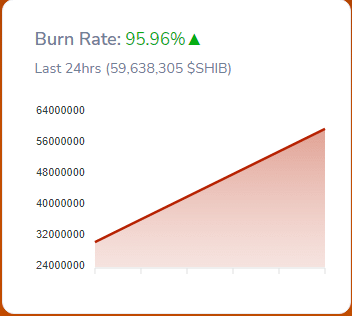
Shiba Inu Community destroyed another 61.16 Million SHIB in the past 24 hours. Two mysterious wallets turned 45.80 Million SHIB to ashes in two separate transactions. SHIB Burn Rate surges 99.35% over the last day.

Despite Bearish Market conditions, the Community-led Burn Initiatives are still committed to reducing the gigantic supply of Shiba Inu (SHIB).

Shibburn.com, the first SHIB dedicated SHIB Burn Project, recently reported that the SHIB Army has reduced another 61,169,479 (61.16M) SHIB from circulation.

Two mysterious wallets added fuel to the fire and spiked the SHIB Burn Rate by sending 45.80 Million Shiba Inu to the dead wallet in two separate transactions.

As per Shibburn.com report, the day’s biggest burn occurred about 17 hours ago. One of the mysterious wallets burned 21,464,117 (21.46M) SHIB in one transaction. A few moments later, another mysterious significant burn transaction came from a separate wallet through which 24,336,644 (24.33M) SHIB were permanently destroyed.

As a result of this massive burn, the Shiba Inu Burn rate surges 99.35% over the last day.

Shiba Inus Burn Rate


The world’s most popular canine-themed cryptocurrency, Shiba Inu, struggles to find support due to the widespread selloff in the global crypto market. Even the positive developments in the ecosystem, including the potential launch of Shiba Inu Collectible Card Games, dubbed “Shiba Eternity,” don’t seem to aid in healing the wounds.

At the time of writing, Shiba Inu is trading at the price of $0.00001097, down -3.95% over the last day, with a 24-hour trading volume of $264,237,026 ($264.23M). On the other hand, the global cryptocurrency market cap currently stands at $916.82 Billion, down -5.79% over the last day with a 24-hour trading volume of $90.39 Billion.

SEC and Tim Draper Know Who Bitcoin Creator Satoshi Nakamoto Is?

0

Was A Meeting Held Between Bitcoin Satoshi Nakamoto and the SEC in 2017?


Fox Business journalist says the SEC held a meeting with Satoshi Nakamoto and Tim Draper.

The cryptocurrency industry has blossomed into a multi-trillion-dollar industry over the years. Interestingly, the industry was born following the creation of Bitcoin in 2009 by its pseudonymous founder, Satoshi Nakamoto. 

For years, people have pondered the real identity of the person or group behind the creation of Bitcoin, and it has so far ended in futility. Some people have come out claiming to be the face behind the pseudonymous Satoshi Nakamoto. 

Terrett’s Assumption

In a recent tweet, Fox Business journalist Eleanor Terrett suggested that both prominent venture capitalist Tim Draper and the Securities and Exchange Commission know the real identity of the Bitcoin creator.

According to Terrett, Valerie Szczepanik, an official of the SEC, organized a meeting with Draper and Satoshi. The meeting was held on August 23, 2017, at the SEC’s office.

“It would appear SECGov and TimDraper know who Satoshi Nakamoto is. Check out this entry from Wednesday, August 23rd, 2017 @ 11:00 AM…,” Terrett said.

It is worth noting that Terrett made this assumption after she obtained a copy of Hinman’s public calendar during his time at the SEC.

A Satoshi Fake

Interestingly, the meeting was never a secret, as Draper revealed the development three days after the meeting.

The venture capitalist said he was targeted by a “fake Satoshi” who was very convincing and wasted his time. Draper advised everyone to tread carefully to avoid getting scammed by a Satoshi fake.

Terrett later confirmed that Draper and the SEC met with a Satoshi fake.

Meanwhile, the Verge, a news outlet, shared details about the meeting. According to the report, the Satoshi fake had an extensive discussion with Draper about an Initial Coin Offering (ICO) that has attracted interest from some influential figures in the cryptocurrency space.

However, Draper dropped out of the deal after it became obvious that he was in discussion with a Satoshi fake.

“Throughout August, the supposed Satoshi and prominent Bitcoin investor Tim Draper were in discussions for an initial coin offering based on the new coin blockchain — talks that seem to have abruptly dropped off when Draper lost faith in the scheme late last week,” the report noted.

FatMan Leans Toward Do Kwon, Believes Terra Founder Did Not Transfer Any Bitcoin From The LFG

0


FatMan Trusts Do Kwon on 3K Bitcoin transfer issue.


Do Kwon and the LUNA Foundation Guard (LFG) have refuted claims that the LFG moved any Bitcoin in response to the South Korean arrest warrant for the Terra founder

In a tweet today, Terra founder Do Kwon denied claims by CoinDesk Korea that he tried to cash in on Bitcoin from the LFG, possibly to aid an escape from law enforcement.

According to the Terra founder, he has not used any of the alleged receiving exchanges in the last year. Furthermore, no LFG funds have been frozen by law enforcement.

“What has been probably the most surprising in all this is the amount of misinformation that gets spread,” tweeted Kwon. “There is no ‘cashout’ as alleged, i havent used kucoin or okex in at least the last year, and no funds of tfl, lfg or any other entities have been frozen.”


The LFG shared its treasury Bitcoin wallet yesterday, asserting that no Bitcoin has been moved since May. Additionally, a check on the shared wallet address shows that the account has been dormant since May 18 and has a balance of 313 BTC.

Terra Whistleblower FatMan Responds

Notably, even Terra whistleblower and vocal Do Kwon critic FatMan, who believes Kwon was complicit in the Terra ecosystem collapse, appears to side with Kwon in this instance. The whistleblower highlighted the fallible nature of chain analysis. However, the whistleblower points out that these speculations are only possible because of the lack of transparency over how the LFG used its Bitcoin reserves.

It bears mentioning that the LFG had amassed about $3.5 billion worth of Bitcoin in early May. This was part of an ambitious ploy by Do Kwon to back TerraUSD (UST), now TerraClassicUSD (USTC), with $10 billion worth of Bitcoin. However, following the collapse of the ecosystem just days later, LFG claims it used its reserve to recover the UST peg and failed without a breakdown of how these reserves were used despite the inquiries by the community. Notably, Binance chief Changpeng Zhao, CZ, criticized the LFG at the time for acting too late.

The Search For Do Kwon 

The South Korean investigation into Do Kwon took a new twist on Monday. Reports indicated that an Interpol red notice had been issued for the Terra founder. It came after Singapore police confirmed that Do Kwon was no longer in the country, sparking speculation that the Terra founder is on the run.

While the court of public opinion remains split on Do Kwon’s guilt or innocence, there are concerns about how the case will affect crypto in South Korea. One of the charges against Kwon is a breach of the Capital Markets Act, which implies that the government views LUNA as an unregistered security. 

On the Unchained podcast episode released yesterday, Zack Guzman, the last journalist to interview Kwon, expressed the sentiment that the Terra founder saw the Capital Markets Act as a “catch-all.” According to the journalist, Do Kwon expressed a lack of preparedness to face such charges should they be brought against him.

Ethereum Founder Vitalik Buterin Finally Releases The Long-Awaited Book On PoS

0


Vitalik Buterin’s “Proof of Stake” book is finally out after a decade of preparation – here is how to get it.


For years, Ethereum’s founder Vitalik Buterin has been writing essays about the blockchain and crypto technology in which he has grown so invested. His brain-child project, Ethereum, has just gone through a revolutionary transition from the PoW (Proof of Work) system to the PoS (Proof of Stake) working model. The big event was dubbed the Merge. This transition could be the motivation behind Vitalik’s decision to release his collection of essays made into a book.

Vitalik announced news of the book’s release in a tweet. Interestingly, the book is titled “Proof of Stake.” As reported by the crypto basic, back in August, the Ethereum founder promised the book would be released in a month. It has taken him 10 good years to prepare the book.


Sale Proceeds To Be Donated

While sharing the news of the book’s release, Vitalik also shared a link to where interested fans can get the book. The book is hosted on Gitcoin, a platform dedicated to pooling funds to support free web development. The book “Proof of Stake” can be accessed here.

In a move seen as a demonstration of his support for the free web, Vitalik has decided to donate all the proceeds of the book’s sales to fund the web.

It’s A First

It’s the first time a good collection of essays about the fairly new blockchain and proof-of-stake network model has been availed on the internet. Also, it’s the first time an author uses Eth keys to sign a book. The book will also be availed as an NFT.

“Proof of Stake” Is Good For The New System

The book’s release comes at a time when Ethereum has just launched the PoS network model. The transition has attracted the attention of various crypto-related parties, including big exchanges like Gemini. Recently, Gemini crypto exchange announced plans to launch Ethereum staking on its platform.

Top Ethereum Whale “Galion” Adds 272 Billion Shiba Inu (SHIB)

0

Key ETH Investors Love to Trade Shiba Inu (SHIB) as 130th Biggest ETH Whale Scooped Up 272 Billion Shiba Inu (SHIB), Worth $3 Million in Past 24 Hours.


Shiba Inu (SHIB) has become the most traded token among the top 100 ETH Whales as the key ETH investor purchased $3 million worth of SHIB in the past 24 hours.

WhaleStats, a crypto whale tracker, recently reported that the 130th biggest ETH Whale tagged “Galion” has just accumulated a staggering total of 272,000,000,000 (272B) SHIB, worth $3,000,159 ($3M) in two separate transactions in the past 24 hours.

As per WhaleStats report, the key ETH trader became active about 8 hours ago and added 100,000,000,000 (100B) SHIB, worth $1,102,999 ($1.10M) at an average price of $0.0000109 per SHIB to her wallet in her first transaction.

At the same time, the deep-pocketed ETH investor performed another momentous transaction and scooped up another 172,000,000,000 (172B) SHIB, worth $1,897,160 ($1.89M).

Etherscan.io data reveals that the top ETH Whale now holds a whopping total of 282,798,383,030 (282.79B) SHIB, worth $3,090,986 ($3.09M) in her wallet.

Top ETH Whale SHIB Balance

SHIB Flipped BAT to Become Most Traded Token Among Top 100 ETH Whales:

Following this massive accumulation from the 130th biggest deep-pocketed ETH investor, Shiba Inu manages to flip Basic Attention Token (BAT) and becomes the most traded token among the top 100 ETH Whales.

Despite these positive developments, the second biggest canine-themed cryptocurrency based on market cap, SHIB, remains on the back foot, and as of writing, the Shiba Inu is seen trading at the price of $0.00001096, down -3.57% over the last day with a 24-hour trading volume of $269,123,902 ($269.12M).

Ripple vs. SEC: 189 Page Hinman Calendar Revealed Covering His Entire Tenure

0


More details emerged, suggesting a suspicious link between Hinman and Ethereum.


Eleanor Terrett, a Fox Business journalist, shared some interesting information about the public calendar of SEC’s Bill Hinman, covering his entire tenure at the commission. 

“I have received a copy of Bill Hinman’s public calendar covering his entire tenure while at the @SECGov,” Terrett said.  

Some of the interesting details of Hinman’s public calendar include a series of meetings he had with Ethereum-related officials.

Hinman’s Meetings with Ethereum

According to Terrett, in the first two years of Hinman’s time in office, four meetings were scheduled with Ethereum blockchain software company ConsenSys and other officials related to the leading blockchain project.

On March 29, 2018, at 12:30 PM, Hinman had a scheduled meeting with ConsenSys and Amy Starr, an official of the SEC Corporation Finance.

A week later, the former SEC Corporation Finance director had a scheduled meeting with the title “ETH.” Another meeting dubbed “Ether” was also scheduled for Hinman on April 12, 2018, at 4:30 AM. On April 23, 2018, at 5 PM, Hinman had a scheduled meeting with Ethereum co-founder Joseph Lubin.

Terrett Further writes:

“Friday, November 20th, 2020 @ 10:45AM: Hinman had a scheduled call with Valerie Szczepanik. The entry is titled ‘Val to call Bill re XRP’. Monday December 7th, 2020 @ 12:30PM: Hinman had a scheduled meeting with Ripple Counsel & Kristina Littman, who was then Chief of the SEC Enforcement Division’s Cyber Unit. That meeting took place 15 days before Clayton brought the lawsuit against Ripple.

After combing through the first two years of entries in the #Hinman calendar, there were 4 total meetings that were scheduled to take place with ConsenSys or officials associated with it and at least two other meetings concerning ETH before Hinman’s June 18th speech. According to the calendar, which may not be complete, Ripple counsel met with the SEC/ (Hinman?) only once and it was on the same day the speech was made. The calendar does not mention Hinman’s attendance at the YahooFinance All Markets Summit.”

Hinman’s Role in the Ripple Lawsuit and Possible Conflict of Interest   

The former director of the SEC’s Corporation Finance is considered a major player in the ongoing lawsuit between Ripple and the commission. His 2018 speech at the Yahoo Finance All Market Summit, where he declared that Ethereum is not a security, has been largely discussed in the lawsuit.

Following a series of investigations by Ripple and cryptocurrency enthusiasts, the former SEC Corporate Finance director is said to have had a possible conflict of interest while in office.

Before Hinman joined the SEC, he was a partner at Simpson Thacher & Bartlett, a member of the Enterprise Ethereum Alliance (EEA). The company was created to market Ethereum technology to various enterprises.

It is noteworthy that Simpson Thacher paid Hinman over $9 million in profit sharing and retirement bonuses between 2017 and 2018 while he was working at the SEC.

Based on Hinman’s affiliation with Ethereum, it was believed he had worked in the company’s interest, which resulted in the 2018 controversial speech where he declared ETH a non-security.

All Vasil Features Go Live On Cardano Mainnet As ADA Turns Five

0

Cardano (ADA) Vasil Improvements Goes Live On The Mainnet As ADA Turns Five.


All Vasil features are live on the chain, promising improved user and development experiences.

Days after the launch of the long-anticipated Vasil hard fork, the Plutus V2 cost model finally went live on the chain. Input Output Global (IOG), the development team behind the Cardano network, disclosed this in a tweet on Tuesday.

“We’re pleased to announce that after a successful Vasil upgrade on the 22nd of Sept, the new capabilities (including node & CLI support for reference inputs, inline datums, reference scripts), along with a new Plutus cost model, are now available on the Cardano mainnet!” IOG wrote.

The new cost model will make decentralized applications (DApps) more efficient and cheaper to run, says IOG. Notably, the marginal change brought about by this new cost model will vary from one DApp to the next. However, initial testing of the new cost model by Artano, an NFT project on the Cardano network, revealed an over 90% reduction in script size and over 75% reduction in cost.

According to a blog post by IOG, nearly two weeks ago, several DApps have been waiting to take advantage of the new Plutus version. These DApps include Indigo protocol, a tokenization network, Liqwid Finance, and Maladex, a Cardano-based decentralized exchange (DEX).

It bears mentioning that the blockchain network conceived by Charles Hoskinson and Jeremy Wood turns five this month. The network has made significant progress along its roadmap, moving from a federated (centralized) chain to one of the most decentralized networks in the crypto space. Currently, the network is in the penultimate phase in its roadmap, the Basho era, an era of improved scalability.

In part of a recent Twitter thread, Hoskinson has hinted that IOG will usher the network into the Voltaire era next year. The founder noted that they would make significant contributions to governance.

Cardano Blockchain Insights shows that there are now over 3.5 million ADA wallets. Furthermore, 1.2 million of these addresses are staking their holdings, according to Pooltool.io. With 25.06 billion ADA staked, it represents nearly 74% of the total supply.

Strike Raises $80 Million to Revolutionize Bitcoin Payments

0

Global Payments Facilitator, Strike, Has Raised $80 Million Funding To Advance Innovative Payment System For Consumers And Merchants.


Strike raised $80 million to further its innovative goals of easing global payments on the Bitcoin Lightning Network.

Since its launch, Bitcoin’s Lightning Network has remarkably improved the original chain. It has greatly improved the network’s processing speed, even winning over the support of popular entities like Strike. The strike is a global payment processor that currently runs on the LN.

Now, Strike plans to expand its operations to ease payment processing for merchants and consumers. The funding round was led by Ten31, an investment company. Other interested parties included Washington University and the University of Wyoming.

Speaking on the new development, Ten31’s co-founder, Grant Gilliam, said,

“Strike and Ten31 have a shared vision for the positive impact Bitcoin can have on the world and are mutually aligned on accelerating its adoption… We believe Strike is poised to disrupt the financial services and payments landscape, enabling a more efficient, innovative, and inclusive financial experience for everyone.”

Strike Has Launched A New API

Just recently, Strike launched an API that brought onboard many of the world’s largest eCommerce and POS (Point Of Sale) systems like NCR, Shopify, and Blackhawk. With this integration, users can now use their cards to pay or receive funds faster over the LN via Strike. This will also save on processing fees. Over 70 million Cash App users will now be able to send and receive instant payments via the Bitcoin Lightning Network.

Talks Ongoing With More Partners, as Strike plans to use the funds to strengthen its current systems, develop more innovative solutions, and expand its base by onboarding more partners.

Strike’s Innovative Payment Processing

Strike also plans to venture into new fields, encompassing the provision of payment facilitation services to large businesses and financial institutions.

“… We can empower businesses to move money in ways networks such as card networks and SWIFT can’t.”

Being a pretty popular global payments system, Strike boasts over 2 million downloads of its App. Users can use the app to send funds to any corner of the world, enjoying its speed, cost-effectiveness, and convenience. The strike was recently praised by Jack Dorsey and other bigwigs in the market for enabling McDonald’s, Walmart, and Starbucks to start accepting Bitcoin payments.