Home Blog Page 2242

Ripple Whale Transactions Spike With Over 421 Million XRP On The Move

0

Ripple whales continue to move vast volumes of XRP. 


Whale Alert, the famous crypto data provider that tracks the large movement of crypto assets across various wallets, observed considerable amounts of Ripple (XRP) shuffled between exchanges and unknown wallets. 

According to Whale Alert, a total of 421,219,375 (421.21 million) XRP tokens have been shuffled between cryptocurrency exchanges and unknown wallets over the last 24 hours. At the current exchange rate, the funds were worth $379.58 million. 

The transactions mainly involved Ripple’s On-Demand Liquidity (ODL) cryptocurrency exchange partners, Bitstamp and Bitso. Based on this, it is believed that all large movements of XRP coins involving Bitso and Bitstamp are mostly ODL-related. 

The first large XRP transaction in the last 24 hours was reported precisely 16 hours ago. Per Whale Alert, 30 million XRP coins were sent to an address on the Bitstamp exchange from an unknown wallet. At the time of the transaction, the funds were worth $10.61 million. 

Roughly 10 hours ago, Whale Alert also tracked the movement of 165 million XRP worth around $58.98 million from the FTX cryptocurrency exchange to an unknown wallet. 

A total of 30 million XRP ($10.73 million) were sent from an unknown wallet to an address on Bitso exchange, a partner of Ripple’s On-Demand Liquidity (ODL). 

In a similar development, another 40 million XRP worth approximately $14.35 million was also sent to an address on the Bitso exchange from an unknown address. 

Whale Alert also saw 40 million XRP worth approximately $14.35 million sent from an unknown wallet to the Bitstamp exchange. 

50,119,375 (50.12 million) XRP were sent to an unknown wallet from the Bitstamp exchange. At the time of the transaction, the funds were worth $17.9 million. 

Furthermore, 66.1 million XRP coins were sent from Bitso to an unknown wallet, and the funds were worth around $23.7 million. 

So a total of 421,219,375 (421.21 million) XRP tokens worth $379.58 million were shuffled over the last 24 hours.
How Much Time Required And What Needs To Happen For Terra Classic (LUNC) To Reach $1 Price Point?

0


Is Terra Luna classic (LUNC) to $1 realistic?


Although pundits like Michaël van de Poppe of Eight Global have asserted that LUNC can not clinch the $1 price point, the LUNC community continues to sell and run on that dream, so it begs the question, is LUNC to $1 realistic or just a pipe dream sold by crypto “degens” to “shill” their bags.

To find our answer, we go to The Coin Perspective to put things in perspective. The data shows that LUNC can clinch the $1 price point under two conditions. The first condition is that LUNC achieves a market cap of $6.9 trillion, nearly seven times the entire crypto market cap. On the other hand, the second condition is for LUNC to get back to a total supply of $40 billion.

While the first case is very unlikely as the project will have to build an economy capable of surpassing the GDP of Japan, the third highest in the world, the second one looks like it can be a function of time. So the question becomes how long it will take to burn 6.86 trillion LUNC, equivalent to 99.42% of the total supply at a burn rate of 1.2%.

While the volume of LUNC being burned appears high today, it is because the asset has a high volume and low price, which means a lot of LUNC can be burnt at little cost. However, increased burns will likely increase the price, reducing the volume burned exponentially.

Let’s say LUNC gets back to a $40B market cap. So for the LUNC price to reach $1, the Terra classic supply has to be reduced 99% from 6.9 trillion to 40 billion, which a 1.2% burn rate can do, but in how much time?

Reddit user u/squatchi says, “If the float (Float is the regular coins that a company has issued to the public available for investors to trade.) decay exponentially by using the rule of 72. 72/1.2=60, so the float will halve when the on-chain volume reaches 60 times the float. It will take about seven halvings to get to the 99%. it is reasonable for the float to turn over every 3-10 days, so realistically we are looking at somewhere in the range of 3-9 years before that much (99% of supply is burnt) is burned.”

Another Reddit user, u/CASASToken, calculates: “If on-chain volume remains about 100B-200B LUNC every day, around 3B LUNC will be burned daily on average. So in 1 year, almost 1 Trillion will be burned if it stays constant for a year. So by burning 1T LUNC per year. It will take 6 to 7 years to reach a $40B market cap and 1 dollar LUNC price.”

So for Terra classic (LUNC) to reach $1, the coin approximately needs 7 to 8 years for a 1.2% burn rate to burn through 99% of the current supply.

Consequently, the best bet for the community to reach the milestone of a $1 LUNC  and $40 billion supply within a decade is to keep the asset price low and provide incentives for users to carry out on-chain transactions at high volumes. However, it bears mentioning that this logic could be thrown out the window in a bull market. Last Tuesday, Santiment Feed noted that LUNC’s price movement and trading volume closely resemble that of Dogecoin in its run-up to $0.8. However, this could also imply that it may be doomed to face the same fate with a subsequent price crash.

Notably, the latest burn initiative by the community, the 1.2% tax burn proposal on on-chain transactions, has received support from TerraForm Labs, confirming that it will go live on September 20. While this is geared towards driving down supply, a new proposal by Max Callisto to re-enable Inter Blockchain Communication (IBC) could help incentivize decentralized app (dApp) development and interaction even as Prism protocol considers coming back to the Terra Classic network. 

LUNC is currently trading at the $0.0003281 price point, down 19.9% in the last 24 hours.

Ripple vs. SEC Lawsuit Approaches Summary Judgment As Parties Begin Filing Motions Under Seal

0

Everyone, including Terrett, is anticipating events of the summary judgment in the suit between the SEC and Ripple. 


Magistrate Analisa Torres, one of the presiding judges in the Ripple vs. SEC lawsuit, has approved the parties’ joint scheduling proposal governing all sealing issues concerning the upcoming summary judgment. 

Judge Torres granted the request on September 12, 2022, as the parties prepared to file all materials relating to the summary judgment motions. 

The approval of the joint scheduling proposal to governing sealing issues concerning the summary judgment has prompted reactions from people following the lawsuit. 

Eleanor Terrett, a Fox Business journalist, took to Twitter to express excitement over the upcoming summary judgment for the SEC vs. Ripple lawsuit.

“And we’re chugging along to summary judgment Ripple,” she said. 

Approved Schedule to Govern All Sealing Issues in Summary Judgment

Following the approval, the parties are expected to file under seal summary judgment motions, including materials and supporting exhibits, today. 

On Thursday, September 15, 2022, the parties will confer to identify redactions to the briefs filed supporting the summary judgment motions. After the necessary redactions have been made, the parties will file the redacted versions of briefs in support of the summary judgment motions by September 19, 2022, a date attorney Jeremy Hogan believes many hidden details about the lawsuit will be revealed. 

On October 18, 2022, Ripple and the SEC are expected to file opposing each party’s summary judgment motions under seal. Two days later, the parties will meet to identify possible redactions in the opposition before filing public redacted versions of the opposition briefs on October 24, 2022. 

The parties will file sealed versions of the reply to summary judgment briefs on November 15, 2022. After two days, they are expected to meet and confer to identify possible redactions sought by each side. On November 21, 2022, the parties will file publicly redacted versions of the reply briefs to summary judgments. 

Finally, by December 22, 2022, the parties are expected to file an opposition to omnibus (big) motions to seal. 

Meanwhile, Ripple has opposed the SEC’s request to seal the identities of its proposed witnesses concerning the parties’ Daubert motions and replies. 

Report Shows Terra Classic (LUNC) Current Performance Similar to Dogecoin Last Year

0


Santiment Shares Similar Trends Between Terra Luna Classic (LUNC) and Dogecoin (DOGE).


Terra Classic Luna (LUNC) has been in the news lately for its meteoric rise from the ashes. Recall that the coin suffered one of the biggest collapses since the inception of crypto after the Terra stablecoin USTC lost its peg to the dollar. 

Things worsened after it became known that TerraForm Labs (TFL) would launch a new token and blockchain as part of an effort to compensate investors for their losses. 

However, supporters of the project refused to give up on the Terra Classic tokens as they embarked on various initiatives to revive the coins from the ashes. Both LUNC and USTC have recorded remarkable growth so far, with the former soaring over 265.8% in one month, according to data on Coingecko. 

Similarities Between Dogecoin and LUNC

With LUNC pushing itself into the limelight again, leading cryptocurrency analytics provider Santiment, has spotted a similar pattern in the coin to what happened with Dogecoin (DOGE) during its massive spike last year. 

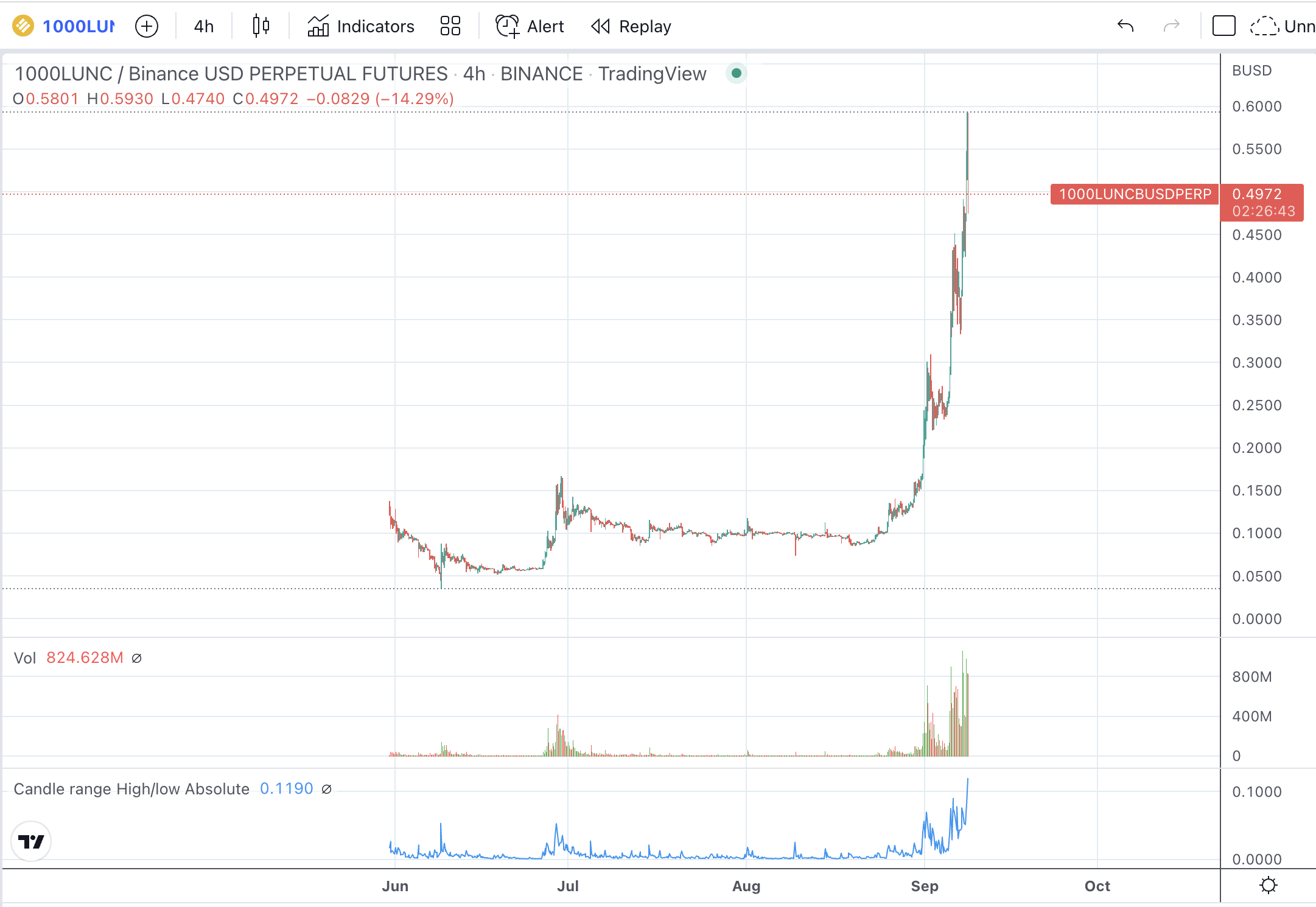
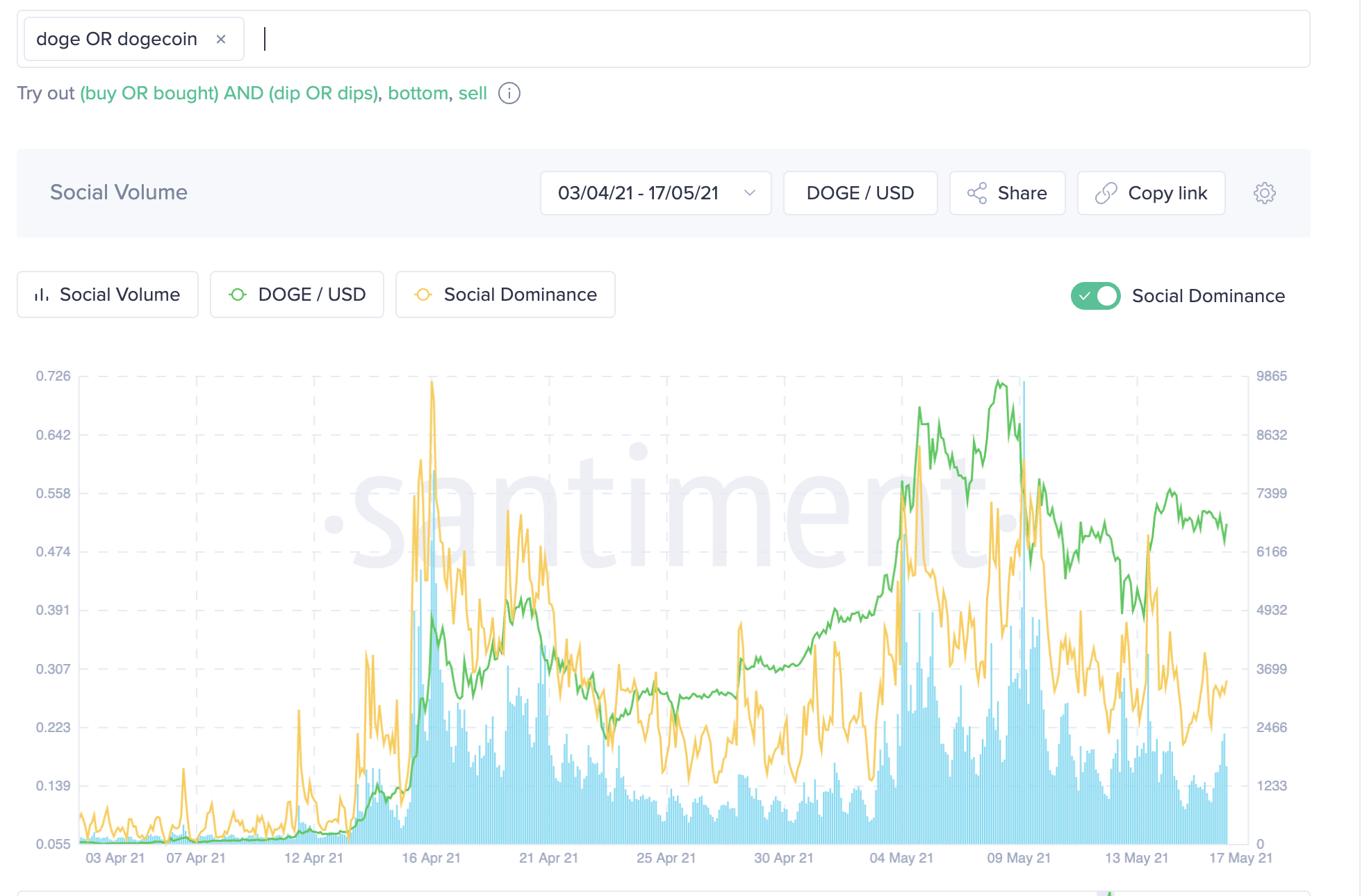
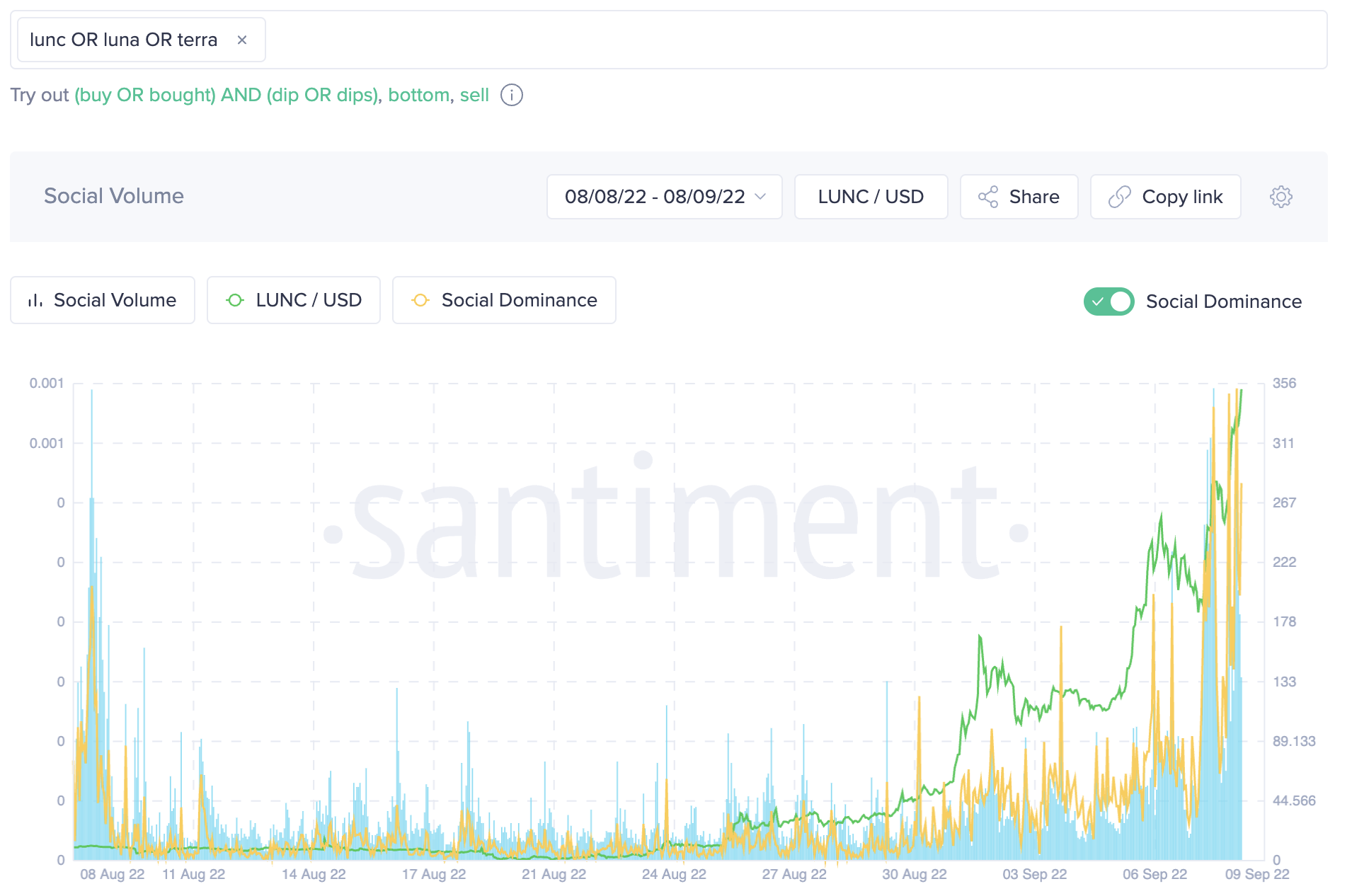
The images below illustrate a similar structure in the current price and volume of Luna Classic with that of Dogecoin a year ago.

Image Source: Santiment

According to Santiment, both Luna Classic and Dogecoin enjoyed an initial run-up before encountering flat consolidation. After that, cryptocurrency assets had massive rallies starting the main craze.

The social indicators of santiment show a similar picture:

Image Source: Santiment


Notably, it is not surprising to see a surge in LUNC price because some related keywords of the cryptocurrency are currently ranked in the first and eighth position of Santiment’s social trends, which is another indication of huge public attention.

Image Source: Santiment

Santiment concluded:

“If next, we see a crash in LUNC to around $0.25 per 1000, followed by the last leg up above $0.8, then we can safely say that the crypto crowd truly never learns anything from the past, and it’s only a matter of time until a carbon copy of today’s event happens again,”

While Dogecoin did not encounter any of the controversies LUNC suffered, the value of the cryptocurrency has dipped massively from its all-time high of $0.73, Coingecko data shows. At the time of writing, DOGE is trading at $0.064, while LUNC is changing hands at around $0.00035768.

Chamber of Digital Commerce CEO: SEC Denial of 16 Bitcoin ETF Applications Mostly Influenced By a Political Agenda

0


The Chamber of Digital Commerce has released a report alleging that the SEC’s refusal to approve the past 16 Bitcoin ETF applications is politically motivated.


Several American business entities have made up to 16 applications to offer Bitcoin (BTC) Exchange-Traded Funds (ETFs) to clients. The U.S. Securities and Exchange Commission has denied all 16 applications, alleging that the applications do not meet the regulator’s standards. Nonetheless, a recent report notes that these rejections could be due to a “political agenda.”

Founder and CEO of Chamber of Digital Commerce, Perianne Boring, disclosed the report in a Fox Business interview Monday. According to Boring, the report reveals that SEC Chairperson Gary Gensler’s refusal to approve these Bitcoin ETFs is not due to the industry’s shortcomings in the regulatory watchdog’s standards.

Boring noted that Gensler’s moves are allegedly politically motivated.

Our conclusion is that BTC ETFs non-approval has little to do with the industry not being able to meet the SEC standards to bring an ETF to market, but it has a lot more to do with a larger political agenda,

Chairman Gensler has a very aggressive agenda and is looking to expand the SEC’s jurisdiction and authority throughout the digital asset ecosystem, and he has laid this out in congressional testimony,” Boring said, “So we detail that in the crypto conundrum. And the reason why it’s such a conundrum is really going back to those protections for the retail investors.”

Boring noted that the SEC is being retrogressive in its approach to regulating the crypto industry. “They’ve accomplished the exact opposite of their mission,” she said, noting widespread discrimination against entities seeking to issue a Bitcoin ETF. “It’s time for a spot, bitcoin ETF to come to market now,” she remarked.

The SEC’s Bizarre Trend of BTC ETF Application Rejections

Gensler’s SEC has habitually rejected any Bitcoin ETF applications from business entities. So far, 16 applications have been rejected by the regulatory body, raising questions about the actual reason behind this trend. Most notably, Grayscale Investments’ spot BTC ETF application rejection sparked outrage within the crypto community.

As reported by The Crypto Basic in June, following the rejection, Grayscale filed a lawsuit against the SEC. Grayscale applied to convert its Grayscale Bitcoin Trust (GBTC) to a spot ETF in October of last year. After several deferments, the SEC ultimately rejected the ETF application, as revealed in a press release from the watchdog on June 29. The SEC noted that Grayscale did not provide sufficient answers to questions preventing market manipulation.

Several crypto proponents blasted the SEC for this decision. Last month, Ryan Selkis, founder and CEO of Messari, called the SEC’s decision a “fraud.” According to Selkis, the denial has cost investors $7B. Selkis added that Gensler’s decision was not motivated by concern for the markets but a desire for power.

CME Group Launches Ethereum Option Contracts

0


CME Group Introduces Ethereum Option Contracts As Blockchain Merger Approaches.


The CME Group (NASDAQ: CME) has introduced options on Ether futures as interest in ETH derivatives spikes ahead of the blockchain’s long-awaited Merge to Proof-of-Stake this week.

Tim McCourt, the company’s global head of Equity and FX Products, said their new options contracts would enhance CME Group’s Ether future. Tim noted that there had been a 43% year-over-year increase in average daily volume.

According to Rob Strebel, Head of Relationship Management for DRW, the new options are an essential part of the trading strategy deployed by Cumberland’s institutional counterparties. He said that whether it is to hedge risk or gain exposure to the asset class without having it on their balance sheets. CME Group facilitates its customers to trade options, cash, futures, and OTC markets.

Global Head of Sales at Genesis, Leon Marshall, also had something to say about the new launch. “Genesis is proud to consistently provide day-one support of CME Group’s ever-expanding suite of crypto derivatives and offer the newest derivatives products to our institutional clients,” he said. “The launch of the new Ether options contract ahead of the highly anticipated Ethereum Merge provides our clients with greater flexibility to trade and hedge their Ether price risk.”

These new contracts offer one Ether future at 50 ether per contract. The price is based on the CME CF Ether-Dollar Reference Rate, which is a reference rate of the U.S. dollar’s daily value for ether.

Ethereum’s long-awaited Proof-of-Stake Merge is happening this week, with many in the cryptocurrency community expecting a spike in ETH prices leading up to and following the event. The CME Group’s new options contracts will give traders a way to hedge their ETH exposure or take a position on anticipated price swings.

Starbucks Partners With Polygon To Launch Its “Starbucks Odyssey” Web3 Program

0


American coffeehouse firm Starbucks teams up with blockchain solution Polygon to make its Web3 program, “Starbucks Odyssey” a reality.


The blockchain industry is fast creeping into the daily life of the average individual as the adoption rate sees a massive surge. Institutions, having noticed the use cases of blockchain and Web3, are showing increasing interest in the sphere. American coffeehouse company Starbucks is the latest in line to jump on the train.

Starbucks’ Web3 adoption is made possible by partnering with Ethereum blockchain scaling platform Polygon. Polygon disclosed the news in a recent tweet Monday and in an official blog post. “Guess what’s brewing today? Starbucks unveils Starbucks Odyssey on Polygon!” the official Polygon Twitter handle revealed. 


According to the tweet, Polygon noted that the Odyssey initiative would allow users to earn digital collectibles as rewards. Additionally, users looking to purchase these digital collectibles would have the opportunity to do so as well. 

The official blog post on Polygon gave more insight into the nascent initiative from Starbucks. Per the post, the Starbucks Odyssey initiative will bring a more exciting experience to the already established Starbucks Rewards loyalty program. 

Through Odyssey, loyalty program members can purchase and earn digital collectibles as NFTs. Besides the members of the Starbucks loyalty program, Starbucks employees in the United States will be granted the same opportunity.

As a consequence of the partnership, the program will be powered by Polygon. Polygon noted that interested parties are welcome to join the waitlist starting today, as the invitation will kick off sometime this year.

“Building Starbucks Odyssey using technology that aligns with our sustainability aspirations and commitments is a top priority,” said Ryan Butz, Vice President of Loyalty, Strategy & Marketing at Starbucks.

“We took a very thoughtful and thorough approach when evaluating which blockchain to utilize. Polygon’s fast, low-cost, and carbon-neutral network is the perfect foundation for our first digital community,” Butz added.

Furthermore, speaking on the development, Sandeep Nailwal, Co-founder of Polygon, highlighted Polygon and Starbucks’ shared interests as a primary reason for the coffeehouse company’s choice of blockchain firm choice. “…both companies place tremendous importance on diversity, accessibility, and sustainability,” said Nailwal.

Launched in 2017, Polygon is a layer-2 solution built on the Ethereum blockchain. Polygon seeks to assist Ethereum with its demands in terms of scalability. Since its inception, the blockchain solution has grown massively to position itself as the go-to option for institutional blockchain adoption. 

Last month, The Crypto Basic reported the Partisia Blockchain Foundation’s partnership with Polygon. The foundation noted that its Mainnet V3 had been successfully integrated into Polygon.

Paramount Pictures Files Trademarks to Gain Exposure to Crypto and Non-Fungible Tokens (NFTs) 

0

A new trademark filing suggests Paramount Pictures wants to expand one of its movie brands into crypto and NFTs.


Paramount Pictures, an American film and television production company, has filed two crypto-related trademarks for its 2004 teen comedy movie, Mean Girls. Mike Kondoudis, a USPTO licensed trademark attorney, made this known in a tweet today. 

Under the new filings, Paramount Pictures wants to expand the Mean Girls brand into the non-fungible tokens (NFTs), cryptocurrency collectibles, and NFT + crypto collectible software. 

“Paramount Pictures has filed two trademarks for MEAN GIRLS! The filings claim plans to expand the #MEANGIRLS brand into NFTs + NFT-backed media, Crypto-collectibles, NFT + Crypto-collectible transfer software,” Kondoudis said. 

According to a screenshot of Kondoudis, the trademark was filed on September 7, 2022. 

Mean Girls is a 2004 American teen comedy movie that featured popular Hollywood stars like Lindsay Lohan, Rachel McAdams, and Lacey Chabert, among others. The movie was directed by Mark Waters and distributed by Paramount Pictures. The budget for the movie was $17 million, and it went on to gross over $130 million at the box office. 

Meanwhile, Kondoudis has been sharing developments about new crypto-related trademark filings made by top companies. 

As reported by TheCryptoBasic, Paris-based luxury giant Hermès also filed a trademark application that will enable the company to delve into the world of NFTs. 

Lowest Ever Shiba Inu Weekly Burn Recorded Since Burn Portal Launch

0


Lowest Ever Weekly Shiba Inu (SHIB) Burn Recorded Since SHIB Burn Portal’s Launch as 272.14 Million Shib Burned in the Past Week.


Interest in Shiba Inu burn has dropped significantly over the last week as the most potent Community in the crypto space just incinerated over 272.14 Million SHIB in the past seven days.

The SHIB Burn tracking website, shibburn.com, reported that the Shiba Inu enthusiasts sent a negligible total of 272,140,724 (272.14M) SHIB to the “inferno” addresses through 101 separate transactions in the past seven days.

This is recorded as the lowest Weekly SHIB Burn total since the launch of the official SHIB Burn Portal powered by Ryoshis Vision (RYOSHI). Before this, the lowest burn was back in June; the Community-led burn initiatives incinerated only 565,490,894 (565.49M) SHIB in that week through 74 separate transactions.

Overall, SHIB Burn Portal launched in April 2022 proved to be the BIG Success for Shiba Inu as it helped the most dedicated Community of the crypto space to reduce SHIB’s circulating supply by burning a gigantic total of 63,320,458,279 (63.32B) SHIB within five months of launch.

Top SHIB Burner of the Week:

1Cent, a community-oriented BEP-20 token deployed on Binance Smart Chain, is recognized as the Top SHIB Burner of the Week. As usual, 1Cent token organized its Weekly SHIB Burn Event on Monday, September 5th, and destroyed 41,459,612 (41.45M) SHIB in one significant transaction.

Past 24 Hours:

Shibburn.com also released SHIB Burn figures for the past day and reported that Shiba Inu Community burned 60,848,839 (60.84M) SHIB tokens through 12 separate transactions in the past 24 hours.

Top SHIB Burner of the Day:

Travis Johnson’s SHIB Super Store was among the Top SHIB Burner of the Day. The individual Community-led project has sent a healthy total of 50,704,939 (50.70M) SHIB to the “inferno” address in one significant transaction. SHIB Super Store claimed to burn over 1.1 Billion SHIB while using the official SHIB Burn Portal and helped Shiba Inu to reduce supply by nearly 2.9 Billion SHIB since November 2021.

Biggest ETH Whale Adds 536 Billion Shiba Inu (SHIB), Worth $7.01 Million From Binance And Coinbase

0

Whale Shiba Inu accumulation continues.


The Top ETH Whale hoarded over 536.51 Billion Shiba Inu (SHIB) through several transactions in the past 24 hours.

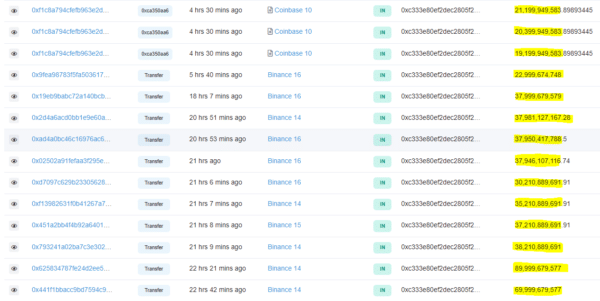
Top Ethereum Whale keeps on gobbling up huge chunks of the most popular canine-themed meme cryptocurrency. Etherscan.io recently reported that the deep-pocketed ETH investor has just purchased a hulk total of 536,519,773,065 (536.51B) SHIB, worth $7,017,678 ($7.01M) via 14 impulsive transactions in the past 24 hours.

ETH Whales SHIB Accumulation

Etherscan.io data reveals that the biggest ETH investor has acquired all of her Shiba Inu from the two world’s leading cryptocurrency exchanges, Binance and Coinbase.

The Whale first carried ten separate transactions on Binance and got her hands on a total of 475,719,924,316 (475.71B) SHIB, worth $6,222,416 ($6.22M).

Later, the Whale shifted to the Coinbase exchange and scooped up another big chunk of 60,799,848,749 (60.79B) SHIB, worth $795,262 in three significant transactions.

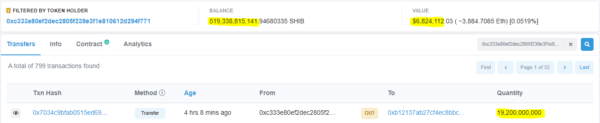
Following the massive accumulation, the top ETH Whale sold some of her SHIB holdings, bartering 19,200,000,000 (19.20B) tokens worth $252,096 through one notable transaction.

The key ETH investor now holds a gigantic total of 519,338,815,141 (519.33B) SHIB, worth $6,824,112 ($6.82M) in her wallet.

ETH Whale Current SHIB Holdings

Shiba Inu is trading at $0.00001309, up 1.30% in 24 hours.