

Home Blog Page 2438

SEC Pleads for Extension Of Time to Respond to Ripple’s Motion to Dismiss Dr. Albert Metz Report

0

SEC Pleads for Extension to Respond to Ripple’s Motion to Dismiss Dr. Albert Metz Report.


The United States Securities and Exchange Commission (SEC) has requested a two-day extension, to respond to Ripple’s motion to strike out a supplemental expert rebuttal report from Dr. Albert Metz. 

The SEC wrote in a motion filed today addressing Judge Sarah Netburn that it needed time to come up with a perfect reply to the defendants, Ripple Lab. 


“Plaintiff Securities and Exchange Commission (SEC) respectfully submits this motion to request that the court permits the SEC to file a response to defendant’s motion to strike the supplemental expert report of Dr Albert Metz on March 18, 2022,” excerpt of the report read.  

Per the motion filed today, after the SEC must have issued a reply to Ripple, the blockchain company is also requested to file a reply on March 24, 2022. 

Dr. Metz Report

It is worth noting that Ripple filed a motion over the weekend to dismiss Dr. Metz’s February 28, 2022 report, with the blockchain company saying the report is illegitimate. 

Ripple disclosed at the time that the supplementary report violates section 26 of the Federal Rules of Civil Procedure and well-settled decisional law. 

Dr. Metz’s report is about an analysis to determine whether specific Ripple announcements affected the price of XRP during the time of the ICO. 

Judge Netburn will now decide whether an extension will be granted to the securities agency. 

The lawsuit had an interesting twist over the weekend after Judge Analisa Torres denied SEC’s motion to dismiss the Ripple Fair Notice Defense, 
 

EU Avoids A Trillion Dollar Bitcoin PoW Banning Mistake

0

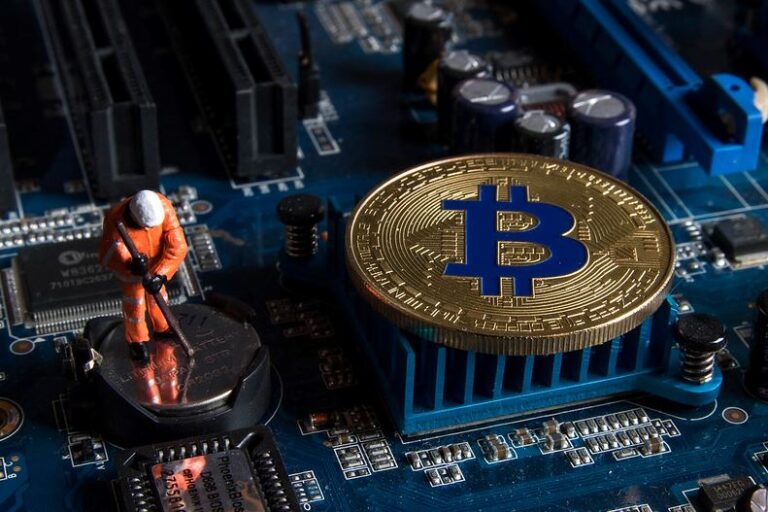
EU decided not to ban Bitcoin mining.


The Committee on Economic and Monetary Affairs (ECON), a committee of the European Parliament, has voted against a Bitcoin mining ban. Members of the European Parliament (MEPs) voted 32-24 against passing the initiative in favor of bitcoin.

Earlier, The EU Parliament voted on Monday to determine if a legislative draft on the regulation of cryptocurrencies could become a law in the EU. The draft, known as the market in crypto assets, seeks to regulate the use of cryptocurrencies, especially with respect to energy consumption and its environmental concerns.

Bloomberg reported that the controversial draft, which has been in the works since 2020, was never voted upon due to a clause that could easily be misinterpreted as a blanket ban on cryptocurrencies. However, a late inclusion of another clause, which demands minimal energy use for cryptocurrencies, has alarmed industry analysts, who believe it could be a move to stifle the industry and the coin market.

MiCA Against Proof-of-work

Market in crypto assets (MiCA), which the EU Parliament voted on this Monday, sought to compel proof-of-work protocols such as Bitcoin and Ethereum to adopt less energy-demanding consensus protocols such as proof-of-stake. However, industry leaders believe that this could be an intentional move to curb the utilization of some of the biggest crypto assets within the EU.

Even though the parliament’s new draft was reportedly less contentious towards PoW digital assets, there are still significant anti-proof work rhetorics that gave industry leaders some concern. A part of the draft seen by this journalist states that coins regulated within the EU:

“shall be subject to minimum environmental sustainability standards concerning their consensus mechanism used for validating transactions, before being issued, offered or admitted to trading in the Union.”

A Trillion Dollar Mistake

Michael Saylor, the co-founder and CEO of Microstrategy said that it would be a big mistake for the EU Parliament to move against cryptocurrencies. A Twitter post from Saylor states:

“The only settled method to create a digital property is via Proof-of-Work. Non-energy-based crypto approaches like Proof-of-Stake must be deemed securities until proven otherwise. Banning digital property would be a trillion-dollar mistake.”


Crypto Adoption Driven To A Point of No Return – Ethereum Co Founder, Joseph Lubin

0

Crypto Adoption Driven To A Point of No Return – Joseph Lubin.


Joseph Lubin, the co-founder of Ethereum, said that the Russian-Ukrainian conflict may have driven the adoption of cryptocurrency to a point where it is irreversible.

During the Camp Ethereal 2022, Lubin made the statement while speaking with the Decrypt editor, Daniel Roberts. According To Lubin, the active role that cryptocurrency has played in the conflict is momentous for the industry, especially with respect to how the Ukrainians used it as a channel to raise funds that have contributed to the resistance to the Russian invasion.

Describing the use of cryptocurrency in the conflict, Lubin said that it represents a transition to national awareness that could lead to widespread adoption of digital assets. He said that this is a point where people, at the national level have realized how powerful the technology is.

“It represents crossing the chasm into mainstream adoption. Now we’re onto national security issues. It’s going to be so profound, a point of no return for our industry because it’s clear that our technology is very powerful and unstoppable,”

Data available at Elliptic shows that the government of Ukraine, in conjunction with a nonprofit organization has raised $63.8 million in funding from crypto donations.

Earlier in the year, at the height of the tension between Russia and NATO, Vitalik Buterin, the co-founder of Ethereum asked for support for Russians that were resisting the policies of President Putin. Buterin had written in a tweet that a war would not be in the interest of Russia.

Lubin said that the use of cryptocurrency as a weapon in war and fundraising to meet strategic national objectives is similar to an arms race. Countries who are now aware of what powerful tools digital currencies could be wouldn’t want to be on the sidelines.

Every nation-state has to create policy, get savvy, and start wielding these tools.”

New Jersey Major Car Dealer Now Accepts Shiba Inu, Bone, And Leash As Payment

0

Shiba Inu adoption growing on a daily basis.


Shiba Inu (SHIB) has continued to gain mainstream adoption within its less than two years of existence. 


Earlier today, a major car dealership in New Jersey named $499 Down Now announced that it will be adopting all native cryptocurrencies of Shiba Inu, including SHIB, BONE, and LEASH. 

The development was announced by the brother of the business owner on Twitter today, who also included an image showing confirmation of the dealership’s acceptance of cryptocurrencies. 

What Led to SHIB Adoption

Announcing how the business owner was converted to a Shiba Inu enthusiast, Ahmed Fazary, the business owner’s brother, stated on Twitter that he has been convincing his brother, who is a car dealer, to accept SHIB as a payment method. 

He said he explained everything about the SHIB ecosystem and how everything works, including the upcoming developments. 

However, he was surprised when the founder of $499 Down Now decided to adopt all three Shiba Inu native cryptocurrencies, including SHIB, BONE, and LEASH, as payment methods. 

“I was trying to [convince] my Brother to accept $SHIB as s form of payment in his car dealership in #NewJersey.  When I told him about our $SHIB #Ecosystem and how it works and the #SHIBARMY power, he decided to accept the Trifecta $SHIB $BONE $LEASH,” Fazary said. 

Widespread Shiba Inu Adoption 

It is worth noting that Shiba Inu has grown significantly since it launched in August 2020. The cryptocurrency has gained traction within this time with a solid community behind the cryptocurrency dubbed the SHIBArmy. 

With Shiba Inu becoming increasingly popular, cryptocurrency exchanges and several businesses are left with no option but to adopt SHIB. 

As reported last year, a New York-based luxury glasses company announced that it has started accepting Shiba Inu as a payment method. 

Similarly, AMC Theaters also disclosed this month that its users can now pay for movie tickets using the popular dog-themed cryptocurrency.  

Austin Mayor Plans To Explore Policy Capabilities To Accept Bitcoin As A Payment Option

0

Austin, the state capital of Texas, is an inland city bordering the Hill Country region looking toward crypto.


As crypto grows in popularity, the mayor of Texas’s fourth-largest city, Steve Adler, has directed city management to consider initiatives to bring Web3 into the city’s ecosystem.

Steve Adler has proposed two new initiatives to bring blockchain and cryptocurrencies into urban infrastructure and business processes. The first initiative aims to promote blockchain in Austin and bring the technology into the city’s ecosystem.

To that end, the mayor directed the administration to explore how Austin can use Web3 and blockchain in twenty areas ranging from smart contracts, supply chain management, and insurance to art, media, fundraising, and identity verification.

“The City Manager is tasked with providing support to the city administration in creating an environment within the city and in the community as a whole that supports the creation and development of new technologies, including blockchain and other technologies, protocols, and applications related to Web3,” the document says.

The second initiative involves directing the city manager to conduct a “study” to find out how Austin can adopt a cryptocurrency. Adler likely wants to offer citizens to pay their bills with cryptocurrencies with these efforts.

As part of this initiative, the city manager must find ways to legalize “the acceptance of bitcoin or other cryptocurrencies as payment of municipal taxes, fees, and fines.” 

The success of these two initiatives will depend on the impact of new applications on the daily lives of Austin residents. The city council will consider the proposals on March 24.

In the US, a growing number of cities are using new technologies to improve the population’s lives. In February, Philadelphia authorities announced that they were considering partnering with CityCoins to develop their own “city coin.”

Last year, the city of Miami announced that they planned to launch a program to pay “dividends” to residents of the city in BTC. To do this, citizens must participate in the staking of the city’s cryptocurrency MiamiCoin.

In July, Jackson, Tennessee, announced that it was testing the possibility of integrating bitcoin into government systems. The mayor of the city sees bitcoin to pay taxes and pay salaries to civil servants.

New York City also revealed Its Own City Coin (NYCCoin).

744M Shiba Inu Burned In Past 24 Hours, Burn Rate Up 5967%, 61.8 Billion Burned Without Including Vitalik Burn

0

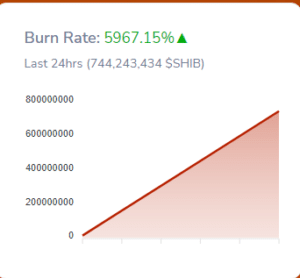
Massive Burn of Over 744 Million Shiba Inu (SHIB) Tokens Took Place Within Past 24 Hours; Burn Rate Skyrockets 5967.15% Compared to the Previous Day.


Shiba Inu (SHIB) token burn rate increased 5967.15% today as a total of 744,178,230 (744M) SHIB tokens have been sent to the dead wallet by the community with the help of five transactions during the past four hours.

Shibburn.com reported five big transactions towards a dead wallet in hours. Over 400 million SHIB tokens were reportedly sent to dead wallets with one transaction fours hours ago. Following this transaction, 1,545,402 (1.5M), 327,564,569 (327M), and 5,000,000 SHIB (5M) tokens have been taken out of circulation forever with 5 transactions.

This massive burning skyrockets the daily burning rate to 5967.15%, indicating that more and more Community-led initiatives are pouring into the SHIB ecosystem day after day. In total, in the past 24 hours, 774,243,434 (744.2M) SHIB tokens were burned.

Whereas Shibburn, via tweet, also mentioned:

“61.8B have been burnt without including Vitalik’s burn. More than 25.5B SHIB tokens were burnt due to ShibaSwap listings and Shiboshi’s renaming fee. The first SHIB transaction sent to the dead wallet in 2020 was for 26.9B tokens.”


Further emphasizing and praising the development team’s efforts for burning, the official Twitter handle of Shibburn noted that the community had seen over 7.2 billion tokens burnt in August and over 6.9 billion SHIB tokens burnt in Sept 2021. This becomes possible only because the Shiboshi and ShibaSwap listing fees were limited burn mechanisms. Shibburn clarified to the SHIB community that developers are also part of the community, and they’re doing so much for SHIB burn.

Recently Shiba Inu announced that its development team has begun testing its much-anticipated burn portal for its native cryptocurrency SHIB. 

The dog-themed project made this known today in a recent blog post. The company announced the launch of a defense breed, a team of enthusiasts responsible for protecting its ecosystem from malicious projects seeking to take advantage of the community.

“Burning SHIB is a core aspect of our ecosystem, and we are always exploring new options to burn SHIB via utility,” Shiba Inu said in a recent announcement.

While there is no official release date for the burn portal, the development team’s initiative is being worked upon, with more details expected to be made public in the coming days, Shiba Inu announced.

“A Burn Portal for SHIB is being currently worked on by the developer team, and there is no current release date, but testing has begun with more details forthcoming.“

Court Denies Ripple’s Executives’ Request to Strike Out SEC’s Charges Against Them

0

Court Denies Ripple’s Executives’ Request to Strike Out SEC’s Charges Against Them.


Judge Analisa Torres has denied Chris Larsen and Brad Garlinghouse Ripple executives’ appeals to dismiss the Securities and Exchange Commission’s motion against them. 

Per court documents issued on the same day Judge Torres struck out an SEC request to deny Ripple’s fair notice defense, the court denied Larsen’s motion because the plaintiff had already acknowledged the existence of a breach of its securities law. 

“For the foregoing reasons, the Individual Defendants motions are DENIED. The Clerk of Court is directed to terminate the motions at ECF Nos. 105 and 110,” excerpts from the court document read. 

SEC Mandated to Prove Defendants’ Guilt

Following the court denial, the SEC is mandated to show that individual defendants joined Ripple, contributed positively to the success of the ICO, and participated in the profit sharing. 

The judge noted that the securities agency must prove that both Larsen and Garlinghouse were aware that Ripple was illegal, disregarding this knowledge and proceeding with its ICO. 

Judge Torres also dismissed the argument that during the time of the Initial Coin Offering (ICO), purchases of XRP were made by foreign clients who reside outside of the United States. 

“The Court finds that the Individual Defendants’ offers were not foreign. These offers and sales were made by U.S. residents, involved alleged securities issued by a U.S. company, and included at least some offers and sales made to U.S. purchasers,” statements from the court papers read. 

Ripple v. SEC Lawsuit

Recall that Garlinghouse and Larsen were the two executives charged for participating in Ripple’s unregistered offering that saw the company raise $1.3 billion. 

Contrary to the SEC’s charges, Larsen argued that the XRP sales were conducted outside of the United States, while sharing an email conversation with a client who disclosed his interest in investing with euros. 

The email conversation made many believe that the XRP sales were conducted outside of the United States. 

The lawsuit, which has lasted for over a year, has been torn in investors’ flesh, who have watched XRP prices shred a significant percentage of its value over the duration of the case. 

Meanwhile, Ripple recorded a major win over the weekend following the denial of the SEC’s request to strike out the company’s fair notice defense. 

Ripple will now have to prove that the SEC did not provide clear regulations to help companies determine which asset class falls under its jurisdiction. 

Cardano Marketing Director Provide Details Of Over 500 Projects Building On Cardano

0

Cardano network is expanding at an instantaneous pace.


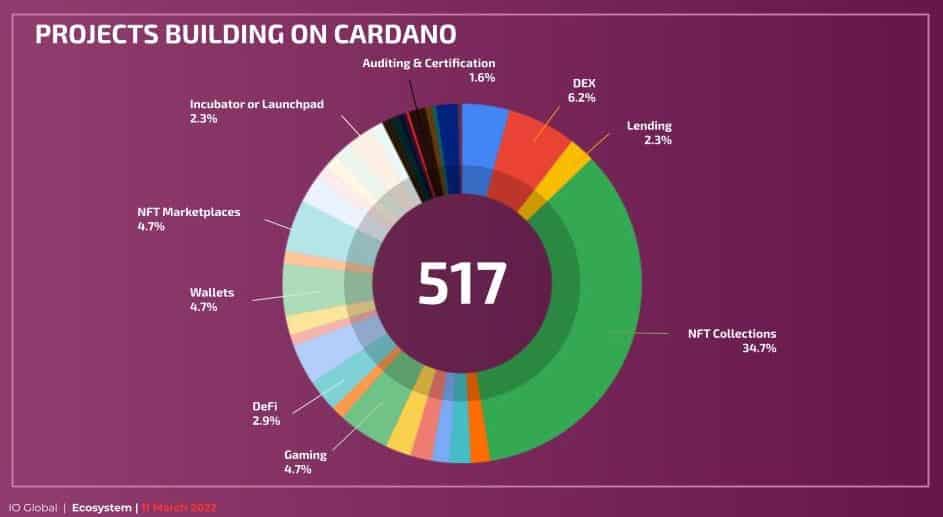
The Cardano network currently has over 500 projects being built on it, according to a Linkedin post by IOHK Marketing Director Tim Harrison.

cardano projects

  • The lion’s share goes to the NFTs collections project which represents 34% of the total project taking place on Cardano.
  • In second place are decentralized exchanges. The DEX share is 6.2 percent.
  • NFT marketplaces, wallets, and gaming each claim a 4.7 percent share.

According to TheCryptoBasic’s previous report, there are 26 decentralized exchanges (DEXs) that are being built on Cardano at the moment.

Some of the decentralized exchanges being built on Cardano include ADA Finance, Ray Network, Occam.Fi, YaySwap, Cardax, Matrixswap, and Meowswap.

While a total of 26 decentralized exchanges are still building to officially make their debut on the Cardano network, it is worth noting that six DEXs had initially launched on the blockchain.

SundaeSwap became the first-ever decentralized exchange to fully launch on Cardano after supporting smart contract functionality.

As of press time, there are currently six decentralized exchanges that are live on Cardano, including ADAX Pro, MuesliSwap, VyFinance, Meld, and Minswap.

Per data on DeiLlama, Cardano’s TVL is currently around $187.59 million in USD, with the volume surging from the $822,261 recorded at the beginning of the year.  Despite Cardano’s total value locked surging above 194x since January 2022, Charles Hoskinson, CEO, and founder of the blockchain network has described the growth as the tip of the iceberg.

In September 2021, Cardano performed the Alonzo upgrade, making the network smart contract compatible.

Cardano (ADA) Founder Charles Hoskinson Says Network’s Total Volume Locked (TVL) Will Surge in June 2022

0

Charles Hoskinson Says Network’s Total Volume Locked (TVL) Will Surge in June 2022.


Despite Cardano (ADA) total value locked (TVL) surging above 194x since January 2022, Charles Hoskinson, CEO and founder of the blockchain network, has described the growth as the tip of the iceberg. 

According to Hoskinson, the TVL on Cardano will experience sensational growth in the coming months after the release of the Vasil hardfork, an upgrade that will enhance the activation of Cardano-based decentralized applications (dApps). 

Speaking about the upcoming hard fork and its significance to decentralized applications, Hoskinson said due to the upgrade’s pipelining benefit, several dApps are waiting for the update to go live in June this year before they will officially launch on Cardano. 

“What most also don’t understand is that many Cardano dApps are waiting for the Vasil hard fork in June to launch to benefit from pipelining. So it seems we ain’t seen nothing yet on TVL,” Hoskinson tweeted in response to an enthusiast’s post who seemed happy about the growth in Cardano’s total value locked. 

Cardano’s TVL Significant Rise this Year 

Per data on DeiLlama, Cardano’s TVL is currently around $187.59 million in USD, with the volume surging from the $822,261 recorded in the beginning of the year. 

The interesting part of the data is that the volume is obtained from only four out of the six decentralized exchanges (DEXs) currently on Cardano. 

While there are only six DEXs that have launched on Cardano, more decentralized exchanges are building their trading platforms in order to make a full debut on Cardano. 

Growing Adoption of Cardano

As stated by the Cardano founder, who was accused of lying about his educational background, the network will release a number of significant upgrades in the coming months that could further boost the value of its native cryptocurrency ADA. 

This assurance has prompted the widespread adoption of Cardano in recent times, with whales leading the accumulation spree. 

Earlier this week, Cardano whales with between 100,000 and 1,000,000 ADA bought a whopping 16 million ADA in 24 hours. 

At press time, a unit of ADA is trading around $0.81, having surged 1.8% in the last 24 hours, according to data on Coingecko. 

Solana & Terra Trading Volumes Surge at the Expense of Bitcoin and Ethereum As Investor Interest Shift

0

Solana (SOL) & Terra (LUNA) Trading Volumes Surge.


Solana (SOL) and Terra (LUNA) have received significant growth in adoption in the past year, with both digital currencies moving to the top 10 ranking of the largest cryptocurrencies by market capitalization. 

Per data on cryptocurrency aggregator platform Coingecko, LUNA is currently ranked as the seventh-largest crypto asset with a market cap of $33.7 billion, while SOL is in the eighth position, which has a market capitalization of $25.9 billion. 

Both cryptocurrencies have recorded growing interest in the past year, resulting in a surge in their trading volume. 

“The past year has seen major changes in trading interest. It’s been well documented that $LUNA and $SOL have emerged into the top 10 market cap assets with very high volume,” Santiment Feed tweeted today.  


However, the duo’s significant growth seems to come at the expense of Bitcoin and Ethereum, the two world’s largest cryptocurrencies by market capitalization, which has seen their trading volume drop off within this period. 

A closer look at data on Santiment Feed shows that Bitcoin in the past year recorded an average trading volume of over $33 billion while Ethereum had more than $21 billion as its average trading volume. 

Over the last couple of days, both crypto assets’ trading volumes have declined, with BTC managing $19 billion on certain days while Ethereum recorded a paltry $10 billion on a few days. 

The same cannot be said for Terra and Solana, whose trading volumes have surged from millions to billions in the past year. 

Investors’ Shift Interest to Solana and Terra

It is worth noting that cryptocurrency investors’ interest is gradually shifting from the dominance of Bitcoin and Ethereum, the two largest cryptocurrencies by market capitalization. 

Both cryptocurrencies have dominated both retail and institutional investors’ portfolios since 2017, which is mostly at the expense of other forms of digital currencies. 

Interestingly, LUNA surged tremendously this year after the Terra-based exchange-traded funds (ETFs) launch. 

The blockchain is also considered a close rival to Ethereum as it continues to be deployed in decentralized finance (DeFi), non-fungible tokens (NFTs), and Web3. 

Similarly, Solana is also considered a major Ethereum competitor. The network offers solutions in DeFi, NFT, and Web 3, adding low-cost transactions and unrivaled speed as part of its features, with developers considering the blockchain as the suitable hub for Web 3 games.