Home Blog Page 1728

Cardano Hits New Milestone Over 78 Million Transactions

0

The Cardano network has reached a new landmark, with 78.3 million processed lifetime transactions.

Since launching in 2017, the Cardano network has come under criticism for not boasting the same level of throughput as other blockchains. However, one thing that cannot be held against Cardano is that the network has longevity and stability. 

Unlike other new-age blockchains, the Cardano network has had few technical glitches and zero downtime in over six years of existence. This stable performance and the recent arrival of more decentralized apps on Cardano have provided the basis for a surge in the number of transactions.

As on-chain data reveals, the Cardano network recently surpassed an important mark, with over 78 million transactions processed in its lifetime. At the time of writing, the total number of processed transactions was 78,312,179, with Cardano still well on track to hit 10 million addresses in the next two years.

Blockchain analytics further shows that the Cardano network has handled 1.29 million transactions in the past seven days. The actual per second (TPS) count is 2.13 TPS over the same timeline, although the network had a maximum TPS of 6.1. The latter means that Cardano could have conveniently processed over six transactions per second if there was user demand for the blockspace.

Meanwhile, Cardano’s latest milestone comes at a time when the blockchain is seeing an uptick in user and developer activity.

Cardano DeFi TVL and Developer Activity Lead Rankings

In line with the increase in the number of transactions, Cardano is also leading the blockchain ecosystem across other metrics. For instance, the blockchain recently topped the chart for the top networks by developer activity, leading the likes of Ethereum and Polkadot.

At the same time, the total value of assets locked across Cardano-based DeFi protocols has been on an upward trend. In the past week, Cardano’s TVL surpassed the Bitcoin network’s, following a period of sustained growth. 

Fake Report of BlackRock XRP ETF Triggers 15% XRP Price Spike to $0.74 in 2 Hours

0

The XRP price saw a substantial 15% spike from $0.6516 to a four-month high of $0.7487 within a two-hour window following fake reports of a BlackRock XRP ETF filing.

Claims of BlackRock XRP ETF

The ruckus began last night when a filing in Delaware suggested that asset manager BlackRock was looking to launch an XRP ETF. Several notable media outlets propagated the claim, including The Block, which disclosed it in a post on X. 

In addition, Bloomberg senior ETF analyst Eric Balchunas also called attention to the claim, giving it more publicity. Balchunas thought it was genuine after seeing it on the Delaware list of corporations. The circulating claim stirred enthusiasm among market participants. 

BlackRock XRP ETF News
BlackRock XRP ETF

However, less than an hour later, reports suggested that the ETF filing was fake, as BlackRock denied ever making such a filing. Balchunas, in a second post, noted that a spokesperson from BlackRock had confirmed that they never filed for an XRP ETF. Nonetheless, BlackRock has not released an official statement as of press time.

XRP Price Responds

Enthusiasm soon turned to disappointment, but the market had already reacted to the ensuing buying spree that came with the earlier reports. Notably, within two hours following the report, XRP rallied from a price of $0.6516 to a high of $0.7487 last night. 

This marked a substantial 14.9% increase in less than two hours, demonstrating the potential effect that a genuine XRP ETF could have on the market. Interestingly, the $0.7487 high represented XRP’s highest value in four months. The last time the asset saw this price was in July.

Nonetheless, the recent upsurge was short-lived, as the subsequent reports emphasizing that the filing was bogus triggered a round of selloffs. The sudden pump and dump led to increased liquidations, as market participants on both ends suffered losses due to the erratic price movements.

Notably, the XRP market has witnessed $6.4 million in total liquidations: $4.1 million in long liquidations, and $2.3 million in short liquidations. Interestingly, 70% of the liquidations over the past 24 hours, amounting to $4.51 million, occurred in four hours following the fake report of the BlackRock XRP ETF.

The market has stabilized, with XRP up 1.78% over the past 24 hours, trading at $0.6644 as of press time. The effects of the report also reflect in XRP’s trade volume, which has skyrocketed by 220% in the last 24 hours to $3,218,415,579.

Conflicting Beliefs

With BlackRock still maintaining public silence on the situation, some community members continue to believe that the filing is genuine. One of the reasons behind this sustained confidence is the fact that the filing is still on the Delaware Integrated Compliance Information System (ICIS) website.

However, more industry pundits have come up to debunk it. Due to the filing’s similarity with BlackRock’s ETH ETF filing, some proponents suggested that either the ETH ETF and XRP ETF are fake or both of them are real. ETF analyst James Seyffart debunked this notion, stressing that the ETH ETF is real, while the XRP ETF is fake.

The recent event would not mark the first time a filing for a fake ETF would make the rounds in the crypto community. In April 2021, an individual impersonated Grayscale to file for financial vehicle on nahmi and theta, two crypto-focused projects, in Delaware. Grayscale’s CEO Michael Sonnenshein clarified that they were fake.

Elliot Wave Theory Shows XRP Needs to Retain $0.6649 to Breach $1.05 in Short Term

0

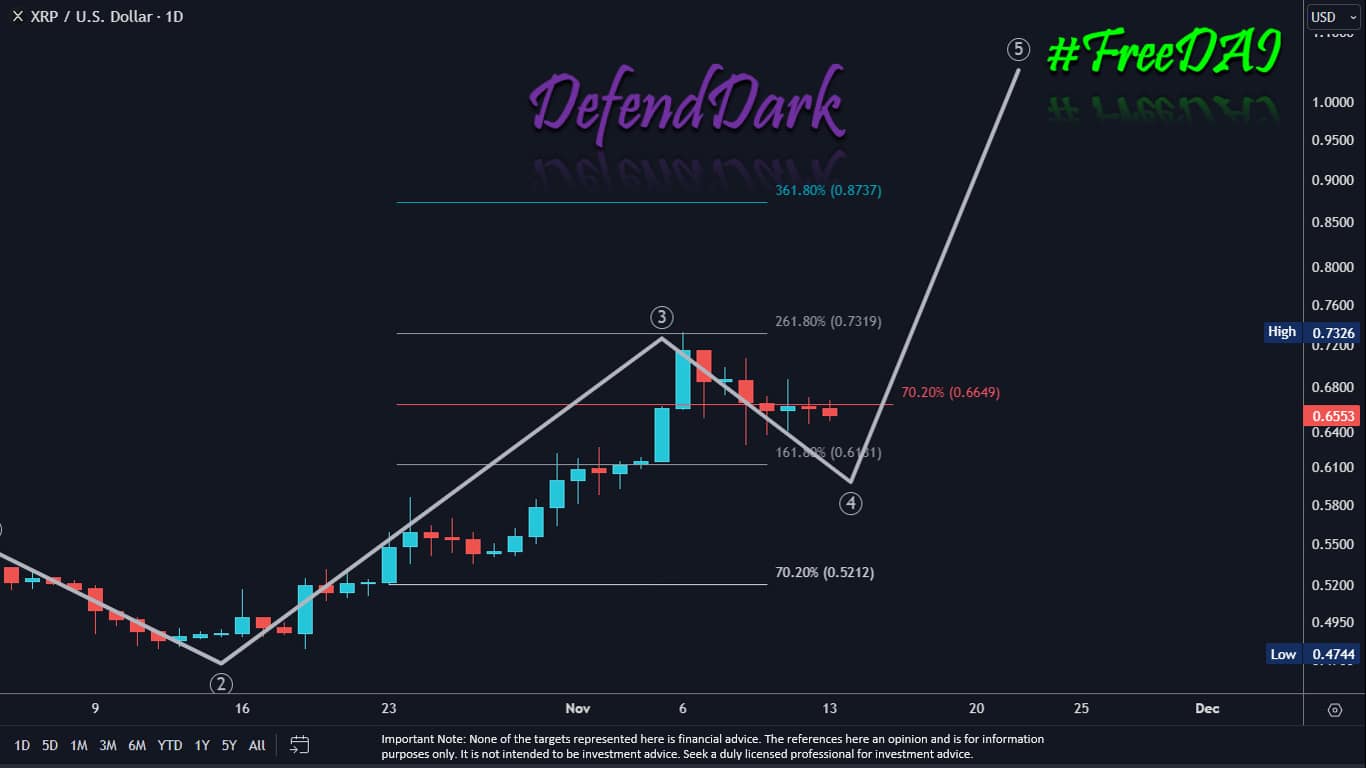
XRP currently changes hands at an important price position, as it needs to retain a value above the $0.6649 level to register a bullish move toward the $1.05 threshold.

Prominent market analyst Dark Defender called attention to the current situation in a recent post on X. The analyst’s latest disclosure builds on a previous analysis on XRP’s price movements, in which he set up short-term targets of $0.87 and $1.05 for XRP.

XRP’s Elliott Wave Movements

In his earlier report, Dark Defender leveraged the Elliott Wave theory to make his XRP price projections, citing the significance of the $0.6649 point as XRP faces the corrective Wave 4.

Notably, XRP has already completed Waves 1 to 3. After witnessing a rally in the completion of Wave 1, XRP faced a correction from the beginning of October, dropping to a low of $0.4739 on Oct. 12. This drop marked the completion of Wave 2.

XRP 1D Chart Dark Defender

However, Wave 3 brought some renewed hope for market participants. Riding on this wave, XRP rallied to a high of $0.7325 on Nov. 6 amid the latest market-wide uptrend. XRP completed Wave 3 upon hitting the $0.7325 high. Nonetheless, the ensuing Wave 4 brought with it another correction.

XRP Needs to Stay Above $0.6649

Amid this correction, Dark Defender believes XRP’s hope of a surge to $1.05 in the upcoming Wave 5 hinges on the asset’s ability to hold above $0.6649. The analyst confirmed that it was discouraging to see XRP close below the $0.6649 level for two consecutive days.

Notably, XRP closed Nov. 11 at $0.6625, and Nov. 12 at a price of $0.6614, both below the $0.6649 level. Dark Defender confirmed that XRP is still trading sideways between the $0.6649 threshold and the $0.6131 level. The $0.6131 level represents the lowest point of the Wave 4 correction.

According to Dark Defender, if XRP continues to stay below $0.6649, it could plummet to the support at $0.6131. Despite this outlook, the analyst confirmed that his earlier short-term targets of $0.87 and $1.05 remain intact. However, for XRP to hit these targets, it needs to stay above $0.6649.

XRP’s Current Position

The recent discussion surrounding the alleged XRP ETF from BlackRock came up a few hours after Dark Defender’s post. Industry commentators such as Bloomberg ETF analyst Eric Balchunas have noted that the ETF registration is false.

However, XRP already rode on earlier reports suggesting it was genuine. The asset soared to $0.7481 in response, but quickly dumped when some pundits confirmed the ETF was fake. Despite the dump, XRP managed to close yesterday at $0.6700, above the $0.6649 level.

Nonetheless, with a 0.95% decline this morning, XRP is now back below $0.6649, currently trading for $0.6642. The bulls are looking to leverage $0.6620 at Fib. 2.618 as a support line in case of further drops. Meanwhile, XRP is seeing a rapid surge in volume, up 231% to $3,234,925,412.

XRPL Undergoing Next Protocol Upgrade as Community Lends Support

0

The XRP Ledger (XRPL) is undergoing a crucial update to add more functionalities to the network, as validators vote to enable the FixReducedOffersV1 feature.

The upgrade FixReducedOffersV1 has secured the required 80% validator backing with 28 supporting the amendment out of a possible 35. Right now, the upgrade has entered the 2 weeks of activation with the Estimated Time of Arrival (ETA) pegged at November 24.

XRPL’s FixReducedOffersV1: What to Expect

The FixReducedOffersV1 comes as part of the rippled v1.12.0, the direct update from the rippled v1.11.0. With the transition in progress, node operators are now advised to upgrade to the latest version.

The FixReducedOffersV1 is an amendment that specifically targets the enhanced functionalities for trading platforms built on the XRPL. Notably, when a reduced offer surfaces on an order book, the network blocks the order book as the rate of these offers affect the remaining amount when rounded.

Based on the current observations, reduced offers come up in three ways: when an offer is partially consumed upon being placed, when the offer is partially consumed after being dropped into order books, and when a market participant underfunds the offer.

According to the documentation detailing the benefits of this function, the FixReducedOffersV1 will help stop the blockage of order books that contain reduced offers by helping to round off these figures.

With the FixReducedOffersV1 amendment, the operations of an XRPL exchange cannot crash when a reduced offer show up in an order book, as the exchange rate of the reduced offer is rounded up in a way that makes it fair when compared to the original offer.

With smart contracts generally automating activities on XRPL, instituting the amendment as a correction mode can bolster equality that will further drive the positive outlook of the XRP Ledger.

XRPL Charts Holistic Upgrade Path

The recent events surrounding the XRPL ecosystem indicate that the ecosystem is creating a holistic path to revamp the network in readiness for its next adoption phase.

Besides the “FixReducedOffersV1” update, XRPL developers have made other impressive pushes to boost the functionality of the network.

Reports of other upgrades have emerged, including that bordering on the XRPL Automated Market Maker (AMM) implementation. Moreover, the XRPL is growing in terms of user count, and as people come aboard, these upgrades will help in sustaining its integrity across the board.

Shiba Inu: Marswap Now Allows You to Buy and Sell BONE on Shibarium Using Bank Card and PayPal

0

Shibarium-based decentralized exchange (DEX) and DeFi platform Marswap has integrated an on/off-ramp feature to enable investors purchase Shiba Inu ecosystem token BONE using bank card and PayPal.

The team behind Marswap announced the development in a recent post on X. Notably, according to the team, Ian (@ICawrey), Marswap’s CEO, demonstrated this new capability in a live broadcast on the project’s community Telegram group.

In the broadcast, he successfully purchased BONE tokens on the Shibarium network using his bank card, and then sold the tokens back to fiat, having them transferred to his PayPal account. All these transactions occurred using Marswap.

Notably, the Marswap team earlier confirmed their intention to integrate this feature as the first on/off-ramp protocol tailored for the Shibarium network. They noted that the process would be seamless, with no need for cumbersome KYC procedures. 

For context, an on-ramp feature helps market participants purchase crypto assets with fiat. Whereas, an off-ramp protocol allows individuals to sell their assets for fiat. The introduction of an on/off-ramp service for Shibarium is a pivotal moment for the expanding layer-2 protocol.

The innovative feature has caught the attention of several notable Shiba Inu community figures, including lead developer Shytoshi Kusama. Kusama replied to the Marswap team’s announcement on X with a simple “Heart on Fire” emoji, signaling excitement.

Interestingly, a quick look at the Marswap platform indicates that the development team has already integrated the PayPal payment option. Individuals looking to leverage the service must head to the official Marswap platform, enter the USD equivalent of the BONE they wish to buy, and follow the on-screen prompts.

Shiba Inu Shibarium based Marswap BONE Purchase
The Marswap Platform

Marswap’s Sustained Support

Marswap launched earlier this year as a Shibarium-based DEX catering to several DeFi offerings, including token swaps, staking, gaming, and NFTs. The project supports the Shiba Inu ecosystem by burning SHIB with 2% with every transaction. 

The Crypto Basic reported in August that the project had burned 4.5 billion SHIB since its launch. Interestingly, the team claimed to have exceeded the 7 billion Shiba Inu burn threshold in a disclosure last month.

Amid the sustained support, Kusama confirmed his trust for the Marswap CEO when asked about his opinion on the platform on the Shibarium Telegram group. However, he charged investors to always carry out proper due diligence.

As one of the prominent projects on Shibarium, Marswap’s success will impact the layer-2 network. The recent on/off-ramp feature could bolster more demand for BONE, Shibarium’s gas token, as it eliminates the stress of purchasing the asset. Marswap is the top DEX on Shibarium, boasting $341,358 in TVL.

Court Sets Schedule for SEC v. Ripple Remedies Litigation, Here Are Next Important Dates 

0

The court has set a schedule regarding the remedies briefing and discovery in the legal tussle between Ripple Labs and the SEC. 

US District Judge Analisa Torres has finally released the schedule for the remedies phase of the SEC v. Ripple lawsuit. The development was shared yesterday by James K. Filan, a seasoned lawyer who has closely followed the Ripple case.  

Remedies Brief and Discovery Schedule 

According to a court order dated November 13, the remedies briefing will officially commence by February 12, 2024. On this date, both the SEC and Ripple will officially complete all remedies-related discovery. 

After the party completes the discovery, the Securities and Exchange Commission will file its remedies brief by March 13, 2024. Additionally, the defendants, Ripple Labs, shall submit its opposition to the SEC’s motion on April 12, 2024. Furthermore, the SEC shall file its reply to the opposition by April 29, 2024. 

Parties Propose Schedule for Remedies Stage

The development comes after the court reviewed the parties’ proposed remedies briefing and discovery schedule. Recall that the court asked the parties to submit a joint proposal for the remedies brief no later than November 9. 

As reported earlier, the SEC and Ripple submitted the proposal on November 9, asking the court to give them 90 days to conduct all remedies-related discovery. 

In addition, the parties agreed that the SEC will file its remedies brief no later than 30 days after the discovery period, while Ripple will submit its opposition 30 days thereafter. Evidently, the court granted the parties’ proposed schedule, as seen in the latest order. 

SEC v. Ripple Remedies 

It is worth noting that the remedies phase is the only pending issue in the SEC v. Ripple case. This part of the case will determine the appropriate remedies Ripple may face for its Section 5 violations regarding its institutional sale of XRP. 

In July 2023, the court ruled that the company’s institutional sales of XRP worth $770 million constitute an investment contract. To this end, Ripple could be required to pay a fine of up to $770 million. 

While the SEC hopes to receive the entire $770 million penalty, Ripple would attempt to reduce the fine by excluding its legitimate business expenses. 

Terra Classic LUNC Sees Dramatic Rise from $0.000064 to Almost $0.0001: Here’s Why

0

The price of Terra Classic (LUNC) recently took the crypto community by storm, as it engineered a dramatic bullish rally not seen in the past months.

In particular, between November 9 and 10, LUNC grew over 45% from $0.000064 to nearly canceling a leading zero.

In parallel, its trading volume, which averaged $30 million in the previous days, grew more than ten times to over $333 million. The driving force behind the LUNC price may be attributed to a pivotal proposal surrounding USTC minting that got approval.

Specifically, the LUNC community has unanimously agreed to halt USTC “minting and reminting” by increasing the Tobin tax to one hundred percent. The proposal reportedly received overwhelming support, with 98.95% of votes in favor. 

The Approved Proposal in Details

In a statement early this month, the Terra Classic Commonwealth portal underscored that the USTC comes into circulation only via the market module. 

However, it noted that the mechanism was deactivated for LUNC to stablecoin pairs by increasing the spread to 100% during the market crash. As a result, the action prevented swapping between LUNC and other stablecoins through the market module.

Furthermore, the report noted that in light of fulfilling the proposed USTC minting disabling, a Layer One Task Force (LITF) team had enforced a code change introducing a new governance parameter. The parameter was designed to enable the setting of “a Tobin tax for swaps to USTC.”

Moreover, it mentioned that given the absence of a practical exit route from stablecoins other than USTC, there was a discussion about simplifying the process by raising all Tobin taxes for all stablecoins to 100% rather than implementing a code change. 

Ultimately, the proposal sought to render all market swapping and associated coin minting on Terra Classic non-operational. This effectively prevents new USTC from coming into circulation. 

Following the approval of this proposal, LUNC’s value grew significantly, registering a 45% cumulative 30-day performance.

Cardano Founder Ready to Build Layer-2 Network for Kraken

0

Amid reports that Kraken plans to build a new layer-2 network, Cardano founder Charles Hoskinson has publicly shared his intent to collaborate with the exchange.

In the past week, reports emerged that the popular crypto exchange Kraken was considering building its own layer-2 network. Kraken reportedly wishes to take the same path as Coinbase, which has enjoyed success with the release of its Base network for decentralized applications (dApps.)

Kraken is still in the process of selecting a partner for the ambitious project, with Polygon, Matter Labs, and Nil Foundation all in the running. However, Cardano also wants to be in the mix and offer its layer-1 network as the primary blockchain on which Kraken builds its layer-2.

Cardano founder Charles Hoskinson made this intent known in a social media post where he reckoned that the blockchain network would be happy to provide a home to Kraken’s rumored layer-2. Additionally, the Cardano founder urged former Kraken CEO Jesse Powell to reach out privately to discuss such a possibility.

At the time of writing, there was no indication that Jesse Powell or anyone from Kraken had connected with Charles Hoskinson. Yet the Cardano founder’s offer has attracted the Cardano community’s interest, many of whom have offered to get behind Kraken if the exchange accepts Hoskinson’s offer.

Cardano Sees Rise in Developer and User Activity

The Cardano founder’s latest offer comes at a time when the blockchain is seeing increased developer and user activity. As recently reported by The Crypto Basic, Cardano leads the way for top blockchains by development activity, topping the likes of Ethereum, Aptos, and Polkadot.

At the same time, user activity on the network is on the rise, as indicated by the value of assets locked across Cardano-based decentralized finance (DeFi) protocols. Cardano’s TVL recently surpassed Bitcoin’s, setting a new high for the year.

Granted, securing a partnership deal with Kraken would further boost Cardano’s fortune. However, Ethereum-based solutions offer significant advantages as applications built on them are compatible with the Ethereum virtual machine (EVM). This means that dApps can easily be launched on the new chain, especially as Ethereum boasts a wider developer base than Cardano.

Nevertheless, many in the Cardano community will be keen to see whether Hoskinson’s attempt yields any fruit. Regardless of the outcome, though, Hoskinson’s approach may strengthen investor confidence that Cardano is ready to help companies build layer-2s, and it may only be a matter of time until major partners arrive on the scene.

Binance Deployer Address Hacked for $27 Million

0

For the umpteenth time this month, top on-chain Sleuth, ZachXBT has flagged another crypto-based theft featuring a Binance Deployer address as the victim.

In a post from ZachXBT, the total amount lost came in at 27 million USDT. The attacker acted by quickly obfuscating the destination of the stolen funds with several transactions.

Spotting the Binance Link

As the crypto ecosystem evolves, cybercriminals are also advancing in their strategy with their fraudulent efforts becoming more pronounced lately. Notably, exchanges are no longer viewed as impenetrable, as even Poloniex faced exploitation that led to over $120 million in losses last week.

ZachXBT disclosed that the latest exploit features a Binance Deployer address. A deployer address plays a role in deploying smart contracts related to a network. Project developers can create a deployer address and with the likelihood of that address holding enough reserve funds, it becomes a target for scammers.

The Binance Depoyer address showcases enough activity. For close to 2 years, it has been the target of fake phishing attempts. Notably, some of the tokens associated with it come with low reputation scores according to labels assigned by Etherscan.

Following the latest attack, the exploiter used services like FixedFloat and ChangeNow to move the stolen funds, on-chain data shows. Data further confirms that the attacker also used THORChain to bridge the USDT to Bitcoin.

Call for Web3 Infrastructure Overhaul

There is a growing concern regarding scams in the crypto ecosystem. This forms a basis for why regulators around the world are doing all they can to provide sufficient laws around the nascent industry to protect investors.

Besides regulators, lawmakers are also skeptical about the security infrastructure of crypto systems. Several protocols are working to solve this menace with Chainlink upgrading its Staking offering to draw more participants, diversify its operations, and stay secure.

Expert Explains How Judge Torres Unintentionally Gave XRP Community a Weapon Against Bitcoin Maxis

0

Attorney Bill Morgan says Judge Analisa Torres inadvertently gave the XRP community a weapon against Bitcoin maxis by analyzing the coin under the framework of Howey.

Australian-based legal expert Bill Morgan has explained how Judge Analisa Torres, the judge overseeing the SEC v. Ripple lawsuit, unintentionally gave the XRP community a weapon against Bitcoin maxis and other critics.

Bitcoin Maxi Highlights Flaw in SEC v. Ripple Ruling

For context, Judge Torres’ ruling in the Ripple case became a topic of discussion over the weekend. In a recent tweet, a Bitcoin maxi named “ScamDaddy” stated that Judge Torres did not clarify what category of asset XRP falls under. In July, the judge declared that XRP in itself is not a security, as alleged by the SEC.

Consequently, ScamDaddy said the judge only declared that XRP is not a security but failed to mention whether the asset is a commodity or currency.

Judge Torres Treated XRP as a Commodity

Reacting, Attorney Morgan posited that the judge treated XRP as a commodity in the landmark ruling. However, the Bitcoin maxi refuted Morgan’s claim while sharing an excerpt from the decision, indicating that the judge did not view XRP as a commodity.

Meanwhile, Attorney Morgan pointed out that the excerpt was part of the judge’s efforts to explain why she found Ripple’s institutional sales to be an investment contract.

The lawyer pointed to a section of the summary judgment where Judge Torres expressed her view of XRP within the framework of Howey.

According to the lawyer, Judge Torres, on pages 14 – 15 of the summary judgment, differentiated the contract, transaction, or scheme from the underlying asset.

Notably, the judge emphasized that the underlying token is not necessarily a security even though it is part of a transaction that constitutes an investment contract. The judge listed various assets, including GRAM, as standalone assets that are not inherently securities.

“She later concludes her analysis by stating that XRP ‘as a digital token” (like Gram) is not itself an investment contract even though it may be the ‘subject’ of an investment contract like any other standalone commodities,'” Attorney Morgan said.

Judge Gave XRP Community a Weapon Against Bitcoin Maxis

The lawyer said the Ripple ruling would still be logically correct if the judge did not provide a legal analysis for XRP. However, he speculated that the judge gave the analysis due to the SEC’s refusal to clarify the security status of the token itself.

The attorney said Judge Torres unintentionally gave XRP community members a weapon against Bitcoin maxis, including ScamDaddy, who claim that everything other than BTC is a security.

Additionally, Attorney Morgan pointed out that the analysis could be used as an argument against critics who stir confusion about the judge’s classification of XRP.