Home Blog Page 1778

Project Team Releases Action Plan as USDR Depeg Nears 50%

0

Tangible, the team behind the crashing Polygon-based stablecoin project, has promulgated specific action plans amid the significant unexpected de-peg.

Recently, the Real USD (USDR) stablecoin, collateralized by a blend of cryptocurrencies and real estate assets, detached from the United States dollar’s value due to a surge in redemption requests.

According to market tracker CoinGecko, USDR now exchanges hands at $0.533546 instead of the $1 value. Moreover, CoinGecko data shows that USDR has lost 29.40% over the last 24 hours and 46.94% in the past seven days. 

USDR Team Reacts

Notably, USDR is issued by the Tangible protocol, a DeFi initiative tokenizing real estate and tangible assets. In a recent tweet, Tangible confirmed that USDR’s de-peg followed a surge in redemption, which led to a depletion of liquid assets, including DAI, from the USDR treasury.

The statement read:

“Over a short period of time, all of the liquid DAI from the USDR treasury was redeemed. This led to an accelerated drawdown in the market cap. Combined with the lack of DAI for redemptions, panic selling ensued, causing a de-peg.”

Amid a nearly 50% decline in USDR’s value, the project’s team has assured the community it will deliver solutions for the issue. They attribute it to a temporary liquidity challenge.

Action Plan

In a follow-up statement, the Tangible team pledged to restore faith in the USDR stablecoin and ensure the satisfaction of its users. They emphasized their determination to continue building on their existing foundation.

Specifically, Tangible disclosed plans of action encompassing several vital elements. It highlighted that USDR’s collateralization would remain at 84% after marking its ecosystem token, TNGBL, and the insurance fund to zero.

Furthermore, the team mentioned it has withdrawn protocol-owned liquidity (POL) from the decentralized exchange Pearl, which operates on the Polygon network. Since the protocol cannot redeem the USDR itself, it has consequently burned the tokens. 

However, Tangible noted it controls approximately $2.4 million in protocol-owned stablecoins, including DAI, USDC, and USDT. 

“The remaining stablecoins from POL and Insurance Fund sales will be available to customers through the redemption process,” the team proclaimed.

In addition to these steps, Tangible announced the imminent launch of Baskets, which are pools of tokenized real estate. According to the team, the Baskets will play a crucial role in the redemption process. 

In particular, it will allow users to hold real estate-backed tokens, collect yield through rebasing, “farm Basket tokens on Pearl, or sell them into established Pearl liquidity.”

The Future of Futures: A Perilous Mission being Tackled By The Trailblazers of Web3

0

Since its 2009 inception, the web3 space has served as a hotbed for innovative, decentralized monetary networks and financial protocols. From sovereign money to decentralized exchanges (DEXs) and peer-to-peer lending platforms, web3’s highly disruptive technologies have attracted the attention and capital of high-profile investors, top technologists, and national leaders alike.

Today in 2023, with Bitcoin and decentralized finance (DeFi) well established, a pair of brave web3 trailblazers, Kinetix and Kava, have emerged from web3’s ambitious community of innovators to deliver the industry’s next groundbreaking product. The pair are disrupting the $1 quadrillion derivatives market and its foremost financial vehicle, the futures contract.

The History of Futures: Crop Production

Futures contracts were originally developed in the 19th century in order to minimize risks for crop producers and the wholesalers who purchased their crops. Due to fluctuations in weather patterns and other climate conditions, seasonal harvests were subject to substantial fluctuation, and thus so too were crop prices. In order to prevent particularly harsh seasons from bankrupting producers or wholesalers, the two parties began exploring economic agreements called futures contracts.

A futures contract composes a legal agreement whereby a seller delivers a specified amount of standardized goods to a buyer on a designated date at a fixed price. With the help of futures contracts, farmers received a guaranteed price upfront that ensured a sustainable income level. Likewise, wholesalers were able to secure an ample supply of product at a fixed price. At large, futures contracts enabled both buying and selling parties to mitigate unhealthy price volatility, and to ensure stability in an uncertain market.

While futures contracts continue to support farmers and wholesalers into the 21st century, the landscape of futures trading has evolved dramatically.

The Evolution of Futures: Financial Products

In the age of the internet, futures have become an investment class of their own, as most buyers have no intention of accepting the delivery of the assets they trade in. While futures contracts continue to play a major role in crop markets, they also serve a robust function acting as hedges for investors and funds that seek exposure to a wide array of assets without having to buy them directly.

On this accord, futures contracts have also expanded to encompass various stock indexes. Indexes allow investors to purchase an entire basket of assets in a single financial instrument, thereby contributing to simplified, secure, and balanced portfolio management strategies for investors and funds across the globe.

The Future of Futures: Landing in Web3

In web3’s digital native landscape of decentralized infrastructure and smart contracts, futures contracts are ripe for a makeover. That’s what Kava, a leading app-chain in the Cosmos ecosystem, and Kinetix, the chain’s premier DeFi hub, have taken on as their cardinal mission.

Kinetix has already launched its debut platform that features a brand new type of derivative instrument inspired by the original futures contract. Called perpetual contracts – “perps” for short – Kinetix’s digital native contracts do away with the outdated, unnecessary characteristics of 19th century futures contracts and leverage smart contracts to produce a revamped, on-chain alternative tailored to the web3 community.

Unlike futures contracts, perpetual contracts never expire, can be held indefinitely, and are always settled in cash. In addition, perpetual contracts allow traders to take on leverage and increase their exposure to price movements by borrowing capital sourced from a distributed body of liquidity providers.

Thus, with Kinetix’s perpetual contracts, investors are not only able to gain access to a wide array of blue-chip crypto assets including USDT, COSMOS, KAVA, BTC, and ETH, but they can also increase their exposure up to 50x, determine personalized holding periods, and open and close positions on demand. Best of all, traders can rest assured that any and all leverage they take on comes from a decentralized body of their peers – not from a small group of invisible plutocrats.

Kinetix and Kava: Trailblazers Leading the Charge

Already, web3’s rapidly growing market for perpetual contracts is regularly generating $100 million in daily volume, and the sector shows no signs of slowing down. As early-stage pioneers, Kinetix and Kava have their heads down working to build out new features that give users more and more of what they want: ultra-fast transactions, lower fees, major leverage, and more assets. As Kinetix continues to work closely with Kava to deploy new platforms in its DeFi hub, web3 traders across the world only continue to benefit from the pair’s synergy and exciting innovations in crypto derivatives.

Bitcoin (BTC) Searches on Google Slump to Lowest Level Since 2020

0

The total number of Google searches for Bitcoin (BTC) has slumped again, returning to its lowest level in three years.

The Google Search trend, highlighted in a post shared by Ki Young Ju, the co-founder and CEO of the crypto analytics platform CryptoQuant, is pegged at just 16 for the week spanning Oct. 1 to 7.

Actual Bitcoin Search Trend Outlook

While Bitcoin is arguably the most prominent digital currency in the Web3.0 scene by market capitalization, it has notably lost its place in the social sentiment scale as measured by Google Search trends.

According to the data, Bitcoin’s search interest volume has slumped from its All-Time High (ATH) of 100 from the week ended May 22, 2021. By Google’s terms, a value of 100 shows the search word is at the peak of its popularity, a value of 50 shows medium popularity, and a 0 value shows the word has no sufficient data to compute its popularity.

Though Bitcoin is not at 0, its value is a testament that it has not recovered from the much-acclaimed crypto winter.

While the asset has also recorded lower search value than what it currently displays, the generally waning sentiment shows it has also not benefited from the growing hype surrounding a potential spot Exchange Traded Fund (ETF) product that may be approved by the US SEC soon.

Encompassing Fading Popularity

With Bitcoin currently not as popular as it used to be, it is worth noting that its woes are not peculiar, as most Web3.0 terms have also plunged to their lowest search scores in years.

According to the Google Search data for the same time under review, terms like Bitcoin ETF, Ethereum, Chainlink, and Shiba Inu have the assigned scores of 5, 7, 15, and 3, respectively. 

Of the lot, “XRP” managed to hit 17, surpassing Bitcoin’s value in what might have been boosted by its status as a non-security token, as has now been affirmed by a Federal US Court.

Shiba Inu Partner Bad Idea Now Supported on Binance, Gate.io, and OKX Payment Platforms 

0

Top crypto payment provider ivendpay adds support for Shiba Inu’s partner Bad Idea (BAD). 

In an exciting development, the native token of Shiba Inu’s partner, Bad Idea AI (BAD), has been listed on crypto payment provider ivendpay. 

Bad Idea noted in an X post yesterday that the token’s listing on ivendpay opens up a range of new opportunities. 

Over 400 Merchants Can Now Accept Payments in BAD

Following BAD’s listing on Ivendpay, the token can now be used as a payment method via different platforms, including Binance Pay, OKX, and Gate Pay. 

It is worth noting that ivendpay has already entered into strategic partnerships with the three crypto payment providers. The rationale behind the collaborations is to allow merchants on ivendpay’s international network to accept crypto payments. 

With ivendpay, businesses can accept crypto payments via mobile apps, point-of-sale (POS) terminals, vending machines, mobile apps, and API. The service is currently available across over 100 locations with more than 400 active merchants.  

Prior to the announcement, ivendpay initially supported 45 digital currencies, including BTC, ETH, ADA, CAKE, BNB, MATIC, EGLD, USDT, and DOGE. However, with the addition of BAD, the number of supported assets on ivendpay has now increased to 46. 

BAD Is Down 2.4% in 24 Hours 

As expected, the price of BAD reacted positively to the announcement. As of yesterday, when the Bad Idea team made the announcement, BAD experienced an 8% surge. 

However, the price increase was quickly followed by a slight decline. At press time, BAD is down 2.4% over the past 24 hours to $0.00000005218, according to CoinMarketCap (CMC) data.

Shiba Inu Community Celebrates BAD Listing on ivendpay 

Meanwhile, Shiba Inu community members also took to X to celebrate the latest milestone achieved by Bad Idea. Celebrating the feat, Shiba Inu’s marketing strategist Lucie described the news as amazing. 

Shiba Inu and Bad Idea Partnership 

Notably, Shiba Inu and Bad Idea enjoy an excellent relationship. Since Bad Idea became an official Shiba Inu partner, SHIB enthusiasts have been supporting the crypto project. 

As reported earlier, Bad Idea recently completed an audit with CertiK, a blockchain security platform, thanks to contributions from the Shiba Inu community. 

The Shiba Inu community supported a proposal to help Bad Idea secure a free audit from CertiK. Although the proposal did not reach the required votes for a free audit, Bad Idea was already entitled to a 20% discount at the time of the report. 

In the meantime, the Bad Ide and Shiba Inu teams are working on a secret AI initiative. 

Top Analyst Highlights Parallels in Bitcoin Current Growth Trend and 2014-16 Era

0

A top market analyst, Blockchain Backer, has shared a series of charts that show similarities between the current price trend of Bitcoin and the 2014 to 2016 era.

The analyst pointed out that each significant milestone that Bitcoin (BTC) has printed in the 2021 to 2023 Calendar year has been replicated in 2014 to 2016.

Zooming Out the Bitcoin Trend Correlation

As detailed on the BTC/USD 8h chart, the analyst circled out the price peak attained by Bitcoin in November 2021 as one that correlates with November 2016. Bitcoin has hit several momentous growths throughout its history, creating an easily traceable pattern.

Bitcoin BTC 8 Hour Chart
Bitcoin 8h Chart | Blockchain Backer

A zoomed-out version of the chart showed a range-bound price trend from July 2022 to November of that same year, and this movement aligns with the era from February to December 2015.

After attaining its All-Time High (ATH) in November 2021, slightly more than a year after its halving event in May 2020. Before this time, the 2016 halving event also birthed an ATH in December 2017 to showcase a balanced historical correlation.

It is worth noting that Bitcoin exhibited some very erratic price actions in the months leading to its halving event, which has shown in both the 2016 and 2020 halving cycles, respectively. 

This erratic trend, which typically keeps the coin from retesting a new ATH pre-halving, is currently at play, with the 2024 halving event just around the corner.

Will the Trend Continue?

The Bitcoin price trend, as showcased by Blockchain Backer, notably resonates well with many industry veterans like Binance CEO Changpeng ‘CZ’ Zhao, who validated the charts. 

However, what many believe will be confirmed with time is whether or not this trend can continue seeing key defining events like the upcoming halving and potential approval of the application for Bitcoin spot Exchange Traded Fund (ETF) product are slated for the coming months.

At the moment, Bitcoin is worth $26,838.58, down by 1.25%, fueling another 1.22% drop in market capitalization which is now fixed at $521.8 billion.

Top Analyst Maintains Bullish Long-Term XRP Outlook Amid Successive Capitulations

0

One of the popular market analysts in the crypto community has maintained a long-term bullish outlook on XRP in the face of potential capitulations.

Despite the growing number of positive news making waves in the XRP ecosystem, market analyst JD chooses to focus on the big picture irrespective of the price surge such positive news can fuel in the short term.

XRP Outlook

As contained in the chart shared by the analyst, XRP’s weekly chart is ‘still creating “Hidden Bullish Divergence” on RSI/SRSI.’ As shown, XRP has already broken away from the base of a symmetrical triangle. With this trend, Jaydee sees more bullish projections, as shown by an arrow pointing to a price beyond the $7 mark.

XRP Weekly Chart JD 2
XRP Weekly Chart | JD

Per the chart, the weekly Stock RSI is flashing a reading of 7.58 to 7.66. Typically, when the Stock RSI is below 20, it suggests the coin in question is in an oversold position. At the upper range of 7.66, XRP investors have the confirmation to take a new position in the asset.

The analysis from Jaydee is in two parts, as he also pointed out a series of capitulation points XRP has printed since 2015. Based on the capitulation points and the chart’s uptrend, the analyst said that from his experience, investors who go long on XRP earn much more than short-term traders overall.

XRP Market Cap
XRP Market Cap | JD

Visible XRP Bull Thesis

XRP is currently down by $0.4788 after losing 1.90% of its value, with market capitalization down 1.79% to $25.59 billion. Despite this gloomy outlook, however, XRP has maintained a daily positive trading volume of $792 million atop a 1.83% surge.

Besides some apparent concerns about the growing selloff of XRP by Ripple, there is a confluence of positive fundamentals that can help stir the growth of the coin. These factors include the high whale activity around the coin and the positive trends favoring Ripple in its legal battle with the SEC.

Ripple CLO Says XRP Uniquely Classified in US, But Regulatory Framework Still Needed

0

Amid his company’s ongoing legal battle with the SEC, Ripple’s chief legal officer has issued a public call for the United States to create a regulatory framework for the cryptocurrency industry.

Stuart Aldoroty, the chief legal officer for blockchain company Ripple, has expressed sheer dissatisfaction with the current regulatory landscape for cryptocurrency-related firms in the United States. 

In the past few years, Ripple has spent hundreds of millions of dollars in its lawsuit with the SEC in a bid to get regulatory clarity for the XRP token, which it uses within the company’s technology stack to facilitate seamless cross-border payments. 

While the courts have eventually ruled in favor of secondary sales of XRP not being a non-security in the U.S., Ripple’s chief legal officer (CLO) believes that much more is needed. 

In a recent CNBC interview, Aldoroty recalled that “XRP as a digital token is now uniquely classified as a non-security in the U.S.” following the landmark July 13 judgment. Notably, XRP is the only crypto token that has received this clarity.

However, Ripple’s CLO shared the company’s opinion that the issue regarding the classification of cryptocurrencies in the country does not require distinct court cases but a regulatory framework. 

He told the CNBC audience, “Even if we [Ripple] won in court, we don’t think that this issue should be fought token by token, case by case, judge by judge. We think we need a rational regulatory framework.”

Regulatory Framework Needed, But Not Near

Speaking further in the interview, Stuart Aldoroty shared the company’s opinion that a comprehensive regulatory framework is necessary for crypto to thrive in the U.S. He cited the existence of such regulatory requirements in regions like the European Union, Australia, Japan, Brazil, and many others.

Yet, Ripple’s chief legal officer fears that the U.S. may still be several years away from providing such regulatory clarity. He acknowledged ongoing efforts by leading policymakers to “develop rational regulatory proposals.”

Nonetheless, Stuart Aldoroty is not very optimistic about the chances of these regulations moving forward in the current Congress session or the next one. In the meantime, Ripple continues to conduct most of its businesses offshore but hopes that regulatory clarity will come soon enough for the company to tap into the U.S. market fully.

Official Shiba Inu Scam Alert Issues New Warning

0

Shiba Inu Scam Alert: Crypto Exchanges Warned of Malicious Emails About Potential SHIB Listing.

As malefactors continue to target Shiba Inu, Susbarium, the cryptocurrency’s official scam alert channel, has issued a new warning to the community and exchanges.

Susbarium alerted the community that bad actors pretending to be official Shiba Inu team members have been sending malicious emails.

Per Susbarium, the intent behind these malicious emails is to deceive unsuspecting SHIB holders and exchanges. Notably, Susbarium shared a vital security tip that could help keep people safe.

“Please exercise caution and always check the legitimacy of the content by contacting the sender/us directly using verified contact methods to confirm the authenticity of the email,” Susbarium noted.

Furthermore, Susbarium urged users to only click on any link if they are certain it is from a trusted source.

Hackers Offer $160K to Poloniex to List Fantom Version of SHIB

The X handle of Susbarium also attached a screenshot of a malicious email sent by hackers to the Poloniex exchange.

According to the screenshot, the attackers, who claimed to be from the Shiba Inu Business Development team, offered to list the Fantom Chain version of SHIB on Poloniex.

The scammers offered the sum of $160,000 to Poloniex for SHIB-related campaigns on the exchange. However, this will only happen after Poloniex successfully integrates the Fantom Chain version of SHIB into the exchange.

Shiba Inu Community Admin Issues Similar Warning

Susbarium’s alert follows a previous warning from Shiba Inu’s community admin, RagnarShib. As reported yesterday, RagnarShib emphasized that Shiba Inu does not have a Fantom Chain version nor an official LinkedIn account.

He issued the warning after multiple exchanges complained they had been receiving offers from fake Shiba Inu team members to support the Fantom version of SHIB.

RagnarShib previously pointed out that SHIB is only available on the Ethereum network while dispelling claims that the cryptocurrency has a version on the BNB Smart Chain (BSC).

Shiba Inu Combats Scams

Cybercriminals are always on the prowl to prey on unsuspecting crypto investors. These bad actors seem more interested in Shiba Inu due to the community-driven nature of the asset.

While hackers have been successful in stealing funds from unsuspecting Shiba Inu investors in the past, the team behind the canine-themed crypto has recently been active in combating these attacks.

It frequently alerts users about potential scam antics. Shiba Inu also introduced Susbarium, a dedicated channel that helps identify various scams related to cryptocurrency.

So far, Susbarium has been making significant efforts to keep users safe. Last week, Susbarium highlighted five distinct ways hackers can steal users’ assets, including SHIB, LEASH, and BONE.

New Shiba Inu Whale Stacks Up 4.6T SHIB Amid Price Drawdown

0

A recently activated Shiba Inu (SHIB) whale with no prior transaction record has stacked up 4,607,030,677,374 (4.6 trillion) SHIB tokens amid the prevalent price decline.

This move demonstrates the allure of SHIB at this time when its price is trading at a visible discount. In dollar terms, the total SHIB accumulated is worth $31,387,700, according to data from crypto analytics service provider Whale Alert.

Maxing Out the Shiba Inu Discount

It is not uncommon to find market whales buying a token after its price is sufficiently lowered. From records, such related SHIB buy-ups have become prevalent. Notably, another top whale stacked up 1.5 trillion SHIB tokens valued at $10.02 million in July.

An intriguing twist to the earlier accumulation is not just the cleverness to take advantage of falling prices at the time but that this whale has been active for some time and had transferred a total of 20 trillion SHIB tokens worth $176.80 million, as reported at the time.

While the purpose of some of these SHIB transfers remains unknown, the emergence of Shibarium has introduced a new possibility. New use cases keep emerging for whales to put their funds to work. These new use cases might also explain why some dormant SHIB addresses are waking up now.

Whale Actions Goes Beyond SHIB

While the whale actions around the Shiba Inu protocol are profound, this trend is not peculiar to the token. Other digital assets, especially Bitcoin (BTC) and XRP, have also witnessed massive whale accumulations and a recent resurgence of dormant whale addresses.

With the general market outlook gloomy at this time, many are convinced we might see more whales taking advantage of the lower prices.

XRP Gears for Recovery Above $0.50 as Stoch RSI and CCI Enter Oversold Regions

0

XRP could be on the verge of recovering above the $0.50 threshold as technical indicators, including the Stoch RSI and the CCI, enter oversold regions.

This hope of recovery comes amid a downward trajectory that has plagued XRP since its brief rally on Oct. 3. The rally resulted from the court’s denial of the SEC’s motion to file an interlocutory appeal in the ongoing Ripple vs. SEC legal battle.

Since reaching a high of $0.5480, XRP’s price has experienced a consistent drop, currently 11.4% down from the price top. This descent has brought XRP to its lowest point in a month, shedding the psychological support levels of $0.50 and $0.49.

However, amid this seemingly prolonged decline, there are promising signs that the asset may be gearing up for a reversal in its price trend. This potential reversal could see XRP regain those critical support levels and even push past the $0.50 mark.

XRP EMAs

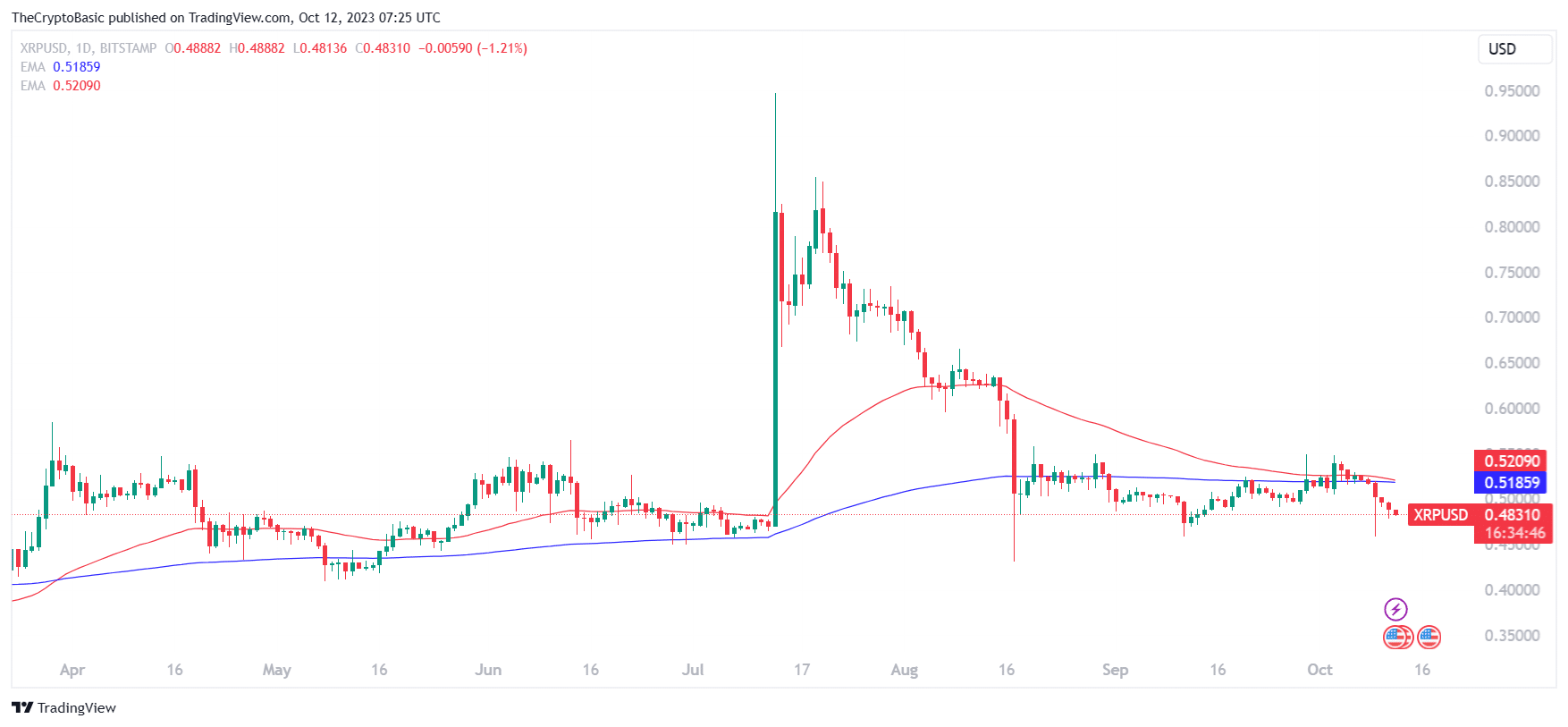
One of the critical indicators hinting at the trend reversal is the convergence of the 50-day and 200-day Exponential Moving Averages (EMAs). XRP has been trading below these EMAs, with the 50-day EMA at $0.51859 and the 200-day EMA at $0.52090. 

XRP EMAs 091128
XRP EMAs

These values indicate bearish sentiment in both the short and long terms. However, these two moving averages are on the verge of forming a golden cross. The 50-day EMA is gradually approaching a crossover above the 200-day EMA. 

The last time such a golden cross formation occurred was in March, followed by a notable XRP price rally, reaching as high as $0.58482. This historical precedent gives XRP proponents hope for a potential recovery.

The Stoch RSI and CCI

Additionally, technical indicators such as the Stochastic Relative Strength Index (Stoch RSI) and the Commodity Channel Index (CCI) offer further reasons for optimism in the XRP camp.

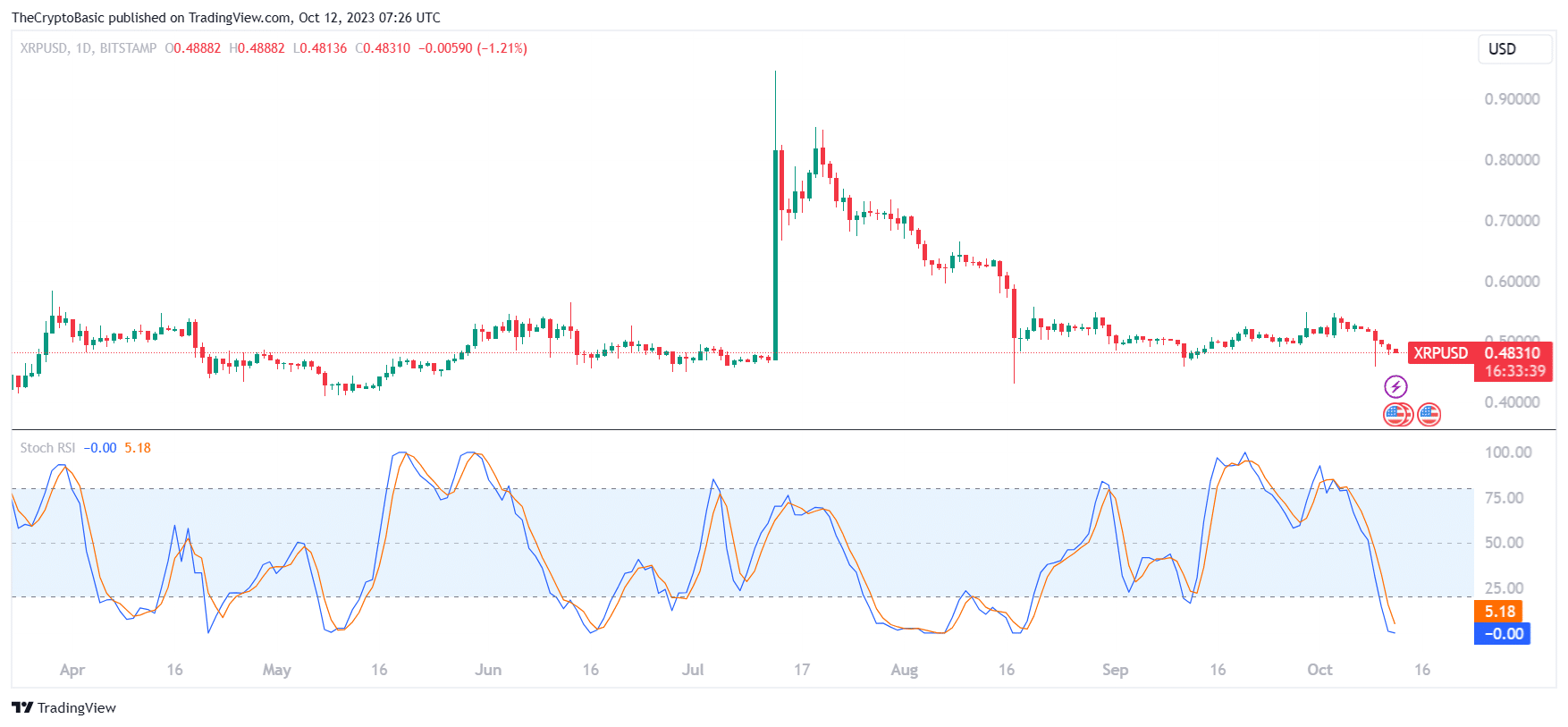
The Stoch RSI has reached a point where its blue line is perched at -0.00, while the orange stripe has descended to 5.18. These values suggest that the cryptocurrency is now in an oversold condition, indicating that the selling pressure may have become excessive and a price reversal might be looming.

XRP Stoch RSI 091131
XRP Stoch RSI

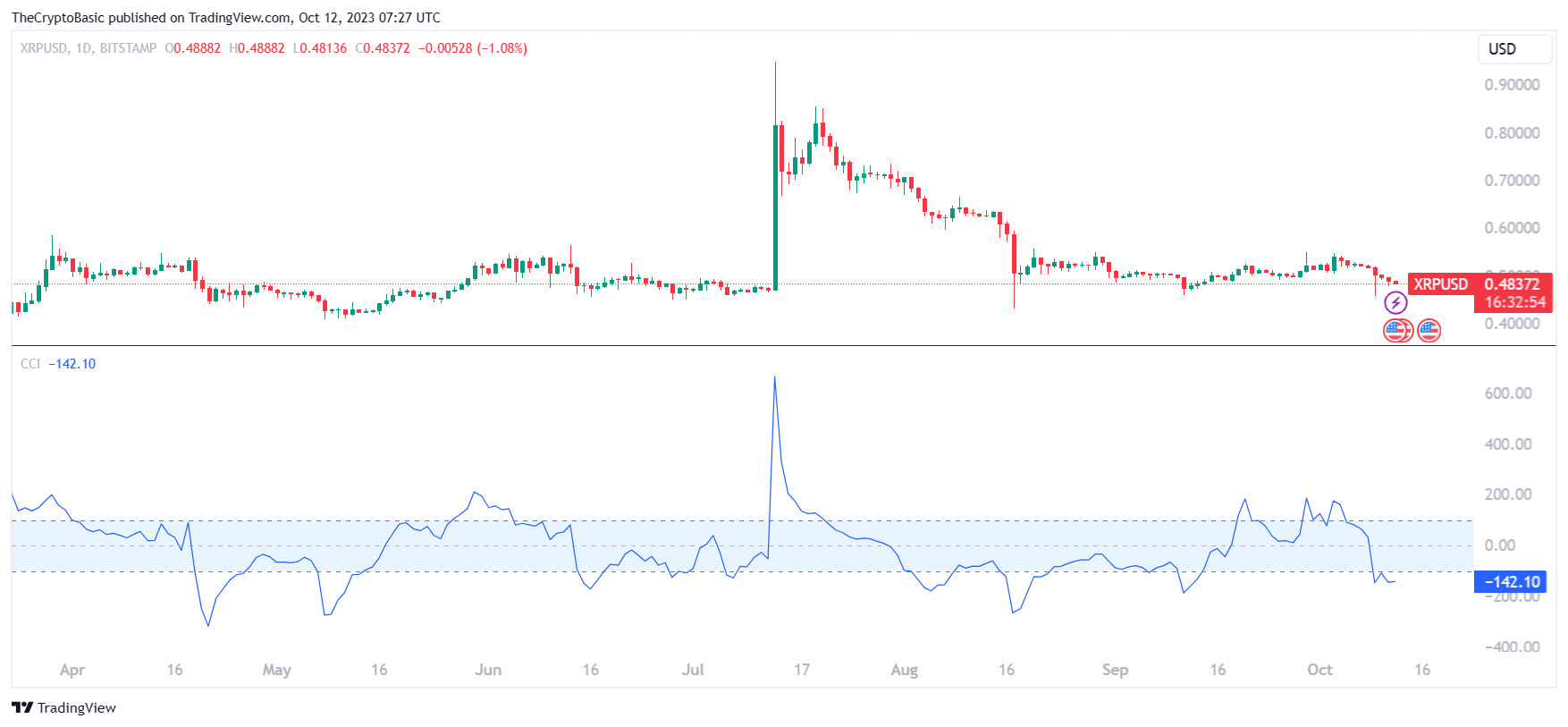
Lastly, the CCI has fallen to a substantial -142.10. The CCI is a bounded oscillator, and a value of -142.10 indicates that XRP’s price is significantly below its typical or average price level, suggesting a strong bearish momentum.

XRP CCI 091121
XRP CCI

However, this value of -142.10 also signifies an oversold condition. This means that XRP’s price may have dropped too fast, and this extreme downside momentum could lead to a reversal or a bounce in the price.

XRP is changing hands at $0.48310, down 1.21% over the last 24 hours. The asset has plummeted by over 9% in the past week. Notably, the current bearish condition in the broader crypto market has exacerbated XRP’s current downtrend.