Home Blog Page 1815

Tangem Showcases Shiba Inu Wallet at Token2049 Event

0

Shiba Inu community admin Ragnar expresses gratitude as hardware wallet provider Tangem showcases Shiba Inu hardware wallet at Token2049, receiving enthusiastic feedback from attendees.

In a recent tweet, Tangem, the Shiba Inu-themed hardware wallet provider, announced its participation in Token2049, a premier blockchain event bringing together the brightest minds in the crypto industry. 

This particular Token2049 event took place last week in Singapore, precisely on Wednesday and Thursday. According to Tangem, the gathering served as a platform to further extend its Shiba Inu-themed presence in the Asian market.

Furthermore, Tangem highlighted that during the event, it received enthusiastic feedback from attendees regarding its Shiba Inu self-custody solution. It mentioned that many expressed admiration for the seedless hardware wallet concept. 

Specifically, the admirers described it as “brilliant and awesome.” Additionally, Tangem noted that the participants were delighted to realize how remarkably easy self-custody could be after connecting.

Moreover, Tangem emphasized that the Token2049 event was an excellent opportunity to engage and network with prominent influencers, top industry players, and prospective collaborators.

“We met with many outstanding bloggers, major companies, and potential partners. Everything went great! Looking forward to seeing you at other venues,” the Tangem remarked.

Shiba Inu Community Admin Reacts

In response to Tangem’s update, Ragnar Shib, a notable Shiba Inu community administrator, expressed appreciation for Tangem’s participation. He emphasized the significance of their presence in the context of Shiba Inu’s history. 

“And Shib was there making company! Thanks, Tangem team, for being part of Shib history,” Ragnar remarked.

Notably, the collaboration between Tangem and the Shiba Inu community underscores the growing synergy within the crypto space and the increasing recognition of innovative solutions in the industry. 

In the past, the Tangem team organized a giveaway session, generously giving out ten hardware wallets to Shiba Inu enthusiasts. 

As The Crypto Basic reported, a renowned firm has compared Tangem’s Shiba Inu-themed wallet to the offerings of other hardware solution providers. It ultimately gave the win to Tangem.
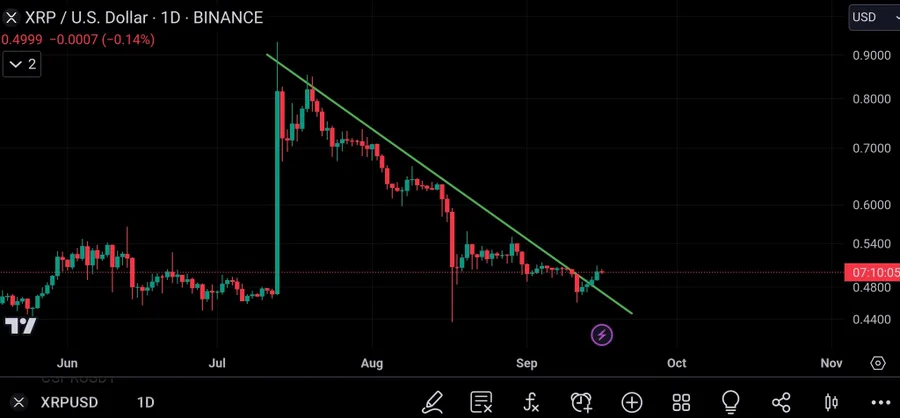
XRP Recovers Above $0.50 Resistance, 3 Possible Outcomes for XRP

0

For the first time since the Ripple victory in July, the XRP price has broken above the resistance line. What are three possible outcomes for XRP?

In July, XRP experienced its biggest rally after Ripple scored a major victory in the SEC case. XRP yielded to mounting bearish pressure in the following weeks, dropping under a descending resistance line. XRP touched $0.90 after the historic win against SEC and then lost all the gains, falling to $0.45 on Sep 11.

Rallying along with the crypto market on September 18, the price of XRP has recovered above the $0.5000 resistance. The rally above $0.5000 marks the first time XRP will trade above the descending resistance line it fell under in July.

Image Source: https://twitter.com/UniverseTwenty/status/1703091300520853813

At the time of this writing, the price of XRP stands at $0.5032, marginally above the resistance level. XRP has gained 0.73% in the last 24 hours and 6.31% over the last seven days.

However, three scenarios can play in the coming days with no clear break above this resistance level.

Scenario 1: A Bull Run

The $0.5000 price level is considered a major support/resistance level for XRP. Flipping this level could start a major rally for the altcoin. However, XRP bulls must keep the coin price above $0.5000 for this to happen.

If $0.5000 is converted into a resistance level, then XRP could experience a short-term bull rally. A short-term target is $0.55 before XRP could rally to as high as $0.7000. The popular XRP trader, @UniverseTwenty, has predicted a rally to $1 for XRP if the bullish conditions hold. 

Scenario 2: A Strong Bear Market

If bears regain control of the XRP market and the dreaded death cross pattern is completed, XRP could suffer a major bear market for the rest of September.

The 21 exponential moving average (EMA) must fall below the 200 EMA for the death cross to happen. If this happens, the popular crypto chartist EGRAG has predicted a decline to $0.4300.

Scenario 3: Consolidation Continues

If XRP fails to convert the $0.5000 resistance into a support level, it could fall back into its consolidation range.

Since the beginning of September, XRP has traded between the $0.4700 and $0.5000 range. However, with the current high volume of XRP (+65% in the last 24 hours), this is probably the least likely of the three scenarios.

Breaking above the $0.5000 puts XRP at a crossroads with no clear direction. However, the sentiment of the broader crypto market would play a part in determining whether XRP bulls or bears take control of the market.

Upgraded Experience: Shiba Inu Wallet Fresh Update Now Available

0

Tangem, a crypto wallet provider close to Shiba Inu (SHIB), is rolling out a new update to make portfolio management more accessible.

Cryptocurrency wallet company Tangem is rolling out an update for its widely used application, Tangem Wallet. The new update will make it easier for users to sort their assets manually based on balances, networks, or any pattern they prefer.

The Swiss-based company took to X to announce the upcoming update expected as soon as October. The release video notably features Shiba Inu (SHIB), Bitcoin (BTC), Ether (ETH), and Polygon (MATIC), showing how users can reorder their portfolio assets for an improved experience.


The latest update comes as Tangem has witnessed a significant uptick in its user base. This month, the company revealed that its customers have grown by 738% in the past year following several partnerships.

Tangem and Shiba Inu

The choice of Shiba Inu as a featured asset for Tangem’s upcoming wallet update is not entirely surprising. Back in May, the Shiba Inu ecosystem entered into a partnership with the wallet maker, leading to the release of a batch of SHIB-themed hardware wallets in July.

The customized card-shaped wallet can store SHIB alongside 6,000 other cryptocurrencies and gained traction with 5,000 devices sold in the first batch. In August, the wallet provider also announced the release of a fresh collection of SHIB wallets that could include a Shibarium integration. Tangem had also given away 10 SHIB wallets as part of its initial partnership to build close ties with the SHIB community.

Meanwhile, Tangem is linked to another major crypto player, Ripple, albeit through another entity. SBI Holdings, Ripple’s biggest Japanese partner, invested $15 million into Tangem’s wallet business back in 2019.

Shiba Inu Blockchain Nears 3M Transactions in One Month

0

The Shibarium network has seen significant uptake within its first month, with the user transaction count now approaching three million.

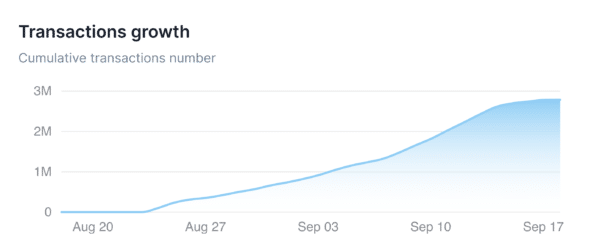
Shibarium, the layer-2 network launched by blockchain project Shiba Inu, is approaching a new milestone. According to data on Shibariumscan, the network is edging closer to having settled three million transactions. 

The current statistics of 2.86 million transactions mean that Shibarium only needs to handle less than 5% of its cumulative transaction count to reach the new landmark. The network has achieved its latest numbers in roughly a month since going live, suggesting the 3 million mark is more likely than probable.

Transactions growth Blockscout chart

On a slightly underwhelming note, the number of new users onboarding Shiba Inu’s layer-2 has dropped. In the past 24 hours, only 24 new accounts were created on Shibarium, a far cry from the 5,552 users recorded on August 24. However, improved network conditions could boost Shibarium’s prospects in the coming weeks.

Shibarium Network Gains More Stability

A further overview of on-chain data reveals that Shibarium users are enjoying a significantly higher stability and success rate on transfers following a below-par launch. Successful transaction count now hovers around 1, meaning nearly every transaction on the network goes through. In the week following Shibarium’s release, this figure dropped as low as 0.45, indicating a low success rate.

Meanwhile, another bright spot for Shiba Inu’s new layer-2 is an increase in the value of BONE assets staked by investors. There are now 21.4 million staked BONE tokens (appr. $22.7 million) across the 12 active validators on the network. 

Similar to most PoS networks, Shibarium requires validators to stake BONE for a right to validate transactions and earn block rewards. Users may also delegate tokens to their favorite validators to foster decentralization, all while earning additional BONE rewards.

The launch and early success Shibarium has recorded adds to growing optimism across the SHIB team that the memecoin is well-positioned going into the next bull run. The number of millionaire SHIB holders is also on the rise, raising hopes within the SHIB community.

Shiba Inu Team Says Migrate from Exchanges to Shibarium to Increase SHIB Burn Rate

0

The Shiba Inu content marketing specialist Lucie has taken to X to stress the need for Shiba Inu enthusiasts to store their assets on Shibarium rather than exchanges.

In the tweet, Lucie first highlighted a prevailing inquiry regarding Shibarium’s role in SHIB burn. The Shiba Inu representative corrected that asking when Shibarium will burn SHIB tokens is a wrong question.

Lucie noted that the question is technically inaccurate since the Shibarium blockchain itself cannot burn SHIB tokens. Instead, she posed a more pressing query to the Shiba Inu community:

“When will you all migrate from exchanges and start using Shibarium?” 

Lucie expressed amusement at the enthusiasm surrounding token burns while many neglect to use Shibarium actively. Lucie reminded the community how SHIB tokens burn with Shibarium. 

She underlined that Shiba Inu burns are determined solely per transaction on the blockchain and not based on tweets or discussions about burns. She added that SHIB burns are a collective effort by the community, not a demand for action from developers.

“The fact remains that $SHIB burns are a community effort, not a call to the devs saying, ‘Do something’, Lucie remarked.

In other words, the more Shiba Inu enthusiasts engage with the Shibarium platform, the more they contribute to SHIB token burns.

Also, Lucie highlighted that the Shiba Inu community has the numbers to push for significant token burns, provided SHIB holders join the burn movement en masse. Lucie urged the community to support the activity in their millions. 

Moreover, the SHIB representative noted that fees on Shibarium are almost negligible but could increase with higher traffic.

Store Assets on Shibarium, Not Exchanges 

Furthermore, Lucie highlighted the security features of Shibarium. She stated that assets stored on the platform are as safe as they would be on an exchange. 

Meanwhile, Lucie called the SHIB Army’s attention to the risk associated with using centralized crypto exchanges to manage their Shiba Inu portfolios. She cited the case of the bankrupted FTX exchange, which, at its peak, was the second-largest exchange. 

Ultimately, she extended an invitation to Opensea, a popular NFT marketplace, urging them to consider integrating Shibarium.

XRP Faces Strong Resistance: Will the XRP Price Rise or Decline in the Short Term?

0

The Descending Trend Line has acted as a strong resistance level for XRP since its SEC-induced rally. Will the XRP price continue to decline or start a rally?

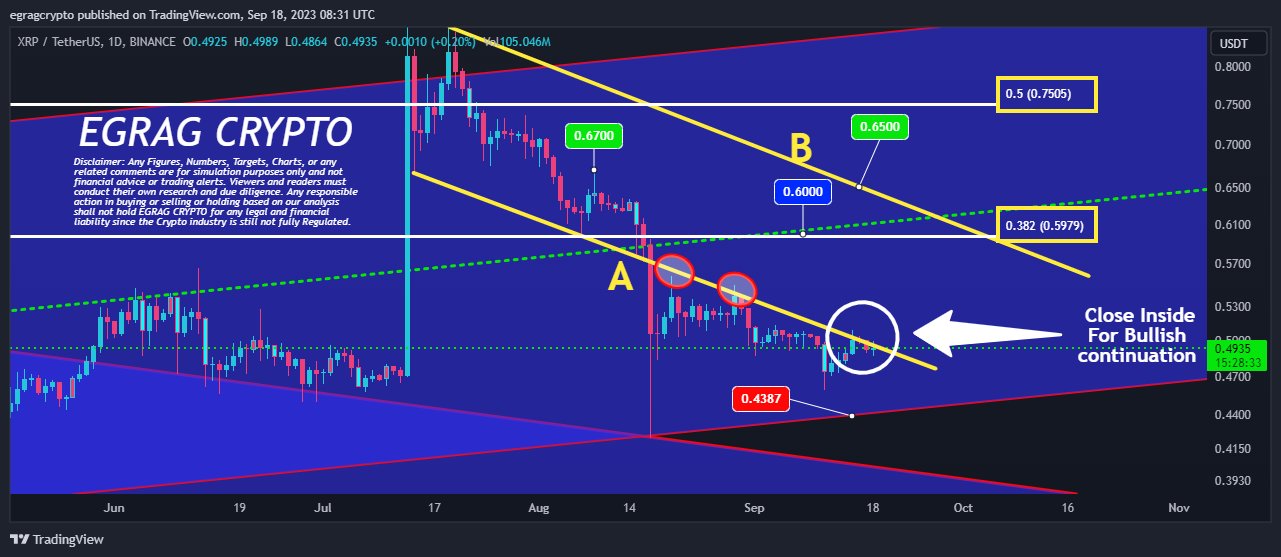
Since the Ripple lawsuit win in July, when the price of XRP increased by more than 90%, the altcoin has declined. EGRAG, a popular crypto chartist on X, has highlighted that the XRP price has been trading under a descending trendline.

Image Source: EGRAG CRYPTO

In the chart shared, the XRP price fell under the Descending Trend Line ‘A’ (DTL ‘A’) on August 17. Since then, XRP has made three attempts to break above, but DLT A has strongly resisted the altcoin.

Each rejection at the DLT A has been met with significant corrections to lower levels. However, XRP is now at a critical level, trading on the trendline (at a price of $0.4946). 

Where Will the Price of XRP Go in the Short Term?

EGRAG has shared two possible scenarios for XRP in the short term. Firstly, another downtrend should be expected if XRP gets rejected at this resistance once again. If this happens, a price drop towards the $0.430 level should be expected.

If the XRP bulls succeed in pushing the price of the coin above the DTL ‘A’ resistance, a rally will ensue. According to the chart, a short-term bull market for XRP will see its price increase to the DLT B or the 0.382 Fibonacci level at a price of $0.590.

What Does the Market Say About XRP?

At the time of this writing, XRP trades at $0.4946, dropping by 0.41% over the last 24 hours. This is significant as the global crypto market is marginally bullish today, increasing by 0.45%, according to CoinMarketCap.

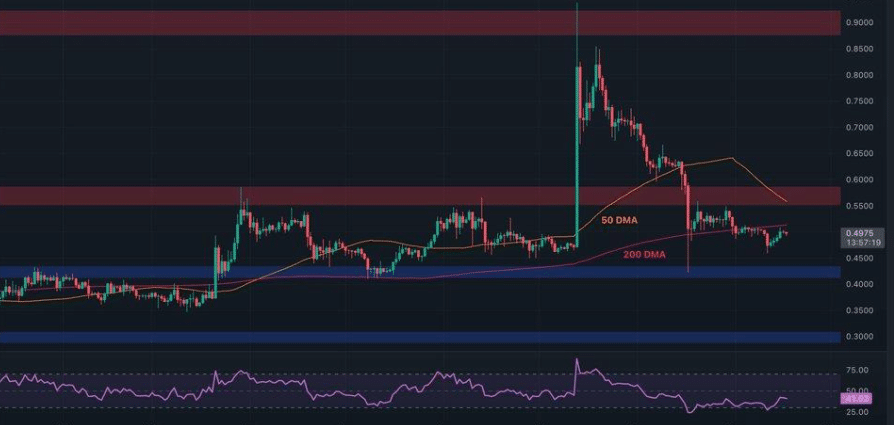
XRP 1D chart and RSI
XRP chart

The 200-day moving average (MA) also confirms significant bearish pressure for XRP. The XRP price has failed multiple times to break above the 200-day MA and 50-day MA, solidifying this resistance level.

In addition, the relative strength index (RSI) of XRP also favors the bears, as it remains under 50. If the price of XRP fails to break above the $0.5000 resistance, then a drop to $0.4300 is the more probable scenario.

While the short-term outlook of XRP looks bearish, EGRAG remains bullish about the long-term potential of XRP. According to the crypto chartist, XRP will outperform other crypto assets in the upcoming bull market. 

How Can XRP Handle Weekends, Holidays, and Night Payment Challenges in Finance?

0

Crypto Industry experts disclose XRP’s role in solving the economic challenges related to holidays, weekends, and nights, as well as market manipulation.

In a recent tweet, pro-XRP lawyer John Deaton highlighted the application of XRP in solving a prevailing obstacle in the economic realm dubbed the “Friday Night Problem.” 

Deaton’s tweet followed a detailed thread from Panos Mekras, the author of Understanding the Crypto Economy. Specifically, Mekras wrote a 16-part X thread pointing out the challenges posed by closing banks and markets on weekends and the potential for market manipulation in such scenarios.

In response, Deaton referenced TapJets, a private jet company that had recognized and harnessed XRP’s capabilities to address the challenges Mekras highlighted. Deaton mentioned that TapJets submitted an amicus brief supporting Ripple in the XRP classification lawsuit.

The lawyer stated that TapJets explained to the court how XRP is an instrumental digital asset in addressing the Friday Night Problem.

TapJets Using XRP to Solve Night Problem

Deaton cited an instance to provide a proper context for XRP’s place in solving financial challenges related to weekends and nights. 

He explained that someone needing to book a private jet at the last minute through the TapJets app often faced a hurdle since banks close after 5 p.m. on Fridays. Deaton highlighted that to secure a reservation, customers must prepay for various expenses like fuel, pilots, flight attendants, and airport fees. 

However, the payment becomes challenging as banks are inaccessible during the period, possibly foiling the private jet booking mission. The lawyer noted that TapJets elaborated in the amicus brief that it integrated XRP as a payment solution. 

In particular, TapJets told the court that the XRP integration allowed all parties to receive their payments in split seconds, even during those critical Friday evenings and weekends when traditional banking was unavailable.

Meanwhile, Deaton clarified that Ripple had no connection to TapJets and was completely unaware of the innovative use case for XRP.

XRP Addressing Holiday Challenges

Moreover, the crypto author Panos Mekras stressed that the traditional five-day workweek of financial institutions alongside holiday periods leaves a significant gap that impedes international trade and hurts individuals reliant on remittances.

Also, he argued that the idle periods allow banks to manipulate the financial market to their advantage ahead of the next business day. In his words:

“They can release news or take positions before the markets reopen on Monday, potentially causing fluctuations in prices that can be advantageous to them and disadvantageous to retail investors.”

To address these issues, Mekras underscored the role of blockchain technology and cryptocurrencies, which operate round the clock. He particularly cited Ripple’s use of XRP in ensuring swift cross-border payment regardless of holidays or weekends.

Also, he noted that the decentralized nature of blockchain networks mitigates the risk of market manipulation from behemoths since it provides a level playing ground for all.

Hifi Token Drops 66% from ATH After Massive Weekend Pump

0

The Hifi Finance token has now plummeted 66% after recently capturing a new all-time high of $2.61 over the weekend.

The native token for Hifi Finance, an Ethereum-based lending and tokenization protocol, was the center of attention for a large chunk of crypto traders on a busy weekend. The Hifi token reached a new all-time high of $2.61 on Sept. 16 before a sharp decline to $0.88 at the time of writing.

HIFI 7D graph coinmarketcap
Hifi 7-Day Chart | CoinMarketCap

The sharp price action for Hifi was largely linked to a flurry of listings on cryptocurrency exchanges. BitMart listed Hifi on Sept. 14, with Poloniex taking the same step two days later. 

While both exchange listings coincided with an uptrend for Hifi tokens, the launch of Hifi perpetual contracts on Binance on Sept. 16 saw the asset enter a sharp downtrend, with traders able to short the asset by up to 20x.

Meanwhile, a listing on HTX (formerly Huobi) on Sept. 17 was not enough to spark a market reversal for Hifi. 

According to CoinMarketCap, trading volume for the asset has dropped 54% in the past 24 hours to $540 million, while its market capitalization now sits at $83 million, down 27% within the same timeline.

At its peak less than 48 hours ago, Hifi had a market cap near $250 million, with trading volume soaring as high as $1.07 billion based on CoinMarketCap data.

Hifi Finance Enjoys Moment in the Spotlight 

Hifi Finance is an Ethereum-based decentralized finance (DeFi) protocol that primarily offers lending for crypto assets and the tokenization of real-world assets. The protocol was formerly known as Mainframe before rebranding to Hifi Finance in 2021. 

Since then, Hifi Finance has refocused its objectives and secured listings on leading exchanges. Yet, the total liquidity on the Hifi Finance lending and borrowing market is $262,000, while Sablier, a DeFi protocol that it acquired in 2020, has around $4.5 million in total assets locked. 

It remains to be seen whether the recent moment in the spotlight will propel Hifi to new heights. Some speculate that the recent upsurge is merely a result of increased social hype. Notably, major DeFi tokens have held up better than most altcoins since the start of the bear market.

Justin Sun Mints $815M in TrueUSD, Raising Concerns Over Stablecoin Collateralization

0

Tron founder Justin Sun has claimed that the $815 million in TUSD stablecoin minted, swapped, and deposited into the JustLend platform were his personal funds, stirring up controversy. 

Tron founder and Huobi board member Justin Sun has been the subject of criticism in the crypto community after minting $815 million worth of True USD (TUSD) stablecoin in a series of 10 transactions. 

Following the minting on Sept. 16, the funds were sent to two Huobi hot wallets, after which they were sent to a Justin Sun-managed wallet address. The funds were later moved to an unlabelled contract address known as “minterproxy.”

From Minterproxy, a total of $865 million was moved to another address, where the tokens were eventually burnt and replaced by $865 million in stUSDT. The move minted the 865 million stUSDT and sent them to one of Sun’s wallet addresses.

According to the on-chain analytics firm Arkam Intelligence, the stUSDT tokens were later deposited to JustLend – a decentralized lending protocol on the Tron network.

The total value locked (TVL) of the decentralized finance (DeFi) protocol increased by 21% after the deposit. According to data from DefiLlama, JustLend has a TVL of $4.585 billion, with an increase of 25.63% over the last seven days.

Crypto Community Reacts Sun’s To TUSD Minting 

The crypto community has criticized Justin Sun for the recent transaction’s lack of transparency and integrity. The collateralization of the TUSD stablecoin is being scrutinized as $815 million appeared to be minted out of thin air.

A Bitcoin Magazine contributor, Dylan LeClair, has directly questioned Sun, asking what and where the TUSD reserves are. In July, the founder of Archblock (the parent company of TUSD) accused Sun of acquiring the stablecoin through various shell companies.

A Tether spokesperson has also clarified that the stablecoin issuer is not involved with Justin Sun, calling the project independent.

Sun Defends the Collateralization of TUSD

The Tron founder has responded to the accusations. Responding to LeClair, Sun claimed that the collateral of the TUSD stablecoin is in treasury bills. However, Sun did not provide further information on the nature or amount of treasury bills held by the stablecoin issuer.

Sun also argued that the entire transaction was drawn from his personal financial dealings and bore no connection to the operations of Huobi.

ETHGate: Expert Identifies Why SEC Cannot Take Ripple and Its Execs to Trial

0

Serious allegations have emerged surrounding the U.S. SEC and Ethereum, leading some key players to assert that the agency might not take Ripple to trial to avoid exposure of its past dealings.

The accusations come from Steven Nerayoff, a prominent crypto community figure, and an early Ethereum adviser. Nerayoff’s comments have triggered the attention of the broader community, eliciting speculation about the impact of further revelations.

As a result, industry figures like Yassin Mobarak, founder of Dizer Capital, suggest that the SEC may never take Ripple and its top executives, Brad Garlinghouse and Chris Larsen, to trial. Mobarak believes the agency would want to avoid trial to keep these secrets hidden.

According to him, if the regulatory watchdog proceeds to trial in its case against Ripple, the firm could invite Nerayoff to shed more light on his allegations, potentially exposing secret dealings that could incriminate the agency.

Allegations Surrounding SEC

The heart of these allegations lies in the SEC’s past engagements and historical entanglement with Ethereum, especially during Ethereum’s initial coin offering (ICO) phase. 

Nerayoff hinted at potential corruption within the SEC, challenges in identifying true Ethereum ICO buyers, and even personal persecution. Though vague, the revelations have already raised questions about the SEC’s credibility.

One of the critical points revolves around the integrity of the current SEC leadership. Nerayoff made comparisons with former SEC Chair Joe Grundfest. This raised concerns about whether the agency upholds the same standards it once advocated.

Ethereum ICO’s Possible Violations

Furthermore, Neyaroff claimed it’s challenging to identify the number of investors that participated in the Ethereum ICO, fueling speculations that some whales might be concealing their true positions. 

This revelation raises significant questions about the transparency of the ICO process and the potential implications for Ethereum.

Another serious accusation revolves around potential Terms of Service (TOS) violations by Ethereum during the ICO phase. The implications of such violations could have far-reaching consequences for the project.

Nerayoff’s allegations further suggest that Ethereum might have been aware of certain entities holding substantial amounts of Ether (ETH), hinting at a concentration of ETH holdings among a select few. This challenges the principles of decentralization.

It bears mentioning that former SEC official Bill Hinman, in his infamous June 2018 speech, suggested that Ethereum should not be classified as a security because it has attained “sufficient decentralization.”

FBI and DoJ’s Involvement 

Furthermore, Nerayoff also claims that he was personally targeted and discredited by the SEC, in conjunction with the Department of Justice (DOJ) and the FBI. However, he points out that the charges against him were eventually dismissed based on government documents.

Recall that pro-XRP lawyer John Deaton previously called attention to how the FBI dropped its case against Nerayoff. The government had charged him in 2019 for alleged extortion. However, they withdrew the case in May 2023. 

Responding to the incident, Deaton questioned why the government would go through the trouble of getting an indictment to withdraw the case later on. The attorney speculated that Neyaroff’s previous allegations against the government could be factual.

While captivating, Neyaroff’s latest accusations against the SEC and Ethereum are vague, giving room for interpretations. When a community figure sought clarification, his lawyer stressed that the necessary facts would come out at the opportune time.

Given that more secrets surrounding the SEC and Ethereum could come to light, industry players believe the agency might not want to push for a trial in the Ripple lawsuit.

Recall that the judge presiding over the SEC vs. Ripple lawsuit recently ruled that most of Ripple’s XRP sales did not constitute securities offerings except sales to institutional clients. 

This ruling delivered both Ripple and the SEC partial victories. However, the SEC has expressed its intention to appeal the part of the ruling it lost, signaling a determination to sustain its legal action against Ripple further.