Home Blog Page 1818

Germany’s Largest Bank to Offer Crypto Custody Services Following Past Report on XRP

0

Deutsche Bank, the largest financial institution in Germany, is launching a crypto custody offering.

Germany’s largest banking institution, Deutsche Bank (with $1.38 trillion in assets), is set to allow its customers to store cryptocurrencies and other digital assets. Deutsche has entered into a partnership with Swiss-based digital asset custodian Taurus to launch the new offering.

Under the agreement, Taurus will offer Deutsche Bank its digital asset custody and tokenization infrastructure. Such integration would allow the German multinational bank to go beyond the nascent market for cryptocurrencies to custody for tokenized versions of real-world assets and digital currencies such as those issued by central banks (CBDCs).

However, Deutsche Bank’s latest partnership with Taurus to unlock crypto custody for its customers is not entirely surprising. The bank participated in a Series B round for Taurus in February, helping the startup raise $65 million. Credit Suisse led the round, with Pictet and Arab Bank Switzerland completing the quartet on the cap table.

In the wake of growing demand for cryptocurrencies and digital assets, integrating with established crypto custody solutions offers a more straightforward way for banks to provide clients with exposure to the emerging asset class. US-based BNY Mellon, in a similar move, integrated with digital asset custody startup Fireblocks.

Deutsche Bank eyes “trillions of dollars” in crypto market valuation 

Germany’s largest bank is expanding its foothold in the digital asset industry, recognizing its potential to morph into a multi-trillion-dollar financial market. Deutsche Bank’s Global Head of Securities Services, Paul Maley, in a statement, noted that the emerging space “is expected to encompass trillions of dollars of assets” and become a top priority for investors and companies.

Deutsche Bank is positioning itself for such a future. In June, the financial institution applied for a digital asset custody license from Germany’s financial and securities markets watchdog, BaFin.

The bank has also undertaken digital asset research projects, including a study highlighting the efficiency of using XRP for global payments.
Realized Value Hint At Change of Trend for Ethereum As Investors Pull $13 Billion from the Market

0

Approximately $13 billion has been pulled out of Ethereum markets, hinting at a possible change in investors’ sentiment about the leading altcoin.

Over the last three days, the price of Ethereum (ETH), the pioneer smart contracts platform, has been bullish, increasing from $1,540 to trade as high as $1,640 on September 15.

However, recent on-chain metrics hint at a possible change of sentiment about the leading altcoin. According to the Realized Value metrics provided by Glassnode, approximately $13 billion has been drained from Ethereum markets over the last three days.

The realized value (RV) of Ethereum is a metric used to decipher the capital outflow from ETH. Realized value is often used as an alternative to the market capitalization of a project.

Popular X (formerly Twitter) crypto analyst @ali_charts shared the charts, tweeting: “Ethereum has seen roughly $13 billion drained out of the #crypto market in the past few days, signaling a shift in investors sentiment.”


Are Ethereum Investors Taking Profit?

Since the realized value tells the points at which investors are entering and exiting the asset, the metric is often used as a pointer to decipher investors’ profit or loss-taking behavior.

The spike in the capital moved out of Ethereum markets coincides with an increase in the price of ETH. Over the last three days, the price of Ethereum has increased from $1,540 to as high as $1,640.

At the time of this writing, ETH is valued at $1,615. This trend hints at investors looking to take profits. To back this, there has been an increase in ETH Put positions across major crypto exchanges.

A Possible Change of Trend for Ethereum?

This week, 156,000 ETH (worth approximately $250 million) with a Put-Call Ratio of 1.09 will expire.

The max pain point for the ETH options expiring is $1,650. As a result, investors will look to keep the price of ETH below this price level until after the expiry. The price of Ethereum is already down by 1.2% over the last 24 hours.

While many on-chain metrics point to a possible change from the recent bullish trend for Ethereum, traders will continue monitoring the price movements of ETH until after the options expiry.

TUSD Market Share on Binance Crashes from Over 30% to 5.6% 

0

TrueUSD (TUSD) has witnessed a crash in its daily market share on the world’s largest exchange Binance, slumping from over 30% to 5.6%.

Notably, TUSD has continued to lose more market share on the world’s largest exchange since early this month, per recent data from the market intelligence provider Kaiko.

As a result of the persistent decline, BUSD, whose market share has remained fairly stable, has now overtaken TUSD in market dominance for the first time in four months. TUSD only towers above First Digital USD (FDUSD) and USD Coin (USDC) in dominance.

TUSD has been relinquishing its market share on Binance to Tether (USDT), the largest stablecoin by market cap. Remarkably, USDT has dominated the entire stablecoin market on the exchange, with its share recently soaring to the 80% mark. 

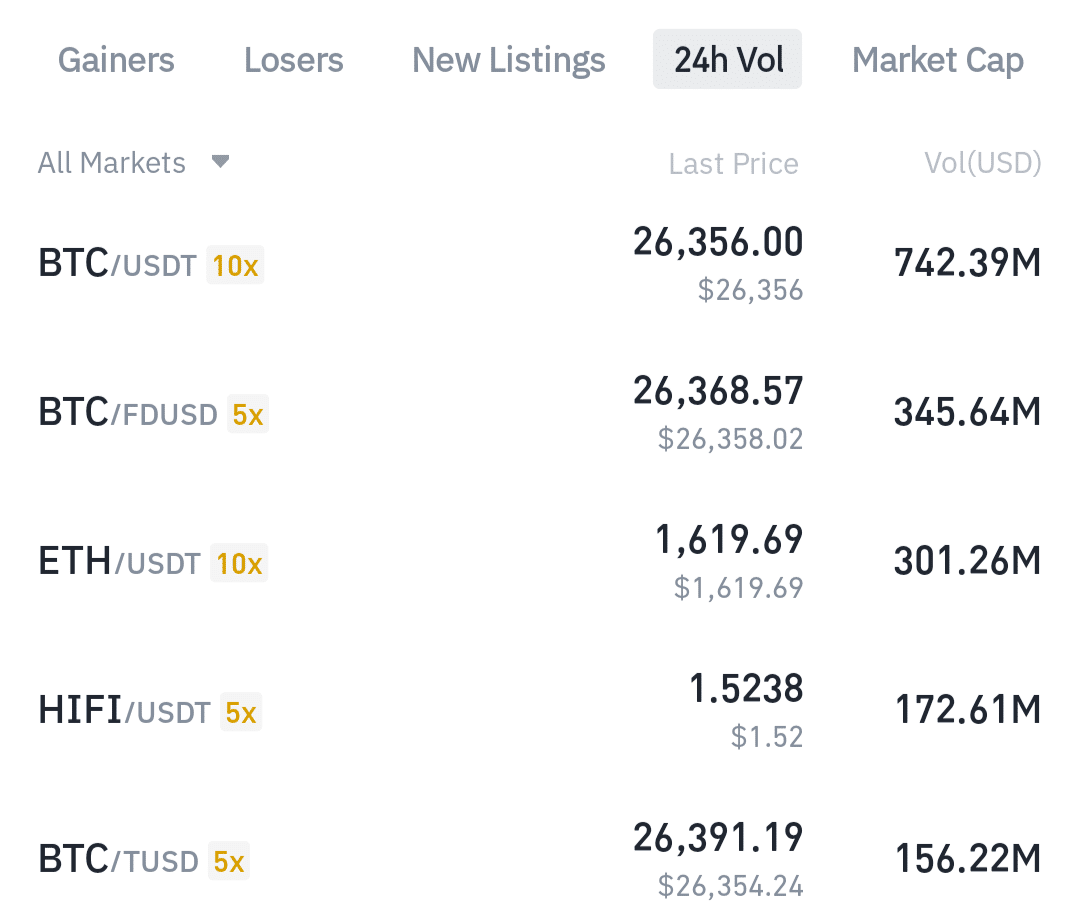
Interestingly, despite FDUSD witnessing a lower market volume overall, the BTC/FDUSD trading pair commands a greater volume than the BTC/TUSD pair. BTC/FDUSD boasts a 24-hour volume of $345.64 million, while BTC/TUSD only sees $156.22 million in volume.

Binance 24H Volume
Binance 24H Volume

Possible Triggers

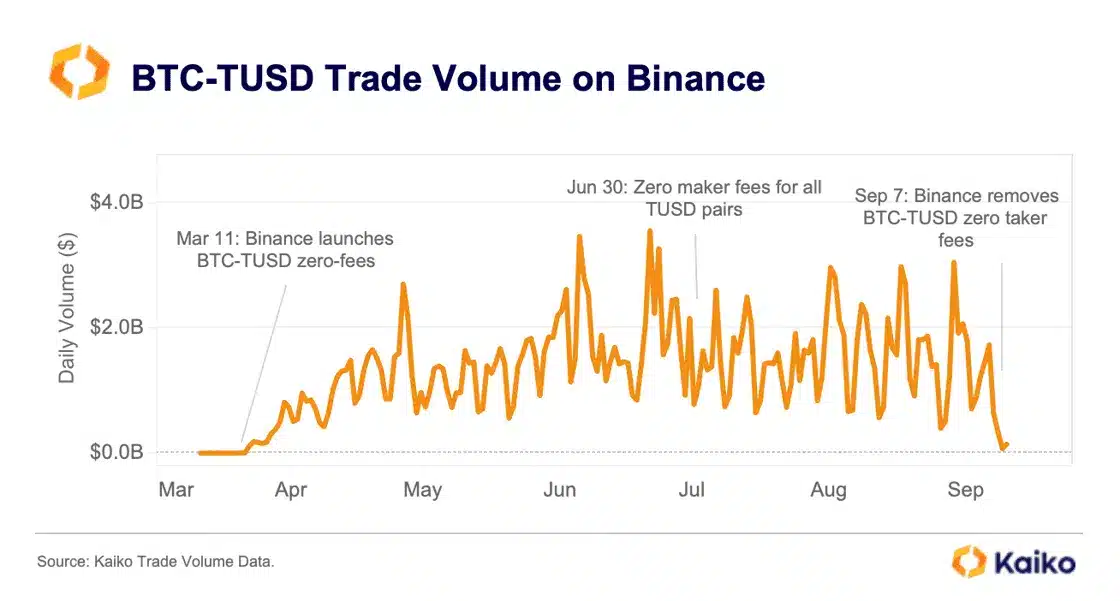
This prevailing drop in TUSD volume on Binance comes shortly after the exchange re-introduced taker fees for the BTC/TUSD pair. Recall that Binance had removed maker and taker fees on BTC/TUSD on March 11. The exchange also removed maker fees for all trading pairs with TUSD in June.

BTCTUSD Trade Volume Binance
BTC-TUSD Volume on Binance | Kaiko

However, Binance decided to re-introduce taker fees for the BTC/TUSD pair last week, allowing only zero maker fees. Meanwhile, the BTC/FDUSD pair enjoys both zero maker and taker fees. This has contributed to the shift in investor interest. The BTC/TUSD pair saw a rapid decline in volume.

Furthermore, the shift could have been compounded by concerns surrounding TUSD following regulatory issues faced by Prime Trust, a partner to TUSD’s issuer, Trust Token. In June, Trust Token had to suspend redemption and minting of TUSD through Prime Trust.

However, the TrueUSD team assured that the minting of the stablecoin through other partners will continue. The team emphasized that Prime Trust’s regulatory issues do not affect TUSD or its general operation.

Nonetheless, amid the growing concerns, TUSD de-pegged on Binance.US. The stablecoin dropped to $0.80 on the exchange before eventually picking up. Also, in July, Kaiko raised concerns about its relative lack of transparency compared to other stablecoins.

Recall that TUSD gained the spotlight in February when Binance adopted it after abandoning BUSD due to regulatory issues Paxos faced with the NYDFS. Binance also minted $50 million in TUSD in February. 

The adoption by Binance and the zero-fee trade promotion skyrocketed the stablecoin’s volume. Now, it is facing persistent declines.

Bitcoin Miner 2Pool Generously Returns 19.82 Bitcoin ($520K) Fee Mistakenly Paid by Paxos

0

F2Pool has returned 19.82 BTC received in an apparent mistake by Paxos.

Bitcoin mining pool F2Pool has refunded 19.82 BTC (appr. $520,000) that it received as bizarre fee rewards for confirming a transaction by blockchain company Paxos.

On Sept. 10, The Crypto Basic reported a weird transaction, which saw a Bitcoin address mistakenly pay 19.82 BTC (worth $511,000) to transfer 0.074 BTC (approximately $1,900).

The average network fee on the day was a mere $2.176, which means the sender overpaid by a whopping ​​234,834 times. 

Interestingly, blockchain company Paxos, which issues stablecoins such as its USDP and the recently launched Paypal USD (PYUSD), later confirmed that it was behind the erroneous transaction.

Paxos claimed the transaction resulted from a bug on a single transfer, which has now been fixed, and that it was already in touch with the miner to facilitate a refund.

F2Pool mined the Bitcoin block containing the transaction in which Paxos paid the exorbitant fee. Following an identity verification process, F2Pool has now “fully refunded the fee” to Paxos, providing the transaction ID as confirmation.

Blockchain’s Open Nature Facilitates Refund

The decentralized nature of blockchain technology arguably played a vital role in the latest turn of events involving F2Pool and Paxos. Bitcoin users incentivize miners to process transactions through the payment of network fees. 

At the same time, users can verify miner addresses, potentially including their real-world identity, with blockchain explorers and sophisticated on-chain analytics tools. Although it is often a moral question whether or not miners should refund such erroneously paid fees, the latest F2Pool refund is not the first such case.

In 2021, an Ethereum miner returned $23.7 million to a non-custodial crypto exchange, Deversifi. The Bitfinex-linked platform had mistakenly paid the hefty amount just to transfer 100,000 USDT.

Gamification Transforming The Crypto Trading Landscape

0

As much as the crypto market has evolved over the past decade, it is still fair to say that the industry is riddled with issues of heavy volatility. This has made it harder for traders, especially those from the traditional finance (Trad- Fi) realm, to transition into this space seamlessly. This is because a lot of the conventional strategies that work well in relation to stocks, ETFs, bonds, etc. fail when translated and used in the context of cryptocurrencies.

For example, earlier in August 2023, a digital asset trader was faced with a massive $55 million loss when the market swung in a bearish direction overnight. Moreover, a recent report by social trading and multi-asset investment platform eToro notes that a whopping 90% of all crypto traders incur losses — estimated to be at 35% of their portfolios — within just a year of entering the market. The reasons described for this include poor education, the use of erroneous trading systems/trading ethics, and weak investor psychology.

Education is the key

Even though crypto is now a trillion-dollar industry, it is still in its nascency when compared to the fiat ecosystem. In fact, many investors/traders still, to this very day, look at digital assets simply as a means of making a quick buck, thus failing to learn about the industry in any sort of detailed way.

For example, a project called Safuu, which offered returns worth 3,00,000%, was able to lure in thousands and thousands of investors, only for them to be duped within a matter of months. This incident, along with several others, clearly showcases a lack of knowledge on behalf of investors, and therefore, it is imperative that these individuals educate themselves immediately. One way of doing this is by using ‘gamification’ tools that allow traders to learn about the market in a manner that is not only engaging and financially safe but also incentivized.

In this regard, Banksters is an EduTech simulator that allows players to immerse themselves in a gamified trading environment where they have to adapt to dynamic market conditions, including heavy day-to-day volatility, short-term pumps, rug pulls, etc. To deal with this uncertainty, users are required to employ smart strategic decisions that can only be implemented once they learn about key financial concepts and gain more financial literacy.

To elaborate, Banksters features many core gameplay elements that pervade the crypto industry. One such concept is mining, wherein individuals use their personal computers, and mining rigs to acquire tokens. Secondly, the game features ‘investment uns,’ i.e. simulated trading experiences (using real-life data) requiring investors to make decisions on their feet so as to not only minimize their losses — during pumps and dumps, liquidation runs, and so on — but also maximize their gains during periods of heavy market turmoil.

In brief, the project offers an immersive educational experience where users can actively influence the outcome of their investments while reaping real-world rewards and incentives in the process.

Bridging the necessary gaps is a must

As more and more investors continue to enter the crypto fray, it is important that the education gap currently permeating the sector be bridged so that a more stable ecosystem can emerge, one where investors are well-informed about the technology they are putting their money into as well as equipped to deal with the many financial curveballs that may be thrown at them.

According to a recent study, the aforementioned lack of education is the number one reason why amateur traders lose their hard-earned money and subsequently drift away from digital assets permanently. Not only that, it is also the reason why many investors fall prey to obvious scams that can otherwise be avoided quite easily.

Thus, as the world increasingly gravitates toward the use of decentralized finance (DeFi) tools, as highlighted by the industry’s rapid financial growth over the last 72 months alone, it stands to reason that offerings like Banksters can help crypto enthusiasts/traders learn the ropes of the market as well as the technology pervading it (i.e. blockchain) in a fun, meaningful and engaging way.

More Top Binance US Execs Exit as SEC Claims Non-Cooperation

0

Key Binance U.S. execs leave as regulatory pressure piles on.

BinanceUS, the U.S.-based sister platform to the popular crypto exchange Binance, has lost several key executives in the past few months.

These departures have only accelerated in recent times, with Brian Schoder (CEO), Sidney Majalya (Chief Risk Officer), and Krishna Juvvadi (Head of Legal) all leaving this week, according to the Wall Street Journal.

Alongside these key departures, BinanceUS slashed its workforce by 33%, roughly 100 employees, lamenting increased pressure from US regulators.

In a statement, a Binance spokesperson described the company’s shrinking workforce as an “unfortunate example” of how the SEC’s aggressive attempts to cripple” the cryptocurrency industry can “have real-world consequences for American jobs and innovation.”

Here is a summary of Binance’s top-level departures in a few months.

Binance:

  1. Chief Strategy Officer Resigns
  2. VP of Compliance Resigns
  3. Head of Product Resigns
  4. General Counsel Resigns
  5. Head of APAC Resigns

Binance US:

  1. CEO Resigns
  2. Head of Legal Resigns
  3. Chief Risk Officer Resigns

Recall that on June 5, the United States Securities and Exchange Commission (SEC) filed a lawsuit against Binance, alleging securities law violations.

The case is built on similar accusations from the Commodity and Futures Trading Commission (CFTC) and has ground BinanceUS’ operations almost to a halt.

Daily trading volume on the platform is currently under $10 million, a significant drop from the $1 billion value the exchange had in late April (shortly before the lawsuit).

This decline in trading activity has primarily been responsible for the Binance US departures as the company struggles to generate revenue while dealing with its legal woes.

Binance US Trading Volume
Binance US Trading Volume (Source: Coingecko)

US SEC Accuses SEC of Not Cooperating with Investigations

In a related development, the SEC, in a Sept 14th filing, alleged that Binance US was not cooperating with its investigation. The SEC accused Binance of refusing to produce relevant business documents that the regulator later obtained from other sources. 

The US regulator also claimed that Binance has only produced 220 documents, largely made up of “unintelligible screenshots and documents without dates or signatures.”

The latest accusations are subject to judicial review and put Binance under further regulatory scrutiny if the court imposes additional cooperation measures on the exchange operator.

In its most recent response covered by The Crypto Basic, BinanceUS on Sept. 12 described the SEC’s continued probe into its business as unduly cumbersome.

BinanceUS said it had produced 5,000 pages of documents, addressed 19 interrogations, and produced verified accounting confirming the safety of user assets.

SEC v. Ripple Case Drives XRP to Third Spot in Social Engagement and Global Searches

0

The ongoing SEC v. Ripple legal tussle has propelled XRP to rank as the third crypto asset with the most social engagements and global searches in the past month.

Popular social intelligence platform LunarCrush has released its list of the top 10 cryptocurrencies with the highest social engagement. Interestingly, XRP ranked third in the list.

According to data on the LunarCrush platform, XRP has had an astounding social engagement of 1,436,785,659 (1.43 billion) in the past 30 days.

Notably, XRP is only ranked behind ETH and BTC, which have total engagements of 5.28B and 10.06B, respectively.

Furthermore, XRP is currently ranked above SOL, LDO, SHIB, ARB, USDT, OP, and MATIC in terms of social engagement over the past month.

Lunarcrush data
Lunarcrush data

XRP Ranks as Third Altcoin With Most Searches 

The development suggests a massive interest in XRP among crypto. The surging interest in XRP is reflected in recent data from Marketplace Fairness, showing the top 10 altcoins with the most monthly web searches.

According to Marketplace Fairness, XRP is ranked as the third altcoin with the most monthly web searches. The cryptocurrency has amassed a whopping 1.25M web searches across the globe in the past 30 days.

XRP sits behind Dogecoin and Ethereum in the ranking, as both assets have 1.65M and 3.26M monthly searches.

Conversely, XRP monthly searches surpassed that of Shiba Inu, Cardano, Solana, EOS, Litecoin, Tether, and Polkadot.

List of altcoins with most monthly searches
List of altcoins with the most monthly searches

SEC v. Ripple Case Propels Interests in XRP

It is not surprising that XRP secured the third position in both rankings, given the widespread popularity of the coin. XRP has been a major topic of discussion since the SEC sued Ripple in December 2020.

The regulator alleged that Ripple sold the coin to investors as an unregistered security. However, the court overseeing the case ruled otherwise, finding that Ripple did not violate securities law by selling XRP on digital exchanges.

Although the ruling was issued in July, the lawsuit has continued to linger as the SEC seeks an appellate review on the areas of the case it lost.

Both the SEC and Ripple have filed the necessary motions as they await the court’s verdict on the matter.

Meanwhile, XRP is ranked as the fifth largest cryptocurrency, with a market cap of $26.41 billion. At press time, XRP is up 3.4% over the past 24 hours to $0.497, according to CoinGecko data.

Top Analyst Says XRP Ecosystem Needs 100k Active Projects To Get Close to Ethereum

0

Prominent XRP figure Eri urges the community to look beyond Ripple for long-term XRP growth, citing the need for 100k projects to rival ETH’s scale.

In a recent tweet, Crypto Eri, a prominent influencer known for her pro-XRP views, argued that the XRP community should look past Ripple for XRP’s long-term value. “We cannot rely on Ripple,” Crypto Eri remarked. 

Notably, her remark comes in response to a known XRP analyst who expressed disapproval that Crypto Eri applauded a view that Ripple is steering away from XRP.

XRP Needs 100k Projects to Reach ETH

According to Crypto Eri, the XRP Army should focus on the projects building XRP-related solutions rather than solely relying on Ripple’s effort to boost XRP’price.

She cited that there are around 1,000 projects in the XRP ecosystem. This estimate was per information from Ripple’s Vice President of RippleX Growth, Markus Infanger.

Crypto Eri expressed that for XRP to come close to the scale of the largest smart contract network, Ethereum (ETH), the XRP ecosystem needs to have 100,000 active projects. 

Moreover, she provided an alternative for the XRP enthusiasts banking on Ripple’s business success. She recommended exploring private equity options available on multiple platforms.

“If you love to focus on Ripple, shop for private equity that is sold on more than a dozen platforms with competitive prices,” Eri stated.

Ripple Shifting from XRP?

Notably, these conversations ensued after Yassin Mobarak, the founder of Dizercapital, expressed that Ripple was shifting its reliance on XRP regarding cross-border payments.

Mobarak believes Ripple could be seeking new use cases, such as providing custody of cryptocurrencies for institutions. 

Additionally, Mobarak echoed Eri’s sentiment that while Ripple’s move is fine, the XRP Army should not rely on the payment firm for XRP’s price growth. He expressed delight at the coming of XRP-based projects such as Xahau Network, Hooks, and Evernode.

Also, in the conversation trend, Eri cited a report from Bloomberg, which captured that stablecoin-based payments surpassed the volume of the translations Mastercard processed. 

In response, Eri noted that the potential for stablecoins to outperform Visa and Bitcoin in the near future could be a reason Ripple’s Liquidity Hub supports not XRP but stablecoin USDT and USDC.

Pro-XRP Engineer Showcases XRP Efficiency in Cross-Border Payments in Demo Clip

0

In a recent tweet, a pro-XRP software engineer shared a clip demonstrating how XRP facilitates cross-border payment with lower cost and increased efficiency.


Bill Morgan, a pro-XRP lawyer, praised the video demonstration. In particular, he lauded the clip for showcasing XRP’s functionality as a bridge asset in cross-border payments rather than a security offering, as the US regulator alleged. 

The attorney further expressed that only individuals with a narrow perspective could interpret XRP as an investment contract. He specifically cited the US Securities and Exchange Commission (SEC) as among the people with an obtuse perspective.

Meanwhile, the demo clip highlighted that the global payments market is estimated at over $130 trillion. It mentioned that while the market continuously expands, its infrastructure is outdated and suffers significant challenges.

It stated that these challenges include trapped capital, high fees imposed by intermediaries, sluggish settlement processes, incomplete transaction data, and frustrating failure rates. The clip also cited the existence of single-point security vulnerabilities.

Ripple Steps in with XRP Solution

However, it mentioned Ripple introduced a payment solution that leverages the XRP Ledger (XRPL) and the digital asset XRP to address the challenges of the global payment market.

XRP, characterized by its rapid transaction speed, minimal costs, high throughput, and carbon-neutral attributes, has been deemed the ideal crypto for facilitating payments. 

The clip noted that Ripple’s payment solution employs XRP to bridge fiat currencies. The method eliminates the need for pre-funding accounts and enhances transparency.

Moreover, it stated that Ripple’s XRP-based solution offers cost-effective credit options that enable greater capital flexibility and swift expansion.

One of the key highlights of the network is its ability to provide access to premier receivers in key markets in under four weeks.

The statement read:

“When you are ready to scale to new corridors, our network provides you access to premier receivers in key markets that you can start transacting with as little as four weeks.”

How Ripple XRP Payment Works

Furthermore, the clip underscored the working principle of the Ripple payment work. The process involves requesting a fiat-to-fiat quote for pricing and foreign exchange, incorporating a pre-negotiated FX margin once the receiver approves. 

Subsequently, the sender initiates payment instructions, debiting funds from a digital asset wallet funded by Ripple with XRP, and transfers these funds to the receiver in less than three seconds. Following predefined payment instructions, the receiver disburses the end beneficiary in fiat currency.

Ultimately, the sending institution receives an invoice the following business week concerning the transaction.

Shiba Inu Monthly Returns for a $1000 Investment at SHIB’s Initial Price of $0.000000000510

0

Shiba Inu (SHIB) has shown remarkable growth since its inception, essentially turning a $1,000 investment into $14.7 million in four years.

Notably, Shiba Inu began trading at $0.000000000510 upon its launch in August 2020. Presented as a meme coin capable of overtaking Dogecoin (DOGE), SHIB garnered considerable attention from investors.

Investments poured in from proponents who sought to ride on yet another meme. However, following a mild increase, Shiba Inu collapsed to $0.000000000001 as 2020 came to a close. This drop tested investors’ sentiments, but some remained resolute.

If an investor committed $1,000 to Shiba Inu upon its launch, this investment would have seen an impressive appreciation rate over the years. The provided chart shows how well this investment choice would have fared until now.

Shiba Inu ROI
Shiba Inu ROI

Shiba Inu Rollercoaster Ride

$1,000 invested in Shiba Inu at its earliest trading price of $0.000000000510 procured 1.96 trillion SHIB tokens. When Shiba Inu plummeted to its lowest value of $0.000000000001 later in 2020, the worth of these tokens dropped to $1.96 from Sep 2020 to Dec 2020.

However, Shiba Inu staged a comeback amid growing interest and demand as investors sought to leverage the dip. This resulted in Shiba Inu deleting up to four zeros, as it rose to $0.00000001 in the first two months of 2021. At this price, the 1.96 trillion tokens were valued at $19,607.

As SHIB continued to appreciate, so did this initial $1,000 investment. The tokens’ value was worth over $3.7 million in April 2021 amid Shiba Inu’s surge to $0.0000019. They hit a worth of $17.25 million when SHIB skyrocketed to $0.0000088 in May 2021.

The highest value presented on the chart is $55.49 million, attained in early October 2021 when Shiba Inu traded at $0.000028.

While not represented in the chart, this investment’s peak occurred when SHIB hit its all-time high of $0.000088 on October 28, 2021. At $0.000088, the 1.96 trillion SHIB tokens were worth $172.5 million. This represented an astonishing 17,254,801% ROI.

SHIB Returns on $1000 at Current Prices

Shiba Inu is currently 91% down from its ATH value due to the prevalent turbulence in the broader crypto market. Despite the massive drop, the $1,000 investment still shows a massive appreciation rate.

If an investor held onto these tokens, at Shiba Inu’s current price of $0.000007381, they would have a worth of $14.7 million. This indicates that such an investment is currently facing a 1,447,154% ROI.

For comparison, $1,000 invested in Bitcoin (BTC) in August 2020 procured 0.0854 BTC tokens. This 0.0854 BTC is currently worth $2,267 as of press time, representing a meager 126% ROI within the same timeframe as the SHIB investment.