Home Blog Page 2050

SEC v. Ripple: SEC Finally Responds to Ripple Letters of Supplemental Authority

0

The SEC finally responds.

The United States Securities and Exchange Commission (SEC), in a letter to Judge Analisa Torres dated yesterday, offered its response to recent letters filed by Ripple, citing recent court rulings to offer supplemental authority to its fair notice defense.

As is usually the case, Attorney James K. Filan, a former Federal prosecutor who has closely followed the case, was on hand to share the letter on Twitter.

In its response, the SEC argues that the decision of two justices to depend on the rule of lenity in their opinion in Bittner v. U.S. does not apply to Ripple’s fair notice defense. Firstly, the commission points out that the rule of lenity only applies to criminal suits, whereas the Ripple case is civil. In addition, it notes that the rule of lenity does not absolve defendants of liability. Furthermore, it asserts that even if the rule of lenity applied to civil cases, the courts have never found that the definition of the term “investment contract” is vague.

Recall that Ripple had cited the recent Supreme Court ruling in Bittner v. U.S. in its first letter of supplement authority, where two justices in the majority depended on the rule of lenity in forming their opinion. For context, the rule of lenity states that where the law is unclear, rulings should be given to best favor the defendants. 

Responding to Ripple’s latest letter, which cites Judge Michael E. Wiles’ recent decision to overrule the SEC’s objection to Binance.US’s acquisition of Voyager’s assets, the SEC states that the judge’s remarks referred only to the circumstances of the bankruptcy case. According to the SEC, the judge never claimed that the agency had failed to give sufficient guidance to market participants in general.

“Defendants shamelessly mischaracterize the Voyager bankruptcy court’s statements and pluck choice phrases out of context in a misguided attempt to boost their unavailing ‘fair notice’ defense,” the SEC’s letter read, as highlighted by FOX Business journalist Eleanor Terrett.

Unsurprisingly, several members of the XRP community have weighed in on the SEC’s response. For example, Attorney Jeremy Hogan concedes that the regulator made some valid points about the Bittner case but asserts that it is laughable that the SEC claims that Judge Wiles did not state that the crypto market is faced with regulatory uncertainty.

Recall that in his decision, Judge Wiles wrote:

“Regulators themselves cannot seem to agree as to whether cryptocurrencies are commodities that may be subject to regulation by the CFTC, or whether they are securities… subject to securities laws, or neither, or even on what criteria should be applied in making the decision … If the current regulatory environment can be characterized as uncertain, the future regulatory environment can only be characterized, in my mind, as virtually unknowable.“

Meanwhile, another thing that has caught the attention of the XRP community is the SEC’s specific reference to direct Ripple sales to public investors alone when highlighting Ripple’s securities law violation and the contention in the case. It is worth noting that in previous filings, the regulator had argued that all XRP sales, including secondary market sales, represent unregistered security offerings. 

Dizier Capital founder Yassin Mobarak asserted that it was a sign that the regulator was yielding its stance of XRP itself being a security. 

As highlighted in previous reports, the legal battle between the market regulator and the blockchain payments firm over whether or not XRP is an unregistered security and whether Ripple XRP sales to fund its business breached securities law has spanned over two years and now awaits a court decision.

Portugal-based NFT Marketplace Now Accepts Shiba Inu

0

Portugal-based NFT Marketplace, Tokapi Now Accepts Shiba Inu (SHIB) for Exclusive NFT Purchases via BitPay.

Tokapi recently entered into a partnership with a leading payment gateway, BitPay, to expand its payment options and now accepts sixteen cryptocurrencies, including popular ones such as Bitcoin (BTC), Ethereum (ETH), and Shiba Inu (SHIB).

This partnership will allow collectors and enthusiasts more flexibility to purchase NFTs with their preferred cryptocurrencies.

Furthermore, Tokapi has announced that its users can now purchase exclusive NFT editions by LA-based Illustrator & Animator Ronald Kuang, known as SeerLight, using Ethereum (ETH) exclusively. Two of his popular NFT editions, “Mirage,” inspired by the remarkable architecture of the KHM, and “Hunters in the Snow,” inspired by the original work of Pieter Bruegel, the Elder, are now available on the platform.

Tokapi is a digital marketplace specializing in non-fungible tokens (NFTs) headquartered in Lisbon, Portugal. The platform provides a user-friendly interface for buying and selling various forms of digital collectibles, including but not limited to digital art, music, virtual real estate, and virtual clothing for avatars in online games. With Tokapi, users can explore various NFTs, discover new artists, and seamlessly participate in the growing digital art market.

Top Crypto Wallets For Business In 2023

0

Merchants that accept crypto have different needs compared to regular Bitcoin holders, so regular  wallets like MetaMask aren’t suitable for them. In this article, we’ll look at the differences between proper merchant wallets and standard wallets, list the best providers, and analyze CoinsPaid wallet – one of the best hot wallets for crypto designed for businesses.

3Top crypto wallets for business in 2022

Why use a crypto wallet for business?

Hot or cold: choosing the right type of crypto wallet for business

A general hot wallet or a business wallet?

CoinsPaid: is this the safest hot wallet for business?

Summary

Why use a crypto wallet for business?

Cryptocurrency payments are a much bigger business than you probably think: for example, CoinsPaid alone processes over a billion dollars each month in crypto transactions for over 800 businesses.

There are several reasons why merchants choose this payment method:

  • Much lower costs than with card payments;
  • Almost-universal acceptance (possibility to sell to customers all across the world);
  • No rolling reserves and therefore no chargeback issues;
  • High security (dedicated security team, integrated two risk scoring systems such as Scorechain and Crystal, security audits like Hacken and 10Guards, passed on a regular basis)

Tens of thousands of e-Commerce and other online companies already have merchant accounts or merchant wallets with one of the dozens of crypto payment providers in the market. To this, you should add the 30,000 offline venues that accept Bitcoin, USDT, and other cryptocurrency (according to CoinMap).

As for the specific use cases for a business crypto wallet, we can name three:

1) Receiving low-frequency payments for goods and services sold online and offline and storing the crypto revenue;

2) Paying partners and affiliates. This use case of business wallet is often overlooked, but it’s really important, because affiliate rewards in crypto are becoming ever more popular – and they are much cheaper for the business in terms of fees.

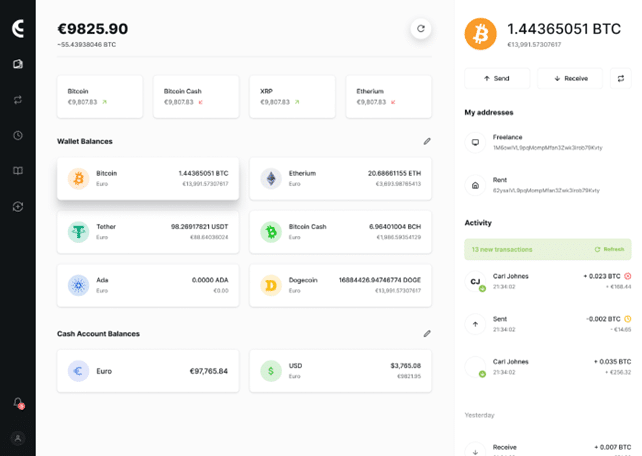
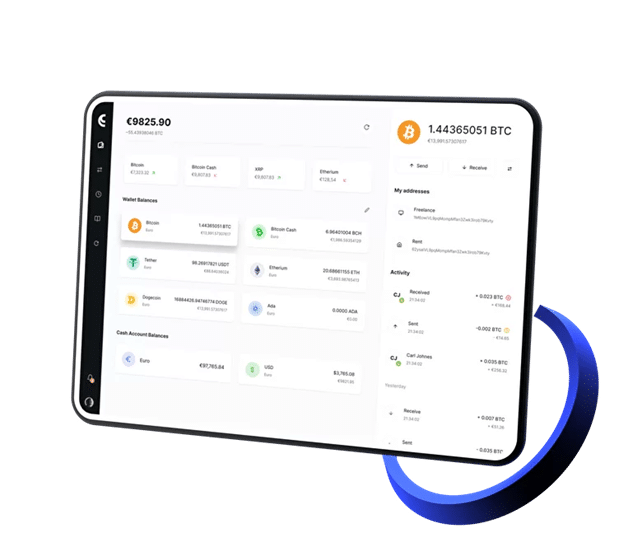
The interface of CoinsPaid wallet

Hot or cold: choosing the right type of crypto wallet for business

Cryptocurrency wallets come in two basic types: hot and cold.

A hot crypto wallet is a piece of software that requires an internet connection to work. It can come in the form of an online app that you access through a website; a program that is installed on a desktop; or a mobile app. Hot wallets are free, except for the transaction fees.

A cold wallet is a hardware device that is kept disconnected from the internet, except for cases when you need to transfer cryptocurrency to or from it. The most popular models are Ledger Nano and Trezor, Both cost around $120-250.

A Ledger Nano S Plus wallet

Cold wallets are very safe, since hackers have no way of accessing them (as they aren’t connected to the internet). A cold wallet is recommended for long-term storage of large amounts of crypto.

On the other hand, the key advantage of a crypto hot wallet over a cold one is that it’s always ready whenever you need to make a transaction. All the wallets for merchants are of the hot type.

A general hot wallet or a business wallet?

There’s one more distinction we need to make: that between the general-use crypto wallets, designed for individuals, and those created with companies in mind. By general-use wallets we mean those that regular crypto holders (individuals) use, such as MetaMask, Trust Wallet, Exodus, Guarda, etc.

A hot wallet for crypto that is designed for merchants can have the following features that a regular one won’t:

  • Integration to a crypto payments system. Practice shows that accepting crypto payments for online purchases to an address of a general Bitcoin hot wallet like Exodus isn’t a good idea. Merchants simply can’t keep track of all the transaction confirmations, and there is a risk that you will receive ‘dirty’ Bitcoins (coins that have been involved in criminal activity). Building one’s own payment system is too expensive and time-consuming, so it’s really better to rely on a professional payment provider, such as CoinsPaid.
  • Support of both crypto and fiat currencies, so that you can exchange Bitcoin into USD, for example. This minimizes volatility risks: even if the price of BTC drops by 10% in a day (which sometimes happens), your revenue won’t suffer;
  • Withdrawals to a linked bank account via SEPA / SWIFT;
  • Professional customer support by the wallet’s team;
  • Enhanced security, as the wallet provider will have their own security team. The best hot wallets are really safe, though users need to exercise caution not to disclose their passwords etc.
  • All the official documents needed for business to integrate this payment method into the ecosystem.

CoinsPaid offers both types of wallets: a hot wallet for business, which we’ll examine in some detail in the next section, and a personal crypto wallet. The difference is that the hot wallet for business is fully integrated with CoinsPaid’s payment processing solution.

Apart from CoinsPaid, some of the best hot wallets for cryptocurrency that are suitable for merchants include:

  • com – supports BTC and BCH (Bitcoin Cash);
  • Binance Pay – by the biggest crypto exchange Binance and also integrated with Binance Card;
  • Coinbase – supports 8 cryptocurrencies, including Shiba Inu and Dogecoin.

CoinsPaid: is this the safest hot wallet for business?

Coinspaid
CoinsPaid

CoinsPaid is the world’s largest cryptocurrency payment provider by volume, and its CoinsPaid Business wallet is one of the best crypto hot wallets designed for businesses. It has a number of advantages that aren’t found in most other merchant wallets:

  • Supports more than 20 cryptocurrencies and over 40 fiat currencies;
  • An in-house security team plus partnerships with two major blockchain security providers Scorechain and Crystal to identify and red-flag suspicious transactions (such as ‘dirty’ Bitcoins);
  • CoinsPaid’s products have been audited by Hacken, and 10Guards – yet another reason to consider it the safest wallet for merchants;
  • Built-in instant crypto exchange and even an OTC desk for large transactions;
  • Instant transaction confirmation thanks to a partnership with GAP600. With other wallets, it can take as much as an hour to confirm one Bitcoin payment; with CoinsPaid you don’t have to wait till a transaction is confirmed in the mempool. You get your crypto instantly to your wallet.
  • Merchants can automatically convert crypto to fiat on the go and then withdraw to a bank account via SEPA / SWIFT
  • Possibility to set different individual transaction limits for withdrawals in different cryptos;
  • All the necessary documentation for tax and reporting purposes provided upon request;
  • Different access rights for various users, plus an address whitelist.

Integrating CoinsPaid and cryptocurrency payments doesn’t take long. Every merchant is assigned a personal integration manager that guides a client through the integration process . Aside from this, merchants can even get advice on how to attract crypto traffic to their site and access new audiences of crypto holders.

Summary

  • Dozens of thousands of merchants accept crypto, attracted by low payment costs, enhanced security, and near-universal acceptance.
  • Apart from accepting payments, business wallets make it possible to settle with partners and pay affiliates.
  • A hot wallet is more suitable for accepting and sending payments, while a cold wallet should be used to store large amounts.
  • The best hot wallets for business have many features that regular crypto wallets don’t such as fiat settlements to a bank account, extra security, customer support, etc.
  • One of the best hot wallets for merchants is CoinsPaid, which supports 40+ fiat currencies and 20+ cryptocurrencies, instant transaction confirmation, and more.
  • Integrating a crypto wallet for business is a quick and painless process, as long as you go with an established provider.

Elon Musk Demands 3 Dogecoin for Visit to Twitter HQ

0

The recent remarks underscore the billionaire’s affinity for Dogecoin payments.

Elon Musk, American business magnate and CEO of Twitter, once again made an allusion to Dogecoin (DOGE), particularly mentioning, in a lighthearted tone, that a visit to Twitter headquarters would cost a total of 3 DOGE.

The latest remarks came in response to an inquiry from CB Doge, a Dogecoin UX/UI, and Graphic designer who has chosen to remain anonymous. He revealed that he plans to visit the United States next month for the SpaceX Starship Launch, which Musk disclosed could occur in the third week of April.

Furthermore, DogeDesigner noted that he aims to visit Twitter headquarters in San Francisco. According to him, he was requesting permission to pay a visit. In response, Musk jokingly noted that it would cost 3 Dogecoin (valued at $0.23) to visit.


Despite the lighthearted nature of this interaction, it has caught the public’s attention, with DOGE proponents using it as an opportunity to call attention to the asset. Musk habitually makes these playful remarks about Dogecoin on occasion, underscoring his long-standing advocacy for the asset.

Musk’s Affinity to DOGE Payments

In the past, Musk had persistently teased that Twitter would introduce a payments system and integrate Dogecoin. Following these hints, several notable influencers propagated claims that the Twitter CEO is reportedly working with developers to integrate DOGE into Twitter, but there is little evidence that suggests this.

Recall that Tesla, Elon Musk’s electric vehicle company, started accepting Dogecoin last January. Musk disclosed four months later that SpaceX, his spacecraft firm, will soon start accepting Dogecoin. In 2021, SpaceX accepted DOGE payments for its “DOGE-1 Mission to the Moon.”

Moreover, last October, Musk’s Boring Company introduced “Burnt Hair,” a fragrance product. The billionaire noted that payments for the product could be made in DOGE. Considering Musk’s affinity to DOGE payments, several proponents believe Twitter could integrate Dogecoin in the future, but this remains to be seen.

Montenegro’s Minister of Interior Says Terra Founder Do kwon Arrested in Montenegro

0

Do Kwon Reportedly Arrested in Montenegro.

The development was shared by the country’s Minister of Interior, who disclosed that authorities are awaiting confirmation of his identity.

Founder of Terraform Labs, Kwon Do-hyung – popularly known as Do Kwon – has reportedly been arrested in Podgorica, the largest and capital city of Montenegro. The disclosure comes six months after a South Korean court issued an arrest warrant for Kwon.

Filip Adzic, Montenegro’s Minister of Interior, shared the development stating that an official announcement will follow shortly once the authorities have confirmed his identity.


According to Adzic, the individual suspected to be Do Kwon was apprehended by the Montenegrin police at the airport in Podgorica in possession of falsified documents. Adzic highlighted that authorities want Kwon in South Korea, Singapore, and the United States.

Do Kwon was branded as a wanted fugitive by South Korean authorities six months back. Authorities claim the Terraform Labs founder has been evading them following a warrant for his arrest issued by a Judge in the Seoul Southern District Court in September 2022. Interpol also reportedly issued a red notice for him in the same month.

Kwon, who insists he is in Singapore, has repeatedly dispelled these allegations, claiming that he is not on the run and willing to work with the authorities as they investigate the Terra collapse of May, which led to over $40 billion in losses for investors.

Despite claiming he is in Singapore, Do Kwon had failed to divulge his actual location, citing security concerns. Singaporean authorities previously revealed that, despite his claims, Do Kwon is not in the country and is currently on the run. Reports that he had flown to Dubai surfaced shortly after.

In February, South Korean authorities entered Serbia in search of him amid reports that he had moved to the country. Despite these developments, Do Kwon had been active on Twitter, with the last tweet from his personal account dating back to Feb. 1.

Notably, the United States Securities and Exchange Commission (SEC) also brought charges against Do Kwon in February, claiming that the South Korean developer defrauded investors by offering unregistered securities.

XRP Ledger Foundation Releases Updated UNL Now Boasting 36 Validators

0

It made three additions from community-owned validators.

The XRP Ledger Foundation (XRPLF) has updated its Unique Node List (UNL), increasing the number of validators trusted by the foundation from 34 to 36.

The group revealed this in a tweet today. Notably, the last time the XRPLF updated its UNL was in January, when the list was reduced from 35 to 34. In January, the number of Ripple-owned validators was reduced from two to one in line with its one validator per entity policy. The XRPLF initially reduced this number to two in October. Nonetheless, it bears mentioning that the blockchain payments company incentivizes most university-run validators. 

For context, a UNL is a list of validators an XRPL participant trusts not to conspire against them. While each participant on the network can choose their own UNL, it is usually based on a default list by a trusted publisher. Trusted publishers include Ripple and the XRPLF. It is worth noting that the XRPL has over 150 validators that can be chosen from to create a UNL.

In its latest list, the XRPLF made three new additions recognizing the impact of long-standing community validators. The additions include xrp.vet run by pseudonymous xrp.cafe co-founder Vet (@Vet_XO), recall that the NFT marketplace recently received a nod from Ripple Chief Technology Officer David Schwartz, katczynski.net run by Christian Katczynski, and xrpgoat.com run by the pseudonymous XRPGoat.

Conversely, only the coil.com validator was removed from the list. The XRPLF noted that the decision came at the heels of a request from the company. In an open letter last February, Coil disclosed that it would be shuttering its services in February this year as it focuses efforts on building the Interledger Foundation to support the Interledger payment network it developed.

CryptoArsenal (_@CryptoArsenal), a prominent community member, in a quote tweet, provided a full view and graphic representation of the latest XRPLF UNL.

Polkadot (DOT) And RenQ Finance (RENQ) Are Seen As The Future of DeFi In 2023 And Beyond

0

Decentralized Finance (DeFi) is a rapidly growing sector within the cryptocurrency industry, with new projects emerging almost every day.

However, not all DeFi projects are created equal, and some have the potential to revolutionize the way we interact with financial services. In this article, we will explore two such projects: Polkadot (DOT) and RenQ Finance (RENQ).

Polkadot (DOT)

Polkadot is a next-generation blockchain platform that aims to provide interoperability between different blockchains. The platform was created by Gavin Wood, one of the co-founders of Ethereum, and launched in 2020. The project has quickly gained popularity, and its market capitalization currently ranks it among the top 10 cryptocurrencies.

Polkadot’s unique architecture allows for interoperability between different blockchains, which enables developers to build decentralized applications (DApps) that can communicate with each other seamlessly. This is a significant improvement over the current state of affairs, where most DApps are siloed within their respective blockchains.

Polkadot achieves this through the use of “parachains,” which are individual blockchains that are built on top of Polkadot. These parachains can communicate with each other through the Polkadot relay chain, allowing for seamless interoperability.

In addition to interoperability, Polkadot also provides a high degree of scalability, security, and governance. These features make it an attractive platform for developers to build their DApps on, as they can benefit from the security and scalability provided by Polkadot.

RenQ Finance (RENQ)

RenQ Finance is a DeFi platform launched in 2023 that aims to provide institutional-grade liquidity to the DeFi market. Its innovative features have quickly gained popularity, and the platform’s fast-growing presale has been oversubscribed in the first and second stages after launch. The third stage is currently ongoing and has already raised over $2.9 million in a short amount of time.

RenQ Finance achieves its goal of providing institutional-grade liquidity through the use of a hybrid infrastructure model that combines on-chain and off-chain elements. This model allows for fast and efficient trading while also providing a high degree of security.

One of the standout features of RenQ Finance is its order book-based exchange, which provides liquidity and slippage-free trading. This is in contrast to the automated market maker (AMM) model used by many other DeFi platforms, which can suffer from high slippage and liquidity issues.

BUY RENQ TOKENS HERE

In addition to its exchange, RenQ Finance also provides a comprehensive suite of DeFi tools, including a wallet, farms, and cross-chain interoperability. The platform’s cross-chain compatibility is particularly noteworthy, as it allows users to trade assets across different blockchains seamlessly.

Future of Polkadot and RenQ Finance in DeFi

The future of Polkadot and RenQ Finance in DeFi looks bright, with both projects well-positioned to capitalize on the growing DeFi market. Polkadot’s unique architecture and scalability make it an attractive platform for developers to build their DApps on, while RenQ Finance’s institutional-grade liquidity and comprehensive suite of DeFi tools make it a popular choice among traders and investors.

In the coming years, we can expect to see more DApps built on Polkadot, which will further increase the platform’s popularity and market capitalization. Additionally, we can expect to see RenQ Finance expand its suite of DeFi tools and continue to provide institutional-grade liquidity to the market.

Furthermore, RenQ Finance passing the Certik audit test is a significant advantage for the platform as it has instilled confidence in investors. Many experts are predicting a massive surge in price for the project, and this has attracted more investors to invest in the platform, further pushing the token to be seen as the future of DeFi.

In summary, the institutional-grade liquidity and extensive range of DeFi tools offered by RenQ Finance make it an attractive choice for developers, traders, and investors alike. With the DeFi market ready for growth, RenQ Finance is well-positioned to become a DeFi giant in 2023 and beyond.

Click Here to Buy RenQ Finance (RENQ) Tokens.

Visit the links below for more information about RenQ Finance (RENQ):

Website
Whitepaper

Shiba Inu L2 Layer Shibarium Docs Ready Says Group Admin

0

Developers might release more than just the documentation.

The official Shibarium documentation is ready according to an admin of the “SHIBARIUM TECH” Telegram group.

According to the message from the admin, known as “Someone Smart (maybe),” developers have not released it because they are reviewing the fine details with Shiba Inu lead developer Kaal Dhairya. Additionally, the admin noted that developers might release more than just the docs. What it could be, remains to be seen.

“Docs are completed and the reason of slight delay is it is being checked with kaal to mark sure everything is fine,” the admin wrote. “Also, we will release more things than docs if possible.”

Notably, prominent Shiba Inu influencers $SHIB KNIGHT (@army_shiba) and LUCIE (@LucieSHIB) also shared the message on Twitter. See tweets below:

Recall that developers had initially disclosed that they would release the docs a week after the beta version of the proposed Ethereum Layer 2 solution launched—the beta version launched on March 11, now nearly two weeks ago. Furthermore, in a Twitter thread on March 16, Kaal had said the docs would ship in 4 to 5 days.

It bears mentioning that the project has faced significant criticism in recent weeks, with the biggest claim being that the code was simply copied from another upcoming project known as Rinia. As reported, the Rinia developer has debunked this claim. 

Shytoshi Kusama, the pseudonymous Shiba Inu lead developer, in the past promised that Shibarium would not only serve as a Layer 2 platform for members of the Shiba Inu ecosystem but would also attract members of the broader crypto community. In addition, it promises to burn SHIB with each transaction, a promise that has the community excited at the prospect of a significantly reduced token supply that could see the value of their holdings boost in price.

Did This Pro-XRP Lawyer’s Prediction Just Come True?

The SEC sets its sight on Coinbase’s asset listing.

In July, CryptoLaw founder and pro-XRP attorney John Deaton predicted that the United States Securities and Exchange Commission (SEC) would eventually sue a U.S.-based crypto exchange before the end of the year, naming Coinbase and Binance.US as potential targets.

It seemed likely that it would happen as just a day later, the SEC, in a complaint against former Coinbase employee Ishan Wahi alleged that nine assets traded on the crypto exchange were unregistered securities. In addition, the regulator launched investigations into the publicly traded exchange. 

However, the year came to an end, and nothing happened. Deaton stuck to his prediction carrying it over to 2023. It is a prediction that has come true in part with recent SEC enforcement actions against Gemini and Kraken. 

But the attorney has maintained that the SEC would go after an exchange for offering unregistered securities for trading. Most recently, the attorney reiterated this view as he expressed confidence that the controversial Hinman documents would become publicly accessible, regardless of what happens in the Ripple case.

For context, the SEC enforcement actions against U.S.-based exchanges so far have revolved around yield and staking products and not around tokens offered by the exchanges, at least until yesterday.

As highlighted in a report today, the SEC has issued a Wells notice to Coinbase. The notice expressed the SEC’s belief that an unspecified portion of its listed assets, Coinbase Earn (its staking program), Coinbase Prime, and its non-custodial wallet violated investor protection laws.

So Has Deaton’s Prediction Come True?

Today’s report explains that a Wells notice informs a firm or individual of the SEC’s belief that the receiver has violated securities law. 

It allows the recipient to try to convince the commission otherwise. From the moment a Wells notice is issued, the SEC has a six-month window to decide whether or not to pursue enforcement action in court.

So while Deaton’s prediction has technically not come true yet, it seems more likely than ever as the SEC attempts to assert jurisdiction over the nascent market one enforcement action at a time.

The attorney described the SEC’s conduct as disgraceful, responding to the Wells notice and Coinbase’s response today.

Rexyz Outlines How Terraport Will Fuel Terra Classic Growth

0

TerraCVita Senior Member States How Terraport Can Help Terra Classic (LUNC).

According to Rex, Terraport will help bring projects to Terra Classic and support the burn initiative by incinerating LUNC tokens.

Rex “Rexyz” Harrison, a senior member of the Terra Classic (LUNC) development group TerraCVita, has once again outlined the avenues through which the upcoming Terraport project can help the Terra Classic ecosystem.

According to Rexyz in a recent tweet, Terraport will serve as an all-encompassing project serving as a crypto exchange and a launchpad, among other things. Moreover, the project will help create numerous trading pairs of LUNC with other tokens, thereby making it easy to buy and sell LUNC. This should help provide liquidity.


Terraport as an Exchange 

As an exchange, Terraport will leverage some of its fees to the benefit of Terra Classic through several means. One of these means is by burning LUNC with a portion of the fees. The fees will also be used to burn TERRA, Terraport’s native token, and provide staking rewards to people who stake the token. Rexyz also disclosed that a portion of the fees would go into improving Terraport.

In addition, the fees will be utilized to help TerraCVita and other developers build new projects for the Terra Classic ecosystem. An example of such is Edward Kim’s idea of a Machine Learning project. Rexyz previously disclosed that TerraCVita is in talks with Zaradar and Kim to learn how Terraport can help to make the project successful.

Terraport as a Launchpad

A crypto launchpad is a platform that provides a range of services to support the launch and growth of new cryptocurrency projects. As a launchpad, Terraport will help bring projects into the Terra Classic ecosystem through several avenues.

One of these avenues is by raising funds to develop these projects. Terraport will also help create new tokens on the Terra Classic blockchain as it facilitates building on the network. Functioning as a launchpad, Terraport will also assist in adequately marketing these projects to attract investors to the blockchain.

Conclusively, Rexyz noted that Terraport’s success is contingent on the support the Terra Classic community gives to TerraCVita as the group looks to use this project to promote LUNC. Recall that TerraCVita confirmed that the project will launch on March 31.