Home Blog Page 2067

Shiba Inu (SHIB) And Dogecoin (DOGE) See No Real Use Cases Compared to RenQ Finance (RENQ)

0

Investors and traders are constantly looking for the next big thing as the cryptocurrency market grows. Recent price increases for Shiba Inu (SHIB) and Dogecoin (DOGE) have made headlines. However, there are some doubts about their long-term sustainability as investments. RenQ Finance (RENQ) multiple use cases help in this situation.

Unlike DOGE and SHIB, RENQ has a clear and practical use case. RenQ Finance is a decentralized finance (DeFi) platform that allows users to easily and securely trade cryptocurrencies, access liquidity pools, and participate in yield farming. This makes RENQ a valuable asset for anyone investing in the growing DeFi space.

Furthermore, RENQ’s underlying technology is based on the Ren Protocol, a cross-chain protocol allowing interoperability between different blockchain networks. This means that RENQ can facilitate seamless trading between different cryptocurrencies and blockchain ecosystems, opening up a world of possibilities for investors and traders.

Investors In Dogecoin (DOGE) And Shiba Inu (SHIB) Fear Further Devaluation

Shiba Inu (SHIB) and Dogecoin (DOGE) investors are increasingly concerned about these joke currencies’ future worth. Despite the early excitement around Shiba Inu (SHIB) and Dogecoin (DOGE), the cryptocurrencies’ prices have progressively fallen lately.

A good example is the stunning 77.40% decline in Dogecoin’s price over the past year, which has resulted in severe losses for many investors. This downward trend has not been halted, not even with the help of well-known individuals like Elon Musk.

Many investors now turn to presale RenQ Finance (RENQ) as a more secure and stable investment option. Unlike Dogecoin (DOGE) and Shiba Inu (SHIB), RENQ has a clear and practical use case, which makes it a valuable asset for those who want to invest in the growing DeFi space.

Similarly, the value of Shiba Inu (SHIB) has also been falling in recent months, causing many investors to sell their coins. The sudden disappearance of SHIB’s creator from social media has also raised concerns about the coin’s reliability among investors.

With all these uncertainties, investors are unwilling to take chances on Dogecoin (DOGE) and Shiba Inu (SHIB). Instead, they are moving towards more practical and reliable investments like RenQ Finance, which has a clear use case and a promising future in cryptocurrency.

BUY RENQ TOKENS HERE

The Practical Applications of RenQ Finance (RENQ) in the Cryptocurrency Space

RenQ Finance (RENQ) is a community-driven organization that addresses the liquidity issue in digital currencies and decentralized finance. RenQ combines the advantages of centralized and decentralized exchanges to provide a comprehensive solution accessible to all sorts of traders, from beginners to seasoned pros.

RenQ’s progress is designed to create a wider variety of network effects, unlike other solutions that provide incremental advances toward solving the liquidity problem. With RenQ Finance (RENQ), users receive full custody of their assets when using the platform, ensuring top-level security through the RenQ Wallet.

RenQ Enclave is turned on by default, and optional Two-factor authentication (2FA) provides an extra layer of security for users to keep their seed/private key secure. RenQ’s solution weaves together different decentralized markets and instruments, offering users all the benefits of centralized exchanges while using a decentralized solution.

BUY RENQ TOKENS HERE

Final Thoughts

The fear of further devaluation of Dogecoin (DOGE) and Shiba Inu (SHIB) is causing many investors to rethink their investment strategies. The decline in the value of these meme coins and the uncertainty surrounding them has made them less attractive to investors.

RenQ’s mission is to create a protocol that solves the liquidity problem and accelerates the adoption of cryptocurrencies and decentralized finance. As a result, more and more investors are flocking to its presale as a reliable investment option. RenQ Finance (RENQ) recently completed its first round of presale, raising over $1 million in just a few days. The ongoing second round is on track to outdo this achievement as more investors learn about the undervalued gem. Don’t fall behind. Join other astute investors who are betting on RenQ Finance’s success today. Analysts predict a 1000x return probability upon launch!

Click Here to Buy RenQ Finance (RENQ) Tokens.

Visit the links below for more information about RenQ Finance (RENQ):

Presale
Whitepaper

Will TMS Network (TMSN) Outperform Conflux (CFX) and Litecoin (LTC) During The Next Big Cryptocurrency Wave?

0

2023 was a new dawn for cryptocurrencies. Market bulls are coming in, and everybody expects the next big wave of cryptocurrencies. Amid the hype, TMS Network (TMSN) is gaining much attention for its cutting-edge technology aimed at improving trading. TMS Network (TMSN)’s presale is aiming for the moon. However, can it outperform established coins like Litecoin (LTC) and Conflux (CFX)? Let’s find out.

TMS Network (TMSN) Setting the Standard for Trading

TMS Network (TMSN) is a revolutionary blockchain-based platform designed to enhance the trading experience. The platform provides a secure and transparent environment that enables traders to buy and sell a range of assets, including CFDs, stocks, cryptocurrencies, and Forex. Its unique architecture ensures high liquidity, making it an ideal choice for traders of all levels.

TMS Network (TMSN) is built on a secure framework that leverages the power of smart contracts to execute transactions. This approach has eliminated intermediaries, reducing the cost of trading and increasing speed. Furthermore, TMS Network (TMSN) is designed to be scalable, allowing it to handle a growing number of trade activities without compromising its speed.

At its pinnacle, TMS Network (TMSN) boasts an intuitive, user-friendly interface that enables traders to navigate the platform with ease. The platform provides many financial education resources, including trading signals and market analysis. Aside from this, traders can use its long list of advanced trading tools, including real-time market data, price aggregators, indicators, trading terminals, AI builders, automated bots and software, etc., for price analysis, and actionable decisions.

TMS Network (TMSN) recently completed the first phase of its presale, and the TMSN token is still seeing a meteoric rise in demand. The second round is set to sell out faster than expected for $0.025. TMS Network (TMSN) has started outperforming many existing coins like Litecoin (LTC) and Conflux (CFX) as its presale price continues to skyrocket. Early investors are up by more than 8000%, and experts are looking at another 1000x at launch.

Conflux (CFX) Chain Grows By 1400% as Adoption and Partnership Grows

Since the year, Conflux (CFX) has been soaring higher, outpacing many top cryptocurrencies as its demand miraculously rose amid market uncertainties. Conflux (CFX) is an open, permissionless, and public layer-one chain. As China’s only regulatory-compliant network, Conflux (CFX) is regarded one of the most scalable chains. It features a hybrid of Proof of Stake and Proof of Work consensus algorithm named the Tree Graph methodology.

Conflux (CFX) has high scalability because it is capable of parallel transaction processing – thus, it has massive throughput, high speed, and low fees. Over the past week, Conflux (CFX) grew by an astonishing 540% after announcing a partnership with the Chinese social media platform, Little Red Book. Conflux (CFX) furthered its bullish price action, peaking at 1500% following the Chinese Telecom partnership and $10 million funding.

Litecoin (LTC) Price Struggling Ahead of Highly Anticipated Halving

Litecoin (LTC) was developed from the fork of Bitcoin shortly after its launch in 2011. Although Litecoin (LTC) is not the only chain using Bitcoin’s architecture, it is one of the most significant ones. Litecoin (LTC) has better throughput, speed, and transaction cost than Bitcoin and therefore is more efficient. In fact, Litecoin (LTC)’s development gave rise to scaling solutions like Segregated Witness (SegWit) and Lightning Network.

Like Bitcoin, Litecoin (LTC) undergoes halving, which always boosts its value. Surprisingly, the network is still struggling in lows ahead of the next halving in August 2023. Currently, Litecoin (LTC) is hovering around $90 and is still about 78% below the all-time high value of $413 in May 2021. Meanwhile, analysts are speculating about a surge in its price in the next crypto wave.

Conclusion

While established coins like Conflux (CFX) and Litecoin (LTC) have their unique features and strengths, TMS Network (TMSN)’s presale success and growth potential make it an exciting coin to watch in the coming years. Its cutting-edge technology, robust tools, AIs, and user-friendly interface make it an excellent choice that traders must not fade.

Presale

Whitepaper

Website

Telegram

Discord

Twitter

TMS Network (TMSN) vs. Solana (SOL) and Zilliqa (ZIL): Which One Could Offer the Best Returns in the Upcoming Bull Market?

0

There are thousands of cryptocurrencies in the market. However, the best ones piquing investors’ interest include TMS Network (TMSN), a decentralized trading hub, Solana (SOL) and Zilliqa (ZIL). TMS Network (TMSN) has already shown huge potential to become the next blue chip investment with its tremendous surge in presale. The question remains, can it offer better returns than existing coins like Solana (SOL) and Zilliqa (ZIL)? Read on to learn more.

TMS Network (TMSN)

TMS Network (TMSN) is a new decentralized one-stop trading hub disrupting trading with its revolutionary features. Using blockchain technology, TMS Network (TMSN) was built to solve conventional trading problems, including centralization, high fees, low returns on investment, slow transaction time, and limited transparency.

TMS Network (TMSN) came up with a state-of-the-art intuitive multipurpose asset trading Ethereum-based protocol that eases the trading of multiple digital assets. With TMS Network (TMSN), anyone can trade cryptocurrencies, stocks, CFDs, as well as Forex, thus providing high liquidity that facilitates easy and faster transaction processing, deposit or withdrawal.

All transactions on TMS Network (TMSN) are controlled by the blockchain’s DLT and smart contracts to ensure they are tamper-proof, transparent, swifter, and seamless. Its decentralization cuts out intermediaries. Hence, the platform can help users finalize their trades at lightning speed for lower fees.

The most important part of TMS Network (TMSN) is its educational resources, like trading signals and market analysis, to promote financial literacy. There is also a long list of trading tools, robust AIs and APIs, which includes price aggregators, real-time price data, on-chain metrics, powerful indicators, and multiple terminals with automated trading bots.

The presale of TMS Network (TMSN) sold out faster than speculated in its first stage. The project has raised over $500k in just two weeks of its launch, and the second round is seeing astronomical demand too. As a result, the TMS Network (TMSN) token is trading at $0.025 from the $0.0003 launch price.

Zilliqa (ZIL)

Zilliqa (ZIL) is a permission less blockchain platform that utilizes innovative sharding technology to address the issues of scalability and throughput. Sharding involves dividing the network into nodes that can process transactions in parallel, thus enhancing speed and scalability. Zilliqa (ZIL)’s high throughput makes it an attractive option for developers to host decentralized apps and execute smart contracts without facing congestion and high gas fees problems.

Zilliqa (ZIL) token has performed below expectations, especially since attaining an all-time high price of $0.26 in May 2021. Currently, the Zilliqa (ZIL) token is trading at $0.027, about 89% below ATH. Although investors’ interest is continuously waning, analysts believe continuous demand and growing development of Zilliqa (ZIL) can boost its token price.

Solana (SOL)

Like Zilliqa (ZIL), Solana (SOL) is a highly scalable open-source layer one chain with smart contract compatibility. Solana (SOL) was designed to support developing and deploying smart contracts, dApss and DeFi protocols. It features an innovative hybrid algorithm, the Proof of History consensus mechanism, that gives it its high throughput, gas efficiency, scalability and low-cost transaction.

Solana (SOL)’s hybrid consensus and goal to make DeFi accessible has enjoyed the attention of developers, traders and institutional investors. Within a few years, it has become one of the most used chains. At its peak, the Solana (SOL) token had more than $80 billion in market capitalization, with its TVL peaking at $9.6 billion. Unfortunately, the token lost much value to macroeconomic conditions, crypto winter and periodic network-wide outages.

Which one could offer the best returns?

While all three coins have unique features and growth potential, TMS Network (TMSN) has shown tremendous potential with its innovative one-stop trading hub and educational resources. Its successful presale and impressive price surge are evidence of investors’ confidence in the project. You can participate by signing up for the presale at this early stage.

Presale

Whitepaper

Website

Telegram

Discord

Twitter

Team Behind P2E Game on Terra Classic Gets Support to Use TerraCVita Endpoints

0

Garuda Nodes team behind the new play-to-earn (P2E) game on the Terra Classic blockchain Gets Support from Rex to Use TerraCVita Endpoints.

Rex disclosed that he had advised the independent validator to leverage TerraCVita endpoints for their projects.

Garuda Nodes, an independent Terra Classic validator, has received support from Rex “Rexyz” Harrison, a senior member of the TerraCVita development group. Rex directed the validator to leverage TerraCVita endpoints on Public Node to enhance the development of their projects on Terra Classic.

According to a recent tweet, Rex disclosed a productive discussion with the team behind Garuda Nodes earlier this Monday. He guided them into utilizing the endpoints operated by TerraCVita on Public Node, an endpoint suite provided by Allnodes.


Rex advised the community to support all projects attempting to introduce utility to Terra Classic by building on the blockchain and burning LUNC. He noted that support should not be limited to projects affiliated with TerraCVita, such as Terraport and Terra Casino.

In response, the Garuda Nodes team thanked Rex for the support and help rendered.


Endpoints nodes are computer servers that act as a gateway between a blockchain network and external applications or services, allowing these applications to connect and communicate with the blockchain.

Public Node is a suite of endpoints released last December by Allnodes, a non-custodial hosting, and staking service provider. This suite is designed to provide endpoints for decentralized applications (DApps) built on various blockchain networks, including Terra Classic, Ethereum, Polygon, Avalanche, and Evmos.

As observed on the official Public Node platform, all current 22 LCD and FCD Terra Classic nodes are operated by TerraCVita.These endpoint nodes will enable Garuda Nodes to connect its projects to the Terra Classic network, ensuring seamless communication with the blockchain.

As reported last week, Garuda Nodes has disclosed plans to launch a new play-to-earn (P2E) game on the Terra Classic blockchain in the year’s second quarter. The team behind the validator confirmed that the game is expected to facilitate on-chain LUNC burns. TerraCVita commended the effort in response to the disclosure.

Is SBF, Ryoshi? Coinbase Director Draws Links Between Shiba Inu Creator and Alameda

0

An OpenSea account connected to a wallet linked with Ryoshi shares the same name with SBF’s trading firm Alameda Research.

Coinbase Director of Project Strategy & Business Operations Conor Grogan has drawn links between Ryoshi, the anonymous Shiba Inu creator and Sam Bankman-Fried’s Alameda Research. 

Grogan did this in a Twitter thread yesterday, showing that a Bitkub deposit address used by Ryoshi was linked with an OpenSea account named “ALAMEDA.” As highlighted by Grogan, Ryoshi used the deposit address twice in 2020 and 2021. As explained by the Coinbase director, Bitkub does not change deposit addresses, a fact that the crypto creator may not have been aware of.

Additionally, Grogan pointed out that the OpenSea account minted an SBF-inspired NFT. Meme Ltd. created the “SBF Legendary” collection in September 2020. It has only ten pieces, with eight owners at the time of writing. It is listed for 25 ETH, a little over $39,000 at current rates.

The Coinbase executive, who occasionally shares interesting blockchain data, disclosed that it is unclear why Ryoshi would take Alameda’s OpenSea handle in 2020, suggesting perhaps the SHIB creator was holding on to it for memes.

Meanwhile, it is not the first time Grogan has drawn links between the popular doggy-themed meme coin and Alameda. In a thread last month, the Coinbase director shared data that indicated that Alameda, at the time the largest SHIB farmer, likely formed the top of the last bull run for the meme coin by dumping it just as FTX expanded SHIB perpetual trading. 

Unsurprisingly, Grogan’s latest findings have led to speculation that SBF is Ryoshi. In response, some Shiba Inu community members have turned to @LucieSHIB, a popular community influencer and Shytoshi Kusama, the volunteer project lead, for responses. At the time of writing, both are yet to respond. 

It is worth noting that Ryoshi, following in the footsteps of Satoshi Nakamoto, the anonymous Bitcoin creator, disappeared from the scene in May 2021. Despite this, the community continues to follow Ryoshi’s vision for the project, an example being Shibarium, a proposed Ethereum Layer 2 protocol, which Kusama maintains will launch soon.

Ripple and Binance Move 134M XRP as Whales Shuffle 230M Tokens

0

364 million XRP tokens have been moved in five whale transactions in the past 24 hours.

Ripple and Binance just moved over 134 million XRP tokens in two separate unrelated transactions, with Ripple sending 100 million tokens to an unidentified wallet and Binance transferring 34 million. Amid these movements, whales have shuffled 230 million tokens in the past 24 hours.

Binance and Ripple Movements

The Binance transaction was the earliest of the bunch, having occurred yesterday at 09:03 (UTC), as highlighted by Whale Alert. The exchange transferred the tokens worth $12.3 million to an unidentified wallet address, per data from Bithomp.


Over 10 hours later, Ripple transferred 100 million XRP valued at $36.9 million to an unknown wallet in a separate unrelated transaction. The tokens were part of the 1 billion XRP the Silicon Valley company unlocked from escrow on March 1. It is presumed that the transfer was intended for financing the company’s internal operations or for ODL purposes.


Ripple has a pattern of periodically transferring batches of 100 million XRP tokens in this manner. The company recently executed these transfers on Feb. 21, Jan. 17, and Jan. 8. Similarly, Binance has also been noticed to perform such sizable XRP transactions, moving over 94 million tokens two months ago.

Other Whale Movements

Besides the recent Binance and Ripple transactions, XRP whales shuffled 230 million tokens in three transactions within three hours. The largest transaction saw the movement of 144 million XRP ($53.5 million) between two unknown addresses yesterday at 20:35 (UTC).


The recipient wallet immediately started offloading the assets in batches of millions to several addresses. One such transaction was the transfer of 45 million XRP to a Bitstamp address yesterday at 22:57 (UTC).

Shortly after that, Whale Alert highlighted an in-house transfer between two Bitso wallets which saw the movement of 41.6 million XRP ($15.4 million).


Single Project Burns 51 Million Terra Classic (LUNC) At once

0

Cremation Coin Burns 51M+ Terra Classic, the Third Largest Burn This Year.

The project’s total cumulative burn has skyrocketed to 93.6 million LUNC tokens.

Cremation Coin just burned over 51 million Terra Classic (LUNC) tokens in a single transaction, representing its largest single burn since it jumped on the Terra Classic burn campaign last December.

Terra Finder data reveals that the transaction occurred today at 03:49 and puts the total incinerated amount at a whopping 51.7 million LUNC. The burn represents Cremation Coin’s weekly contribution to the Terra Classic burn initiative.

The team behind the project called public attention to the development shortly after carrying out the transaction.


Following its latest significant burn, Cremation Coin has secured the eighth spot among the largest LUNC burners indexed by LUNC Dash. Presently, the project’s overall cumulative token burns stand at 93.6 million. It is worth noting that due to the delayed indexing of its address, LUNC Dash data only accounts for 81.4 million tokens burned.

Since pledging its support for the Terra Classic burn initiative, Cremation Coin has converted 10% of its transaction volume to LUNC and incinerated millions of tokens weekly. Last week, the project burned 4.4 million tokens, the largest burner for the week.

The recent 51 million burn transaction is the third largest single burn transaction witnessed by the Terra Classic community this year, behind the Allnodes burn of 123.7 million tokens on New Year’s Day and the recent Binance burn of 8.8 billion tokens.

Total burns so far this week now sit at 53.5 million LUNC. Independent validator LUNC DAO has also made its mark on the burns for the week, incinerating up to 1.67 million tokens at the start of the week.

In the wake of the latest burns, the Terra Classic burn initiative has now resulted in the incineration of 48.7 billion tokens, with Binance accounting for 28.9 billion tokens, representing 59.3% of total burns.

Deaton Says Ruling in SEC v. Ripple Lawsuit Could Come ‘Tonight’

0

Ruling in SEC v. Ripple Case Imminent Following Latest Case Update, Says Deaton.

Deaton says he does not expect Judge Torres to significantly delay in giving her ruling on summary judgment motions.

Attorney John E. Deaton has opined that the ruling in the United States Securities and Exchange Commission case against Ripple is imminent. 

The CryptoLaw founder, who represents thousands of XRP holders as a friend of the case, made this known in a tweet today in response to inquiries about whether the release of the judge’s decision on Daubert motions gives any hints on the timeline for her summary judgment decision. Deaton expressed doubts that there would be significant delays. The lawyer noted that the judge could release her ruling as early as tonight or in a few weeks.

“I seriously doubt that we see a significant delay from here,” Deaton wrote. “Could be tonight or in a couple weeks.”

As reported today, in her Daubert motion ruling, the judge granted and denied motions in part from both parties to strike out expert testimony. As highlighted in the report, XRP holders were the biggest winners as Judge Torres struck out expert opinions that the SEC used to support its claims that XRP holders purchased the token with reasonable expectations of profits solely from Ripple’s efforts. 

It is worth noting that last week, the attorney indicated that the ruling in the case over whether XRP is a security could take two more months. 

As recently highlighted by Ripple General Counsel Stuart Alderoty, it would be one of three outcomes. The court could side with the SEC or Ripple or send the case to trial. 

Deaton has noted that his preferred outcome is for the court to clarify the secondary market sales of XRP, which the SEC also claims constitute unregistered securities offerings. If the judge opposes the SEC’s stance on this, it would be a significant victory for XRP holders even if Ripple loses in the district court.

30M Shiba Inu Burnt in a Day With 22M in One Transaction

0

Over 30.44 Million Shiba Inu (SHIB) have been removed from circulation forever in the past 24 hours, 22 Million in a single transaction.

Over the past 24 hours, the Shiba Inu Community-led burn initiatives have sent 30,449,440 (30.44M) SHIB to the “inferno” address via five separate transactions.

One transaction alone saw the mysterious wallet remove a massive 22 million SHIB, making it the giant SHIB burner of the day.

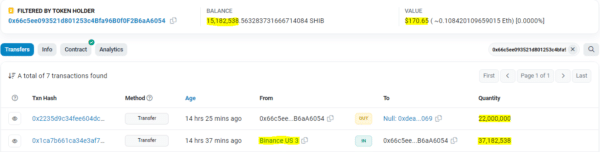
According to data from Etherscan.io, the mysterious wallet initially purchased 37,182,538 (37.18M) SHIB from a wallet associated with Binance.US (tagged “Binance US 3”) before tossing 22 million SHIB into the dead wallet. After this burn, the wallet now holds 15,182,538 (15.18M) SHIB.

Unknown Wallet Burned 22 Million SHIB

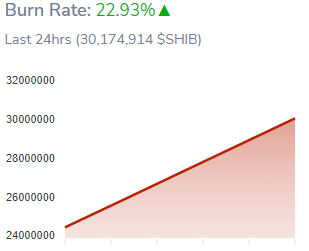
Despite this massive burn, the overall Shiba Inu burn rate had only increased by 22.93% compared to the previous day, when 24,223,415 (24.22M) SHIB was burned through five separate transactions.

Shiba Inu Burn Rate Surges By 2293 Percent in the Past 24 Hours

According to a previous report by The Crypto Basic, over the last 7 days, the Shiba Inu Community burned a massive amount of 170,718,939 (170.71M) SHIB across 59 different transactions.

The Shiba Inu ecosystem is seeing an increase in mainstream adoption. Binance.US has recently introduced a new SHIB/USD trading pair, which replaces the KSHIB/USD pair. This move was likely due to the growing popularity of SHIB, which was ranked as the fourth most searched digital currency in the US, according to a recent study by Cryptomeister.

Moreover, Shiba Inu’s governance token, BONE, has also gained traction with its recent listing on Gate.io, a global Bitcoin exchange with a long history.

Proposal Submitted to Remove Zaradar from Terra Classic L1 Team

0

The proposal claims that Zaradar is allegedly predisposed to “bend” the truth for his gains.

A Terra Classic proposal to remove Tobias “Zaradar” Andersen from the recently-formed Joint L1 Task Force has been submitted for voting. The proposal alleges that Zaradar’s presence does not benefit the Terra Classic blockchain.

Proposal 11383, submitted 19 hours ago as of press time, points out that working on the Terra Classic blockchain goes beyond an individual’s software development skills but also requires professionalism.

The proposal alleges that Zaradar lacks this sense of professionalism, claiming that he is predisposed to “bend” the truth for his own personal gain.

Furthermore, the fact that the community pool funds the L1 team was called to attention. According to the proposal, individuals getting paid by the community to carry out work on the blockchain should be “factual” and “truthful.”

Given this requirement, the proposal concluded that the survival of the Terra Classic chain is at stake should Zaradar be allowed to retain his role in the L1 team and he should be replaced with someone else.

Responding to the proposal, Zaradar quoted a renowned statement from Sir Winston Churchill, a former Prime Minister of the United Kingdom. “You have enemies? Good. That means you’ve stood up for something sometime in your life.”


The votes cast on the proposal so far suggest that the community does not agree with the content of the text. As of the time of writing, 18 validators have voted, with 6 votings “No” and 11 opting for “No with Veto.” Only 1 validator has chosen to abstain, and none has voted “Yes” to the proposal.

Voting on the proposal is expected to close in 6 days, but the community consensus has already exceeded the veto threshold as of press time.

The L1 Team has Made Considerable Progress

Recall that the L1 team was formed last December following Zaradar’s departure from the Terra Rebels group. The team, formed by Zaradar and Edward Kim, released its first funding proposal on Dec. 24, seeking $141K+ for work on the LUNC chain for Q1 2023.

Despite concerns raised then due to the financial issue with Terra Rebels, the community voted to approve the L1 team funding. Two months back, it was reported that the group had made considerable headway in its proposed Q1 work, staying ahead of its schedule.