Home Blog Page 2147

Fidelity Hints At Possible Shiba Inu Listing

0

Fidelity says it hopes to expand its cryptocurrency trading opportunities over time.


U.S.-based financial services company Fidelity Investments recently responded to a request made by a prominent Shiba Inu influencer. In a recent tweet, @ShibPP, one of the top Shiba Inu influencers, requested that Fidelity Investments consider integrating SHIB into its trading app alongside other supported cryptocurrencies- Bitcoin (BTC) and Ethereum (ETH).

“Fidelity Crypto, in addition to the ability to purchase and sell Bitcoin and Ethereum in the @Fidelity App, the SHIBARMY requests that you integrate Shiba Inu as well,” @ShibPP quizzed.

Surprisingly, the United States-based financial services company responded to @ShibPP’s request, saying it currently offers only Bitcoin and Ethereum. The company added that it has plans to expand its cryptocurrency offering in the future.

Fidelity Offers Commission-Free Crypto Trading Services

Earlier this month, Fidelity Investments announced it was offering commission-free cryptocurrency trading services to its retail clients. CNBC reported that the company named the service Fidelity Crypto – an initiative designed to allow retail investors to buy and sell Bitcoin and Ethereum. The American financial services company will provide custody services for supported cryptocurrencies through its subsidiary, Fidelity Digital Assets. 

In a statement shared with CNBC, Fidelity said: 

“Where our customers invest matters more than ever. A meaningful portion of Fidelity’s customers are already interested in and own crypto. We are providing them with tools to support their choice so they can benefit from Fidelity’s education, research, and technology.”

Fidelity also offers other crypto-related trading services, including providing Bitcoin custody services.

On April 26, Fidelity allowed its employees to have a portion of their retirement savings in Bitcoin via their 401(k) accounts.

Fidelity Will Further Boost SHIB’s Adoption

Fidelity Investments is one of the biggest financial services companies in the United States, with over $9.9 trillion in assets under management. Should the company eventually decide to integrate Shiba Inu among its cryptocurrency offerings, it would contribute to the widespread adoption of the canine-themed token among retail investors. 

Shiba Inu’s influencers have continued to push for SHIB’s mainstream adoption. Influencers were instrumental in helping Shiba Inu to be listed on Robinhood by sharing the link to a Change.org online petition on their social media pages. As reported, the online petition requested the commission-free trading platform to add support for SHIB. Interestingly, Robinhood finally listed Shiba Inu on its trading platform in April. 
Top Cryptocurrencies For College Students To Buy In 2023

0

Cryptocurrencies seem like lucrative investment opportunities, especially for college students. They are affordable (some of them are, at least), they are easy to purchase and store, and if you follow the crypto tidings, you can make decent money by reselling them once the price is higher than your purchase price. Let’s read on and see what crypto you should buy as a college student in 2023.

Why Invest When in College?

Investing when in college may seem far-fetched. After all, most students study and work part-time, which enables them to have access to just enough money to make it to the end of the month. However, starting your investment journey is always a good idea, even when you are this young since you will be able to secure a good position in the market and avoid having to time the market.

For most students, however, finding the resources (aka. money) to invest may be difficult. For this reason, you should always take up a part-time job and start making some extra cash early enough. Sure, finding the time to do so may be a limiting factor, but you can find some of the best essay writers online to help you out. Professional writers such as these can make your study notes, write a few forgotten assignments or even do prep work for an entire exam. Be wise with your time and see what you can do to use it better.

Top 5 Cryptocurrencies for Students

Once you have some resources, you can start thinking about investing in crypto. This can be a long journey, especially since so many new cryptocurrencies have sprung up since the success of Bitcoin during the 2020 pandemic. The number of new millionaires that the currency has made is difficult to estimate. With this in mind, let’s check out some of the best cryptocurrencies to invest in 2023:

  • Ethereum,
  • Polkadot,
  • Dogecoin,
  • BNB, and
  • Avalanche

Ethereum

What makes Ethereum a great investment chance is that its growth has been more stable than that of Bitcoin. Bitcoin experienced unprecedented heights during the pandemic but has slumped in the meantime, just like all other cryptos. Ethereum, on the other hand, has managed to recover and is considered the safest crypto to put your money in.

Polkadot

Polkadot (DOT) is considered to be the safest crypto to invest in. This is a no-brainer for many so that purchases of Polkadot are stable and keep driving the price up. The truth is that it is the feeling of security that comes with the tokens that people like.

Dogecoin

Unjustly named ‘shitcoin’ back in 2021, dogecoin has grown to be the largest memecoin in 2022. This coin is expected to grow in 2023, so you still have time to make your purchase. DOGE has received a lot of support from Elon Musk, and stable support from its massive number of owners is almost certain to drive the price up.

BNB

BNB is the only token on our list that strives to create an ecosystem of digital products to support its value. BNB itself shows positive trends toward growth and is likely to keep growing in 2023. In reality, any crypto can crash, but the ecosystem that BNB is building is much more than a token and acts as a balancing factor.

Avalanche

Avalanche is another cryptocurrency that is likely to experience growth in 2023. The currency itself is a competitor of Ethereum. The platform it resides on currently supports around 6,500 transactions per second, with maintained stability. The token itself allows for easy scalability without compromising performance.

Is Crypto a Good Idea?

Crypto is a great idea. Needless to say, the technology is digital, easily accessible to students, and likely to keep expanding its market. However, as with any new (disruptive) technology, the very idea that your investment could decrease in value is off-putting. For this reason, estimate how much money you really have to invest and spread your money across multiple currencies. This way, you will be able to spread the risk as well, and diversification is one of the greatest ways to increase your security.

Final Considerations

Cryptocurrencies are not a completely new idea. However, starting to invest when very young may be. As most college students are hesitant to make their first investments, more education and baby steps toward the goals are needed. With this in mind, consider rereading our guide to the best cryptocurrencies for students and secure financial freedom for yourself.

BlockFi Files For Bankruptcy, Liabilities Range From $1B to $10B

0


BlockFi has officially filed for chapter 11 bankruptcy amid the contagion precipitated by the FTX implosion.

Cryptocurrency lender and prominent exchange platform BlockFi has just filed for Chapter 11 bankruptcy as the contagion from the FTX collapse spreads further. Information from the bankruptcy proceedings reveals that the crypto lender decides to restructure its operational business units to maximize what is salvageable for clients and stakeholders.

The bankruptcy filing, which was made at a United States Bankruptcy Court for the District of New Jersey, revealed that BlockFi has liabilities that range from $1 billion to $10 billion, according to an official press release today from the crypto lender.

The media release further revealed that the crypto lender would seek to recover all obligations owed by external entities, including the recently-imploded FTX and affiliated firms. Notwithstanding, BlockFi has acknowledged that it expects such recovery from FTX to be significantly delayed due to the crypto exchange’s current bankruptcy proceedings. FTX’s first bankruptcy hearing was held last Tuesday.

BlockFi disclosed that the recent FTX collapse triggered its liquidity predicament. On November 14, the firm revealed a significant exposure to FTX and affiliated entities, one week after FTX filed for bankruptcy. BlockFi, whose predicaments began even before the FTX saga, announced in July that it had signed a deal with FTX, which would result in a $400M credit facility from FTX with an option to acquire the crypto lender for $240M. CEO Zac Prince had in June quelled insolvency concerns due to the 3AC collapse.

“From inception, BlockFi has worked to shape the cryptocurrency industry and advance the sector positively. BlockFi looks forward to a transparent process that achieves the best outcome for all clients and other stakeholders.” BlockFi’s financial advisor Mark Renzi remarked, speaking on the development.

The crypto lender is seeking approval to continue operations as the bankruptcy proceedings carry on, as revealed in customary motions filed. This is meant to ensure a seamless transition to chapter 11 bankruptcy. One filed motion demands that workers’ remunerations be paid without disruptions. BlockFi also wishes to minimize running costs.

Information from the press release reveals that the firm currently holds about $256 million as cash on hand. The cash will fund its operational cost as the bankruptcy proceedings progress.

Recall that BlockFi, on November 11, made the difficult decision of limiting activities on its platform, which affected customer withdrawals, as the lender noted that withdrawals would be suspended. The platform cited a lack of clarity on the situation surrounding FTX following the platform’s collapse.

Newly Born Whale Gets 138B Shiba Inu From Single Wallet

0

The mysterious wallet transferred an astounding $1.25 Million worth of Shiba Inu (SHIB) to the brand-new Shib Whale in a single transaction.


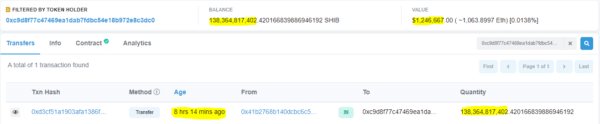
Etherscan.io data reports that the mysterious wallet transferred a whopping 138,364,817,402 (138.36B) SHIB, worth $1,246,667 ($1.24M) to the brand new wallet in one significant transaction. The transaction is executed about 8 hours ago from now.

Shiba Inu Whale Accumulated 1.24 Million Worth of SHIB in the Past 24 Hours

The Whale’s interest in the world’s 14th largest cryptocurrency in terms of market cap continues to soar in recent days as Shiba Inu’s official Twitter handle confirmed the presence of the lead SHIB Metaverse advisor at the upcoming Immerse Global Summit on December 5th – 7th at Fontainebleau Hotel Miami, Florida. She is reported to discuss the development of SHIB Metaverse and how it will help the Shiba Inu Ecosystem to grow alongside major industry players, including Meta Platforms, Inc. (Meta), Microsoft (MSFT), web3equity, and TerraZero.

As reported by TheCryptoBasic World Economic Forum is seeking Shiba Inu Team support on global metaverse policy.

On the other hand, Shiba Inu Community continues to reduce the total circulating supply of SHIB at a rapid pace. In the past 24 hours, Shiba Inu Community has successfully removed 22,028,239 (22.02M) SHIB from circulation forever through 11 separate transactions.

Two Wallets Cumulatively Burn 9M+ Terra Classic (LUNC)

0

Over 9M LUNC tokens have just been burnt in two different transactions, with LUNCDAO accounting for 4.9M of the incinerated assets and Luna Station 88 burning 4.4M.


The Terra Classic (LUNC) community recently witnessed two burn transactions which saw the incineration of 9.3M LUNC tokens, with independent validator LUNCDAO accounting for 4.9M burnt tokens as part of its periodic incineration exercise aimed at supporting the initiative for the revival of the once-neglected token. Additionally, the validator Luna Station 88 burnt 4.3M.

The recently indexed transactions occurred barely 16 hours apart between November 27 and 28. The first transaction incinerated 4,454,817 LUNC tokens on November 27, 9:49 (UTC). Despite being without a memo, the transaction can be traced to the Terra validator Luna Station 88, as disclosed in a recent tweet.

The burn transaction from Luna Station 88 involved a third of a commission the Terra validator recently withdrew to 13.3M LUNC and 45K USTC. The validator burnt 4.4M LUNC and 15K USTC. The other third was used to support the validator, while the last was sent to the community pool.

The second burn transaction occurred on November 28, 2:39 (UTC) witnessed the transfer of 4,928,589 LUNC to the central burn address. The memo on the transaction reads LUNC-DAO-BURN-37, indicating that the burn transaction was carried out by the independent LUNC validator LUNCDAO. This marked the 37th burn transaction from LUNCDAO since it began its burns to support the campaign.

Due to its consistency in keeping up with the burns, LUNCDAO currently holds the fifth position of top entities which have burnt the most LUNC tokens, with a total burn of 409M+ LUNC. While LUNCDAO towers over fellow Terra validator Allnodes, it’s understandably behind Binance, which secures a first position, and MEXC, which is fourth on the list. LUNCDAO burnt 22M tokens in one transaction late last month, as previously highlighted.

Amidst the uncertainties and numerous debates launched within the LUNC camp concerning the burning campaign, entities involved have remained consistent in keeping to their promise of supporting the community. As a result, the network has witnessed a total cumulative burn of 28.6B LUNC, per data from LUNC Pengiuns, with Binance accounting for 13.7B incinerated tokens.

It is worth noting that a recent proposal to temporarily increase the on-chain tax burn rate to 1.2% once more as a way to leverage the potentially heightened volume of transactions that could arise from the re-opening of the Inter Blockchain Communication (IBC) on December 5. The Crypto Basic recently noted that the proposal sparked a debate within the community, as some members believe it is an imprudent decision.

Former U.S. FDIC Chair Says Lawmakers Have To Resist Lobbying From Crypto Industry

0

Bair says regulators have to work together, and lawmakers have to do better at resisting lobbying from the industry.


Former chair of the US Federal Deposit and Insurance Corporation, Sheila Bair, has said that there is a lot that needs fixing for the crypto industry to get clear regulations in the US in a recent episode of CNBC’s Squawk Box shared today.

The former regulator made this known when asked about the reason for the sluggishness of regulators in the US to create crypto guidelines which pushed crypto exchanges like FTX to the Bahamas. 

According to the former FDIC chair, the fact that there are separate regulators for commodities, securities, banks, etc., is already an issue. Bair says this leads to disputes about who regulates the market, distracting policymakers from actual regulations. In addition, she noted that regulators are under pressure from lawmakers that are “heavily influenced” by industry participants.

Consequently, Bair notes that regulators like the US Securities and Exchange Commission and the Commodity Futures Trading Commission, who depend on Congress funding, end up “a bit timid.”

She surmises that regulators must work together for the crypto industry to get clear rules, and Congress has to be less susceptible to lobbying efforts from industry participants.

“There are a lot of things that need to be fixed,” Bair said. “more consolidation among regulators and Congress, exercising greater restraint when the lobbies come knocking on their door.”

Bair’s statements come in the wake of the spectacular collapse of FTX, a once-leading crypto exchange. Notably, several reports and findings from the exchange’s bankruptcy proceedings reveal gross mismanagement of corporate and client funds.

The crypto community and the finance world, stunned by these events and how they could have happened in a “regulated” crypto exchange, have poked holes at the integrity of regulators and lawmakers. For example, the crypto community has drawn the attention of Congress to links between SEC chair Gary Gensler and FTX founder Sam Bankman-Fried. In addition, reports recently revealed that members of Congress intervened in March when the SEC requested information from crypto exchanges, including FTX, with five members from the group receiving campaign donations from the crypto exchange.

After a year of mostly signaling, there are still no clear guidelines for the emerging market in the US. Recently, Ripple Chief Brad Garlinghouse asserted that the US is behind other G20 countries in crypto regulations.

Cardano dApps Witness a Surge in Unique Account Growth, With Indigo Protocol Leading

0

Cardano dApps witnessed a surge in unique account growth in the last five days, as Indigo Protocol topped the list with an increase of over 62,000%.


Decentralized application (dApp) projects on the Cardano network saw a massive surge of unique accounts within the past five days, with Indigo Protocol having an incredible account growth of 62,109% as it tops the list of projects with the highest increase in unique accounts.

Cardano Daily first disclosed the achievement, an unofficial community-driven Twitter handle dedicated to providing updates on Cardano-related developments. “The top gainer in the percentage of the growth of the unique account is @Indigo_protocol – a project which has been going mainnet in the last week. Congratulations for having such an amazing beginning,” Cardano Daily disclosed Monday, sharing a dashboard with more information on the top projects.

The dashboard reveals that Indigo Protocol currently has unique accounts totaling 835, with a rapid surge of 62,109% following its launch on the mainnet. Second on the list is DeFi protocol Aada Finance with a unique account increase of 278% in the past five days, leading to 1.8K unique accounts.

Community-driven project ADAO claims the third position with a surge of 97% in the last five days, with unique accounts totaling 134. The fourth project is the NFT marketplace Flipr which had a unique account increase of 96% to 898 accounts. Reward and distribution platform SmartClaimz is fifth, with an 82% increase and unique accounts of up to 199.

The sixth project is the DeFi protocol, Minswap. Minswap had a 79% increase in unique accounts in the last five days, leading to total unique accounts of 53K. WingRiders has 12.7K unique accounts following a 62% surge, claiming a seventh position on the top list. MuesliSwap is eighth with a 56% increase, having up to 40.3K accounts.

Ninth and tenth are, respectively Artifct and Epoch Art, two NFT marketplaces, with respective growths of 42% and 27%. While Artifct has total unique accounts of 744, Epoch Art has 5.5K.

Innovation on Cardano Sees a Rapid Increase

These massive surges in unique accounts indicate the growing adoption of the Cardano ecosystem, as several developers bring it to public exposure through numerous projects. Cardano Daily highlighted that the DeFi sector contributed to half of the list of assets with the highest unique account growth, indicating the growing attention in the scene as the markets seek to recover.

As a testament to the growing adoption rate on the network, Cardano’s co-founder Charles Hoskinson highlighted reports of a 90% increase in daily active addresses on the network last Thursday. Furthermore, the number of smart contracts based on Plutus surged 300% this year to 3,791 last Saturday amid active development moves on the network.

Additionally, as a means to drive more innovation, the stablecoin DJED was recently slated to launch on the Cardano mainnet in January 2023, as previously reported.

Meanwhile, the first USD-backed stablecoin on the Cardano network, dubbed iUSD was launched by Indigo Protocol last Monday. Furthermore, in addition to the expected launch of DJED, Cardano will be welcoming another stablecoin, USDA, from EMURGO in early 2023.

Lionsgate Entertainment Files NFT-Focused Trademark Application

0

Lions Gate Entertainment has indicated an interest in providing NFT-focused services through a recently-filed trademark application.


Top American-Canadian entertainment company Lionsgate Entertainment Corporation (Lionsgate) has filed a trademark application with the United States Patent and Trademark Office (USPTO) for its business name Lionsgate with intentions to provide NFT-related and crypto trading offerings under the trademark.

The development was recently disclosed by USPTO-licensed trademark attorney and NFT enthusiast Mike Kondoudis. According to Kondoudis, Lionsgate seeks to offer services bordering on a crypto trading platform, NFTs, digital tokens, and virtual goods.

The trademark application with the serial number 97686763 was filed on November 21 with the USPTO and owned by Lions Gate Entertainment Inc., per data from a document shared by Kondoudis.

Information from the document also suggests that Lionsgate is looking to provide customers with offerings in the form of digital media, such as virtual art, digital tokens, non-fungible tokens (NFTs), and digital collectibles.

Additionally, the company plans to release its virtual currency exchange platform, which would be used for the creation, storage, tracking, and processing of digital tokens, including but not limited to NFTs and digital collectibles.

Lionsgate also plans to offer products bordering on digital currencies created using blockchain technology. In addition, the document reveals that Lionsgate will provide services that would give customers access to downloadable digital avatars, skins, and characters.

Furthermore, the firm will be looking into developing and presenting a multifaceted platform that will facilitate several services relating to cryptocurrency and NFT trading. These include transactions carried out with digital collectibles, cryptocurrencies, digital arts, NFTs, and other virtual tokens.

Lionsgate’s Increasing Interest in Web3 and NFTs

Lionsgate’s recent trademark application isn’t it’s first dealing with the cryptocurrency scene.

Last month, Lionsgate partnered with Autograph and Internet Game as the firms looked to release a new web3 experience linked to Lionsgate’s horror TV series SAW. Players are expected to survive the horror web3 experience to win prizes which include a Mutant Ape NFT.

Additionally, in June, web3 game The Sandbox announced a partnership with Lionsgate to leverage the top entertainment company’s film collection in providing its customers with movie-themed web3 destinations in the Metaverse.

Being one of the leading entities in the entertainment industry, Lionsgate’s sustained involvement with the web3 and NFT scene is likely to drive more attention to the industry. Furthermore, its recent trademark application suggests an intention to dive directly into the NFT scene.

Other Developments

Amid a surge in institutional adoption, the cryptocurrency and NFT scene has captured the attention of several top companies who are looking to leverage the nascent blockchain technology and its applications as they stay ahead of the curve.

There appears to be a surge of crypto-focused trademark applications of late. The Crypto Basic has previously reported four applications from top corporations this month alone, including Nissan, Rolex, the University of Alabama, and JPMorgan.

Kondoudis also disclosed that Mastercard recently filed another trademark application for Mastercard Crypto Secure, under which the firm will provide services in the form of a transaction surveillance platform, cryptocurrency information provision, and risk assessment.

VeChain Mints €1.5 million NFT In First Ever Inventory Monetization Using Blockchain

0

VeChain completes the first transaction to monetize inventory on the blockchain using NFTs.

Leading enterprise blockchain VeChain has recently minted an NFT worth about €1.5 million ($1,558,500) as part of an initiative to allow businesses to raise capital without debt by monetizing inventory on the blockchain.

The blockchain network iterated the achievement today in a Twitter post. However, the actual transaction occurred at the end of October. The tweet said that the NFT represents the inventory of an Italian automobile manufacturer.

It represents a significant milestone in the blockchain’s partnership with Supply@ME (SYME), a fintech company that focuses on helping companies monetize their inventory to raise capital. Together, they plan to launch “a full Inventory Monetisation Platform” by December with all the bells and whistles of the Web 3 space, as reported by The Crypto Basic in June.

“By deploying this, our companies together are able to limit a need for overproduction, promote sustainable global development, improve cashflow for businesses and create a new digital asset class which provides capital directly to the real economy,” VeChain Foundation CEO Sunny Lu said per a Fintech Finance report. “We look forward to launching – phase 2 of our alliance to involve our community and the rest of the crypto market into this disruptive initiative.”

Implementing this service on the VeChain network speaks to the enterprise chain’s flexibility, which has also been utilized in supply chain provenance in several industries. Most recently, it was tapped by the Chinese coffee brand Yongpu Coffee to do just that. 

VeChain token (VET) holders are excited by the news, with some speculating that the automobile manufacturer could be Ferrari or Lamborghini.

Terra Classic Proposal To Again Increase Burn Tax to 1.2% Sparks Debates

0

Terra Classic Community Debates Proposal To Temporarily Increase On-Chain Taxes.


A proposal to increase the Terra Classic on-chain tax to 1.2% once more has sparked debates within the Terra Classic community.

The Terra Classic community is currently mulling a proposal to temporarily increase the on-chain tax to 1.2% before the re-opening of Inter Blockchain Communication to take advantage of a predicted increase in on-chain transactions.

It is worth noting that the network is set to re-open IBC channels on December 5 as the community expects the proposal to pass.

Notably, the new tax proposal with the ID 10960 has already passed the governance vote. However, it faces stiff resistance from developers and popular validators who believe it would only hurt the chain, according to a tweet from Classy, a community influencer, and validator who is also opposed to the proposal.

It bears mentioning that in September, the Terra Classic community implemented a tax parameter change creating an on-chain burn tax of 1.2% to reduce the Terra Luna Classic (LUNC) supply. However, the community quickly realized the tax was unsustainable and detrimental to on-chain development as on-chain volumes plummeted. Consequently, it voted to reduce this tax parameter to 0.2% in October.

Now, the author of the latest proposal to take the parameter back to 1.2% argues that the temporary change will allow the network to maximize burns due to the increased volumes that will come from locked liquidity on Osmosis once IBC channels are re-opened. Meanwhile, other proponents appear to have lost patience with developers, claiming they have yet to see the utility they were promised while burn rates have considerably dropped. As such, these proponents believe the only way to go is to increase the tax.

Arguments From Developers and Validators 

In light of the latest developments, developers and validators have argued that the proposal will kill any of the utility the network hopes to attract with the re-opening of IBC channels and future upgrades.

Cosmos developer Cephii, amongst those who helped with the IBC code, highlighted that it would prevent the development of several cross-chain apps, which works against the goal of attracting capital from the Cosmos ecosystem. Addressing the concerns of those upset about the declining prices, he asserted that price retracements are bound to happen.

Classy, explaining why his validator voted against the proposal, disclosed that it creates an unprofitable business environment for decentralized applications. The validator asserted that it would turn the chain into Ethereum without any of its benefits, referring to high transaction fees on the leading blockchain.

David Goebelt, another validator, asserted that building takes time in response to concerns that developers have not built anything. 

Rex Harrison, AKA Rexzy, a member of the TerraCVita, arguing against the tax, asserted that it could put Apps like the newly launched casino out of business by pushing users to tax-free casinos. Notably, the casino has already burned 1 million LUNC.


Meanwhile, reXx, a member of the Terra Rebels @reXxTerraRebels, asserted that extra taxation adds no value to the blockchain. “You cannot tax your way to growth,” the developer tweeted, later adding, “Utility > higher taxes.”

Currently, the volunteer developers and the community are at an impasse. Already some users have begun to question the point of voting if developers can override the vote.