Home Blog Page 2198

Users Can Now Create XRP Accounts On Metamask

0

XRP Users can now use Metamask, the popular self-custody wallet.


XRP holders can now create Metamask accounts, according to a tweet on Monday by Peersyst Technology, which is currently working with Ripple developers to roll out an Ethereum Virtual Machine (EVM) compatible side chain for the XRP Ledger (XRPL).

Notably, a guide on how users can do this will be released today to enable users to test the sidechain.

As reported by The Crypto Basic, XRPL developers announced the launch of the EVM-compatible sidechain for the XRPL yesterday. Notably, the development will bring Ethereum smart contracts to the XRPL. Consequently, developers will be able to combine the robustness of Ethereum smart contracts with the XRPL’s speed and low fees.

Additionally, holders will soon be able to access a rich ecosystem of decentralized apps (DApps) and decentralized finance (DeFi) using XRP. Promising a throughput of about 1000 transactions per second (TPS) with low fees, the EVM sidechain will be a catalyst for even greater XRP adoption.

Notably, developers opted to create a sidechain instead of making the XRPL EVM-compatible as it risked compromising the XRPL’s scalability and security. As per the previous report, the rollout will happen in three phases, with the mainnet launch set for some time after early 2023.

Unsurprisingly, the latest developments have received massive support and excitement from the community.

The XRPL continues to see unwavering development despite legal woes in the US. Last week, developers launched a fiat on/off-ramp and extended the multisig list for multisig addresses.

Unsurprisingly, as a result, the network has continued to see growing adoption and influencer mentions in recent weeks. Notably, whale activity has spiked as well.
Binance, OKX, Huobi, Coinbase, and FTX to List Aptos (APT)

0

Top cryptocurrency exchanges declare support for Aptos.


Following the launch of Aptos mainnet, several cryptocurrency exchanges have declared that they will list the Aptos native cryptocurrency, APT, for trading purposes. 

Some top exchanges that declared support for Aptos (APT) include Binance, Coinbase, FTX, Huobi, and OKX.

Binance Announcement

In an announcement by Binance today, the world’s largest cryptocurrency exchange by 24-hour trading volume will list three spot trading pairs for Aptos tokens, including APT/BTC, APT/BUSD, and APT/USDT.

Users can send their APT deposits in preparation for trading that will commence tomorrow by 01:00 UTC.

“Binance will list Aptos and will open trading for these spot trading pairs [APT/BTC, APT/BUSD, and APT/USDT] at 2022-10-19 01:00 (UTC),” Binance said in an announcement. 

Coinbase Announcement

In a similar development, San Francisco-based exchange Coinbase announced that it would add support for APT. Coinbase users are only asked to deposit their APT on the Aptos network, as trading is scheduled to take place “when all liquidity requirements are met.” 

Unlike Binance, Coinbase plans to open trading only for the APT/USDT pair. 

“Once the sufficient supply of this asset is established, we will announce the impending launch of trading on our APT-USD pair in phases,” Coinbase said. 

Other Cryptocurrency Exchanges’ Announcements 

FTX, one of the world’s leading cryptocurrency exchanges and an Aptos investor, also said it would list APT on its trading platform. FTX users have already started depositing APT on the trading platform in preparation for trading which is slated to commence tomorrow by 01:00 UTC.

Furthermore, OKX, a Seychelles-based cryptocurrency exchange, will join other exchanges to open trading for APT on the condition that the token deposits meet its requirements. OKX opened APT deposits today at 06:00 UTC, while withdrawals will open tomorrow at 10:00 UTC.

Like Binance and FTX, leading cryptocurrency exchange Huobi, Global said APT/USDT trading would commence tomorrow by 01:00 UTC. In preparation for the trading, users are asked to deposit their APT today by 03:00 UTC, while withdrawals of the token will commence on October 21, 2022, at 01:00 UTC.

Aptos Mainnet Launch

There has been so much fuss about the Aptos mainnet launch.

Aptos is a Proof-of-Stake (PoS) Layer-1 blockchain launched by Meta (formerly Facebook). Recall that Meta’s plan to launch its stablecoin project dubbed Libra (later renamed Diem) was met with lots of resistance, forcing the team to abandon it for Aptos. The team claims Aptos will be a suitable blockchain for decentralized application developers, prompting many to describe it as Solana Killer.

The network has been under development for over four years and is valued at a whopping $1 billion. During its testing, the Aptos team claimed the network could handle 130,000 transactions per second, which is way ahead of the 30,000 TPS Ethereum network.

Aptos attracted some heavyweight VCs like Andreessen Horowitz (a16z) during its May strategic funding round, where it raised $200 million. Earlier this summer, Aptos also completed a $150 million Series A round led by Sam Bankman-Fried’s FTX.

APT is the native cryptocurrency of Aptos, which will be used for network fees. The token has a total supply of 1 billion.

Terra Classic (LUNC) Community Passes New Proposal Decreasing Burn Tax From 1.2% To 0.2%

0


The Terra Classic community passes proposal 5234 in hopes of bringing back on-chain volume and incentivizing development.


The Terra Classic community passed proposal 5234 on Monday after a week of voting and debates.

Notably, the proposer, a community member known as Akujiro, confirmed the development in a tweet yesterday.

LUNC developer Alex Forshaw giving details about how the vote went, reveals that the proposal attracted about 83% community participation, even without 58 of the network’s 85 validators. Notably, about 92% of non-abstainers voted for the proposal.

It is worth noting that proposal 5234 suggests that the community should slash the 1.2% tax burn parameter to 0.2% while channeling 10% of the tax obtained to the community pool to fund development activities. For proponents, it is a desperate attempt to attract lost on-chain volume and development while still being able to burn LUNC rapidly. Unfortunately, LUNC on-chain volume has declined over 90% since the 1.2% tax parameter went live.

It is worth noting that the new tax parameter will go live with the new epoch, estimated at around 12:50 pm UTC on October 19.

While the proposal initially faced resistance from some in the community who felt it was too early, it also received support from influential community members. For example, it received approval from KuCoin, Edward Kim, Alex Forshaw, TerraCVita, and community influencer Classy Crypto.

It bears mentioning that there are also hopes that the tax burn parameter reduction may also encourage exchanges to burn LUNC from trading activity. Notably, Binance chief Changpeng Zhao told the community in an Ask Me Anything (AMA) session that the lower the fees, the greater the burn. The leading exchange has so far burnt about 11 billion LUNC from its 0.1% trading fee, more than the 6.5 billion obtained from the 1.2% tax within the same period.

As reported by The Crypto Basic yesterday, LUNC core developer Edward Kim has proposed that the community start a grants program to allocate the funds in the community pool efficiently.

TerraForm Labs Launches New Proposal to Expand and Strengthen the Terra Ecosystem 

0

TFL has proposed an ecosystem expansion program.  

The team behind the Terra project, TerraForm Labs (TFL), is not relenting in its quest to make Terra investors whole again. 

According to an announcement today, a new proposal that would contribute to the ongoing LUNC revival initiative was posted on Terra Agora. The proposal, dubbed Terra Expedition | an ecosystem expansion program, was created in a bid to strengthen and expand the Terra ecosystem through several initiatives. 

The program, which is expected to run for four years, will focus on incentivizing developers to build decentralized applications (dApps) on the Terra Classic network, deepening liquidity, and onboarding new users to the Terra ecosystem. 

“The Terra Expedition is a revised iteration of the Developer Mining Program and Developer Alignment Program initially defined at the launch of the Terra blockchain […] This revised proposal aims to better align incentives across the ecosystem and focus on attracting developers, onboarding users and promoting deep liquidity,” the team noted. 

Terra Investors React

Meanwhile, victims of Terra’s debacle are not willing to support any proposal from the company believed to have caused them huge losses worth over $40 billion. 

Many took to the comment section to air their grievances at the Terra team for putting them in an unfortunate situation. Popular Terra whistleblower, FatMan, lead the charge at the TerraForm Labs team by saying: 

“Terraform Labs scammed thousands of people through the UST scheme. Never forget, no matter how much they try to distract you.” 

Other aggrieved Terra investors also took time out to slam the Terra team. 

The major reason why LUNC investors are angry with TFL is that the team opted for a different approach as opposed to what the community wanted. LUNC investors had called on the team to burn a part of the token’s supply to boost its value, instead TFL launched a new chain and tokens as part of its compensation plans. 

Based on this, the Terra Classic community had to embark on the LUNC burn program themselves.


Zero Weekly Inflow for XRP and Cardano (ADA) While Bitcoin (BTC) Leads with $8.8M

0


Bitcoin (BTC) records the highest weekly inflow in the latest CoinShares report, as XRP and ADA trail behind with zero.


Being the firstborn crypto, Bitcoin (BTC) has consistently maintained its dominance in the cryptocurrency space. While the bear market has not shown any respect for the asset’s lofty status, Bitcoin has persistently put up a decent fight against the bears. 

Despite BTC’s positive sentiments, the asset has seen inflows into investment funds in the past week despite worrisome market conditions when most digital assets are trailing behind.

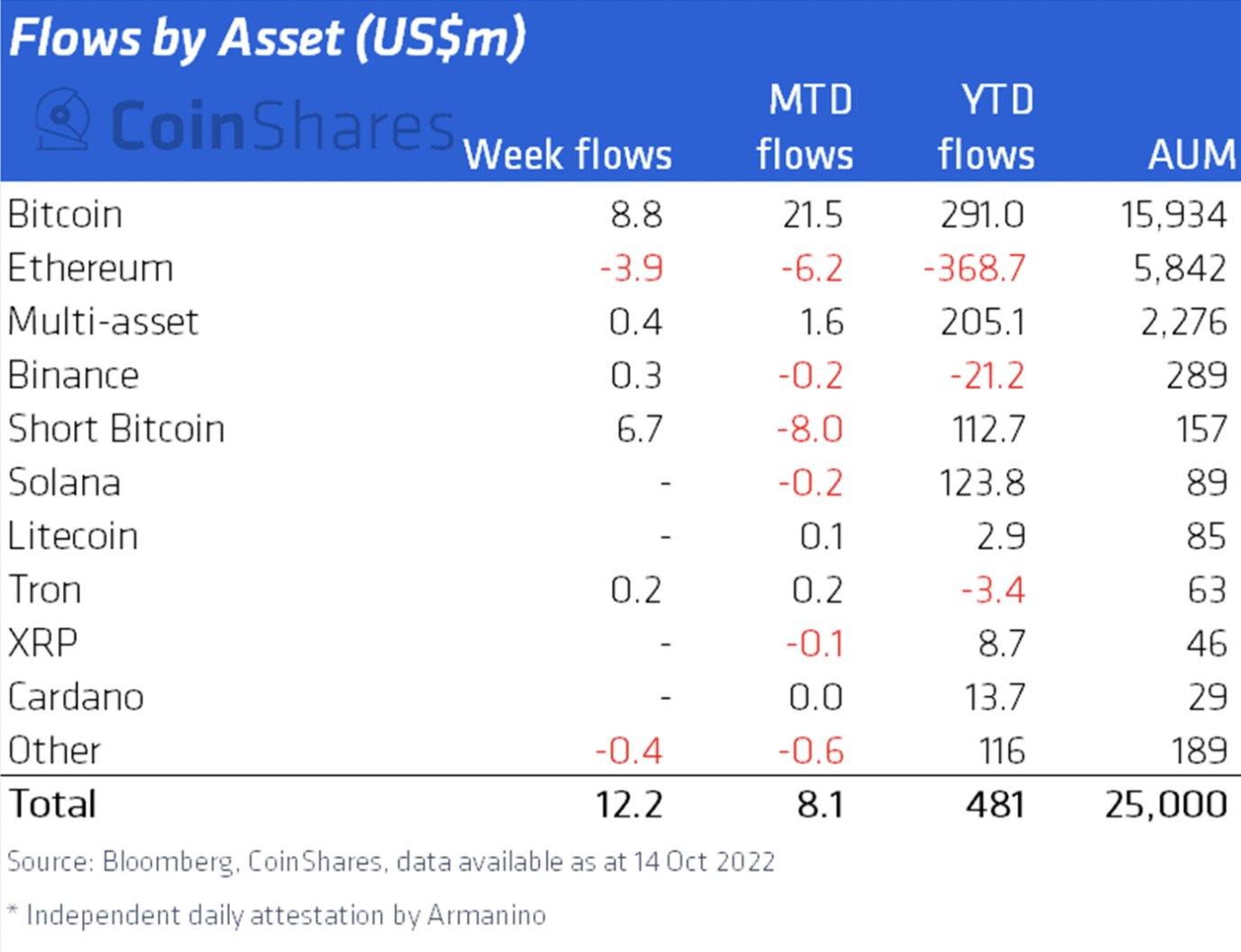
CoinShares recently shared its Digital Asset Fund Flows Weekly Report for last week. The report revealed a cumulative inflow of $12M into digital asset funds in the past week. While this level of inflow is rather low compared to previous weeks, it beats other weeks that witnessed outflows from these funds.

Bitcoin reiterated its dominance in the digital asset space by taking the largest chunk of the total inflows, reaching $8.8M – 73% of the cumulative value of $12M. The recent inflow of $8.8M marked the fifth consecutive week of inflows BTC funds are seeing.

On the other hand, investors appeared to have been less inclined towards pumping funds into XRP and Cardano (ADA), as both assets saw zero flows. XRP’s good run hit a roadblock in October, as the asset saw outflows for the first time on OCT 3rd, before that, XRP was recording inflows for seven consecutive weeks. Cardano also met the same fate after eight consecutive weeks of positive flows.

Month-to-date (MTD) flows of Cardano remain flat at a value of $0, while XRP has seen a slight MTD outflow of $0.1M. Bitcoin, however, is still looking good, with MTD inflows totaling $21.5M. The king altcoin, Ethereum, appears to be seeing even more bearish sentiments than XRP and ADA, as it recorded outflows of $3.9M in the past week, with MTD outflows of $6.2M.

11% of Small-Scale Entrepreneurs in the U.S. Plan to Fund their Businesses Using Crypto

0


A recent survey revealed that up to 11% of small business owners in the U.S. are looking to fund their businesses using cryptocurrencies in the following year.


Cryptocurrencies have taken the financial world by storm as they fast creep into the global finance scene. Adoption has seen a massive surge, with top entities seeing demands for Bitcoin and other digital assets from their clients.

As a testament to the increasing interest in cryptocurrencies, a recent survey has revealed that up to 11% of small-scale business owners plan to turn to cryptocurrencies to raise funds for their businesses in the coming year.

The survey, which was conducted by the Bank of America (BoA), sought the funding choices of small business owners in the U.S., with Cryptocurrencies presented as one of six available choices.

Other funding choices include Family/Friends, Traditional Bank Loans, Personal Credit Cards, Personal Savings, and Business Credit Cards. Amongst the respondents, 11% indicated plans to finance their businesses with cryptocurrencies. These business owners are looking to cryptocurrencies to bankroll their ventures, indicating the nascent industry’s growing adoption rate. Despite the majority – about 51% – indicating an inclination towards Business Credit Cards.

The Crypto industry is quite young, and with the pace of adoption, the scene will be welcoming more interest before long. Entrepreneurs could secure capital for their businesses through crypto loans via Aave, Compound, SALT, and Nexo, as these are major names within the crypto space that could provide loans for new businesses.

Some businesses tend to fold even before they get a chance to make a mark in their native industries due to a lack of funds. Business owners often turn to traditional loans for capital, which can be cumbersome for many entrepreneurs. Consequently, the reliance on crypto loans has grown in recent years.

Due to the steadfast Crypto Winter and the Terra debacle witnessed in May, the vulnerabilities of some of these lenders were exposed, leading to a cascade of failures within the crypto lending space. Entities such as Hodlnaut, BlockFi, and Celsius were affected

Notwithstanding the recent disturbing wave of fiascos, proponents have remained confident in the resilience of the entities left standing, contributing to a newfound level of trust. This survey demonstrates such trust.

These Cardano dApps Have 376,300 Unique Accounts

0

Here Are Top Unique Accounts On Cardano dApps.


Here is the list of the top 10 Cardano dApps with the most unique accounts.

Cardano-based decentralized applications (dApps) have received a lot of engagement from members of the cryptocurrency community in recent times. This can be seen in the number of unique accounts created on these platforms.

According to an infographic by Cardano Daily, a media outlet that covers Cardano-related developments, the number of unique accounts on Cardano-based decentralized applications has grown massively.

Cardano dapps unique accounts
Image source: https://twitter.com/cardano_daily/status/1582009090313572352

Per the data, JPG Store, a non-fungible token marketplace built on the Cardano blockchain, is ranked as the top Cardano dApp with the most unique accounts. JPG Store has a total of 114,000 unique accounts, according to the data.

Leading Cardano-based decentralized exchange SundaeSwap is the second-largest Cardano dApp with the most unique accounts. SundaeSwap’s unique accounts currently sit at 86,100.

Cardano’s NFT marketplace, CNFT.io, sits in third place, recording 53,700 unique accounts. Furthermore, Cardano’s decentralized finance applications, such as Minswap (45.8K), Muesliswap (38.6K), MELD (12.6K), and WingRiders (11.3K), were ranked as the fourth, fifth, sixth, and seventh top Cardano dApps with the most unique accounts, respectively.

Another NFT marketplace built on Cardano called Epoch Art has 5,300 unique accounts and currently sits in the eighth position. Mutants NFT (5.2K) and SpaceBuds (3.7K) were ranked ninth and 10th top Cardano decentralized applications in unique accounts. In total, these Dapps possess 376,300 unique accounts.

XRP Launches First Step To Bring Ethereum Smart Contracts to XRPL

0

XRP developers have begun tests for an Ethereum Virtual Machine (EVM) sidechain that would seamlessly bring Ethereum smart contracts to XRPL.


Ethereum currently secures the position of the most versatile and utilized blockchain in cryptocurrency. The EVM, which serves as a program responsible for executing smart contracts and computation of network states on Ethereum, has been utilized by several blockchain developers to launch dApps fully compatible with the Ethereum network.

The XRP Ledger (XRPL), on the other hand, appears to have been behind the curve in blockchain interoperability with the EVM, despite seeing massive growth in recent years.

This is about to change with the launch of the testing phase of XRPL’s EVM-compatible sidechain, as announced by the official Twitter account of XRPL Developers, RippleXDev. Ripple developed the sidechain in partnership with blockchain development firm Peersyst.

“Introducing the first phase of bringing an Ethereum Virtual Machine (EVM) sidechain to the XRPLedger,” the handle mentioned in a tweet Monday.


The EVM-compatible XRPL sidechain will enable developers to seamlessly launch Ethereum smart contracts on the XRP Ledger without hassle. The initiative will introduce XRPL to a broader audience due to Ethereum’s massive reach in the crypto scene.

EVM developers were called upon to begin deployment tests on the recently-introduced sidechain as the bridge’s first stage goes live on the XRPL Devnet. ETH developers are to experiment with the chain and provide feedback and suggestions on the XRP Developers Discord channel.

Mayukha Vadari, Software Engineer at Ripple, speaking on behalf of RippleX developers, noted that the initiative would help developers leverage XRPL’s several benefits, including but not limited to high throughput and low transaction costs.

XRPL promises a plethora of benefits for blockchain developers, but its incompatibility with the versatile EVM has resulted in developers having to choose between XRPL’s attractive features and the EVM’s versatility. This sidechain will ensure developers can have both at once.

The sidechain launch will come in three phases, according to Vadari. The launch of the testing stage marks the first phase of the process, with the second phase expected to come in early 2023. The second phase will welcome participation from the general public as the sidechain goes permissionless.

The third phase, which will feature the final launch of the EVM sidechain, is slated for Q2 2023. “Throughout all three phases, the EVM sidechain will feature block and finality times comparable to the XRPL Mainnet and support Ethereum smart contracts and applications like Metamask, Remix, and Truffle,” Vadari added.

He mentioned that RippleX Developers settled for the launch of an EVM sidechain instead of making XRPL itself EVM-compatible because the latter would undermine XRPL’s scalability, security, and efficiency. The sidechain is expected to run in parallel with XRPL.

Morgan Stanley Says Ethereum (ETH) Is Becoming More Centralized

0

Ethereum is becoming less decentralized as only four companies control 60% of the network’s validators.


In a recent research report, Morgan Stanley, American multinational investment management and financial services company, said Ethereum has become more centralized following the network’s transition to a Proof-of-Stake (PoS) algorithm.

According to the Morgan Stanley report, 65% of Ethereum’s nodes are cloud-hosted, while half of the network’s validators use Amazon Web Services (AWS).

Morgan Stanley Fears

Morgan Stanley noted that there could be a problem if some of these service providers choose to censor some cryptocurrency products or participants. Furthermore, Morgan Stanley noted that a bigger issue could emerge if there is a lengthy network outage.

Following Ethereum’s transition from a Proof-of-Work consensus to Proof-of-Stake, transactions on the network are approved by validators. Per the report, 60% of Ethereum’s current validators are controlled by only four companies.

Meanwhile, Martin Köppelmann, founder of Gnosis, raised concerns about Ethereum centralization problems last week. According to Köppelmann, 51% of Ethereum blocks complied with regulatory measures set by the Office Of Foreign Assets Control (OFAC). Köppelmann noted that the Ethereum chain could be censored if these validators decide not to attest to non-OFAC compliant blocks.

The Crypto Basic reported that France energy giant EDF was running over 150 Ethereum nodes. Recall that soon after merge, data from Santiment showed that only two addresses ran over 45% of the Ethereum nodes; it was believed that those two addresses belonged to Ethereum Foundation and JPMorgan.

It is noteworthy that the Ethereum team is aware of the network’s centralization issue and is currently working on possible solutions to address these concerns.

Binance Burns 2.5B Terra Classic, As Exchange Based LUNC Burns Surpass 11B In 3 Weeks

0

Binance Burns 2.5B LUNC in Its Third Week of Off-Chain Burns.


Despite the low trading volume, Binance has burnt an additional 2.5B Terra Classic (LUNC) tokens ($659K+) in its third batch of weekly off-chain burns.

Binance has not relented in keeping its promise to the Terra community to implement off-chain LUNC burns by sacrificing fees realized from LUNC spot and margin trades. Following two successive weeks of sustained burns, the world’s largest exchange has made another massive burn, amounting to $659M+.

A Twitter handle dedicated to tracking LUNC burn transactions recently updated the community on the latest burn from Binance. “Burn alert! 2,500,382,131 LUNC ($659,051) burned to Luna Burn Wallet,” the handle noted in a tweet Monday, as a link to the burn transaction was shared.


A view of the transaction on Terra Finder indicates that the burn, which involved a whopping amount of 2,500,382,131 (2.5B) worth $659K, occurred on October 17, 1:38 PM (GMT+1). Despite not explicitly ascribing the burn to Binance, the sheer magnitude of the transaction and the time of occurrence point to the exchange.

This third batch of burns saw Binance sacrifice $659K in trading fees in its commitment towards satiating the Terra community. The latest burn brings Binance’s cumulatively off-chain burn to 11B LUNC tokens in three weeks.

As expected, Binance will update its official announcement page on the LUNC burn transactions before long, as initially promised. Despite initially indicating a reluctance to implement the off-chain burns, Binance has remained committed to keeping to its word following a change of heart.

Recall that the exchange agreed to the Terra community’s demands for implementing off-chain LUNC burns. Following an opt-in feature that was summarily rejected by the community, Binance decided to sacrifice its LUNC spot and margin trading fees by converting them to LUNC and having them burnt every week.

The Crypto Basic reported the second batch of burns last week, which involved 2.9B LUNC, worth $922k at the time. The first batch involved a whopping amount of 5.5B LUNC tokens, worth $1.8M at the time of the burn. This recent burn would bring the total amount to $3.3M.

The Terra community’s goal to revive the long-forgotten LUNC token remains on track despite some setbacks, especially with the persistent bear market. The community has seen support from several entities within the space.

Recently, Allnodes, a LUNC validator, indicated that it had burnt over 56M LUNC tokens on Monday to engage in weekly LUNC burns until year-end.