Home Blog Page 2144

Shiba Inu Proponent Burns 1 SHIB At The Cost Of 1.53M SHIB In Fees

0

Shibburn burnt one SHIB at the end of November to gain traction from trolls, but it came at a high cost.


SHIB burn tracker Shibburn, in a tweet on November 28, disclosed that it burnt one whole SHIB worth $0.000009015.

While the value burnt appears insignificant and perhaps laughable, as Shibburn concedes, the burn tracker believes there is utility in the transaction. “It’s all kicks and giggles, but every visit to these transaction pages on the Shibburn website help with even more burns,” the burn tracker tweeted, asserting that the transaction will bring more clicks to its website.

Going through the transaction details, The Crypto Basic discovered that it came at the cost of 0.010742491880203624 ETH or $13.79 in fees at the time, worth about 1.53 million SHIB.

Despite this unique transaction, it is worth noting that Shibburn remains one of the top burners of SHIB. Remarkably, it topped the SHIB burners list for last month, burning 127.82 million SHIB, as recently reported.

According to the report, community members burnt about 666 million SHIB in November alone.

It bears mentioning that Shiba Inu launched the burn portal in April. Developers highlighted that it came in response to calls from the community to increase the scarcity of the token, which had an initial supply of 1 quadrillion SHIB to increase the value.

Already over 410 trillion SHIB have found their way to burn addresses representing nearly 50% of the total initial supply per data from shibburn.com. The total supply now sits at 589 trillion SHIB, with about 562 trillion in circulation.

Despite the tremendous feat that the community has achieved in reducing the token supply, it is worth noting that SHIB has failed to replicate last year’s meteoric price run. It is exchanging hands for $0.000009246 today, down 0.21% over the previous 24 hours.

Ripple and SEC Started To File Summary Judgment Replies

0

The parties officially file sealed versions of summary judgment replies.


Former federal prosecutor James K. Filan revealed that the United States Securities and Exchange Commission (SEC) and Ripple have officially filed, under seal, their respective summary judgment reply briefs.

“The parties have begun to file, UNDER SEAL, their replies to the opposition to the Motions for Summary Judgment,” Filan said.

Following the summary judgment reply briefs’ filing, the parties will meet and confer tomorrow, as stated in the updated schedule note, to identify necessary redactions in the reply briefs.

Parties Could File Redacted Replies Before Scheduled Date

After the necessary redactions, a redacted version of the summary judgment reply briefs will be filed publicly by December 5, 2022.

“The public, redacted versions of the Replies are due by Monday, December 5th,” he added.

Interestingly, the former federal prosecutor believes there is a tendency for the public to have access to redacted versions of the parties’ replies before the scheduled date, December 5, 2022.

In a previous tweet, Filan explained that both redacted versions of the summary judgment motions and oppositions were filed days before the scheduled date. According to Filan, the redacted summary judgment motions were originally due on September 19 but were filed on September 17.

“[…] The redacted oppositions were due on October 24 but were filed on October 21. So, expect the redacted replies to be filed early as well,” Filan said.

Possible Reference Points in the Redacted Replies

Since the replies are still sealed, the public can only speculate on possible areas that the parties focused on in the briefs. XRP holders expect the parties to address the amicus curiae briefs filed by non-parties in the lawsuit.

As reported, 16 entities filed amicus curiae briefs in the Ripple vs. SEC case. Out of the 16 entities, 13 entities are in support of Ripple’s case against the SEC, and they include:

  1. TapJets 
  2. I-Remit 
  3. Investor Choice Advocates Network (ICAN) 
  4. Blockchain Association 
  5. SpendTheBits 
  6. Coinbase 
  7. Cryptillian Payment Systems. 
  8. Crypto Council for Innovation (CCI) 
  9. Valhil Capital LLC 
  10. Reaper Financial 
  11. Paradigm Operations
  12. Veri DAO LLC, and 
  13. Attorney Deaton, on behalf of over 75K XRP holders.

Notably, two non-parties, including the New Sports Economy Institute (NSEI) and Accredify Inc (InvestReady), have thrown their weight behind the Securities and Exchange Commission. However, one entity, the Chamber of Digital Commerce, chose a neutral stand in its amicus curiae brief.

Meanwhile, Filan ruled out the possibility of the parties referencing excerpts from the sealed controversial William Hinman documents. Per the pro-Ripple lawyer, the SEC will redact any portion of the defendants’ reply that references excerpts from Hinman’s documents.

Filan further said Judge Analisa Torres would unseal Hinman’s document if she relied on it when drafting her summary judgment ruling.

Terra Classic Proposal To Allocate 50% Of LUNC Burns To Community Pool Faces Stiff Resistance

0

A new proposal to allocate 50% of all LUNC burns to the community pool to fund on-chain development has sparked outrage in the LUNC community.


Yesterday, @reXxTerraRebels, AKA reXx, brought the community’s attention to a new proposal that will allocate 50% of all token burns to the community pool to fund development currently up for voting on the Terra Station.

Notably, community influencer Classy also shared the proposal hours later. But, like reXx, he refrained from giving an opinion on it.

Cosmos Capybara, a Cosmos validator, authored the proposal. The proposal with ID 10983 asserts that the community pool is grossly underfunded and threatens the community’s ability to fund high-cost development activities. Consequently, Cosmos Capybara believes the correct action is a parameter change allocating 50% of all Terra Luna Classic (LUNC) and TerraClassicUSD (USTC) burns to the community pool at the end of every epoch.

Per the proposal, the community could have allocated 400% more to the community pool at the end of the last epoch from November 21 to November 28 with this parameter change. Cosmos Capybara argues that the community needs a well-funded community pool if it plans to remain self-reliant.

The Terra Classic Community Does Not Look Pleased 

Judging by the comments, most Terra Classic community members are firmly against it. For example, one user threatened to delegate his tokens elsewhere if his validator voted “yes.”

For some, the primary concern is the impact on the already slow rate of LUNC burns as the community faces the imposing task of reducing the over 6 trillion LUNC supply. Others are concerned that the proposal threatens to jeopardize the community’s relationship with Binance and other independent supporters who burn LUNC tokens. Instead, many believe that the network should tax validator commissions.

However, it bears mentioning that the reception was not all bad. For example, one user highlighted that the Terra Rebels would soon move to a paid working model, a development previously reported by The Crypto Basic. Accordingly, he argues that it is necessary to fund the pool so the community can fund development activities when the time comes.

The decision on how the community plans to fund development is potentially pivotal to the continued progress of the network. Ultimately, quality developers are unlikely to continue to work indefinitely for free. Without an environment that supports increased utility, the lofty goals of the community stand the risk of falling flat.

Developers’ funding remains the subject of intense community debates. Notably, the current burn tax parameter model allocates 10% of all LUNC burns to the community pool.

Solana (SOL), Fantom (FTM), And Metacade (MCADE) Price Prediction: How To Invest Your Money During The Crypto Crash

0

Following the crypto crash of 2022, many tokens are currently sitting at heavily discounted prices. If you’ve been doing your due diligence, you might’ve heard good things about Solana and Fantom. You might’ve even heard about Metacade, a new token that’s been attracting substantial attention as of late.

In this article, we’re going to give a Solana price prediction followed by a Fantom price prediction. Then we’ll be discussing how Metacade stacks up against these two players before concluding which one you should consider investing in.

Solana (SOL) Price Prediction

Solana is one of the leading Ethereum competitors on the market today, holding the ninth spot as one of the most valuable projects by market cap. Like Ethereum, it offers smart contracts that are used to power various decentralized projects built on the Solana chain.

Where it differs, however, is in its transaction speeds. By combining proof-of-history (PoH) and proof-of-stake (PoS), Solana offers theoretical speeds of up to 710,000 transactions per second (TPS), as per the Solana documentation. Even after the merge, Ethereum only manages around 30 TPS (ethtps.info).

This was partly the catalyst for Solana’s epic run in 2021, where it peaked at $259. Nowadays, it’s worth around $28. As far as Solana price predictions go, the area around $140 will likely be the next major obstacle. If it can get above $200, it’s very likely we’ll see prices up into the $500 area, potentially even breaking the $1000 mark.

Fantom (FTM) Price Prediction

Fantom is another Ethereum competitor aimed at solving the high costs and slow speeds that plague the Ethereum chain. It uses a directed acyclic graph blockchain, resulting in transactions that take mere seconds while costing a fraction of a dollar. Fantom makes an excellent investment if you want to diversify your smart contract blockchain investments.

Fantom peaked at $3.48 in October 2021, but has since tumbled in the crypto crash of 2022. It’s now worth just $0.20 today. In terms of a Fantom price prediction, FTM would need to break above $1.66 for fresh highs to be made. At that point, it’s probable we’ll see FTM at least hitting the $10 mark. Past that, prices could go as high as $15 in the next bull cycle.

What is Metacade (MCADE)?

Metacade is a community hub with big plans to be one of the leading platforms at the cutting edge of Play2Earn and metaverse gaming. It’s a platform for like-minded individuals to link up, explore the latest Play2Earn games, and give their gaming income a boost.

Metacade is packed with features that are sure to electrify the gaming community. For a start, you’ll be able to find reviews, leaderboards, GameFi alpha, chat rooms, and dedicated forums that help anyone make their foray into the world of Play2Earn. To cultivate a collection of the best Play2Earn know-how in Web3, Metacade rewards players with the MCADE token whenever they contribute reviews, alpha, or other content, meaning you can get paid for simply sharing your thoughts and expertise.

Sharing rewards and tips on maximizing your in-game income aren’t the only ways you can earn with Metacade, however. You can also use your MCADE tokens to enter prize draws and exclusive tournaments to go head-to-head in your favorite games. Further, Metacade will be launching a job board in 2024 where community members will be able to find gigs and long-term work on the platform. It’s set to  feature casual testing work, internships, and even senior roles with Web3’s most innovative companies.

Most excitingly are the Metagrants set to launch in 2023. A Metagrant is a funding tool that enables the community to vote on the games they want to see built. Developers will post their ideas into a pool of competing projects and the winner will recieve financing to create their vision with the support of the game’s most avid fans. Ultimately, Metacade will have its virtual arcade filled with only the best Play2Earn games, as voted for by the community.

Metacade (MCADE) Price Prediction

Given that the GameFi industry is set to expand from a $1.5 billion industry in 2021 to a $50 billion industry in 2025 (Crypto.com), Metacade is primed to ride the wave and deliver some hefty gains over the coming years. The Metacade presale finishes at $0.020 per token and has a circulating supply of 1.4 billion tokens, giving it a launch market cap of $28,000,000.

Bearing in mind that, during bull markets, tokens often see a market cap of hundreds of millions, even billions, we can give an estimate on where MCADE might end up. If Metacade can reach a $500 million market cap, a feat achieved by many tokens in 2021’s bull run, then that would give MCADE a price of about $0.35 – an approximate 12x return, a 1,200% increase!

If Metacade successfully follows through on its plans, then we could see it hitting a $3.5 billion market cap. This is a conservative figure, given that other leading GameFi and metaverse projects have attained $7-10 billion market caps in the past. At these levels, one MCADE token would be worth $2.50 – soaring from its presale launch price in the process.

Solana (SOL), Fantom (FTM), or Metacade (MCADE): Which One Should You Invest In?

With these figures in mind, our Solana price prediction and Fantom price prediction are clearly lagging behind the returns that Metacade could offer. The GameFi industry is rapidly growing and is set to take the gaming sector by storm over the next few years. With Metacade’s clear strength as a metaverse gaming powerhouse and its goal to position itself as a leader early on, it could quite easily attract hundreds of thousands of players interested in GameFi, pushing up the MCADE price in the process.

If Metacade can reach our relatively conservative estimate of a $3.5 billion market cap, investors who got in at the end of presale would see unbelievable returns. But the earlier you buy, the greater your returns. If you buy at the start of presale, then you’ll get 125 MCADE tokens for $1 vs. 50 MCADE tokens for $1 at the end of presale. This could more than double your overall profit simply by getting in sooner rather than later!

You can participate in the Metacade pre-sale here.

Market Maker Keyrock Raises $72M from Ripple, And Others in Series B Funding

0


Keyrock has raised $72 million from Ripple, SIX, and Middlegame in its Series B Funding round.


Brussel-based digital asset market maker Keyrock has concluded its Series B funding round, with a whopping $72 million raised from investors including leading technology company Ripple; the venture capital arm of SIX Group, SIX FinTech Ventures; and fintech venture capital firm Middlegame Ventures.

The funding, which was closed in September, comes two years after the conclusion of its seed round in October 2020, as led by investors including Middlegame Ventures and SIX. Keyrock will use the fund to boost several crucial engagements such as scalability tools; development of infrastructure; and pursuing regulatory licensing in several jurisdictions, including the United States, Singapore, and Europe; says CEO Kevin de Patoul.

Despite concluding the round two months back, Keyrock’s recent announcement has been strategically set at a point within the cryptocurrency scene when most entities would look to market makers for liquidity provision, especially considering the collapse of Alameda Research, which left a vacuum within the space and a contagion of a liquidity crisis.

Keyrock, which had some of its assets in the custody of FTX, took the precaution of moving most of its funds from the exchange the same week the CoinDesk article, which exposed the platform’s liquidity crisis, surfaced. The market maker still had some funds on FTX upon its collapse, but CEO de Patoul noted that it was an inconsequential amount that would not affect the firm’s operations.

“The new round of funding allows us to dramatically accelerate executing our vision to provide liquidity solutions for all digital assets […] doubling down on our focus on clients and scalability, we will be looking to expand into new markets with targeted services,” Keyrock Chief de Patoul remarked, speaking on the development.

“We believe Keyrock will establish itself as one of the top-tier liquidity solution providers for digital assets not only in Europe but globally,” commented Andreas Iten, Head of Corporate Ventures at SIX, and co-founder of F10 FinTech Incubator.

Keyrock’s Massive Growth Since 2017

Founded in 2017 by Juan David Mandieta, Jeremy de Groodt, and Kevin de Patoul, Keyrock began with a vision to provide liquidity to digital assets and markets through its efficiently scalable algorithmic technologies. Having launched in the Belgian city of Brussels, Keyrock has secured a space in the United Kingdom to set up offices in countries such as Singapore and Switzerland in early 2023.

The firm seeks to support digital asset brokerages, exchanges, and tokens with liquidity provision, having so far provided its liquidity support to over 85 entities within the space since 2017, with an extension to 200 new market scenes within the past year.

Keyrock’s trading volume has also surged by over 300% YoY with a double increase in its global staff to 100, indicating its expanding reach despite the prevalent Crypto Winter. The firm is seeking to increase this value by two times in 2023.

The digital asset liquidity provider’s previous funding round was concluded in October 2020, led by SIX and Middlegame. Keyrock secured up to €4.3 million after the round.

Ripple CTO Pokes Holes At Theories Suggesting XRP Priced $327k On Private Ledger

0

Rumors that XRP is priced higher on the private chain have resurfaced.


Ripple CTO David Schwartz, in a tweet yesterday, questioned the logic behind conspiracy theories suggesting that XRP is priced considerably higher on the private XRP Ledger.

The response came as a crypto influencer, @CryptoGeekNews, shared a clip suggesting that Ripple had priced XRP as high as $327,000 on the private ledger. Notably, the influencer also shared a more extended version of the video on his YouTube channel to his over 11k subscribers, describing the individual that claims to have seen proof of the price variation in the clip as “a major venture capitalist.”

However, The Crypto Basic found that the person in question was another influencer with a YouTube channel called Black Swan Capitalist. It is worth noting that the influencer with 15k subscribers dedicates most of his content to XRP and is known for false albeit bullish narratives about XRP.

In response to yesterday’s speculations, Schwartz questioned why arbitrageurs were not actively taking advantage of the price variation if the asset in question was XRP.

“If it can’t be arb’d, why would you call it XRP?” Schwartz tweeted. “Why wouldn’t it be a completely different asset?”

Notably, the speculations also got the attention of former Ripple Director of Engineering Nik Bougalis, who wondered if anyone took these theories seriously.

As highlighted by another influencer, it bears mentioning that these narratives are a recurring theme in the XRP community. Schwartz also had to debunk similar rumors in an interview in April, saying, “it doesn’t make sense.”

Recall that Ripple launched the private XRP Ledger in March to support central bank digital currencies. While Ripple says the blockchain employs the same underlying technology as the public XRP Ledger, there is no clarity on whether the private ledger has a native token. Moreover, even if it did, it would be a different asset entirely for several reasons, including tokenomics and market forces.

James Filan Shares Insights About Timing For Unsealing Hinman Documents

0

James Filan Says Judge Torres Will Only Unseal Hinman Document If She Relied On It During Her Summary Judgment Ruling.


Since Ripple announced last month that the SEC had surrendered the draft of William Hinman’s 2018 speech, the document has remained sealed. The public, especially XRP holders, has continued to wonder when they will access the controversial document, which the SEC fought relentlessly to prevent defendants from laying hands on them.

Despite surrendering the documents to Ripple, the SEC still wants the drafts of Hinman’s 2018 speech to remain sealed. Hinman relied on the document to declare Bitcoin and Ethereum as non-security. Although he did not talk about XRP during the speech, Ripple believes the agency discussed XRP while the speech was being drafted.

Notably, the SEC and Ripple have officially filed their respective summary judgment reply briefs under seal, and many expect the parties to refer to Hinman’s documents in their replies.

Filan’s Opinion About the Unsealing of Hinman’s Documents

In a tweet today, former federal prosecutor and pro-Ripple lawyer James K. Filan shared his opinion regarding the unsealing of Hinman’s documents and the possibility of seeing the parties reference excerpts of the documents in their respective summary judgment reply briefs.

Filan said he does not think the summary judgment reply briefs will reference excerpts from Hinman’s documents. According to the pro-Ripple lawyer, should the defendants reference the drafts of Hinman’s 2018 speech, the SEC would redact such references citing portions of Hinman’s documents. 

“I don’t think we see references to the Hinman documents in the upcoming replies. To the extent the Hinman documents are referenced, I think the SEC will redact those references as they have done in the past,” he said. 

Furthermore, Filan also commented on the sealing of other outstanding documents, including expert reports and materials relied on by the parties in their respective motions, among others. 

The pro-Ripple lawyer said he also does not think U.S. district judge Analisa Torres will rule on all pending sealing issues soon after “the parties file opposition to omnibus motions to seal on January 9, 2023. The presiding Judge in the Ripple vs. SEC lawsuit will not approach the remainder of the case using that approach.

Judge Torres Will Unseal Documents She Relied On

Per Filan, Judge Torres will only unseal any document, including Hinman’s, depending on whether she relied on it while making her decision on the summary judgment motions.

“If the Judge relies on a document in her decision, that document is [automatically] considered a judicial document, and then it will be disclosed,” Filan said.

He further gave his opinion on how Judge Torres might draft her ruling and unseal documents in the case. The pro-Ripple lawyer noted that Judge Torres would work backward by first drafting the summary judgment ruling and identifying any documents she relied on, including those sealed and redacted.

However, other documents Judge Torres did not rely on in her summary judgment ruling will be subject to debate on whether the documents need to remain sealed, Filan added.

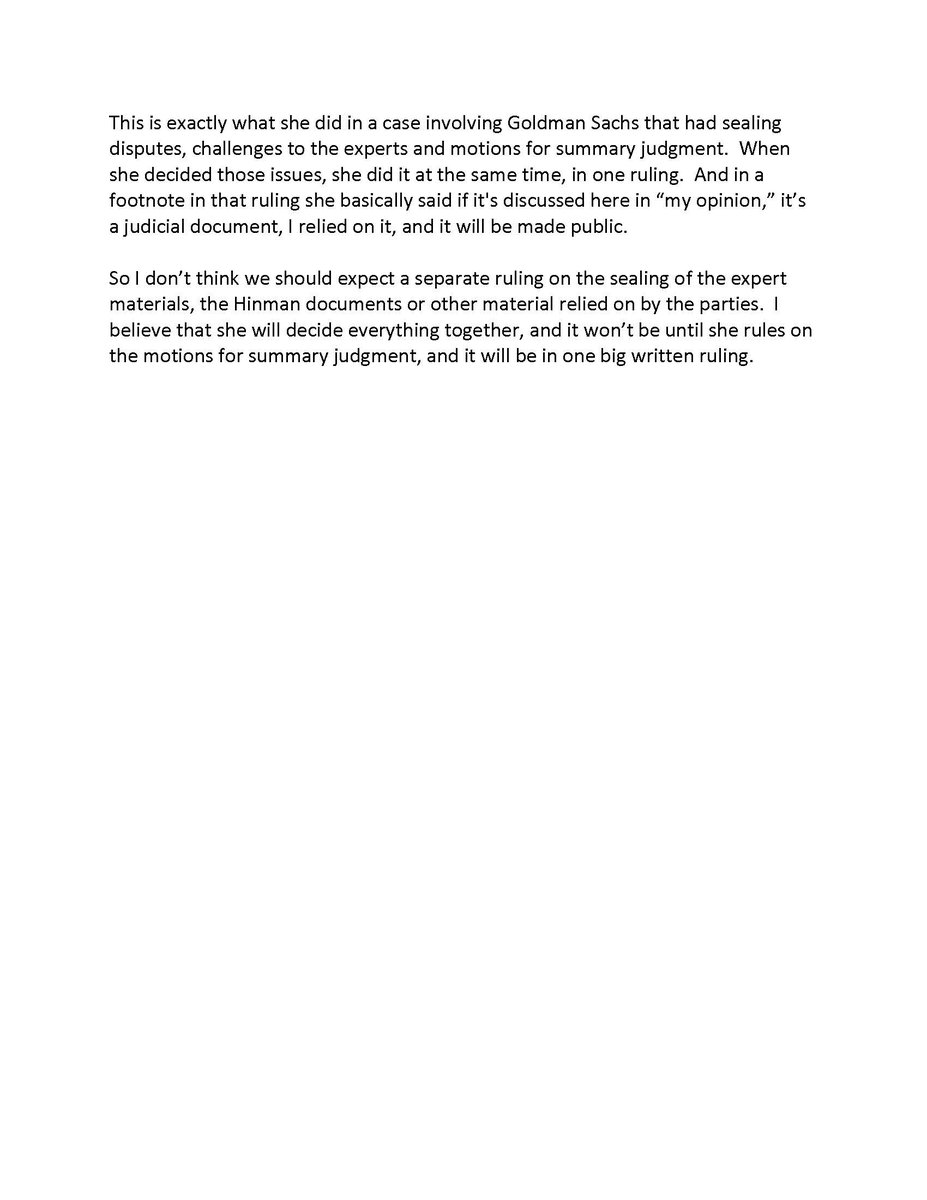
According to Filan, Judge Torres had previously adopted this approach in a Goldman Sachs case, which also had sealing disputes and challenges to the motions for summary judgment.

“When she decided those issues, she did it at the same time, in one ruling. And in a footnote in that ruling, she basically said if it’s discussed here, in my opinion, it is a judicial document, I relied on it, and it will be made public,” Filan said.

Filan’s thoughts regarding upcoming decisions:

Shiba Inu Army Burns 666 Million Shib In November

0

Over 666.90 Million Shiba Inu (SHIB) burned in November.


Shibburn.com recently released Shiba Inu’s Burn figure for November. As per the report, the Shiba Inu Community permanently removed 666,903,322 (666.90M) SHIB from circulation forever via 149 separate transactions in the past 30 days.

Biggest SHIB Burners of the Month:

Shibburn.com, Travis Johnson’s SHIB Super Store, and 1Cent Token make it to the list of “Top 3 Biggest SHIB Burners of the Month.”

Shibburn.com:

Shibburn.com makes it to the top of the list of “Biggest SHIB Burner of the Month” as the first-ever dedicated SHIB Burn Project incinerated a mammoth 127,821,443 (127.82M) SHIB in one significant transaction. The burn transaction is reported to occur on November 22nd, 2022.

SHIB Super Store:

SHIB Super Store managed to burn the second-highest number of Shiba Inu tokens in November. An individual SHIB Burn Project led by Travis Johnson organized four Weekly Burn Events in the past 30 days. It destroyed an astounding 105,230,377 (105.23M) SHIB in 4 separate transactions using SHIB Burn Portal.

1Cent Token:

1Cent token took third place among the “Top SHIB Burners of the Month.” The project sent 51,658,319 (51.65M) SHIB to the dead wallets via four transactions in the past 30 days.

On the other hand, Whales keep loading hundreds of billions of Shiba Inu. As reported earlier by TheCryptoBasic, two major Shiba Inu Whales have accumulated a staggering 507,549,845,605 (507.54B) SHIB, worth $4,694,835 ($4.69M) from Coinbase via two separate transactions.

Shiba Inu’s mainstream adoption is also on the rise. Recently, FCFPay enabled its users to book flights with American Air and Air Canada using FCF Pay Visa Card.

Ripple Unlocks 900M XRP From Escrow After Two Months Pause

0

Ripple resumes monthly XRP unlock.


Ripple today resumed its monthly XRP escrow unlocks after an unexplained two months break.

Per tweets from the crypto blockchain tracker, Whale Alert, the payments firm, unlocked 900 million XRP in two transactions. Notably, Ripple released 400 million XRP in the first transaction and 500 million in the second.


It is the first time Ripple has released XRP in escrow since September. The firm unexplainably failed to do so in October and November. Instead, in November, it uncharacteristically locked 1.2 billion XRP in escrow without first releasing any tokens.

At one point, it bears mentioning that Ripple held 55 billion XRP, about 55% of all XRP. To quell investor fears that the company could one day dump all of this XRP on the market, effectively rugging the project and tanking the value, Ripple placed this holding in 55 time-based escrow accounts, each holding 1 billion XRP. The move ensured that the supply of XRP grew and a steady and predictable rate. In addition, from this released sum, Ripple provided liquidity for the users of its On-Demand Liquidity service and bought back the rest to lock up in escrow again.

Usually, after each escrow unlocks, the firm buys back and locks up around 800 million XRP not needed by ODL partners. The reason for the pause in October and November remains unknown. However, it is worth noting that as part of its Q3 report, Ripple said it owned less than 50% of the XRP supply for the first time in its history, citing increased adoption. 

It bears mentioning that demand for the Ripple ODL service has grown exponentially, so the need for XRP liquidity should rise in tandem. According to a recent report, it now serves about 40 pay-out markets representing approximately 90% of the FX markets.

Notably, at inception, the Ripple escrow unlocks faced a lot of resistance as it placed sell pressure on the asset price. However, the latest unlock appears to have had little impact as people understand the process more. XRP is trading at the $0.4021 price point, down only 0.04% in the last 24 hours, with a circulating supply of 50.29 billion XRP.

Flare Releases List of Exchanges Supporting FLR Airdrop for XRP Holders

0


Flare has released a list of all exchanges distributing the FLR tokens within two weeks of the token distribution event.

The Flare team has officially unveiled a list containing exchanges supporting the Flare (FLR) tokens to eligible XRP holders’ addresses within two weeks of the Token Distribution Event (TDE), which has been confirmed to occur on January 9, 2023.

The Flare Networks team unveiled the list through an official press release today as it sought to get the community’s attention on Twitter. The team tweeted that they had been in close communication with most top exchanges to ascertain the ones willing to support the distribution within two weeks of the TDE. 

The team shared a list of exchanges that confirmed their support for the distribution, as they assured the community that the eligible XRP holders will get their FLR tokens as close to January 9, 2023. The Flare team expressed their gratitude to the exchanges who supported the project. The list of exchanges as of press time includes the following platforms:

  • Binance
  • OKX
  • Kraken, which will also support FLR staking and trading.
  • Nexo
  • KuCoin
  • Huobi
  • Gate.io
  • Bitfinex
  • Bitrue
  • Crypto.com
  • BitStamp
  • Bithumb
  • UpBit
  • Okcoin
  • MEXC Global
  • Poloniex
  • Uphold
  • Bitso
  • CEX.io
  • GateHub
  • Probit
  • iTrust Capital
  • Liquid
  • BTC Trader
  • Bitcoin Meester

Japanese Exchanges Indicating an Interest in Supporting the TDE

Besides the above-mentioned global exchanges, a few Japanese exchanges have also indicated an interest in supporting the distribution event as they work towards obtaining approval from the Japanese regulatory agencies Japan Virtual Currency Exchange Association (JVCEA) and the Financial Services Agency (FSA) of Japan. These exchanges include:

  • Bitbank
  • Coincheck
  • Huobi JP
  • DMM Bitcoin

Exchanges Yet to Confirm Their Support

Notwithstanding, several other exchanges have not particularly confirmed that they are going to support the TDE. The Flare team noted that they would burn the tokens if these exchanges do not confirm support for the distribution event within six months of the TDE date. These platforms are:


  • Coinbase
  • eToro 
  • Binance US
  • BitFlyer
  • SBI VC Trade
  • BITPoint Japan Co., Ltd
  • Amber Japan K.K. (Former DeCurret Inc.)
  • SAKURA Exchange BitCoin, Inc. (Former Xtheta Inc.)
  • CoinSpot
  • BTC Markets
  • Bittrex
  • Bittrex US.

The team revealed they would speak with Bittrex and Bittrex US this week. Additionally, the list will be updated as more exchanges confirm their support.