Home Blog Page 96

Top Cardano Builder Breaks Down After Years of Sacrifice, Reconsiders ADA Conviction

0

Zachary Soesbee, CEO of Anvil Development Agency and Cardano Constitutional Delegate, has voiced deep frustration with the current state of the Cardano ecosystem. 

In a statement on X, Soesbee revealed that he invested his time, expertise, savings, and even retirement funds into Cardano while operating Anvil under extremely lean conditions. He noted that both he and his co-founder went three years without taking salaries to ensure employees received their pay on time and the company remained afloat.

According to Soesbee, he initially viewed Cardano as a community of determined builders working toward a shared vision. However, he argued that some participants benefited from treasury resources while maintaining comfortable salaries, leaving smaller development teams struggling as ADA’s price declined and funding opportunities dried up.

Financial Pain and Forced ADA Sales

One of the most painful aspects of Soesbee’s journey involved his personal investment in ADA. He disclosed that he heavily invested in the token, even allocating a portion of his retirement savings to it.

After holding ADA for roughly five years, including through its rise to an all-time high of $3.10, Soesbee said he recently sold part of his holdings at $0.16 to avoid losing his home.

As a result, he began questioning the value of unwavering loyalty to a project. Instead of being rewarded for his long-term conviction, he believes his faith in the ecosystem ultimately resulted in substantial personal losses.

Frustration With Cardano Governance

Beyond the financial strain, Soesbee criticized Cardano’s governance and funding mechanisms. He claimed that months of work on community proposals have yielded little progress and expressed frustration with the difficulty of engaging key Delegated Representatives (DReps).

According to him, he spent several days explaining to a leading DRep why a product should be built on Cardano instead of discussing the product’s actual value proposition. He viewed the experience as evidence of a disconnect between builders and decision-makers within the ecosystem.

Despite these challenges, Soesbee maintained that he consistently engaged with community members, responded to feedback, and worked to improve his proposals. Nonetheless, after years of sacrifice, financial losses, and mounting frustrations, he openly questioned whether continuing to build on Cardano remains worthwhile.

While uncertain about his next move, Soesbee indicated that he is now focused on regaining stability in his personal life.

Dan Gambardello Urges Strategic Reset, Not Surrender

Soesbee’s emotional remarks quickly drew reactions from Cardano supporters and broader crypto community members. While some commenters encouraged him to explore opportunities on other blockchains such as Solana and Kaspa, crypto analyst Dan Gambardello offered a more measured perspective. 

Responding to the situation, crypto analyst Dan Gambardello urged Soesbee not to interpret the setback as a failure but as a normal part of building in the crypto industry.

He argued that experience gained within Cardano remains valuable, even amid setbacks. However, he also acknowledged that Cardano has faced missed opportunities and reputational challenges, suggesting that a strategic pivot may be reasonable. He compared such a shift to tax-loss harvesting, framing it as a chance to reset and reposition for future cycles. 

Growing Concerns Within the Cardano Ecosystem

Meanwhile, Soesbee’s comments have amplified concerns among some long-time Cardano community members regarding sustainability, governance effectiveness, and the availability of meaningful opportunities within the ecosystem. 

Earlier this month, Cardano analytics platform TapTools announced plans to wind down operations in the coming weeks due to funding challenges. The shutdown follows the exits of other Cardano-based projects, including JX Door and JPG.store, which have also ceased operations.

In addition, prominent Cardano contributor Chicken recently announced his departure from the ecosystem, further intensifying concerns among community members. Even Gambardello has diversified part of his crypto portfolio beyond ADA, adding exposure to the Sui ecosystem.

These developments underscore the growing debate over Cardano’s long-term trajectory and its ability to retain developers, businesses, and community leaders. 

Standard Chartered Says Crypto Winter Is Over as Bitcoin Bottomed at $59K, Keeps $100K BTC and $4K ETH Targets

Standard Chartered’s senior crypto analyst, Geoffrey Kendrick, believes the recent market downturn in Bitcoin has ended.

He argues that Bitcoin’s fall to around $59,000 last week marked the bottom of the current cycle.

In a note highlighted by Wu Blockchain, Kendrick reaffirmed his year-end targets of $100,000 for Bitcoin and $4,000 for Ethereum. He said that “crypto winter is over” and that a new “crypto spring” has begun.

Why Standard Chartered Believes the Bottom Is In

Bitcoin’s decline to roughly $59,000 represented a correction of about 53% from its October all-time high of $126,000. Market data shows Bitcoin briefly fell to around $59,108 on June 5 before rebounding toward $64,000.

Kendrick said the selloff was due to several temporary factors. One of the biggest was heavy selling in U.S. spot Bitcoin ETFs. Since the second week of May, cumulative ETF outflows have exceeded $5.72 billion, putting significant pressure on prices.

He also pointed to the highly anticipated IPO of SpaceX. According to Kendrick, some ETF investors may have sold Bitcoin to free up capital for the offering. The stock began trading on Nasdaq on Friday and rose about 26% above its IPO price shortly after listing.

Improving Macro Conditions Could Support Crypto

Kendrick also cited easing macroeconomic concerns as a reason for his bullish outlook. He said a potential peace agreement between the United States and Iran could help prevent further increases in oil prices. 

Lower energy costs could reduce pressure on U.S. Treasury yields and create a more favorable environment for risk assets, including cryptocurrencies.

However, uncertainty remains. U.S. President Donald Trump later suggested that the publicly discussed deal did not accurately reflect the final agreement. He also urged Iranian officials to “get their act together.”

What Could Confirm the Recovery?

Kendrick said he is monitoring several indicators that could confirm the market bottom is firmly in place.

One key signal would be an announcement that Strategy purchased more Bitcoin during the week. He is also watching for U.S. spot Bitcoin ETFs to return to net-positive daily inflows.

Another positive sign would be continued declines in oil prices, which could improve market conditions.

While Kendrick expects Bitcoin to reach $100,000 by year-end, he believes Ethereum may outperform Bitcoin in the near term. He maintained his $4,000 target for the second-largest cryptocurrency.

Image

At press time, Bitcoin is trading at $63,700, up 1.01% over the past 24 hours and marking a 4.7% rebound on the weekly timeframe. Meanwhile, Ethereum is trading at $1,667. To reach Kendrick’s $4,000 target, ETH would need to rally by nearly 2.5x from current levels, compared with roughly 1.57x for Bitcoin to reach $100,000.

Applying Bitcoin’s Peak-to-Peak Multiples on XRP Puts the XRP ATH at $24

0

Applying Bitcoin’s peak-to-peak multiples across the past two bull runs on XRP puts XRP’s implied all-time high price in double digits.

Prominent market commentator Jungle Inc. recently argued that XRP could have already crossed the $24 price mark if the SEC lawsuit had not interrupted its growth during the last major bull market.

XRP Could Have Reached $24 Without the SEC Lawsuit

In an analysis, Jungle Inc. said XRP missed out on what should have been its 2021 market cycle. According to him, the SEC filed its lawsuit against Ripple just as Bitcoin began a major repricing phase. 

In an attempt to estimate where XRP might have traded under normal market conditions, he applied Bitcoin’s actual peak-to-peak growth multiples from recent cycles to XRP’s previous all-time high.

The analysis used Bitcoin’s 3.49x peak-to-peak gain from the 2021 cycle and its 1.83x gain from the 2025 cycle. When the market analyst applied these multiples to XRP’s 2018 record high of $3.84, the result led to a potential all-time high of about $24.50.

What if XRP had captured Bitcoin last two cycles?

Jungle Inc. stressed that this figure is not based on unrealistic expectations. He argued that it simply follows the same path Bitcoin already took, while XRP spent much of that period dealing with legal challenges instead of benefiting from normal market-driven price discovery.

XRP Once Outperformed Bitcoin by a Wide Margin

Notably, XRP’s strong performance during the 2017 bull market confirms its potential to have recorded massive gains in 2020/2021. Specifically, in 2017/2018, XRP outpaced Bitcoin by a significant margin, even though its rally began later than much of the broader crypto market.

The XRPBTC trading pair climbed from 0.00000470 in March 2017 to 0.0002296 by January 2018. This move represented a gain of 4,785% against Bitcoin in less than a year.

During the same period, XRP surged to around $3.80 in January 2018, setting its contested all-time high. The performance showed XRP’s ability to generate stronger returns than Bitcoin during favorable market conditions.

However, the market eventually turned lower, and both assets suffered steep declines as the bull run came to an end.

Legal Troubles Prevented XRP From Joining the 2021 Rally

By December 2018, Bitcoin had fallen 84% from its cycle peak of $19,666 to $3,122. XRP experienced a larger drop, falling 96% from its high and reaching $0.1140 by March 2020. However, this confirmed that the downturn was not unique to XRP.

As the crypto market began recovering later in 2020, XRP initially followed the broader uptrend. However, the recovery faced a major setback when the SEC filed its lawsuit against Ripple in December 2020.

The legal action triggered delistings and heavy selling pressure across several exchanges in the United States and Canada. Essentially, these developments created a unique obstacle for XRP and prevented it from fully participating in the broader market rally.

The lawsuit continued to weigh on XRP throughout the 2021 bull market, limiting its ability to reach new highs while many other crypto assets saw strong gains.

XRP Could Now Eye Higher Prices

Currently, XRP trades at $1.13, which leaves it about 70% below its 2017/2018 peak. Bitcoin, on the other hand, trades at $63,600 and remains about 223% above its 2017/2018 high. 

This shows how Bitcoin has moved well beyond its previous peak while XRP remained below its record level after missing much of the market growth that occurred between early 2020 and late 2024.

Jungle Inc. believes the situation has changed since then. He noted that the SEC lawsuit has now been resolved, spot ETFs are already trading, and institutional infrastructure continues to grow across the crypto industry.

As a result, the analyst suggested that XRP could reach the low-to-mid $20 range even if adoption only grows at an average pace. He argued that stronger adoption could push prices even higher as market valuations adjust upward.

Japanese Public Firm Remixpoint Discloses 1.19 Million XRP Position on Corporate Balance Sheet

0

Japanese publicly traded company Remixpoint has attracted attention across the XRP community after revealing a significant XRP position on its corporate balance sheet.

The company disclosed the holdings in its official earnings forecast for Fiscal Year 2027, highlighting XRP’s growing role within its digital asset strategy.

Remixpoint’s XRP Holdings

According to the announcement, Remixpoint held approximately 1,191,204 (1.19 million) XRP as of March 31, 2026. Based on current market prices, the company’s XRP holdings are worth roughly $1.34 million.

The disclosure further reinforces XRP’s emergence as a treasury asset among global corporations, including those in Japan. Several companies have already begun integrating digital assets into their balance sheets as part of broader investment and treasury management strategies.

For example, Japanese mobile gaming and Web3 company AltPlus Inc has adopted XRP as a treasury asset, although the exact size of its holdings remains undisclosed at the time of writing.

Meanwhile, major Japanese financial institutions such as SBI Holdings and MUFJ have embraced XRP’s underlying payment infrastructure for cross-border transaction solutions. In addition to XRP, Remixpoint maintains positions in several major cryptocurrencies, including Bitcoin, Ethereum, Solana, and Dogecoin. 

Remixpoint crypto holdings

FY2027 Projections 

Notably, the company’s substantial XRP holdings come as it continues to expand its crypto-focused business model. Remixpoint expects its cryptocurrency investments to generate valuation gains ranging from ¥4.707 billion ($29.37 million) to ¥12.042 billion ($75.15 million) during Fiscal Year 2027.

Furthermore, the company projects approximately ¥400 million ($2.49 million) in revenue from cryptocurrency lending activities. Together, these revenue streams could transform the digital asset segment into one of Remixpoint’s most significant profit contributors over the coming year.

Remixpoint Forecasts XRP Upside

As part of its earnings outlook, Remixpoint assumed that XRP would trade between $1.50 and $1.76 by March 2027. If realized, those prices would represent gains of approximately 32.74% to 55.75% from current levels.

The company also outlined assumptions for several other major cryptocurrencies, including Bitcoin: $86,000–$116,000, Ethereum: $2,337–$2,744, Solana: $92–$108, Dogecoin: $0.10–$0.12. 

These estimates form the basis of the company’s revenue projections and valuation models for its digital asset portfolio.

Not a Price Prediction

Despite outlining these price assumptions, Remixpoint stressed that its earnings forecast should not be interpreted as a guarantee or prediction of future cryptocurrency prices.

Instead, the company explained that the figures represent internal assumptions used to calculate its earnings outlook based on information available at the time of the forecast. As a result, actual market performance could differ significantly from the projected ranges. 

Cardano Ships USDCx, Midnight Mainnet, and First Onchain Audit in Landmark Quarter

Cardano continued building institutional-grade infrastructure in Q1 2026, even as ADA fell 27.4% quarter-over-quarter to $0.24, according to a new report from Messari.

The report highlighted progress across stablecoins, tokenization, compliance, governance, and privacy-focused infrastructure. These developments support Cardano’s long-term goal of attracting institutional users and regulated financial activity.

USDCx Milestone

One of the quarter’s biggest milestones was the launch of USDCx, Circle’s regulated stablecoin on Cardano, on Feb. 27. Within weeks, USDCx became the network’s largest stablecoin. It ended the quarter with a supply of $17.5 million and captured 36% of Cardano’s stablecoin market.

As a result, Cardano’s total stablecoin market capitalization grew 27.1% to $48.6 million. USDCx overtook USDM as the network’s dominant stablecoin, while supplies of other major stablecoins declined.

Image

Messari also noted that Cardano advanced its regulated payments strategy through integrations such as the EMURGO-Wirex Cardano Card and Stablecoin Push-to-Card functionality powered by Visa Direct.

Midnight Launch Boosts Tokenization Strategy

Another milestone came on March 30 with the launch of Midnight, a privacy Layer-1 blockchain and Cardano’s first partner chain under its Partner Chains framework.

Midnight launched with nine institutional validators and a dual-token model. NIGHT is for governance and rewards, while DUST serves as a shielded resource for transaction fees.

Messari researcher Jonnytoshi described Midnight as a key part of Cardano’s plan to become a regulated tokenization platform by combining privacy features with institutional oversight.

Cardano also secured several strategic infrastructure partnerships during the quarter. LayerZero integrated with the network on March 17, providing access to cross-chain connectivity and more than $80 billion in omnichain liquidity. Additional partnerships included Pyth Network and Dune Analytics.

Meanwhile, Grant Thornton Switzerland completed what Messari described as the world’s first on-chain financial audit using the Cardano Foundation’s Reeve framework. The system supports regulated blockchain financial reporting.

Governance and Treasury Activity Accelerate

Meanwhile, Cardano’s decentralized representatives (DReps) approved a 350 million ADA Net Change Limit covering February 2026 through July 2027. The measure established a multi-year capital allocation framework for the ecosystem.

During the quarter, 80.1 million ADA was deployed through governance-approved treasury withdrawals. The Critical Integrations Budget became the first major initiative funded under the new structure and supports Cardano’s institutional adoption plans.

Staking metrics remained strong despite market weakness. Total staked ADA rose 1.5% to 21.7 billion ADA, pushing participation to 58.3%.

However, ADA’s price decline reduced the dollar value of staked assets by 26.4% to $5.2 billion.

DeFi Activity Mixed 

Cardano’s DeFi ecosystem delivered mixed results during the quarter. Total value locked (TVL) fell 23.5% to $133.1 million, slightly worse than the industry’s 18.9% decline. Average daily DEX volume also dropped 44.3% to $2.5 million.

Despite the slowdown, several protocols posted strong growth. SundaeSwap’s TVL increased 45%, while DanoFinance grew 31.7% to $15.6 million, making it one of Cardano’s three largest DeFi protocols.

Image

DanoFinance was also the only top-five Cardano DEX to record positive trading volume growth. Average daily volume climbed 48.6% quarter-over-quarter to $242,700, helped by the launch of a USDCx lending pool in March.

Although average daily active addresses declined 28.1% to 13,400, transaction activity remained resilient. Average daily transactions rose 2.2% to 26,550, driven partly by activity surrounding USDCx and the NIGHT token launch.

Messari noted that transactions per address increased 16.5% to 1.98, suggesting existing users became more active even as the active user base shrank.

Focus Shifts to Upcoming Upgrades

Looking ahead, Cardano is preparing for the Van Rossem hard fork, also known as Protocol V11, which is scheduled to launch in June 2026.

The network also continued work on several scaling initiatives. Leios consensus reached its first working prototypes, while the LSM Tree update reduced stake pool operator hardware requirements from 24GB to 8GB of RAM. Hydra v1.3.0 and Amaru also moved closer to production readiness.

Messari noted that CME’s launch of ADA futures on Feb. 9 started a six-month countdown toward spot exchange-traded product (ETP) eligibility on Aug. 9, 2026.

According to the report, Q1 saw Cardano’s market performance and infrastructure development move in opposite directions. 

While ADA declined, the network delivered a series of institutional upgrades, partnerships, governance initiatives, and compliance tools that could strengthen its position in the quarters ahead.

Bitcoin History Shows SP500 Could Drop After SpaceX IPO: Possible Impact on BTC

0

Historical data surrounding how Bitcoin reacted before and after the Coinbase IPO suggests the S&P 500 could pull back after the SpaceX IPO.

As investors look ahead to the SpaceX IPO, market analyst Ali Martinez has called attention to Bitcoin’s performance around the Coinbase public listing in 2021 as a hint to what could happen next in the stock market. 

According to Martinez, the strong gains recorded by the S&P 500 over the past year could be followed by a period of cooling off after SpaceX goes public. If this happens, some of the money leaving stocks could find its way into Bitcoin and the broader crypto market.

Ali Martinez Compares SpaceX IPO to Coinbase Listing

In a recent market commentary, Martinez compared the upcoming SpaceX IPO with the Coinbase IPO, which took place on April 14, 2021.

He noted that Bitcoin enjoyed a massive rally before Coinbase entered the public market. Specifically, between March 2020 and April 2021, BTC climbed more than 1,200% and reached a high of about $64,000. 

However, the rally did not continue for long after the listing. Within weeks, Bitcoin lost around 50% of its value and dropped to roughly $30,000 by May 2021.

Martinez believes a similar pattern could play out in the stock market following the SpaceX debut. He pointed out that the S&P 500 has already recorded impressive gains ahead of the offering. 

Specifically, the index has risen from a low of 4,802 in April 2025 to its current level of 7,406, representing a 54% increase over the past year.

Bitcoin with Coinbase IPO and S&P500 with SpaceX IPO Ali Martinez
Bitcoin with Coinbase IPO and S&P500 with SpaceX IPO | Ali Martinez

Considering this, Martinez argued that much of the excitement surrounding the SpaceX IPO may already be reflected in stock prices. He suggested that a period of consolidation and profit-taking across major equity markets would be normal and healthy.

Can a Stock Market Decline Benefit Bitcoin?

Notably, a drop in stock prices does not automatically lead to higher Bitcoin prices. In many cases, both stocks and cryptocurrencies behave as risk assets and move in the same direction. During periods of market uncertainty, their correlation can become stronger.

However, there are situations where Bitcoin could perform better than stocks during an equity market pullback. One possible reason is portfolio reallocation. When stock prices fall, some investors choose to move part of their funds into alternative assets instead of keeping everything in cash or bonds.

This can strengthen Bitcoin’s appeal. If investors see falling stock prices as a sign of broader economic weakness or concerns about declining trust in traditional financial systems, they may increase their exposure to Bitcoin as a diversification tool or long-term store of value.

Bitcoin does not always move in lockstep with traditional markets. Studies have shown that its correlation with stocks changes over time and often remains relatively low outside periods of major market stress. There have been times when Bitcoin remained stable or moved higher while stock markets weakened.

The SpaceX IPO

Martinez’s latest commentary comes as SpaceX prepares for what most consider the largest IPO ever. Space Exploration Technologies Corp. is expected to begin trading on Nasdaq under the ticker SPCX on June 12, 2026, after finalizing its offering price on June 11.

The company plans to sell around 555.6 million Class A shares at $135 each, aiming to raise about $75 billion. Net proceeds could reach roughly $74.4 billion before any overallotment option. If completed as planned, the deal would easily surpass Saudi Aramco’s previous IPO record of about $29 billion.

At the IPO price, SpaceX would carry a valuation of around $1.75 trillion to $1.77 trillion, making it one of the world’s most valuable publicly traded companies from day one. Some reports have even suggested the company had ambitions to exceed a $2 trillion valuation.

Notably, a group of 21 banks led by Goldman Sachs and Morgan Stanley is managing the offering. Investor demand has been exceptionally strong throughout the roadshow process.

Michael Saylor Reaffirms Commitment to Bitcoin, Says “I Haven’t Sold a Sat and Strategy Is Stacking Bitcoin”

0

Strategy Executive Chairman Michael Saylor has reaffirmed his unwavering commitment to Bitcoin, emphasizing that he has never sold any BTC from his personal holdings.

In a post on X today, Saylor declared that he has not sold a single satoshi—the smallest unit of Bitcoin. His statement drew a clear distinction between his personal investment strategy and the actions of Strategy. 

The development came amid growing scrutiny over Strategy’s recent Bitcoin sale. Notably, Saylor reiterated that Strategy remains firmly committed to its Bitcoin accumulation strategy. He stressed that the company is still acquiring BTC, signaling that neither his personal conviction nor Strategy’s long-term Bitcoin thesis has changed.

Strategy’s Bitcoin Sale Sparks Backlash

The controversy began last week when Strategy triggered widespread concern across the crypto market by executing its first Bitcoin sale since 2022.

As previously reported, the company sold 32 BTC, representing only a tiny fraction of its more than 840,000 Bitcoin holdings. Despite the negligible BTC sale, the transaction fueled market anxiety, and Bitcoin later fell to around $59,108.

Consequently, many crypto enthusiasts accused Saylor of contradicting his long-standing advice that investors should never sell their Bitcoin holdings.

Saylor Clarifies “Never Sell Your Bitcoin” Message

During a fireside chat at BTC Prague 2026, Saylor clarified that his famous “never sell your Bitcoin” message was directed at individual investors rather than Strategy’s corporate treasury operations. 

He argued that a public company cannot refuse to sell Bitcoin under all circumstances to satisfy critics on social media. According to him, Strategy has consistently disclosed over the past five years that it may sell Bitcoin when necessary to meet corporate obligations.

Furthermore, he maintained that preserving the health of a $100 billion company must take precedence over appeasing online commentators.

Personal Bitcoin Holdings Remain Intact

Notably, Saylor holds a substantial personal Bitcoin position. In October 2020, shortly after Strategy launched its Bitcoin treasury strategy, he revealed that he owned 17,732 BTC acquired at an average price of $9,882 per coin.

Years later, he reinforced his conviction by posting, “You do not sell your Bitcoin” on X, a statement many interpreted as confirmation that he had not liquidated any of his holdings. 

Strategy Returns to Buying Bitcoin

Despite the recent sale, Strategy quickly resumed its accumulation strategy. Earlier this week, the company announced the purchase of 1,550 BTC for approximately $101 million.

As a result, Strategy’s Bitcoin holdings increased to 845,265 BTC, valued at roughly $53.32 billion at press time. The purchase underscored Saylor’s latest assertion that the company remains committed to stacking Bitcoin despite engaging in limited treasury-management sales when necessary. 

XRP Seeing Hidden Coiled Spring as Heavy Shorting Meets Growing Accumulation

0

XRP trades within a hidden coiled spring, with the market witnessing an influx of short positions amid growing spot accumulation.

XRP has dropped nearly 14% this month due to the recent broader selloff led by Bitcoin. At the time of writing, XRP trades around $1.14. 

Despite the ongoing weakness, recent market data suggests that some investors may be quietly building positions while many traders continue to bet on lower prices.

XRP Faces Selling Pressure as Bearish Bets Increase

In a recent market report, verified CryptoQuant analyst CryptoOnChain called attention to signs that XRP could be preparing for a massive move despite its recent decline.

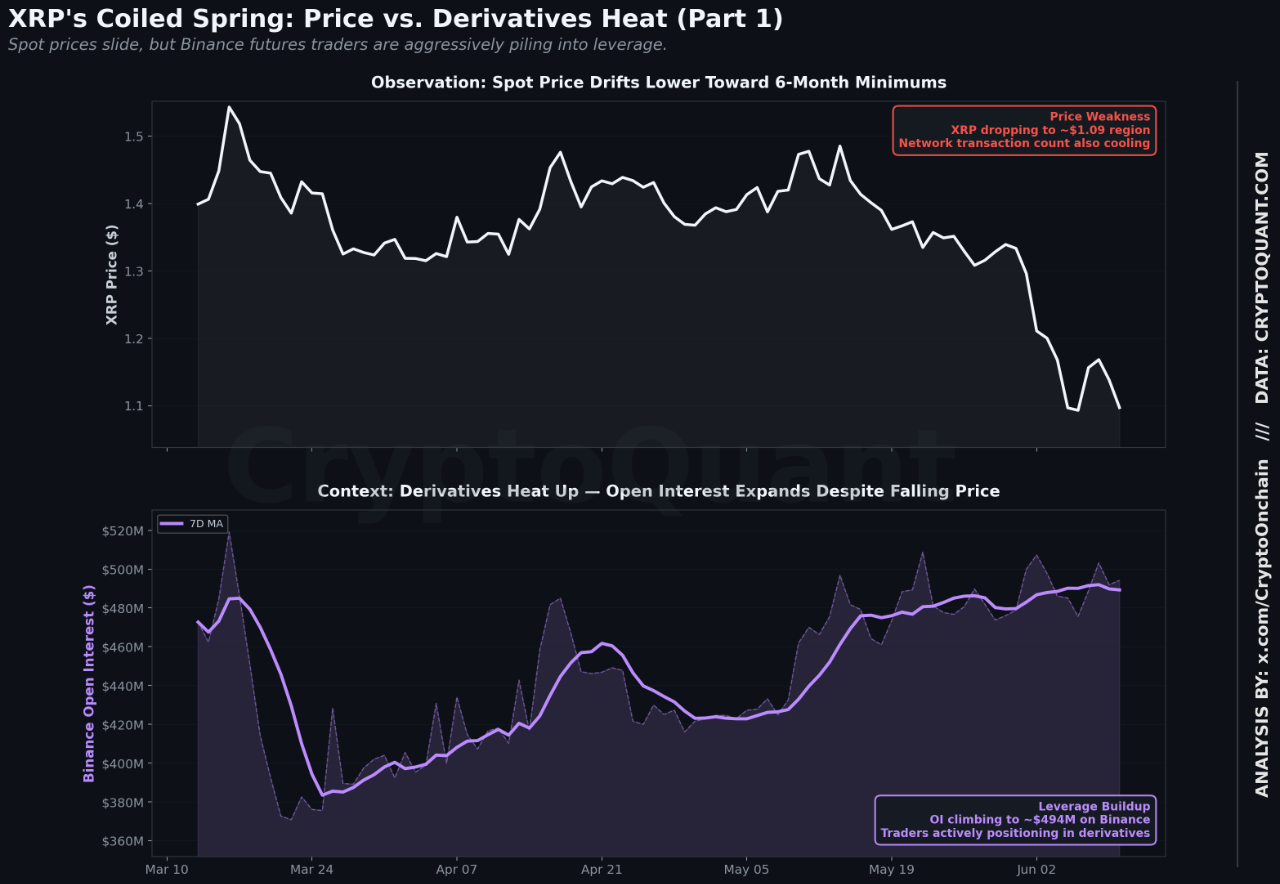
According to the analyst, XRP fell to around $1.09, its lowest level in six months. The slowdown has also affected network activity, with total transaction counts dropping 25% compared to the previous month. While these figures show weaker activity across the network, derivatives data reveals a growing interest.

CryptoOnChain noted that Open Interest has grown to 494 million. Also, the Estimated Leverage Ratio has continued to rise, showing that traders are taking on larger leveraged positions. This increase suggests that speculation remains strong as the asset struggles to recover.

XRP Open Interest Spikes Despite Price Drop CryptoOnChain
XRP Open Interest Spikes Despite Price Drop | CryptoOnChain

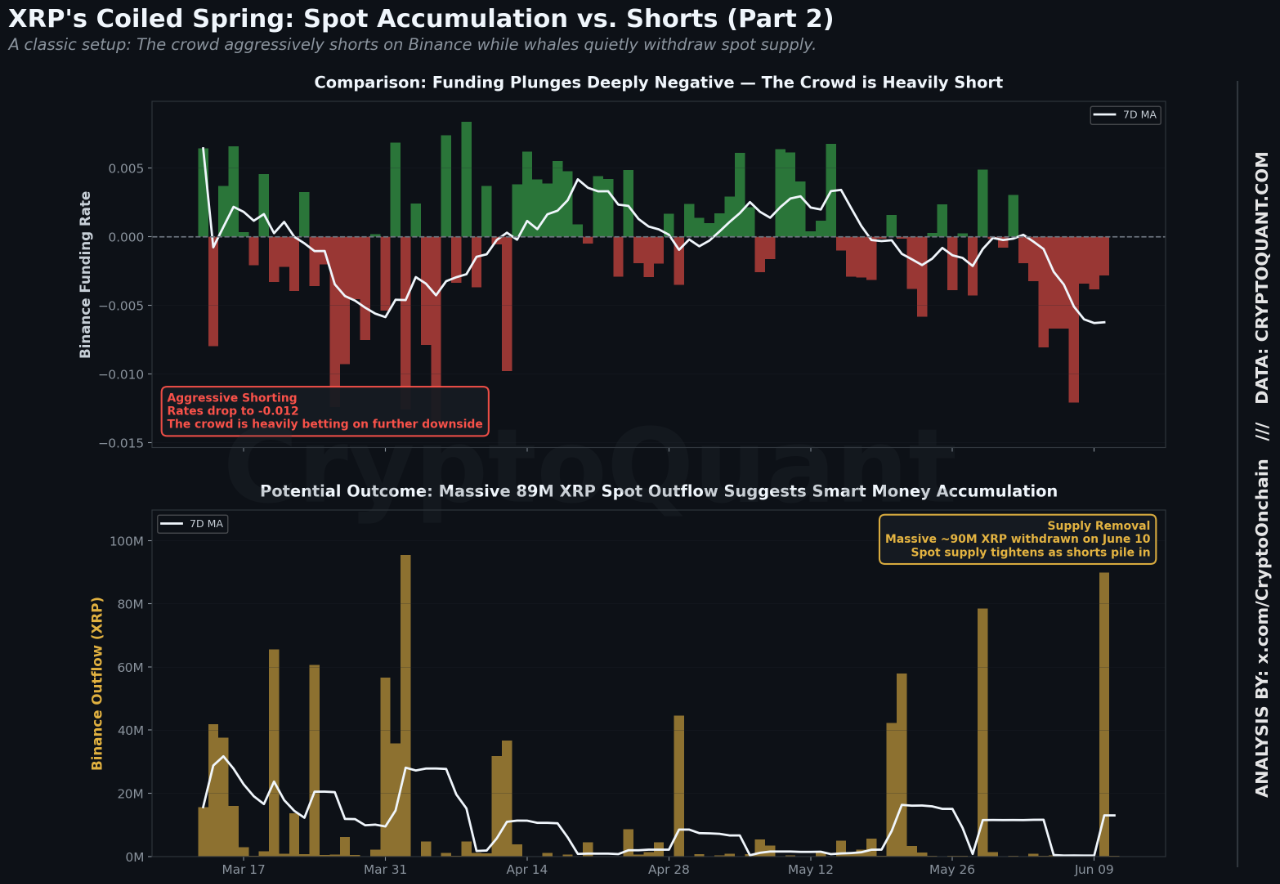
Importantly, much of this leverage is coming from traders expecting further losses. Binance Funding Rates have moved into negative territory, averaging -0.006 after falling more than 550% week-over-week. This shows that a large number of traders are opening short positions as XRP trades near local lows.

XRP Seeing Growing Spot Accumulation

While futures traders continue to increase bearish positions, activity in the spot market appears to be moving in the opposite direction.

CryptoOnChain observed that large investors have been withdrawing XRP from exchanges. For instance, The Crypto Basic confirmed that Binance recorded nearly 90 million XRP in net outflows on June 10. CryptoOnChain confirmed this, noting that withdrawals far exceeded deposits during that period.

The analyst also pointed out that Binance outflows have jumped more than 83% month-over-month. This means that XRP supply is leaving the exchange at a faster pace while traders on the derivatives side continue to increase their short exposure.

According to CryptoOnChain, when high Open Interest combines with deeply negative funding rates and large exchange withdrawals, the conditions often become favorable for a short squeeze.

XRP Sees Rising Shorts and Spot Accumulation CryptoOnChain
XRP Sees Rising Shorts and Spot Accumulation | CryptoOnChain

The analyst acknowledged that XRP could still face additional downside, but argued that the continued reduction of exchange supply suggests that larger market participants may be accumulating.

Important XRP Levels to Watch

Meanwhile, in a separate analysis, market commentator EGRAG noted that XRP was moving sideways above its short-term moving average. According to him, buyers remain in control on the lower time frame as long as the price stays within the support zone between $1.1340 and $1.1408.

The analyst presented $1.1938 as the first major resistance level. If bullish momentum strengthens, XRP could then move toward the next key target at $1.26. 

XRP 1h Chart EGRAG Crypto
XRP 1h Chart | EGRAG Crypto

However, on the downside, EGRAG highlighted $1.09 as the main support level. He also mentioned $1.05 as a critical support area and invalidation level. 

According to the analyst, a breakout above the current consolidation range could clear the way for a move toward $1.1938. However, if XRP loses its current support zone, the asset could revisit the $1.09 level.

Everstake Says Cardano Could Be This Year’s Biggest Surprise

0

Leading non-custodial staking infrastructure provider Everstake remains confident about Cardano’s outlook for the rest of the year.

According to Everstake, Cardano could emerge as one of the biggest surprises in the crypto market in 2026. The firm argues that ADA remains undervalued despite the network’s strong fundamentals and continued ecosystem development. 

Rising On-Chain Activity Signals Potential Reversal

Everstake’s optimism stems from Cardano’s growing on-chain activity, particularly recent spikes in the Age Consumed metric. This metric tracks the movement of coins that have remained dormant for extended periods.

Data from Santiment shows Cardano’s Age Consumed metric reached a five-week high on June 9, with several notable spikes recorded between June 4 and June 5. According to the staking provider, an increase in Age Consumed typically indicates that long-term holders are becoming active again. 

Furthermore, Everstake stressed that this type of activity has historically served as a reliable indicator of major trend reversals. As a result, the firm believes Cardano may be positioning itself for a significant upward move. 

Image

Strong Fundamentals Suggest Cardano Will Win: Everstake

Despite ongoing market distractions, Everstake maintains that Cardano’s core fundamentals remain exceptionally strong. As a long-time supporter of the ecosystem through its staking infrastructure services, the company reaffirmed its confidence in Cardano’s long-term trajectory.

Consequently, Everstake believes the project is well-positioned for future growth and could outperform broader market expectations during the remainder of the year, declaring that Cardano will win. 

Everstake’s comments echo the views of Cardano founder Charles Hoskinson, who previously predicted that 2026 would be a breakthrough year for Cardano. Hoskinson highlighted several key growth drivers, including the network’s DeFi ecosystem, the Midnight privacy-focused sidechain, and the Leios scalability upgrade. 

Earlier in the year, several developments appeared to support that outlook. Midnight secured a major partnership with Monument Bank, which announced plans to tokenize £250 million of customers’ deposits on the blockchain. Meanwhile, Cardano’s DeFi ecosystem surged in April, pushing total value locked (TVL) to a more than one-year high of 559.4 million ADA. At the time, Everstake described the increase as evidence of a healthy and expanding network.

ADA Price Lags 

However, Cardano’s market performance has moved in the opposite direction. Despite the network’s operational progress, ADA has struggled throughout much of the year.

So far, the token has declined by 48.9% year-to-date, falling to $0.1699. In addition, Cardano has slipped out of the top 15 cryptocurrencies by market capitalization and now ranks as the 16th-largest cryptocurrency globally.

Although supporters such as Everstake remain bullish on Cardano’s prospects, the ecosystem continues to face several challenges. Governance disputes and project shutdowns have fueled concerns within parts of the community on X. 

Adding to the friction, Hoskinson recently proposed migrating Cardano community hubs to Discord, a move critics argue could restrict adoption rather than expand it. Navigating through these headwinds will determine whether Everstake’s optimism materializes. 

XRP Forms ‘Power of Three’ Pattern After 18% Drop, Analyst Says Expansion Phase Could Be Next

XRP could be preparing for a major move if a widely followed chart pattern plays out as expected, according to CoinvoTrading.

The analyst believes many investors are giving up on XRP at the worst possible time. He pointed to what he described as a textbook “Power of Three” (PO3) pattern forming on the daily chart.

Three-Phase XRP Structure

The Power of Three pattern is a popular market structure among technical traders. It consists of three stages: accumulation, manipulation, and expansion.

According to CoinvoTrading’s chart, XRP spent several months trading within a wide range, forming the accumulation phase. The recent break below that range is viewed as the manipulation stage.

This phase typically sees prices move against market expectations. It forces weaker holders out of their positions before the next trend develops.

CoinvoTrading believes XRP is currently in this manipulation phase. If the pattern continues to unfold, the asset could soon enter the expansion stage, which is usually marked by a strong upward move.

The chart projects a rally toward the $2.60–$2.80 range, representing a gain of more than 145% from the current price.

XRP Now Recovering from Steep Pullback

Indeed, XRP has experienced significant volatility in recent weeks. The token traded near $1.33 at the start of the month before falling to a weekly low of around $1.05. That decline represented a drop of roughly 18%.

Despite the correction, XRP’s price has begun to recover. CoinMarketCap data shows the token is trading at about $1.14, up roughly 3% over the past 24 hours. The rebound has helped trim recent losses, though XRP remains below its monthly highs.

The asset remains down approximately 21% over the past month. Moreover, XRP is still down around 38% year-to-date, reflecting the broader bearish trend since the start of the year.

CoinvoTrading argues that the recent weakness may be part of a manipulative move designed to shake out investors. He stressed that, based on historical market behavior, a major uptrend could ultimately follow.

CoinvoTrading's chart
CoinvoTrading’s chart

XRP Buy Signal Emerges

Notably, as The Crypto Basic reported earlier, XRP has flashed a TD Sequential buy signal on its 3-day chart after falling from $1.33 to $1.05. Analyst Ali Martinez noted that similar signals on higher timeframes have historically led to short-term rebounds.

However, on-chain data suggests caution. Whale transactions above $1 million have dropped 57%, from 157 to 67, over the past nine days. This implies that major investors are remaining on the sidelines.

Meanwhile, whale wallets have sold or redistributed about 60 million XRP over the past week, indicating continued selling rather than accumulation.

Martinez believes XRP could see a brief relief rally, but sustained upside may remain limited unless whale buying returns. He also identifies $0.90 as a key long-term support level and a potentially attractive accumulation zone if the price revisits it.