Home Blog Page 2207

One Cardano Investor Lost 60 Million ADA in Celsius Network

0

Celsius Network reveals thousands of users’ transaction histories.


The recent leak of Celsius Network’s users’ transaction history has revealed some interesting development days after the unfortunate incident happened.

It can be recalled that the troubled crypto lender Celsius had revealed the identities and transaction history of thousands of users, who suffered groundbreaking losses. The document comprises 1,450 pages and contains Celsius’ customer personal information, including wallet ID, types of tokens held, and the value. Per the data, the top 10 Celsius investors suffered losses worth over $200.6 million at the current exchange rate.

Details of Celsius Customers’ Losses

The Celsius customer who suffered the major loss is Jacob Benjamin Fite. According to the data, Fite ranked first in the list, with losses worth more than $40 million. Fite’s major holding, which amounts to 98% of his portfolio, is Bitcoin (BTC).

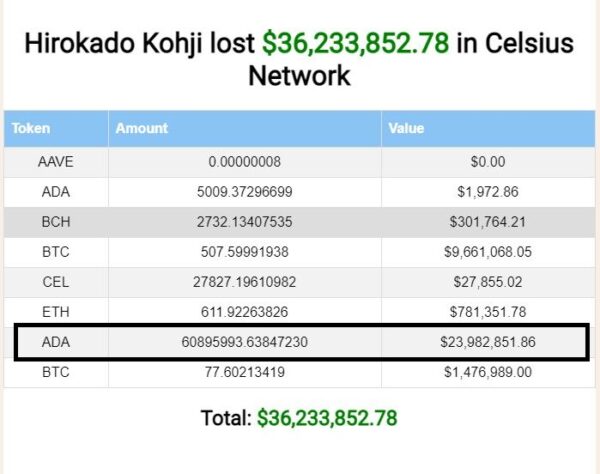
The second Celsius user with the most losses is Hirokhado Kohji. The user lost a whopping $38 million in the Celsius collapse. Kohji is a Cardano maxi, as his major cryptocurrency holding is ADA. According to the data, Kohji held 60,901,003 (60.9 million) ADA before the Celsius Network incident. At the time of writing, Kohji’s ADA holdings were worth $25.33 million.

60M ADA LOST
Image source: https://celsiusnetworth.com/

It is noteworthy that Kohji was not the only Celsius’ top 10 individual investor that held a significant amount of ADA. Celsius’ fourth-largest investor named Keri David, has a total of 269,993 ADA ($106,329) in his portfolio.

The amount of funds lost in the Celsius incident further confirms the importance of always being in control of your funds and not trusting a third-party platform.

Celsius Crisis

The Celsius data leak has received widespread criticism on various social media platforms. In a recent tweet by Nick Hansen, CEO and co-founder of Luxor, he noted that the crypto lender’s data leak “could go down as the greatest breaches of customers’ information ever.” 

Meanwhile, Celsius had already filed for Chapter 11 bankruptcy earlier this year, and the proceedings have commenced. The company is seeking to auction some of its assets to reimburse creditors. As reported by TheCryptoBasic, some companies, including Ripple, already indicate interest in Celsius assets.

Neblio Becomes An Official Supporter Of Terra Classic (LUNC)

0

The Terra Rebels will receive support from Neblio in its goal to rebuild the Terra Classic chain.


In a tweet on Monday, the Terra Rebels, via its official Twitter account, disclosed that Neblio, a leading enterprise blockchain, has become its official supporter.

Notably, Neblio will be an advisor and support the developers’ team in infrastructure and finance.

“Terra Rebels is proud to announce that NebliTeam has become our Official Supporter, providing infrastructure, financial & advisory support to help us deliver on our core mission to maintain the Terra Classic blockchain on behalf of the Terra Classic Community,” read the announcement.

Neblio also announced the partnership.


It is worth noting that Neblio is an enterprise blockchain platform to make the development of decentralized applications (DApps) easier. In addition, the platform also provides support and consultation services for other blockchains.

The partnership with the Terra Rebels could offer a plurality of benefits to the Terra Classic chain:

  • It is likely to incentivize DApp development.
  • It could help tackle issues related to a lack of compensation for developers.
  • Financial incentives could help attract new development talent.

Notably, these have been key challenges plaguing the revival of the network. Last week, the shortage of development talent and financial incentives was made painfully clear when Terra Classic core developer Tobias Andersen, AKA Zaradar, threatened to censor the chain. Moreover, many have dubbed the network a ghost chain because of the lack of functional DApps.

However, the latter narrative is not likely to hold up for long as at least 18 DApps are actively building to launch on the chain. Meanwhile, this number is expected to see a massive boost once the chain achieves full Cosmos compatibility and technological parity with Luna v2.

It bears mentioning that, as reported by The Crypto Basic, the Terra Classic network is expected to become fully Cosmos-compatible, with the v23 upgrade expected in December. Meanwhile, the Terra Rebels are working with Cosmos developer Jacob Gadikian to achieve technological parity with Luna v2. Edward Kim believes the network will achieve this well before mid-2023.

Ethereum Scaling Solution Polygon Launches Its zkEVM Public Testnet 

0

Polygon has finally launched the public testnet for its zkEVM solution.

Since its inception as an Ethereum scaling solution to address the low throughput and high fees faced with the blockchain, Polygon has consistently made several improvements. Following the introduction of its EVM-compatible zk-rollup solution, Polygon has finally launched the public testnet for the zkEVM.

Polygon announced the launch of the public testnet via its official Twitter handle and website in the late hours of today. 

“When we unveiled Polygon #zkEVM in July, it was a milestone not only for Polygon, but also for Ethereum & Web3. We’re proud to announce Polygon zkEVM Public Testnet, the world’s 1st open source zkEVM network,” Polygon noted in a tweet. 

The solution is open-source, and per information from the official blog post, the launch of the public testnet will give developers from the community the opportunity to try out the solution, and share feedback on areas of improvements or bugs noticed.

Notwithstanding, as a means to expedite the testing process, Polygon has welcomed four specific platforms to test the solution. These include DeFi platforms, Aave and Uniswap; gaming studio, Midnight Society; and Web3 social media platform, Lens Protocol.

Recall that Polygon introduced the zkEVM solution to the crypto community sometime in July, as previously reported. While zero-knowledge rollups have been utilized by several platforms to improve blockchain scalability, Polygon’s approach launched a zk-rollups solution compatible with the Ethereum Virtual Machine (EVM). 

Polygon’s zkEVM combines the scaling potentials of zk-rollups with the versatility of the EVM to produce a universal solution for improved scalability. This makes Polygon’s solution compatible with any platform that is capable of using Ethereum. 

How To Stay Safe From Crypto-Targeting Phishing Attacks

0

Phishing is a well-known online attack that steals people’s personal information or financial funds. After the emergence of cryptocurrencies and their turbulent path, it was only a matter of time for scammers to exploit this venue.

Many day-to-day phishing campaigns fail to get researchers’ attention. However, large-scale attacks can result in enormous losses for crypto enthusiasts. Furthermore, the buzzing NFT trends are also venues that criminals embrace for their devious plans.

In most cases, attackers present themselves as legitimate individuals or entities to earn trust, but once they have all the information, they steal crypto funds or access crypto wallets. These scams have become very common, and hackers use more sophisticated methods.

They know the value of initial coin offerings, crypto exchanges, and crypto-wallets. Furthermore, scammers can have confidential insights into your crypto holdings. It might be random, but previous data breaches could have exposed such details. So, as a cryptocurrency holder, you must consider protecting your assets and personal data.

How crypto-targeting phishing attacks work

Like typical phishing attacks, it all starts with the victim receiving a message or email from a “legitimate” sender. Emails or text messages can contain information on exclusive offers. For instance, an entity might claim to offer free tokens for a new and upcoming cryptocurrency. In other cases, they might tempt crypto enthusiasts with rare and valuable NFTs.

If the user performs an action demanded by attackers, the consequences depend. For instance, a honeypot account refers to smart contracts that users might be able to drain crypto from. However, users need to transfer crypto first. Sadly, only the perpetrators profit from such deals.

Another crypto-related phishing scam exploited Unicode letters to trick victims into visiting dangerous websites. However, since the URLs get spoofed, users believe that they are accessing legitimate crypto-related sites.

Learning how to recognize these attacks

A big part of protecting yourself from these attacks is to recognize them. After all, you’re the one who will click on the link or provide sensitive information. However, as we mentioned, phishing attacks can come in many different forms, and hackers put in a lot of effort to look legit.

However, there are some things you should pay attention to.

Look for writing errors

Phishing attacks often have grammar or spelling mistakes. Attackers can be thousands of miles away but use English to lure in their victims. However, sometimes they can try and translate email to their victim’s native language. Look for obvious grammar errors before clicking anything.

Learn to recognize copycats

Phishing messages will often appear as if they were sent by one of your services. They will include the colors, logos, typefaces, font, and other elements of the genuine website. However, they aren’t identical, and attacks often make visible mistakes.

On the other hand, always check the address of the email the message is coming from. If there’s a link to a page, check the URL to see if it matches the official website. On one occasion, sites like CoinGecko displayed suspicious pop-up messages that were not featured usually. They required visitors to connect their wallets or confirm transactions. However, malicious scripts caused these messages to appear.

Poor attention to details

As we mentioned, phishing attacks often try to look like emails from some reputable organizations you’re using. Sometimes, they will try to copy the email’s structure, tone, and style entirely. However, that’s not an easy task, and you always spot the differences.

For example, the images could be placed in the world place, messages could have a wrong tone, or you will simply “feel” there’s something wrong. The images can often be misaligned with the messaging so pay attention to every detail.

Malicious links

As mentioned, phishing emails often include links to build their credibility or send you to a misleading website. Some links will instantly activate processes harmful to you and your personal information.

On the other hand, some links will send you to fake websites designed to earn your trust and get you to perform some action. These links often come in shortened URLs to hide the actual address.

Use a VPN

Apart from recognizing phishing attacks, it’s essential to reinforce your online security and prevent them from getting to you. For instance, an unsecured network should not open doors for hackers to eavesdrop on your traffic or capture information. A Virtual Private Network can help you prevent such scenarios.

This tool encrypts your traffic and online connections, making it difficult for anyone to track you, see your IP, or know what you’re doing online. A VPN download can even bring you an features that block access to potentially dangerous sites. Usually, such blocking gets done according to databases of dangerous websites or certain features (like lacking HTTPS).

Be wary of new crypto exchanges, coin offerings, and wallets

In many cases, crypto phishing is directed toward those digital currencies people use to trade, buy, sell, and store their assets. You must be careful when getting messages about new excellent exchanges, offers, wallets, etc.

As a crypto holder, you must be careful and learn as much as possible about new platforms before committing to them. Not only that this can help you protect your assets, but it will also help you increase them.

Bottom line

These are some of the most critical threats you should consider regarding phishing attacks. Take the time to analyze all unknown messages you receive and use your assets responsibly.


David Gokhshtein Expresses Regrets Says “Should Have Just Went All In” on Shiba Inu

0

Gokhshtein wished he had invested all his meme coin funds in Shiba Inu.


There comes the point in an investor’s life when he wishes he had taken a particular investment decision instead of others. This is the case of David Gokhshtein, a cryptocurrency entrepreneur and the founder of Gokhshtein Media.

Gokhshtein wished he had gone “all in” on Shiba Inu (SHIB) when choosing the best meme coin to invest in.

“When it came to meme tokens, I should have just [gone] all in on SHIB,” the prominent cryptocurrency entrepreneur said. 

Going “all in” is a phrase used in the cryptocurrency community, which indicates when an investor decides to commit all his funds to a particular asset. In this case, Gokhshtein wished he had committed all the funds he invested in other meme tokens into Shiba Inu.

Although he did not give any specific reason why he would have focused more on Shiba Inu over other meme tokens, the recent developments happening in the SHIB ecosystem could be a factor backing Gokhshtein’s comment.

Shiba Inu has been in the limelight in recent times. The team behind the development of Shiba Inu has worked relentlessly to transform the project from being a meme coin into a digital currency with enormous utility.

As reported by TheCryptoBasic, Shiba Inu launched its much-anticipated play-to-earn (P2E) game, dubbed Shiba Eternity. The game has attracted a lot of engagement since it went live, with over 10,000 downloads recorded in less than one week on the Android mobile store. To get more people to play the game, Shiba Inu disclosed that it would release a guide to get more people familiar with it.

Aside from Shiba Eternity, the team is also working on a stablecoin, a Layer-2 network, among other projects; thus, Shiba Inu ranks as one of the top crypto coins.

A “Very Big Move” For Bitcoin Coming As BVOL Tanks Below 25

0


Bitcoin might be getting ready for a breakout, according to Michaël van de Poppe, as BVOL sees a drop below the 25 mark.


Bitcoin (BTC) has been trading sideways for months as the community witnesses an extensive period of consolidation for the firstborn crypto. The lack of interesting movements might serve as a disappointment for market watchers expecting a major breakout. While it serves as a relief for others, as the asset can hold against some major support levels.

As a top analyst, Michaël van de Poppe forecasts a looming rally, and Bitcoin’s current consolidation trend might end. Van de Poppe’s prediction is influenced by the recent movement of the Bitcoin Historical Volatility Index (BVOL).

“A very big move is on the horizon for Bitcoin, as BVOL drops sub 25,” van de Poppe said in a tweet Monday.

He highlighted three historically significant events prompted by the drop below 25 for BVOL.

These events include the BTC crash to $3k in 2018, the breakout from $4k to $14k in 2019, and the surge above $10k in 2020 that started the bull run.


As witnessed on the chart of van de Poppe, a drop below 25 for BVOL has historically marked an end to sustained consolidation. BVOL saw a dip below 25 in late-2018 when BTC was consolidating at the $6k level. Following the BVOL drop, BTC crashed to $3k a few months after, dropping to $3,200 in December 2018.

Furthermore, after trading sideways between $3k and $4k from December 2018 to April 2019, BTC staged another rally when BVOL plummeted below 25 in April 2019, gaining over 240%.

The last time the index saw levels below 25 was in mid-2020. This contributed to the rally that led to the ATH above $68k in November of 2021. BVOL has seen another dip below 25, with a current value of 23.41 as of press time, per data from a TradingView chart.

The Bitcoin Historical Volatility Index tracks the volatility rate of Bitcoin and is efficient in determining the rate of market fluctuations for BTC. With the recent dip, van de Poppe is predicting a looming end to the current consolidation, but that breakout move can be on either side, so investors need to be careful.

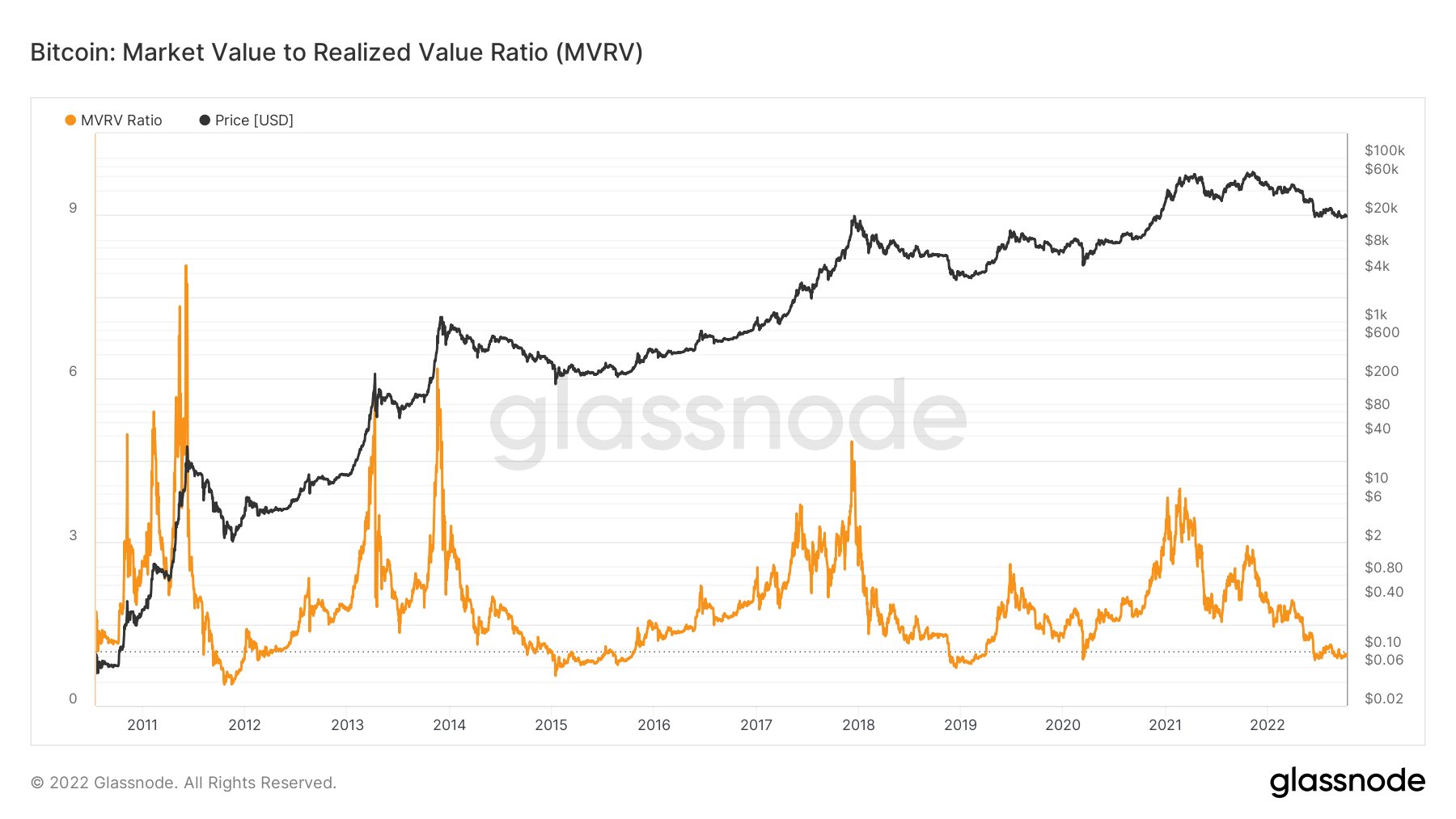
Van de Poppe’s conviction of a breakout is further influenced by indications from Bitcoin’s Market Value to Realized Value (MVRV) ratio. The MVRV ratio of an asset is crucial in determining whether its current price is overvalued or undervalued.

An MVRV ratio below 1 indicates that the asset is undervalued and is useful in predicting price bottoms. According to a CryptoQuant chart, the Bitcoin MVRV ratio is currently 0.9, showing that the asset is undervalued. Van de Poppe also highlighted this metric, as it had been previously noticed in the bottoms of Q4 2011, 2015, November 2018 to April 2019, and the COVID-19 crash.

“The MVRV ratio for Bitcoin is at its lowest point. It means the current traded price per Bitcoin is far beneath the fair value. 

Previous times of these levels;

– Q4 2011

– 2015

– 2018 November-April 2019

– COVID-19 crash

We are bottoming on Bitcoin, accumulate,”

MVRV ratio for Bitcoin
Image source: https://twitter.com/CryptoMichNL/status/1579422259047206913

Meanwhile, Bitcoin’s consolidation persists at the reporting time, as the asset has seen a slight dip of 0.76% in the past 24 hours. BTC is changing hands above the $19k support, at $19,343, down 0.34% in the past seven days as of press time.

Total Value Locked (TVL) on BabyDoge Swap Surpasses $18 Million in 4 Days

0

Less than a week after its debut, Baby Doge Swap has hit a new milestone.


According to data from the decentralized exchange, the total value locked (TVL) on Baby Doge Swap recently surpassed $18 million. At press time, Baby Doge Swap’s TVL is currently worth $18,287,096 ($18.28 million).

The development was also announced on Baby Doge Swap’s official Twitter account.


Baby Doge Swap is a decentralized exchange launched last week to increase the project’s use case. The DEX is built on the Binance Smart Chain, making it simple for users to perform token swaps for all BSC-based tokens, including Binance Coin (BNB) and the project’s native cryptocurrency, BabyDoge.

Baby Doge Swap also offers yield farming on BUSD/USDT pairs, with users entitled to receive up to 6,000% APY rewards for providing liquidity. However, the APY rewards are expected to be reduced as more liquidity providers use the service.

The DEX was audited by leading cryptocurrency security firm CERTIK as part of efforts to keep users safe from malefactors. Since Baby Doge Swap was developed to make token swaps and yield farming to be cheap and fast, the team ensured that users would pay meager fees when using the platform.

Team to Burn BabyDoge Using DEX’s Fees

Despite charging low fees for transactions on the platform, BabyDoge still chose to allocate a portion of transaction fees to buy and burn Baby DogeCoin. 

There have been calls by the community to reduce the total supply of BabyDoge to boost the price of the cryptocurrency. BabyDoge has a total supply of 420 quadrillion tokens, with a circulating supply of 160.9 quadrillions. The community believes the whopping amount of BabyDoge total supply negatively affects the token’s price, hence the need to burn some of it.

In July, the Baby Doge Coin performed the biggest burn by incinerating 50 quadrillion cryptocurrency units, worth around $88 million.

Cardano in Top Five (Excluding Stablecoins) For Last 7 Quarters

0

Cardano Has Remained in the Top 5 List of Largest Crypto Assets in the Past 7 Quarters.


Cardano maintains a top 5 position (excluding Stablecoins) in the list of largest cryptocurrencies for the 7th consecutive quarter.

Cardano (ADA), often touted as one of the most reliable Ethereum Killers, remains the favorite of several proponents within the cryptocurrency scene. Though pummeled by the current bear market, the asset has retained its prominence amongst top digital assets.

ADA has seen a massive surge in adoption rate, contributing majorly to its resilience against the Winter. As a testament to ADA’s prominence, recent data reveals that the asset has remained in the top 5 list of largest cryptocurrencies since Q1 2021. The feat was revealed Monday by an unofficial Twitter handle dedicated to Cardano-related updates on projects, data, and news.

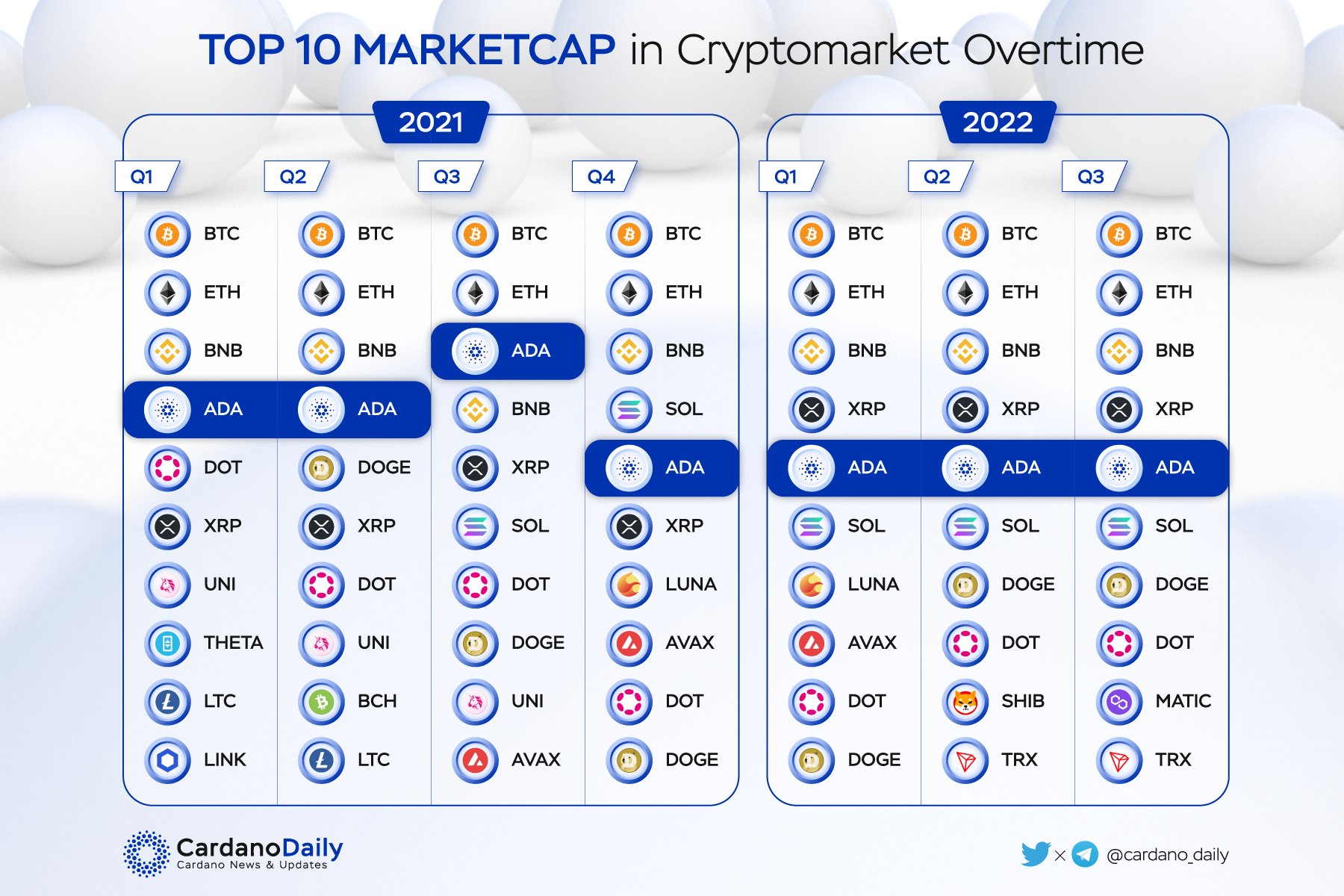
“The below infographic showed the top 10 coins with the largest market cap in quarterly from 2021 (exclude stablecoin),” the handle noted, as a dashboard revealing the top 10 crypto assets since Q1 2021 was shared.

Cardano In Top five
image source: https://twitter.com/cardano_daily/status/1579427039211245573


Information from the infographics reveals that ADA has retained a position in the top 5 list of digital assets since Q1 2021, excluding stablecoins. Launched in 2017, Cardano’s rise to the top 5 list in 2021 has solidified the asset’s position amongst top competitors in the space.

The asset secured the 4th position of top cryptocurrencies by market capitalization in Q1 2021, bestriding notable assets such as Polkadot, XRP, and Ripple. The asset rose to the 3rd position in Q3 2021 before dropping to 5th in the following quarter.

ADA has remained in the 5th position of biggest cryptocurrencies by market cap (excluding stablecoins) since Q4 2021. Despite staying below BTC, ETH, BNB, and XRP since Q1 2022, ADA has consistently towered over SOL, LUNA, DOGE, TRX, and DOT.

Per data from CoinMarketCap (CMC), with a current market cap of $14.28B as of press time, ADA still retains its 5th position – declining to 8th with the inclusion of the three largest stablecoins, USDT, USDC, and BUSD.

ADA’s current market cap of $14B+ indicates that the asset will not be moving below its current spot anytime soon, as its valuation is over $2.5B ahead of top competitor SOL which secures 6th position with a market cap of $11.70B at the time of reporting.

Cardano has sustained its prominence in the cryptocurrency scene due to the major developments engineered by the project’s team of developers, fueling the adoption rate. Cardano’s much-anticipated upgrade Vasil Hard Fork was successfully deployed on September 22, following a series of deferments.

The upgrade brought several performance improvements to the Cardano network. As The Crypto Basic reported last month, the community is already experiencing the improvements introduced by the Plutus V2 functionality from the upgrade a few days later. The upgrade brought with it lower fees and faster transactions.

Meanwhile, last week, the decentralized payment network COTI announced an initiative to bring more exposure to Cardano stablecoin Djed. The initiative involves a partnership with DeFi property platform Empowa which would include Djed as a payment option for African partners.

Amidst these promising indicators, ADA has been holding up against the bears. Despite a recent drop below the support at $0.42, the asset shows signs of a comeback. ADA currently trades at $0.41 as press time, down 1.42% in the past 24 hours. This marks the first time the asset has been trading below $0.42 since July.

EQIFi Integrates Its $EQX Token With HYVE, Betting On Freelancers As Tech Tumbles

0

EQIFi, a leading regulated global DeFi services platform backed by EQIBank, partners with HYVE, a blockchain-based platform for freelancing services. Through the partnership, EQIFi integrates its native $EQX token into HYVE’s ecosystem, expanding the selection of cryptocurrencies with which freelancers can do business on the platform. EQIFi also integrates HYVE’s native $HYVE token as an option for P2P transfers on its own mobile app.

Companies ranging from early-stage startups to the likes of Meta and Netflix have announced hiring freezes or layoffs in recent weeks as tech feels the burn of the economic downturn. Among the many challenges this creates, hiring managers now have to find ways to support shrinking teams without hiring for in-house roles. In many cases, freelancers offer a solution for part-time support.

Through its integration with HYVE, EQIFi empowers freelancers on the platform to earn in $EQX and other cryptocurrencies at low fees, ensuring they are adequately compensated for their work. Freelancers can use the platform to find work without owning crypto. On the employer front, companies can choose to pay freelancers in crypto without having to exchange them, ensuring no value is lost in the process.

EQIFi makes DeFi as accessible as regular online banking, offering users a convenient platform incorporating the largest array of financial services in the DeFi ecosystem. Backed by a licensed bank, the platform grants its clients the certainty and security that comes with the highest level of regulatory compliance. Its relationship with EQIBank also positions it as the efficient gateway between DeFi and traditional finance, enabling its clients to swiftly move their assets between crypto and a variety of fiat currencies.

“It’s simply fantastic to be able to offer multiple use cases in this integration that push the boundaries of decentralization,” says Brad Yasar, CEO of EQIFi. “Supporting a platform that cuts out the middleman to empower freelancers and companies alike during a time of economic uncertainty with our token is exactly what EQIFi stands for, and will continue to stand for.”

“The accelerated shift towards online work has allowed firms to recognize the benefits of hiring freelance professionals,” says Tudor Stomff, CEO of HYVE. “Apart from being more cost-effective when planning a project, it also gives access to a wider pool of talent from which companies can select. On top of that, by working with freelancers, professionals are not bound by factors such as geography, allowing a higher degree of flexibility. EQIFi joins us in our missions to take this to the next level, by adding $EQX as a payment method on the platform to empower freelancers.”

About EQIFi:  

EQIFi is a leading regulated global DeFi services platform backed by EQIBank, a global licensed digital bank. EQIFi offers its users a wide array of financial services, including a DeFi yield aggregator leveraging third-party yield protocols for maximum returns as well as loans and deposits. The platform bridges the gap between decentralized and traditional finance and makes using crypto as convenient and easy as traditional online banking.

For more information, visit https://www.EQIFi.com/ 

About HYVE:

HYVE has created a community-driven ecosystem, facilitating collaboration between users in a uniquely decentralized environment. While traditional freelancing websites have been slow in adapting to change, HYVE has introduced payments directly in cryptocurrencies, providing numerous advantages and facilitating interaction regardless of external factors.

For more information, visit https://hyve.works/ 

Binance Burns 3 Billion Terra Classic In Second Round Of LUNC Trading Fee Burns

0


Binance continues LUNC burn initiative, giving up trading fees.


In a tweet by LUNC DAO, a Terra Luna Classic (LUNC) community validator moments ago, the validator disclosed that world-leading exchange Binance had sent nearly 3 billion LUNC worth about $1 million to the Terra burn wallet as part of its burn initiative to support the network.

Transaction Details: https://finder.terra.money/classic/tx/B16C36B73EE4DA971D0AA6A63C6E701147A1F162BD91F5E5245C03661C35AA94


Notably, the transaction had first been flagged by LunaBurnTracker, a Twitter account dedicated to tracking LUNC burns.

It bears mentioning that Binance is yet to update this transaction on the blog post dedicated to tracking the burn event. However, it should be updated on or before 00:00 UTC on Tuesday.

As reported by The Crypto Basic on September 26, Binance disclosed that it would be burning all fees obtained from LUNC trading activity in response to demands from the LUNC community that a 1.2% tax be implemented on off-chain transactions. It is believed that the initiative will be discontinued after 4-weeks should other exchanges not follow suit.

Notably, about 5.5 billion LUNC was burnt in the first round of trading fee burns. Today’s burn puts the total burn by Binance from trading fees at about 8.5 billion LUNC. It comes at a $2.8 million cost to the exchange.

Since the LUNC community introduced burns, about 17.9 billion LUNC have been burnt. Binance burns from trading fees now represent over 47% of that number. Meanwhile, the 1.2% burn tax on on-chain transactions has only burned about 5 billion LUNC, only about 28% of the total.