
Home Blog Page 2370

Nigerian Government Taps Algorand Blockchain to Commercialize Intellectual Property Rights Globally 

0

The country is determined to help content creators monetize their arts through the Algorand network.


Nigeria has partnered with Developing African Group on a three-year Intellectual Property Right (IPR) agreement that will lead to the commercialization of IPs created and registered within the country. 

Details of the Partnership

Under the partnership, the Nigerian government will grant Developing African Group the exclusive license to develop a platform where citizens of the country can upload and trade their intellectual properties in exchange for royalty rights or proceeds. 

All royalties and proceeds will be received in users’ wallets on the platform, created by Developing African Group. 

Some of the content that can be commercialized on the platform include copyrights and trademarks of songs, videos, lyrics, shows, podcasts, and other forms of streamable content, the press release notes. 

Developing Africa Onboards Algorand and Koibanx

With Developing Africa Group not planning to waste any time, the company has chosen Koibanx and popular blockchain network Algorand following the Nigerian government’s approval, to get things started. 

Per the announcement, while Koibanx will develop the tokens that will be used to trade various artists’ intellectual properties, Developing Africa plans to build the entire platform, including the digital currency, on the Algorand network.

Commenting on the adoption of Algorand to foster the partnership, Ben Oguntala, CEO of Developing Africa Group, said: 

“Algorand’s protocol not only provides the performance, scalability, security, and functionality required to implement such a large scale project but is also environment-friendly which is important for the Government and has a huge philosophical match with the `creators economy industry´ we’re targeting here.” 

Koibanx and Algorand Collaboration Broadens

It is worth noting that this is not the first time Koibanx and Algorand will be partnering on an initiative. The duo has worked on several initiatives, including in the private and public sectors across Latin America. 

Leo Elduayen, Koibanx´s CEO described the initiative as the largest cryptocurrency project globally, adding: 

“I believe this initiative could change the lives of over 50 million people easily. Since we launched Koibanx back in 2015 we were convinced Blockchain tech and cryptocurrencies were the foundational building blocks for economic development in emerging markets, being able to have an active part in how is happening is a privilege.” 

Widespread Algorand Adoption

Meanwhile, the Algorand blockchain has been widely adopted by government authorities as well as private entities. 

Algorand, which became the official blockchain of FIFA earlier this month, saw Australian Zoo launch its non-fungible tokens (NFTs) on the platform. 

The Algorand Foundation also took to its Twitter page to announce the development, saying: 

“BREAKING: @koibanx and @developingafro to develop #Nigeria’s official platform for commercialization of all IP in the country, on #Algorand.” 

The company also went a step further to illustrate the significance of the initiative to the Nigerian entertainment industry. 

Over $80 Billion Erased from the Decentralized Finance (DeFi) Market Amid Terra (LUNA) Collapse

The decentralized finance market was also not spared following the Terra ecosystem tokens collapse.


The collapse of Terra ecosystem tokens TerraUSD (UST) and LUNA had a major impact on the entire cryptocurrency market, including the decentralized finance (DeFi) sector.

With UST losing its peg to the dollar due to the mouth-watering rewards attached to Terra’s Anchor program, DeFi investors who mostly borrow and lend crypto assets fear that a similar fate may befall their favorite digital currency.

Large Movement of Funds from DeFi protocols

As part of efforts to save themselves from seeing their favorite crypto project collapse like in the case of Terra, there has been a large movement of funds from various DeFi protocols in recent weeks.

According to data on DeFi tracking platform DeFi Llama, the total value locked (TVL) across various protocols plummeted to $112 billion from $195 billion in the aftermath of Terra ecosystem collapse.

A quick look at MakerDAO, the largest DeFi project by total value locked, shows that the platform has seen the volume of its asset locked dip by over a third in less than a month to $9.7 billion.

A similar event was recorded for the second-largest DeFi platform dubbed Curve, a protocol that enables users to swap stablecoins at a negligible fee.

Per data on DeFi Llama, the total value locked on Curve plummeted by over 55% to $9 billion.

Commenting on the decline in the volume of TVL, Kaiko, a cryptocurrency research firm, noted that the reason why staking in DeFi protocols has been on the decrease in recent times is because of the massive capital outflows from the cryptocurrency space.

“Fear is rampant. And you’d have to look long and hard to find a bullish investor across any risk asset,” Jeff Dorman, Arca’s Chief Investment Officer, said in a report published by Bloomberg.

Cryptocurrency Market Suffers Huge Losses 

Aside from the DeFi space, the entire cryptocurrency market has also suffered huge losses. Over $1 trillion has been wiped out of the entire market since the unfortunate incident with Terra started.

Bitcoin saw its value plummet to below $27,000 from nearly $40,000, while Ethereum (ETH) also plunged below $1,800.

With the massive losses investors have suffered over the past week following the Terra ecosystem collapse, many feared widespread capitulation would be recorded in the crypto space.

Meanwhile, the IMF Managing Director recently urged cryptocurrency investors not to flee the industry as the market has become a pivotal aspect of the global financial industry.

Shiba Inu Smashed Dogecoin In Coingecko Better Project Poll

0


Shiba Inu Community just smashed Dogecoin Community in one of the polls conducted by CoinGecko.


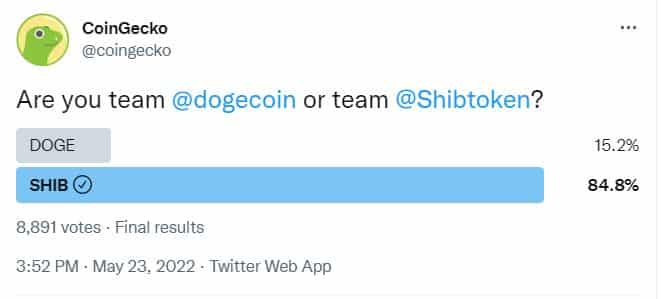
CoinGecko, one of the reliable crypto data tracking websites held a poll on their official Twitter page, asking the users which is a better project. The poll included two of the most popular canine-themed tokens Shiba Inu (SHIB), and Dogecoin (DOGE).


Shiba Inu took a lion’s share of the votes with 84.8% preference. The total number of votes upon the conclusion were 8,891. Doge took only 15.2% of the votes.

Shiba Inu Vs Dogecoin:

The mainstream adoption of Shiba Inu is on the rise. Many corporations and firms have recently accepted SHIB as a form of payment.

The Cardinale Automotive Group, MotoRenn, Tag Heuer, and Gafisa, are some of the companies that have recently begun to accept SHIB as a form of payment.

Besides this, a new cross-distribution partnership between Lavu, major global restaurant software and payments solution provider, and Verifone, a global FinTech leader, and payment solution provider also made it possible to accept Shiba Inu as a payment in thousands of restaurants in 65 countries.

Additionally, the lead developer of the Shiba Inu ecosystem, Shytoshi Kusama hinted at a possible upcoming partnership with Red Bull, the most popular energy drink brand. Collaboration with Red Bull will surely accelerate SHIB’s popularity.

Today Shiba Inu Adds an Immersive Media Veteran With 20 Years of Experience to Its Metaverse Team.

Other than that Shib metaverse, NFTs, ShibaSwap, and Shibarium all show team commitment in making shib compete with the world’s top coins.

Moreover, SHIB has been following up on its burn sessions as well. With each passing day, the burning of the Shiba Inu token has accelerated. Recently, 603,240,815 (603.24M) Shiba Inu tokens were burned by the community through 69 separate transactions in the past 24 hours. Despite all the above developments, the price of Shiba Inu continued to fall. SHIB is yet to see the results of its collaborations, and adoptions reflect in its price, which has not seen its better side as of yet.

On the other hand, Dogecoin and its team are doing nothing rather than enjoying Elon Musk’s support.

Shiba Inu Community Burns 603 Million Shib In One Day

0


During the last 24 hours, the community destroyed 603.24 Million Shiba Inu (SHIB).


According to a SHIB burn tracker report, more than 603 million canine-themed tokens have been taken out of circulation over the last 24 hours.

Crypto burn tracker Shibburn has reported that over the past 24 hours, multiple initiatives within the Shiba Inu fan community have eliminated a total of 603,240,815 (603.24M) tokens, worth $7,112 through 69 separate transactions carried via SHIB Burn Portal.

Shiba Inu Community benefits from low prices and aims to burn an astounding amount of Shiba Inu in this bear market. This is proved by the fact that in the past week, the SHIB Army has sent a whopping total of 22,200,398,699 (22.20B) SHIB tokens to the dead wallet through 497 separate transactions.

On the other hand, SHIB Burn Portal rewards the SHIB Burners with some healthy rewards in the form of Ryoshi Vision, an official partner token of the Shiba Inu ecosystem.

The first-ever ShibaBurn rewards have been officially distributed among Shiba Burners on May 17th, 2022. The community cheered the rewards, and soon after the distribution of rewards, a record burn of an extraordinary 12,421,420,499 (12.42B) SHIB, worth $143,964, was permanently removed from circulation on May 19th alone.

Impact of SHIB Burn on Price:

Shiba Burn is not impacting the asset price as the global crypto market is still under some mild selling pressure. However, the drastically reduced supply of Shiba Inu will undoubtedly show its influence once the next bull market comes around, reviving interest in the Shiba Inu once more.

At the time of writing, Shiba Inu is trading at the price of $0.00001166, down -6.65% over the last day, with a 24-hour trading volume of $538,392,736 ($538.39M).

Ripple Validators Voting To Upgrade XRP Ledger: Details


Ripple (XRP) Validators Upgraded Network To Support Increased NFTs Transaction Volumes.


Ripple is in the process of upgrading its servers to a new version 1.9.1. Validators are voting to activate the XLS-20 amendment that has been in the works for some time.

Back in May 2021, Ripple tabled the XLS-20 proposal for the amendment that is supposed to bring NFT support and enable developers to mint NFTs on the XRPL.

The amendment will also cater for provisions for people to co-own assets, automated royalties, and a few other functionalities. These features will not need smart contracts to run. The announcement was made in a tweet by the XRP Ledger Explorer.


Code Testing Completed

In an update, Ripple intimated that prior to the amendment being implemented, extensive code testing was undertaken to ascertain the stability, performance, and scalability of the NFT code.

This is to prevent anomalies that could occur when the transaction volumes increase. The XRPL can now handle an increased transaction volume when the on-ledger NFT support is activated. By the new amendment, it would be possible to mint, transfer, and burn NFTs on the XRP ledger.

The upgraded version 1.9.1 has improved memory management for better efficiency, targeted NFT object page allocation, and increased account signers from 8 to 32. At the time of this writing, voting is still ongoing on Ripple’s amendments registry.

The Voting Process

An amendment cannot be activated by one entity on the XRPL MainNet. Rather, it requires a majority of the nodes on the network to agree and keep the link alive for a while. Before the final results are outputted, the default vote display is set to NO.

Currently, as mentioned, there are 3 amendments proposed. If two of them attain 80% majority support on the network, the vote will have achieved a YES consensus, and server version 1.9.1 will be installed automatically.

All other servers who will still be running previous versions will be blocked and required to upgrade their software to match the new specifications.

Ripple is also developing in-house tools to boost network performance and scalability. The open-source project is named Clio. For now, Ripple has set up an NFT-Devnet to use by potential developers who want to test the capabilities of the XLS-20 NFT standard.

Brazilian Real Estate Giant ‘Gafisa’ Can Now Engage Shiba Inu As Payment Method, Here’s How

You Might Be Able To Use Shiba Inu (SHIB) to Purchase Real Estate Properties From Brazilian Home Builder Gafisa.


Shiba Inu’s utility can be increased once again as people might be able to use the cryptocurrency to purchase real estate properties from Gafisa.

Following a partnership with Latin American cryptocurrency payment provider and exchange Foxbit, Gafisa, a Brazilian home builder, now accept crypto as a payment method for the purchase of its real estate properties.

Reason for Shiba Inu’s Adoption

In a press release, Foxbit noted that Gafisa adopted the nascent asset class as a payment method because it eliminates the intermediaries involved in the traditional payment sector, as customers can directly pay for properties without much hassle.

Furthermore, Foxbit noted that the benefits associated with crypto are one of the reasons why the real estate developer decided to accept cryptocurrency as a payment method. Cryptocurrency offers fast, low-cost transactions and better cost benefits for commerce and eliminates fraud that may arise via payments.

Foxbit noted that the disruptive nature of cryptocurrencies was among the reasons Gafisa chose to adopt crypto as a payment method.

Commenting on the development, Guilherme Benevides, CEO of Gafisa Incorporadora e Construtora São Paulo, said:

“Cryptocurrency is growing in popularity every day, also expanding the possibilities of its use. There is a natural tendency to digitize payments.”

Foxbit Crypto Offering 

Gafisa can now effortlessly receive over 40 cryptocurrencies supported by Foxbit, including Bitcoin (BTC), Ethereum (ETH), and Shiba Inu.

Foxbit is committed to helping businesses in Latin America accept cryptocurrency payments for their goods and services.

The payment provider has added over 40 cryptocurrencies since its inception as traders in the region can either trade these coins on the Foxbit exchange or use them to buy goods and services from businesses the company has partnered with.

Foxbit pay says:

“Foxbit Pay is a solution that allows businesses and online stores to receive their payments in cryptocurrencies, whether bitcoin or one of the other 40 currencies listed on Foxbit’s exchange.”

foxbit pay crypto
image source: https://foxbit.com.br/foxbit-pay/

As reported previously, Foxbit added Shiba Inu to its list of supported cryptocurrencies in February 2022. Any business partnering with Foxbit can accept Shiba Inu as a payment method and 40 other cryptocurrencies that the Brazilian payment service provider supports.

Gafisa Dominating the Brazilian Real Estate Sector

Meanwhile, Gafisa is one of Brazil’s real estate development pioneers. The company offers various properties such as land, residential houses, commercial hubs, as well as hotels.

The real estate developer has had remarkable growth since it was established. According to Gafisa’s data, the company houses at least one out of 130 Brazilians in one of its real estate properties.

Why Terra 2.0 And Awaited LUNA Airdrop Might Never Happen


Terra 2.0 And Luna Airdrop Might Be In Ambiguity.


The Terra community has been in limbo for days waiting for Do Kwon and Terraform Labs to formulate a plan to help investors mitigate losses after Luna’s price crash. When Do Kwon proposed the creation of a new Terra chain, dubbed Terra 2.0, things seemed to get better.

However, a recent expose has the community worried. Back in South Korea, Do Kwon and Terra Foundation Guard (TFG) are facing a legal backlash, even as they try to assure the community that Terra 2.0 is coming.

South Korean Police To Freeze Terra Assets 

Apparently, the South Korean police, precisely the Seoul Metropolitan Police, have requested all crypto exchanges in South Korea to freeze all assets owned and TFG. This is after allegations of embezzlement were leveled against the foundation and its controller, Do Kwon.


The charges revolve around the Bitcoin reserves that TFG held to protect UST’s and Luna’s prices from crashing to extreme levels. While Do Kwon and TFG claim that the reserves were used during the crash but weren’t as effective as expected, there are claims from other quarters that this didn’t happen and that the funds were embezzled.

Terra 2.0 To face Hurdles

Following Do Kwon’s proposal 1623, the community voted to build a new Terra chain and airdrop the new Luna tokens to current holders. However, creating an entirely new blockchain network takes resources, workforce, and time. This is where things get thick since the legal issues facing Do Kwon, and the TFG in South Korea have led to the freezing of much-needed funds. This could complicate matters as Terra 2.0 could run into financial hurdles that could delay its creation and launch. In turn, the Luna airdrop might turn out to be a mirage that will never materialize.

It’s not yet clear what Do Kwon and the Terra team are doing to mitigate these issues to prevent Terra 2.0 from running into roadblocks. However, the discussions surrounding the building of Terra 2.0 are still in infancy, and the community is still looking up to Do Kwon and his team for solutions.

On the other hand, Terra Founder Do Kwon Faces Three South Korean Investigations.

The South Korean Congress has demanded Terra’s Do Kwon to be brought before it for question over the Luna and UST price crash that saw 200,000 South Koreans lose their investments in the crypto.

Kwon And Terra Owe $78 To The Government

Also, Do Kwon and Terra are faced with another tax issue. According to the authorities, Kwon and Terra have tax arrears amounting to $78 million. Do Kwon has denied these allegations.

Revived Crime Unit To Investigate Terra

Luna’s and UST crash led the South Korean government to revive a disbanded crime investigation that was last active two years ago. The unit, consisting of 40 officials, will investigate to establish what led to the collapse of Terra and whether anyone is responsible for it. Millions of investors have lost money due to the collapse of Luna and UST.

Under such circumstances, it might not be possible for the Terra team to continue, especially when all of your assets are frozen by exchanges at the request of the Seoul Metropolitan Police as air drops and building a new blockchain from scratch needs funds.

IMF Managing Director Says Cryptocurrency Must Not Be Abandoned After Terra’s Collapse 

0

A top IMF official said cryptocurrency investors should not flee the market after the Terra ecosystem tokens crash. 


Following the collapse of Terra ecosystem tokens in the past few weeks that resulted in great losses, many feared that the resultant effect could be a widespread capitulation. 

In what may come as a shock to many, a top financial regulator with the International Monetary Fund (IMF) has urged cryptocurrency community members not to desert the market based on the Terra incident. 

Speaking at the World Economic Forum’s annual meeting in Davos, as reported by Bloomberg, Kristalina Georgieva, IMF’s Managing Director, has pleaded with the crypto community not to completely shun investments in the sector. 

Georgieva acknowledged that global regulators have not lived up to expectations in protecting cryptocurrency investors, as they were supposed to offer “guardrails” in the form of regulation while educating people about the associated risks with cryptocurrencies. 

“I would beg you not to pull out of the importance of this (crypto) world, It offers us all faster service, much lower costs, and more inclusion, but only if we separate apples from oranges and bananas, it’s the responsibility of regulators across the globe to put up guardrails and offer education to protect investors.”

Georgieva Speaks About Terra’s Collapse

Commenting on the collapse of TerraUSD (UST), the algorithmic stablecoin of the Terra ecosystem, Georgieva noted that there is a difference between stablecoins backed by fiat and those that are backed by algorithms to maintain their values. 

“The less there is backing it, the more you should be prepared to take the risk of this thing blowing up in your face,” Georgieva said. 

For the IMF Managing Director, the fact that Terra tokens collapsed the way they did does not mean people should tarnish all digital currencies using the same brush. 

Other Financial Regulators Comment on Terra’s Incident

Aside from Georgieva, other financial regulators also spoke about the recent collapse of the cryptocurrency market. 

Francois Villeroy de Galhau, France’s Central Bank Governor, while commenting on the collapse of Terra’s ecosystem tokens, said: 

“My impression is that in recent weeks, citizens have lost trust in crypto, more than in central banks.”

Top Media Veteran With 20 Years of Experience Joins Shiba Inu Team

Shiba Inu Adds Immersive Media Veteran With 20 Years of Experience to Its Metaverse Team.


The dog-themed project has added a veteran entertainment expert to the team that will oversee its metaverse project.

Shiba Inu is committed to making its metaverse project one of the best in the cryptocurrency industry as it announced the addition of a media veteran to its virtual reality project team.

According to a Shiba Inu blog post, Marcie Jastrow, who has over 20 years of experience in the entertainment industry, has been added to the team that will oversee SHIB: The Metaverse project.

Commenting on the development, Jastrow said:

“It is quite an honor to be a part of such an amazing project.  The ShibArmy is truly one of the most robust communities out there, I am thrilled to be able to help build and construct an amazing place for the whole community to explore and call their home.”

Shytoshi Kusama, Shiba Inu’s lead developer, reacted to Jastrow’s appointment with the tweet:

Her Responsibilities In Shiba Inu Metaverse

Jastrow is considered a perfect fit for the team due to her expertise in the media and entertainment industry.

Since the future of Shiba Inu’s metaverse project will bring about partnerships with other firms, Jastrow will use her expertise to guide these brand partnerships.

Part of her responsibility will also include providing a broad approach that will bring about a conducive environment where exceptional products and mouth-watering features can be delivered.

Following her appointment, the veteran entertainment expert will be joining other titans working on the Shiba Inu project.

Recall that last year, the Shiba Inu development team announced veteran game developer William Volk, who is currently among the developers of the upcoming SHIB play-to-earn game.

Jastrow’s addition comes less than a week after Shiba Inu announced that it had appointed Craig Kessler to become its first Legal Counsel.

Jastrow’s Work Experience

It is worth noting that prior to her appointment as a member of the Shiba Inu metaverse project, Jastrow has gathered more than 20 years of experience in different entertainment companies.

She is a former Business Development Advisor at Evercast and the VP of Immersive Media at Technicolor. Per her LinkedIn profile, some of her roles at Immersive Media Technicolor include conducting architected marketing that spans augmented reality, mixed reality, and virtual reality.

She also served as SVP of Sales for Technicolor Production Services and EVP of Sales at Laser Pacific among others.

Terra (LUNA) Team Confirms Terra 2.0 Is Not A Fork But Entirely New Chain

Terra team reveals Terra 2.0 is not a fork.


For days now, there have been speculations as to whether Terra 2.0 will be launched or whether Do Kwon and his team will change their minds and agree to burn extra Luna tokens to revive the dwindling price. Now, it appears that Terra 2.0 will happen.

However, contrary to what most people thought, Terra 2.0 will not be a fork of the Terra chain that’s currently harboring Luna.

Instead, it will be a whole new blockchain network that will start from Genesis block 0. Terra shared this revelation in a recent Twitter thread. Earlier on, Do Kwon had tweeted that Terra 2.0 will be a hard fork of Luna. That doesn’t seem to be the case anymore.


Terra 2.0 Will Not Share History With Current Terra Chain

Terra sought to distinguish between a hard fork and a new blockchain network in the Twitter thread. First off, a hard fork shares history with the original chain, but a new chain doesn’t. This means that Terra 2.0 will not share any history with the current Terra Luna chain (which will now be called Terra Classic).

As such, Proposal 1623 is about the complete re-birth of Terra as opposed to tweaking the chain to create a split chain of the current one. However, Terraform Labs has yet to develop a launch date or a roadmap for the new Terra 2.0.

DApps To Migrate To Terra 2.0

Since Terra 2.0 will not share any history with the original chain, dApps and other projects that are currently on Terra (Luna) will have to be migrated to Terra 2.0. The point to note here is that in the case of a hard fork, dApps pre-exist in the new chain. This will not be the case with Terra 2.0.

According to Terra, various popular dApps have already pledged to migrate to Terra 2.0 once the new chain is launched.

Prism Protocol, Stader Labs, Random Earth, One Planet, ChainLayer, BTCSecure, Sigma, TerraBay, and Nebula Protocol Show Commitment to Validate New Terra (LUNA) Network.

Initially, the Terra community was majorly in favor of burning Luna to reduce its supply and pump up the price, but Do Kwon’s proposal to create Terra 2.0 took center stage in the end. Do Kwon plans to airdrop the new Luna tokens to holders of Luna Classic once Terra 2.0 is live.