Home Blog Page 1799

Bitcoin’s Role In The Modern Financial Ecosystem: Beyond Digital Gold

0

The crypto world is vast, complex, and ever-evolving; yet, Bitcoin, as the inaugural cryptocurrency, stands tall as the face of this dynamic movement.

Initially tagged as ‘digital gold’, Bitcoin has expanded its roles, influencing various facets of the modern financial ecosystem.

This article from us at The Crypto Basic – your source for the Latest Crypto news & Defi Topics –  embarks on a voyage, retracing Bitcoin’s journey and highlighting its potential in reshaping the financial landscape.

Bitcoin’s Journey

Bitcoin’s inception in 2009 by the elusive Satoshi Nakamoto was met with skepticism; designed as a decentralized, peer-to-peer form of digital cash, Bitcoin promised a financial system free from central authority oversight.

Its early years were marked by its use as a currency for online transactions, most notoriously, perhaps, on the dark web.

However, over the years, Bitcoin has undergone a metamorphosis – from being a niche currency for tech enthusiasts to gaining mainstream acceptance, Bitcoin has transitioned from just an online currency to a legitimate asset class in the eyes of institutional investors and regulators.

Bitcoin’s Potential

The world is starting to recognize Bitcoin not just as ‘digital gold’ but as an asset with multifaceted utility in the financial ecosystem.

●       Hedge Fund

One of the primary roles Bitcoin has acquired over time is its use as a hedge against traditional market volatility.

With global economic uncertainties such as inflation, geopolitical tensions, and fluctuating stock markets, Bitcoin presents an alternative investment for those looking to diversify their portfolio.

Its decentralized nature means it isn’t directly linked to any country’s economy, making it relatively resilient to localized economic downturns.

●       Medium of Exchange

Contrary to some beliefs, Bitcoin is still used as a medium of exchange, and several merchants globally accept it.

Its borderless nature allows for international transactions without the need for currency conversions or hefty fees; however, high volatility and transaction fees have sometimes hindered its adoption for smaller, everyday transactions.

With the introduction of second-layer solutions like the Lightning Network, Bitcoin transactions are faster and more scalable, hinting at a future where Bitcoin could become a widely accepted medium for all sizes of transactions.

Bitcoin’s Role in Modern Investment Portfolios

●       Diversification and Risk Management

Historically, traditional portfolios were dominated by a mix of stocks, bonds, and commodities; Bitcoin, due to its unique properties and low correlation to traditional asset classes, is emerging as an attractive option for diversification.

By allocating a small percentage of a portfolio to Bitcoin, investors can potentially achieve higher returns with only a minimal increase in risk.

This diversification can be especially crucial during economic downturns or periods of significant stock market volatility.

●       Attracting Institutional Interest

The past few years have seen a significant rise in institutional interest in Bitcoin – high-profile endorsements, integration by financial giants, and the launch of Bitcoin futures and ETFs are all indicative of its growing legitimacy in the professional investment space.

This institutional involvement not only boosts Bitcoin’s liquidity and stability but also signals a broader shift in perception, where Bitcoin is increasingly viewed not just as an experimental digital currency but as a genuine store of value.

●       Future Projections and Growth Potential

While past performance is never a guarantee of future results, many analysts and crypto enthusiasts believe that Bitcoin’s potential for growth is substantial.

As regulations become clearer, technology evolves, and the general public’s understanding and acceptance of Bitcoin grow, there’s potential for increased demand, which could drive its value upwards.

Of course, investments in Bitcoin, like all assets, come with risks, but the prospective rewards, for many, are deemed worth the venture.

Bitcoin as a Value Transfer System

Beyond hedging and everyday transactions, Bitcoin has made its mark as a valuable transfer system – sending large amounts of money across borders is often bogged down by delays and fees in the traditional banking system.

Bitcoin, with its global decentralized ledger, allows for large sums to be transferred quickly, securely, and often at a fraction of the cost.

The Socioeconomic Impact of Bitcoin

In regions plagued by economic instability and hyperinflation, Bitcoin offers a refuge; in countries where the local currency has devalued rapidly, many have turned to Bitcoin to preserve their wealth.

Moreover, in regions with limited banking infrastructure, Bitcoin provides a means for financial inclusion, enabling people to participate in the global economy.

In Conclusion

Bitcoin’s role in the financial ecosystem is multifaceted, transcending its initial ‘digital gold’ label; as a hedge fund, a medium of exchange, a value transfer system, and a beacon of financial hope in unstable economies, Bitcoin demonstrates its versatile potential in modern finance.

As technological advancements continue and adoption widens, Bitcoin’s influence on the global financial stage is poised only to grow; its journey, from a concept in a whitepaper to a major player in the financial realm, is a testament to the transformative power of innovation.
Bitcoin Shockingly Drops 90% to $2,707 on Binance Futures

0

Bitcoin (BTC) experienced a jaw-dropping 90% price plunge on the Binance BTC/USDT perpetual contract today, dropping from $27,100 to a low of $2,707.

Data confirms that this shocking drop occurred multiple times within 17 minutes, from 08:00 to 08:17 (UTC). However, the chart corrected itself and resumed normalcy shortly after the multiple drops occurred.

The unprecedented decline triggered speculation within the crypto scene, leaving proponents and market participants confused. Some vigilant users even captured screenshots depicting the price dipping to as low as $2,706. 

BTC USDT Perpetual Pair Binance
BTC USDT Perpetual Pair | Binance

This drastic plunge into uncharted territory raised concerns and drew immediate attention. To put this into perspective, Bitcoin hadn’t visited the $2,700 price range since July 2017.

Binance CEO Comments

Changpeng Zhao, the CEO of Binance, quickly addressed the issue on X, stating that it was related to a Kline display issue for the BTC/USDT chart. However, he reassured users that trading remained unaffected. According to him, the raw data via the API was functioning correctly.

Zhao clarified the situation, reiterating that the raw Kline data was fine. He provided data to substantiate this statement. He acknowledged that the problem resided with the Kline UI (display) and provided supporting data.

Kline refers to the price and time information used to create candlestick charts, which visualize price movements over time. The Kline UI (display) shows how these charts are presented on a trading platform’s user interface (UI).

Zhao’s statement confirmed that the issue was purely graphical. While the raw data remained accurate, with all trades and positions unaffected, the case merely affected the visual representation of price movements on the platform’s UI.

Despite the alarming screenshots circulating on social media, The Crypto Basic could not identify any user who reported significant liquidations due to this incident. This aligns with Zhao’s explanation that the glitch was purely graphical, with no effects on trades.

Shortly after his first remarks on the issue, Zhao confirmed that the engineers had identified the cause of the glitch. According to him, the problem resulted from a new code added to the codebase. He noted that the engineers were working to revert the code. Binance has resolved the issue as of press time.

Similar Case with XRP

Interestingly, this incident resembles a previous occurrence involving XRP on Bitrue on April 26. During that event, the XRP/USDT pair nosedived from its usual trading range of around $0.47 to a mere $0.0001.

However, what sets the Bitrue incident apart from Binance’s is that the XRP crash on Bitrue resulted in the liquidation of numerous XRP long positions, causing substantial losses for affected traders.

IOHK Shares Latest Cardano Developments as Number of Projects Building on Cardano Hits 1,287

0

The Cardano network has seen an influx of developer interest, with more than 1,280 projects currently building on it.

Input Output Hong Kong (IOHK), the independent foundation overseeing the growth of the Cardano blockchain, has released its latest development report. A key takeaway from the most recent release is that there are now 1,287 projects building on the Cardano network. 

The current figure means that at least ten new projects began building on Cardano in September. Notably, the last report in August showed there were 1,277 projects, with July also seeing a lower number, 1265. 

The increase in the number of projects building on Cardano underlines growing developer interest in the layer-1 blockchain. Having more developers on the network also paves the way for IOHK to benchmark the efficiency of recent upgrades also revealed as part of the latest development update.


Cardano Sees Further Network, Wallet and Smart Contract Upgrades

IOHK’s latest development update also reveals several enhancements across different infrastructures and tooling that enhance the developer and user experience.

For instance, the foundation’s performance and tracing team completed an analysis that benchmarked various Cardano clusters and enhanced various backend features.

The user-facing Lace wallet built mainly for Cardano also saw a few improvements. The Lace development team executed tasks related to fixing the staking delegation ratio and portfolio resistance.

Per the report, Lace also enhanced its user interface to reflect changes in governance decisions and allow users to connect to more extensions via its native dApp connector.

There were also some updates by the Marlowe team, which focused on making it easier for developers to write Cardano-based smart contracts.

Marlowe made code commits that make it easier for developers to import and run relevant packages. The team also upgraded Marlowe’s Cardano node dependencies to the latest version, v.8.1.2, for smoother dApp functionality.

The latest developments on Cardano support recent findings placing the network high on the list of top ten blockchains by development activity. A separate report also found that there are 168 researchers working on the layer-1 blockchain.

XRP Reclaims $0.53 in Recovery Attempt Amid Improved Liquidity

0

XRP recently reclaimed the $0.53 threshold for the first time this month, triggering hopes of a recovery campaign amid improved liquidity.

XRP’s struggle against the bears took a favorable turn on Sept. 12 following a massive plunge the previous day that saw the asset plummet to a three-week low of $0.4590. XRP registered a comeback on Sept. 12, closing above the $0.48 price threshold.

This comeback persisted until Sept. 20, resulting in the reclamation of the $0.52 territory for the first time in September. XRP surged by 13.36% from Sept. 12 to 20, registering seven winning sessions out of nine. Now the asset has recovered $0.53 amid a 4.16% increase.

XRP Daily Chart 5
XRP Daily Chart

XRP rallied to a high of $0.5254 on Sept. 20 to recover the value lost during the correction in August. The reclamation of the $0.53 threshold has triggered speculation of an incoming recovery that could see XRP reclaim the highs of July and early August.

Improved Liquidity

Hopes of this recovery were further compounded by an improvement in liquidity for XRP over the past few weeks. As previously reported by The Crypto Basic, XRP witnessed an impressive increase in liquidity following the lawsuit victory on July 13.

While the asset’s price faced a downtrend after that, liquidity remained reasonably high, per data from Kaiko. According to the crypto data provider, XRP’s 1% market depth increased to a $12 million average in early September.

XRP Faces Opposition

However, amid the bullish expectations, XRP previously faced opposition to its latest recovery move. Upon hitting $0.5254 on Sept. 20, XRP witnessed resistance from the bears but managed to close the day above the $0.52 zone.

Nonetheless, the opposition from the bears became fiercer as the broader crypto market declined. XRP relinquished the $0.52 threshold, dropping to the support at $0.50. The asset is leveraging this point to prevent drops below $0.50.

Now, XRP has towered above the $0.53 price point, currently looking to capitalize on the market-wide rally to retest the much-coveted $0.55 territory.

In one of his most recent analyses, notable crypto analyst EGRAG called attention to XRP’s latest price movements. He asserted that if the rally continues, the asset needs to conquer the $0.55 resistance point to reclaim $0.60. 

Notably, XRP sits below these price points despite a 4% increase over the past 24 hours. At $0.5311, the asset trades below the 50-day EMA ($0.5341) but sits above the 200-day EMA ($0.5202). This trend indicates bearish momentum in the short term but bullishness in the long term.

Coinbase CEO Says Ripple and XRP Win Helps Coinbase Case

0

Coinbase CEO Brian Armstrong believes Ripple’s recent win against the U.S. SEC would help his company’s quest against the regulatory agency.

Coinbase CEO Brian Armstrong has underlined how the recent ruling in favor of Ripple against the United States SEC helps his company.

Recall that the SEC sued Coinbase on June 5, alleging that the company operates an unregistered securities exchange and that its staking offering constituted unregistered securities under U.S. laws.

However, the SEC has since then lost a related case against Ripple, where the judge ruled that secondary sales of XRP did not constitute securities transactions. Referring to that ruling, Coinbase CEO Brian Armstrong said in a recent CNBC interview that it helps his company’s course of defense. 

The CEO was speaking on the same day on which Coinbase held a landmark “Stand With Crypto” event in Washington, DC. Responding to questions on the progress of Coinbase’s lawsuit against the SEC, Brian Armstrong noted that his company “feels very confident about the case.”

That confidence, according to Brian Armstrong, comes from recent court cases in which three different judges found that certain cryptocurrencies were not securities. The Coinbase CEO singled out Ripple’s case and another one involving the infamous Terraform Labs.

“For example, in the Ripple and the Terraform case, the judge ruled that the underlying assets themselves were not securities. That’s an important fact in our case as well,” the Coinbase CEO said during his interview.

Admittedly, the finding that certain cryptocurrencies are not securities would effectively cancel out the SEC’s arguments that Coinbase operates an unlicensed securities exchange by letting customers trade the assets. In effect, the law does not mandate that the exchange be registered with the SEC, contrary to the agency’s claims.

Coinbase CEO Remains Pro-regulation

Despite expressing dissatisfaction at the SEC’s regulation by enforcement approach, Brian Armstrong spoke favorably about the need for clear regulations for the crypto industry. According to the Coinbase boss, such rules would help protect crypto investors against bad actors, as evidenced by the FTX collapse.

Coinbase’s CEO also said it would have been better if the regulator had published clear rules and engaged in a rule-making process as the law requires.

Such laws would have been easier for crypto-related companies to follow. It could also have prevented the current scenario where “courts have to come in to provide regulatory clarity” before the U.S. Congress, Brian Armstrong concluded on the subject.

Expert Argues Charts Cannot Determine XRP Future Price

0

A notable XRP community figure and the founder of Black Swan Capitalist, Versan Aljarrah, has countered the popular narrative about XRP’s price growth based on suggestions from chart patterns. 

In a recent tweet, Aljarrah argued that chart patterns do not solely determine the price of XRP. He expressed that XRP’s price is instead a reflection of the prevailing market forces.

In his words, “The price of XRP has nothing to do with charts. It’s a reflection of market forces.”

The Role of Monetary System 

Notably, Aljarrah took to X to express this sentiment in response to a post predicting a 1,160% surge in XRP’s price following market analysis. In contrast, Aljarrah contended that XRP’s value will appreciate to meet the demand of the global monetary system rather than what the market chart suggests.

Specifically, Aljarrah stated that the demand for fast and affordable payment solutions is expected to intensify in the face of global monetary system uncertainties and narrowing access to liquidity. 

Therefore, he asserted that as this demand escalates, the value of XRP will inevitably need to rise to meet the increased requirements.

Community Disagrees

Some crypto market participants presented counterarguments in response to Versan Aljarrah’s perspective on XRP’s price and market forces. 

One user acknowledged Aljarrah’s emphasis on market forces but highlighted the merits of using charts as well. According to the commenter, charts serve as a valuable tool because they incorporate the actions of countless individuals involved in buying and selling. 

Moreover, he claimed charts effectively aggregate millions of market participants’ collective knowledge, experience, and wisdom. The commenter believes that collective wisdom surpasses what any single individual can suggest about XRP’s price. 

In their opinion, charts offer a real-time, live-streaming representation of market forces, providing insight into the dynamic interactions within the market. Another crypto enthusiast echoed a similar sentiment :

“Don’t charts reflect market forces? Specifically the collective greed and fear of the market.”

Notably, chart analysts have reasoned that XRP will be in double digits in the coming months. They concluded by observing the historical patterns that played out prior to XRP reaching its previous all-time high.

How a $100 Monthly Investment in Shiba Inu Became a $38 Million Fortune

0

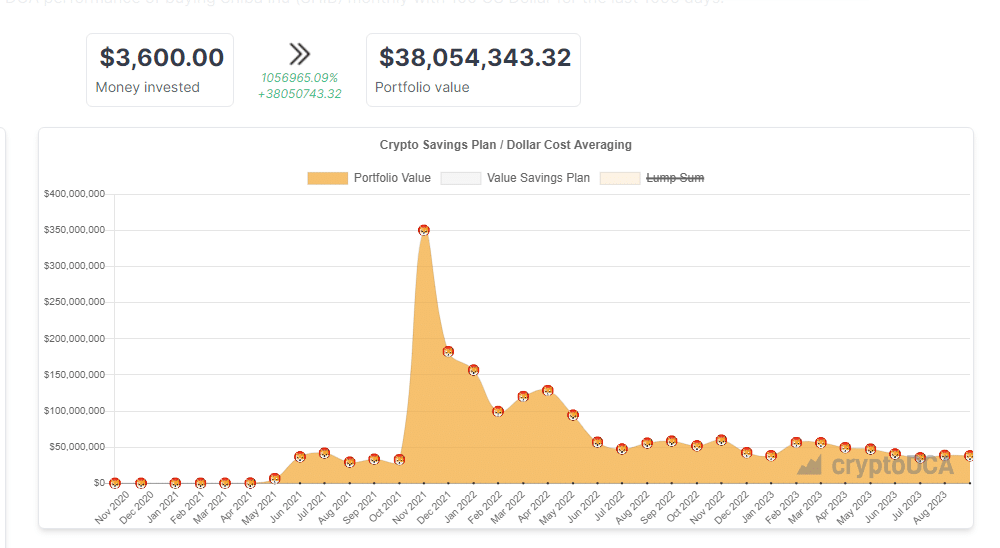
CryptoDCA data shows how a $100 monthly investment in Shiba Inu could have turned into over $38 million.

According to data from CryptoDCA, Shiba Inu investors who used the dollar-cost averaging (DCA) strategy, investing $100 monthly in SHIB during its early days, would have become multi-millionaires in three years.  

Using the DCA strategy and investing $100 monthly, the data showed that an investor would have committed $3,600 in SHIB from September 28, 2020, to September 28, 2023.

At the time of writing, the value of this investment was worth $38,054,343 ($38.05 million). This represents an astronomical increase of 1,056,965% in the investment value.

SHIba Inu $3600 to $38M
Image Source: https://cryptodca.io/crypto-dca-calculator/shiba-inu/

DCA Strategy Explained

It bears mentioning that DCA is a popular trading strategy that involves regularly investing a fixed amount of money, irrespective of the asset’s price.

The DCA strategy is mostly suitable for long-term investors and not short-term traders. This type of investment can be made monthly or quarterly, depending on the investor’s preference.

However, some investors have adopted a more flexible style, only investing in the given asset when its price is lower than their initial entry point.

Famous investors like Warren Buffett and Michael Saylor have been implementing the DCA strategy. While Buffet uses DCA to invest in stocks, Saylor implements it in accumulating Bitcoin.

Earlier this month, Saylor’s MicroStrategy purchased an additional 5,445 BTC, bringing the firm’s total holdings to 0.754% of Bitcoin’s total supply.

Early Shiba Inu Investors Reap Bountifully

Meanwhile, Shiba Inu is among the top crypto assets that fetched early investors huge returns. Recall that the canine-themed cryptocurrency recorded a massive spike a year after its launch, hitting an all-time high of $0.00008616.

Following the tremendous surge, an unknown early investor made a whopping $1.5 million from a paltry investment of $17.

As reported earlier, the investment was made on October 27, 2020, a few months after Shiba Inu’s launch. The user swapped $17.53 worth of ETH for SHIB. Interestingly, the paltry investment turned to $1.5M a few months later.

Similarly, another early Shiba Inu investor cashed out a massive $5 billion from an investment of $8K.

Ripple Partner SBI Remit Debuts International Money Transfer Services With Shonan Shinkin Bank

0

SBI Remit, a money transfer service that utilizes the Ripple payment solution, has partnered with a Japanese credit union to make international transfers cheaper and faster.

Long-standing Ripple partner SBI Remit has expanded its footprint in Japan. On Thursday, SBI Remit’s parent company, SBI Group, announced that the company has partnered with Japan’s Shonan Shinkin Bank for an international remittance service. 

Shonan Shinkin Bank operates Shonan Credit Safe, a 99-year-old credit union that allows foreign workers residing in Japan to receive and transfer payments to relatives back home. The union also services corporations, providing deposits and loan services.

However, the latest partnership between SBI Remit and Shonan Shinkin Bank focuses on helping foreign workers send remittances. The official announcement acknowledges a significant increase in the need for foreign workers in the regions where Shonan Shinkin Bank operates, especially the industrialized Kanagawa Prefecture region. 

Kanagawa Prefecture is the 4th largest area with foreign workers in Japan, with the number of employees reaching a new high. The growing number of companies launching in the region and the acceptance needs of foreign workers make the partnership with SBI Remit ideal for Shonan Shinkin Bank.

New Remittance Service to Use Ripple’s Technology

The new partnership between SBI Remit and Shonan Shinkin Bank will incorporate “the latest financial technologies, such as Ripple’s distributed ledger technology,” SBI Group stated in its announcement. Leveraging the solution allows the new partners to provide highly convenient, low-cost, and fast payment remittance services to foreign nationals in Japan.

Meanwhile, the latest development marks another landmark in Ripple’s partnership with SBI, which has been in place since 2016. Both companies had established SBI Ripple Asia, a joint venture that explores the use of XRP for international payments.

In a related development, SBI recently showcased the use of XRP for on-demand liquidity (ODL) remittances in Japan and the Philippines. The Ripple-developed solution would drastically reduce international transfer timelines from days to mere minutes.

XRP Army Awaits Ripple Victory Party for Clues on XRP Futures, IPO, Trillion-Dollar Partnerships

0

As the celebration party by Ripple takes place today in New York, XRP enthusiasts eagerly await what could be in store for them from the XRP victory commemoration.

Some members of the XRP Army believe Ripple could make a pivotal declaration at the gathering. In a recent tweet, Collin Brown, a pro-XRP blockchain researcher, shared his anticipation and speculation for the Ripple Proper Party.

The tweet garnered significant attention, posing the question: “What Kind of Announcement Awaits Us?”

Brown outlined several intriguing possibilities. He speculated Ripple could be on the verge of a settlement in its ongoing legal battle with the US Securities and Exchange Commission (SEC). 

Given that such an outcome implies the end of the protracted legal suit, the XRP community believes it would impact the market value of XRP significantly, similar to the scenario witnessed in July.

Moreover, Brown highlighted the prospects of Ripple going public through an Initial Public Offering (IPO). Based on results from a deep examination of 64,000 firms that have existed through an IPO, a prominent financial research firm concluded that Ripple has a 98% chance of an IPO. 

Meanwhile, Brown also put Ripple’s long-standing efforts to establish partnerships with major financial institutions and payment networks under consideration. He argued Ripple could be gearing up to unveil strategic alliances with trillion-dollar banks or even with SWIFT.

Besides, the researcher speculated about XRP Futures contracts coming to fruition. 

XRP Community Reacts

Amid the anticipation surrounding the Ripple Proper Party, not everyone within the XRP community shares the same level of optimism. Some commenters to Brown’s tweet expressed skeptical viewpoints about the outlined events happening.

An X user remarked:

“[It is] just a celebration of the court’s decision. Everything else is hopium. We are still in a bear market.”

Ripple CTO Confirms Anticipation

Meanwhile, in a prior statement, Ripple’s Chief Technology Officer, David Schwartz, gave credence to similar speculation of potential developments from Ripple’s celebration. 

Previously, a prominent XRP influencer highlighted five possibilities resulting from the party. They included settlement, IPO, XRP reaching $3.84, SEC chairman being shamed, and “XRPP does Jell-O shots with B-Rad.” Schwartz said two of the events would come to pass.

Trading Legends Peter Brandt and John Bollinger Tease Potential Bitcoin Rally

0

With the third quarter coming to a close, a new trading pattern appears to be forming around Bitcoin (BTC), the industry’s premier digital currency, with a potential rally looming.

For a year characterized by a mix of positive and negative fundamentals, optimism from prominent market analysts, including Peter Brandt and John Bollinger, is lending a new interest to the much coveted positive close for the quarter.

At the time of writing, Bitcoin is changing hands for $27,074.75, up by 2.55% in the past 24 hours, per data from CoinMarketCap. 

This growth might be the start of a unique resurgence as many observers are hailing the push to breach the $27,000 resistance level despite the bouts of ETF delays from the United States Securities and Exchange Commission (SEC).

The Brandt and Bollinger Optimism

In assessing the current status of the Bitcoin price trend, Peter Brandt shared a chart infused with both the Average Directional Index (ADX) and H&S indicators, respectively. He noted that there is a possibility the BTC bulls might be awoken, seeing the coin’s ADX reading is depicting its lowest since July 2020.

Brandt confirms this suspicion as there is a second retest of the underlying H&S bottom, a play complemented by the possibility of the small 6-week inverted H&S indicator.

This technical nuance suggests one thing: there is a brewing revival in the price of Bitcoin that is worth watching for market observers across the board. John Bollinger, the inventor of the Bollinger Bands, shared another thesis suggesting a similar bullish wave might be engulfing Bitcoin.

Per the chart shared by the market veteran, as shown above, the two-bar reversal for BTC/USD at the lower Bollinger Band can still be recognized as its dominant controlling technical factor. Notably, the pattern formed earlier this month.

While he acknowledged that this indicator is a basis to see the price of Bitcoin soar toward the upper Bollinger Band, the absolute certainty will be nabbed when more strength might manifest as a more intensive buyup emerges.

Backing Bitcoin Fundamentals

Though many analysts emphasize technical indicators in determining the potential price outlook of Bitcoin and other digital assets, the impact of unique fundamental boosts cannot be shoved aside.

With growing institutional embrace from the likes of MicroStrategy Incorporated, we might see non-technical traders have something to hinge their confidence on to throw their weight behind the digital currency.