Home Blog Page 2368

SEC Granted Time Extension to Object to Attorney John Deaton’s Move to Represent 67K Ripple (XRP) Holders

SEC’s time extension request has been granted. 


A United States District Court has granted the Securities and Exchange Commission (SEC) an extension of time to object to attorney John Deaton’s amici request less than 24 hours after the motion was filed.

Following the Court’s approval, the Securities and Exchange Commission’s objection to attorney Deaton’s amici request to participate in the expert challenge is now expected to be submitted by June 7, 2022.

The court also ordered that any response to the SEC’s objection must be filed by June 10, 2022, in order to allow the parties to proceed with the lawsuit.

Judge Analisa Torres granted the SEC’s request since both the Defendants and attorney Deaton did not object to Plaintiff’s request for an extension of time to file an objection.

Legal expert attorney James K. Filan disclosed the development of the microblogging platform Twitter, saying:

Attorney Deaton Requests to Represent XRP Holders

Recall that attorney Deaton took advantage of the amici status given to him earlier in the lawsuit to request that the court grant him the necessary approval to enable him to represent 67,300 XRP holders in the upcoming expert challenge.

Attorney Deaton is seeking to file a brief on behalf of 67,300 XRP holders in response to the upcoming testimony of one of SEC’s experts, Patrick B. Doody.

Doody’s Testimony Not Looking Good for Ripple

Doody is expected to tell the court what motivated XRP holders to buy the cryptocurrency during Ripple’s Initial Coin Offering (ICO) in 2013.

Although one cannot say exactly what is contained in Doody’s testimony, it is expected that the SEC’s expert would deploy the same tactic he used during the SEC v. Telegram lawsuit.

At the time, Doody noted that investors bought Telegram tokens (GRAM) in expectation of huge returns, which makes the digital currency security, thus subject to the regulatory oversight of the Securities and Exchange Commission.

According to attorney Jeremy Hogan, a Partner at Hogan & Hogan law firm, Doody’s expert testimony was one of the Court’s bases for concluding that GRAM was security.

It is worth noting that Ripple and its community are focused on dismissing such testimony from Doody, as it could become a major determinant in the lawsuit like the Telegram situation.

Attorney Deaton Addresses Community’s Outburst Toward Him

Meanwhile, the Ripple community lashed out at attorney Deaton for not objecting to the SEC’s extension of time requests, which they believe would cause further delays in the lawsuit.

Responding to the outburst, attorney Deaton tweeted that his hands were tied since Ripple and Individual Defendants had already agreed to the SEC’s request.

Shib Team Expand Further As iPhone Game Developer Joins Shiba Inu Metaverse Team

Shiba Inu has continued the expansion of the team behind its metaverse project. 


In a recent blog post, the dog-themed project announced that it has onboarded Sherri Cuono to its metaverse team.

Cuono, who has worked on a series of projects ranging from entertainment, healthcare, to enterprise, has joined Shiba Inu’s Metaverse team as an advisor, the dog-themed project noted in a blog post.

Cuono’s Work Experience

During her previous work on other projects, Cuono has scaled businesses and products and designed some sophisticated solutions and pipelines.

Over the years, she has been infatuated with visual effects and her curiosity has led her to become proficient in machine learning, XR, artificial intelligence, as well as blockchain.

Cuono’s proficiency in these diverse fields and her ability to articulate complex technologies are among the reasons why she is selected by top creators to help them reach their visions.

She was among the team that built the first 3D interactive video portal and also the first iPhone game. Cuono’s proficiency and completed projects expand beyond the aforementioned, which further makes her an important addition to Shiba Inu’s Metaverse project.

Commenting on her recent appointment, Cuono said:

“Super excited to be an advisor on the SHIB: Metaverse project. I look forward to employing technological advancements, working with AAA teams, and listening to the SHIBArmy to achieve the Shiba Inu mission.”

Cuono added that she is passionate about being in the Shiba Inu Metaverse team that will develop the next generation of products and services, which will play a pivotal role in defining “the future of gaming, web, commerce, and community.“

Plans to Make SHIB’s Metaverse Project the Best

Meanwhile, Shiba Inu is still focused on making its metaverse project one of the best in the cryptocurrency sector, as it continues to add professionals that will oversee the project.

The development comes less than a week after Shiba Inu recruited a veteran media expert, Marcie Jastrow, who will focus on upcoming partnerships for SHIB’s metaverse project.

Cuono will join other professionals who are working on the Shiba Inu metaverse project, including William Volk, the veteran game developer, who is currently working on SHIB’s play-to-earn game.

Dogecoin Creator Says Terra 2.0 Launch Will Show the Dumbness of Cryptocurrency Gamblers

0

The Dogecoin creator still thinks the upcoming Terra 2.0 will encounter major issues along the way.  


Billy Marcus, the creator of popular cryptocurrency meme project Dogecoin (DOGE), has made his prediction for the upcoming Terra 2.0 network.

Apparently, the Dogecoin creator does not believe things would go smoothly for Terra after the project proceeds to launch its new chain scheduled to go live on Friday, May 27, 2022.

According to the Dogecoin creator, the upcoming Terra 2.0 will show the world how dumb most “cryptocurrency gamblers” are.

Marcus’ Feud With Terra’s Founder

While Marcus did not discuss in detail what he meant by the statement, based on recent developments surrounding the Terra project, it is easy to conclude that the Dogecoin founder believes things may still get worse even after Terra launches its new chain.

Recall that the Dogecoin creator joined other members of the cryptocurrency community to criticize Terra’s founder Do Kwon for the crash of LUNA and UST.

The outspoken Dogecoin creator referred to Kwon as tech bros’ hubris in a tweet, which read:

“Tech bros operate in a bubble where they all read the same game theory book and think they understand everything about human nature. They don’t know how humans really behave outside of their bubble when they design things, that is why you shouldn’t blindly listen to them.”

Kwon did not take Markus’ comments lightly as he proceeded to block the Dogecoin creator on the microblogging platform Twitter.

Responding to the development, Marcus said Kwon’s decision to block him did not come as a shock to him, adding that it is great to block people in the crypto industry, especially people who “deserve it.”

“It makes sense he would block me, as I am not a fan of psychopathic people ruining trust in this space,” Marcus added.

Terra Is Close to Launching Its New Chain

Marcus’ recent comments come a few hours after Terra’s team announced that voting for its proposal has come to an end, with the majority of the Terra community declaring support that a new chain should be created.

As reported, following the green light of the proposal, a snapshot will be taken on May 26, 2022, at 16:00 UTC, which will be followed by the official launch of the new chain.

After the new chain is created, the Terra team will rename old LUNA tokens to Luna Classic ($LUNC) while the new ones that will be created alongside the new chain will be named $LUNA.

The new $LUNA tokens will be airdropped to holders of $LUNC, as part of efforts by the Terra team to make its investors whole again.

Binance, Huobi, and Other Top Exchanges To Support Terra 2.0

Terra 2.0 Has Passed Voting Stage, And Top Exchanges are Already Getting Onboard.


The Terra community is currently welcoming news of a successful voting session that ratified the creation of Terra 2.0. Terra broke the news on Twitter.


In the tweet, Terra noted that voting had ended for the amended Proposal 1623. The community gives Terra the green light to initiate the re-birth or revival of the Terra ecosystem through the genesis of the Terra 2.0 blockchain.

In the beginning, the community was opposed to Terra 2.0 and favored the burning of Luna tokens to increase the token’s price. However, the voters have changed their minds after Do Kwon and Terraform Labs tabled an amendment to the proposal. The Terra 2.0 system will not involve any algorithmic stable coins like UST.

Exchanges To Support Terra 2.0 Luna Airdrop

As the voting ends, various crypto exchanges are coming to express their support for Terra 2.0. Binance informed its customers of the voting outcome, saying that the exchange collaborates with the Terra team to draw up a recovery plan for Binance users affected by the Luna and UST crash. By this, the exchange may have meant facilitating the planned Luna airdrop expected to occur after the launch of Terra 2.0 on May 27.


On its part, HitBTC said that it would be supporting the new Luna token that will run on Terra 2 as of May 27. The old chain, which exists currently, will be renamed Terra Classic, and its tokens will be renamed Luna Classic (LUNC).


Huobi is another crypto exchange that seems excited and eager to support Terra 2. The exchange sent out a tweet to prepare its customers for the “LUNA Rebirth.”

BYBIT said it would be renaming UST and LUNA tokens on its platform on May 26, before Terra 2 goes live. This is in preparation for the planned migration. However, deposits and withdrawals will be halted on May 25 in the afternoon.

Birtue says they’ll be the first exchange to launch LUNA 2.0 trading on May 27th, 2022


More exchanges are expected to join the Terra 2 bandwagon as Do Kwon and his team rebuilds community trust after what happened to Luna and UST. According to Terra’s announcement, addresses belonging to the Terra Foundation Guard (TFG), Terraform Labs (TFL), and the distribution module in the community pool will be removed from the airdrop whitelist. This will make the Terra 2.0 ecosystem fully decentralized and owned by the community.


Lido Finance Will Not Launch on Terra 2.0 as Community Votes Against the Move

The Lido Finance community does not want the project to relaunch on Terra 2.0.

As Terra edges closer to its much-anticipated fork that will give birth to a new chain, the Lido Finance community has voted against the decentralized application’s relaunch on the new Terra network. 

This comes following the closure of its proposal dubbed “Should Lido support Terra reboot?” that was launched by the Lido Finance team earlier this week. 

The proposal, which ended today, saw the majority of members of the Lido community vote against the protocol’s relaunch on the upcoming Terra 2.0. 

According to the Lido Finance recently-concluded proposal, 94.57% of participants of the proposal voted against the relaunch of the protocol on Terra 2.0, while 5.43% declared their support for the dApp to continue on the new Terra network. 

Lido Finance allows users to stake their assets without locking the assets as required by other staking apps. The protocol lowers the barrier of entry into crypto staking by simplifying the process.  

Terra Loses Investors’ Confidence After UST Collapse

The obvious reason why the Lido community is not motivated to see the protocol relaunched on the new Terra network could be because of the massive crash of Terra ecosystem tokens, which many believe were solid and without flaws. 

However, many are still in shock that TerraUSD (UST) and LUNA could crash the way they did despite the numerous venture capitalists (VCs) backing the project. 

It is common knowledge that Terra has lost investors’ confidence in the project following its ecosystem tokens crash. However, the team behind Terra is not giving up on the project as they have launched significant efforts to make investors whole again. 

Terra 2.0 Proposal Passed

Terra is close to launching a new chain after LUNA and UST plummeted. The firm’s proposal to launch a new chain without the algorithmic stablecoin was concluded earlier today, and officially passed with 65.5% of participants in favor of the move to create a new chain dubbed Terra 2.0. 

Out of the more than 305.9 million votes recorded, 200.4 million representing 65.5% of the total votes were in support of the Terra 2.0 launch. 

With the proposal passed, a snapshot of the balance of all LUNA holders will be taken as early as Thursday, May 26, 2022 at 16:20 UTC. 

Once the snapshot is taken, the new chain will go live on Friday May 27, 2022, with the old tokens renamed to LUNA Classic ($LUNC), while the newly created tokens that will be airdropped to users will be referred to as $LUNA going forward. 

Although Lido Finance will not be continuing with Terra 2.0, five validators have already declared their intention to continue working on the new Terra network when it goes live. 

Terra’s Do Kwon Refuses Claims That He Lobbied Korean Exchanges To Accept Terra 2.0

Terra’s Do Kwon Refutes Claims That He Lobbied For Terra 2.0 To Be Accepted By Korean Exchanges.

Reports are circulating in the crypto space that Terra’s Do Kwon has been trying to get South Korean exchanges to agree to his plan to create Terra 2.0. As such, Kwon has been lobbying for the exchanges to relist his tokens when Terra 2.0 is launched.


Terra’s UST and Luna were delisted by many crypto exchanges after the price crash that resulted in UST being de-pegged from the US Dollar. Since then, Do Kwon and his team at Terraform Lab have been trying to come up with a way to revive the troubled ecosystem. Creating Terra 2.0 is their solution.

Terra 2.0 Rejected In South Korea

Apparently, while Do Kwon has been expending energies trying to convince exchanges to accept Terra 2.0 and Luna 2.0, it appears that a number of South Korean crypto exchanges are not buying his idea.

For starters, Do Kwon and Terraform Labs are currently in legal muddy waters in South Korea. Kwon is facing a tax evasion investigation that could see him pay $78 million to the tax authorities. There’s also an investigation going on concerning the possible embezzlement of the reserve funds that were held by the Terra Foundation Guard (TFG) before the crash.

For these reasons, South Korean exchanges are staying away from Terra 2.0 and many of them may not relist Luna on their platforms. They simply don’t want to get involved in Terra’s legal issues that may be bad business for them. Of the top 5 crypto exchanges in the country, only Upbit, which is the largest, is willing to support Terra 2.0.

“Yeah No I Did Not”

However, in a tweet responding to the claims, Do Kwon said he didn’t approach any South Korean exchanges to relist Luna. Interestingly, the Terra founder didn’t give any details about his plans for Luna and Terra 2.0 in South Korea.


You Can Now Pay For Hotels, Airlines, Rental Services Worldwide With Shiba Inu as XcelTrip Adds Support for Shib

0


Shiba Inu holders can now book 2.30 million hotels and over 450 airlines using their SHIB holdings.


XcelTrip, a next-generation, decentralized travel and booking platform, added support for Shiba Inu (SHIB). The announcement is just made public by the company via tweet.

Besides this recent addition, the travel company is already accepting nine other cryptocurrencies, including the major ones. The list includes Bitcoin (BTC), Ethereum (ETH), Tether (USDT), Binance Coin (BNB), Litecoin(LTC), Bitcoin Cash (BCH), XcelDefi (XLD), XDC Network (XDC), and XcelToken Plus (XLB).

XcelTrip is on a mission to provide a decentralized travel ecosystem to its users. This decentralized travel ecosystem will allow users to directly connect and access travel service providers without the need for middlemen in travel planning and booking. The company has built a platform and base to leverage crypto adoption and uses-cases to make this system purely decentralized.

As per the official website, users can book 2.3 million hotels, over 450 airline service providers, and car rental service providers in more than 70 countries from Xceltrip.com. The company has 650,000+ Registered Users.

The mainstream adoption of Shiba Inu is on the rise. Since May 16th, The Cardinale Automotive Group, MotoRenn, Tag Heuer, and Gafisa have begun accepting SHIB as a payment.

Besides this, a new cross-distribution partnership between Lavu, major global restaurant software and payments solution provider, and Verifone, a global FinTech leader, and payment solution provider, also made it possible to accept Shiba Inu as a payment in thousands of restaurants in 65 countries.

Terra Luna Meltdown: Lessons For The Future Of Stablecoins

The past two weeks have been a rollercoaster for crypto enthusiasts. One of the most praised projects, Terra Luna (Luna hereafter), a platform that issues an algorithmic stablecoin, Terra USD (UST hereafter), is in trouble. The pair UST/USD started de-pegging on May 8th, 1UST was worth less than 1USD. The culprit? According to Luna defenders, a big trader dumped $286 million of UST on Curve finance. Whether the ‘attack’ was orchestrated or not is rather moot nonetheless. Indeed, the UST peg to USD is under immense stress. Should the market and demand shocks be predictable to keep troubles at bay to maintain the UST parity to the dollar is a clear indicator of Luna’s design flaws. The PoS-based algorithmic stablecoin was not as sustainable as the team claims. What are the lessons for the future of stablecoins that we can draw from this market meltdown?

This is not the first time in history that a bank run occurs, and it will not be the last. However, failure seems like an inherent feature of algorithmic stablecoins, as the list of unsustainable projects is growing faster than ever: AMPL, UST, followed by DEI, just to name a few.

In the realm of digital currencies, there are 3 main ways to peg a token value to the dollar: i) with cash or liquid assets reserves in a bank account. For each $ value that is issued in a token, a corresponding dollar sits (or other liquid assets) in a bank account to ensure a 1:1 exchange rate at all times, ii) with volatile collateral such as BTC or ETH. In that case, you need, for instance, $1,5 in collateral in order to issue $1 of stablecoin. However, this method is capital consuming for issuers and not very efficient, iii) with a fully decentralized stablecoin where its monetary policy is automated by a smart contract. The third road was the one taken by Luna.

UST printing spree

Printing and burning UST goes hand in hand with the demand for Luna. The peg is maintained through arbitrage. If the price of 1UST>1USD, traders have an incentive to destroy $1 equivalent of Luna to create $1 of UST and sell it back to the market, pocketing the difference. Conversely, if 1UST<1USD, arbitrage traders need to remove UST out of circulation by printing some Luna to restore the pair. As long as the price of the underlying asset price goes up, more UST can be printed. Indeed, a Luna price at $100, allows you to print 100 or destroy 100 UST.

Between November 2021 and May 2022, approximately $16bn worth of UST have hit the market, or 90 million UST every day have been issued. The Anchor protocol, a lending and borrowing platform running on Terra’s blockchain, was offering interest rates up to 20% by staking your UST through Anchor. This drove up the demand for UST and the destruction of Lunas along the way. Less Lunas in circulation translate into price increase.

This mechanism is therefore correlated to a relatively high market cap for Luna. However, if a huge amount of UST is sold into the market, the pair UST/USD is not maintained, forcing arbitrageurs to issue more Luna and restore the peg. Luna’s newly created supply put downward pressure on its market price. Thus, if more UST need to be removed from circulation during an economic shock, the price of Luna will continue to decrease.

At the time of writing, there are 11.28bn of UST in circulation, for a market price of $0.09. Thus, 11.28*($1-$0.09)=$10.26bn extra supply! In other words, 91% of UST should be removed from the market to restore the pair. By doing that, the protocol should create another 73 trillion Lunas at the current price of $0.00014 to repeg UST, hence decreasing the price of Luna further and triggering a death spiral. Luna becomes a worthless asset on a balance sheet, which cannot maintain the peg. Terra Luna went bankrupt.

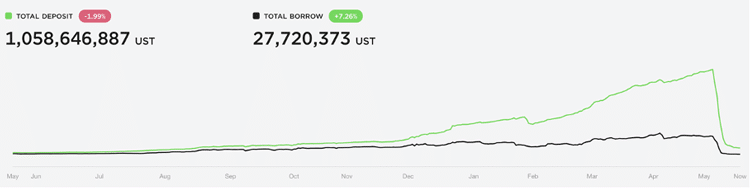
When UST stakers on Anchor saw their money losing its value, they started to panic sell their UST to the market to save what still could be saved. Over the span of 10 days, 13bn UST have been removed from Anchor, reinforcing the downward pressure on UST.
Playing against the market

As of today, the extra supply of UST has not been removed, avoiding inflating the Luna token even more, where its supply already stands at 6.5 trillion. Luna’s core team and the market have been playing cats and mice. Between May 8th and May 11th, while Luna’s co-founder, Do Kwon, was trying to both reassure his community and restore the pair by selling out Luna’s reserves pool of BTC, the market was playing against the team. Indeed, this move signals to the market that Luna is too big to fail and the team will come to the rescue no matter what.

Unless Do Kwon is playing rug pull, then it’s a safe bet to buy UST at a low price, and sell them back for BTC even before the pair is fully restored to pocket the difference. In this scenario, Luna is losing their BTC while trying to restore a pair against arbitrage traders. The trader can even cover his or her long position on UST by shorting Luna. Either way, he/she will pocket the money by betting against the possibility of a peg. Luna’s team is now alone playing against arbitrage traders in a market where bears were taking over bulls. This is just a recipe for catastrophe for UST users. Luna’s billions of BTC won’t be enough to restore the pair, let alone users’ confidence.

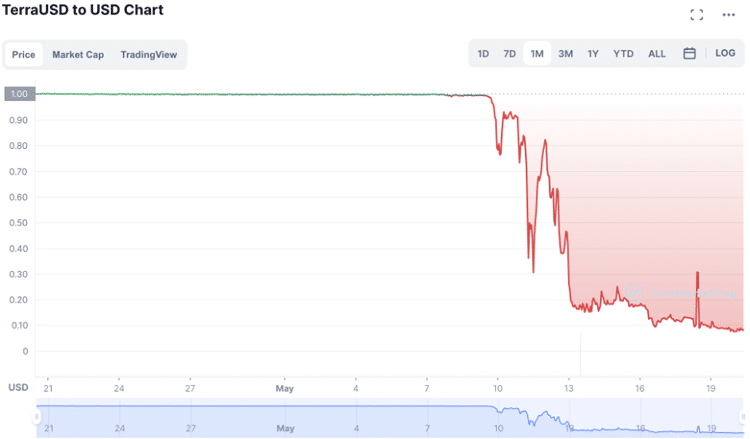
In fact, the UST/USD pair has never been restored, as the graph below is showing:
Private monies: learning from history

Both economists Benjamin Klein (1974)[1] and Milton Friedman (1959)[2] researched the era of private monies in the US in the 19th century. Klein’s research was very insightful, as he argued that competitive private monies in circulation would lead to the payment of interests to holders. This is exactly what happened in the case of UST. Indeed, Anchor was paying a 20% yearly interest to UST stakers, and Luna was conveying a convenience yield to its holders. Well, as long as everything was working fine.

Friedman argues that the supply of competitive money leads ultimately to a peg to its paper value, due to infinite inflationary pressures. The case actually happened in Somalia in the 1990’s during the civil war, and was detailed by Mubarak (2003)[3]. This is due to the lack of confidence inherent to private monies, since banks’ balance sheets were hard to audit until the National Banking Act was passed in 1864, which regulated private banks. Before this piece of regulation, banknotes in circulation were far greater than bank reserves, putting the whole system at risk.

We, at Jax.Network, did not wait for the regulators to fix those issues that are shaking the algorithmic stablecoin economy. We made it very costly to print JAX, hence, preventing inflation and printing sprees like Luna. Our asset coin mining is completely decorrelated to our transaction coin, preventing market manipulations. Furthermore, our balance sheet is our blockchain, and is thus fully auditable in real time. Users know exactly how many transaction coins are circulating. Also, they are not used for staking, only for transaction purposes. The convenience yield is provided by the success of our transaction coin, which is reflected by the price movements of the asset coin, but production of both coins follows completely different rules and is in no way interlinked. Check our project in more detail here.

[1] Klein, B., (1974). The Competitive Supply of Money, Journal of Money, Vol.6, No4, pp. 423-453.

[2] Friedman, M., (1959). A Program for Monetary Stability. New York: Fordham University Press.

[3] Mubarak, Jamil A. (2003). A Case of Private Supply of Money in Stateless Somalia, Journal of African Economies 11(3): 309-325.


Binance Loans Adds Cardano (ADA) and Avalanche (AVAX) As Collateral Assets

Binance has added the two cryptocurrencies in order to expand its loan service to more users. 


Binance, the world’s largest cryptocurrency exchange by trade volume, has announced that it has added Cardano (ADA) and Avalanche (AVAX) to its list of supported staking collateral assets on the Binance Loan platform.

The exchange noted in a blog post today that ADA and AVAX holders can now stake the cryptocurrencies in order to borrow other crypto assets on the platform.

With the addition of ADA and AVAX, Binance has increased the list of assets that users can drop as collateral, in a bid to allow more people to join the initiative.

“Binance has added ADA and AVAX as staking collateral assets on the Binance Loans platform. Loan orders with ADA and AVAX as collateral will be staked to reduce interest.”

Binance Loan Services

Launched in 2019, Binance Loans allows users to deposit supported cryptocurrencies as collateral in order to obtain a loan in another digital currency.

Aside from ensuring that the cryptocurrency you want to borrow and use as collateral is supported on the platform, there is no entry barrier for Binance users who want to participate in the exercise.

Some of the crypto assets users can borrow include Tether (USDT), Binance Dollar (BUSD), Fantom (FTM), USD Coin (USDC), etc.

Similarly, the world’s largest cryptocurrency exchange also supports a variety of assets users can deposit as collateral in order to borrow other digital currencies from the loan platform.

Users can choose the duration of the loan as they deem fit, which ranges from between seven to 180 days.

Passive Earning, Deflationary, Bot Proof, Details About Shiba Inu Burn Portal Rewards Token ‘Ryoshi Vision’ (RYOSHI) 

0

The team has provided the necessary details about its trending reward token RYOSHI.


Following the distribution of rewards to Shiba Inu holders who participated in the official SHIB burn portal, the project team has explained everything the community needs to know about its reward token Ryoshi Vision (RYOSHI).

Named after the pseudonymous founder of the Shiba Inu project, RYOSHI was created on August 7, 2021, as part of efforts to reward members of the community.

The press release highlights three objectives of RYOSHI, which includes:

“Creating community-based initiatives and projects into utilities aligned with their core values, Incentivizing holders through deflationary tokenomics and built-in burn mechanism, as well as. encouraging the community to vote and take part in the project’s decision making (DAO).”

RYOSHI Created Mainly for the Shiba Inu Community

Wifey, who developed the cryptocurrency, ensured no unit of the cryptocurrency was allocated to the Shiba Inu team members, in a bid to honor the vision of Ryoshi.

Unlike other cryptocurrencies that conduct presale or Initial Coin Offering (ICO) to raise funds, the ERC-20 token made its debut via a fair launch.

With the Shiba Inu team focused on rewarding members of the SHIBArmy, investors are rewarded based on their activities on the project.

Passive Earning

To accomplish this feat, 1% of all RYOSHI transactions are distributed to xSHIB holders. Similarly, the developer used deflationary techniques to ensure the token steadily increases in value in the long term.

According to the Shiba Inu team, at least 1% is deducted for every transaction, including buy, sell, and swap, which is burnt out of the supply forever.

“RYOSHI provides passive earnings to everyone by distributing 1% of all transactions to xSHIB holders staked on Shibaswap. Another 1% of every buy, sell or transfer transaction is deducted and burned to the $SHIB wallet address forever. To guarantee an ever-increasing price floor, the $RYOSHI token is deflationary in nature by default.”

RYOSHI Is Deflationary

Notably, the team also noted that it burnt half of RYOSHI’s supply during its launch last year to further bolster its value.

It is noteworthy that the Shiba Inu team burnt 100% of RYOSHI tokens, which made the cryptocurrency safe to invest in. Aside from this move, 50% of RYOSHI’s circulating supply was also burnt to SHIB during the token’s launch last year.

Per the announcement, the wallet where burnt RYOSHI tokens are sent now holds more than 50% of Ryoshi Vision’s total supply.

Bot Proof

Meanwhile, the cryptocurrency is designed to mitigate the impact of sandwich bots via the use of smart contracts. Notably, RYOSHI’s smart contract is equipped with coded protection to prevent sandwich bots. By this, each wallet is allowed to conduct one transaction in one block, thus making it difficult for whales to manipulate the price of RYOSHI.

SHIB Burn Portal Rewards

Meanwhile, unlike other Shiba Inu native cryptocurrencies, RYOSHI became increasingly popular after the developers of the project announced the distribution of rewards to addresses of users who participated in the burn program.

As reported, participants of the exercise were rewarded with RYOSHI in the form of passive income based on the amount of SHIB they burnt.

However, the Shiba Inu team still went a step further to ensure it protects the value of RYOSHI by deploying techniques to ensure recipients of Ryoshi Vision airdrop do not dump the tokens in the market upon receiving their rewards.

RYOSHI Dip

RYOSHI’s value has slumped tremendously in the past week despite the mechanism in place.

According to data on the cryptocurrency aggregator platform, $RYOSHI, which soared to a high of $0.0000000516 is down nearly 30% to $0.0000000383 in the last seven days.