The IOTA Foundation is in conversation with US partners, including the government, about an iota-based vaccination passport.
Last Wednesday, the IOTA co-founder, named Dominik Schiener, held a Ask Me Anything (AMA) session. In it, he gave in-depth insights into the strategy of the IOTA foundation.
Schiener revealed that the full beta of the identity protocol would soon be released. He said that IOTA is working on a vaccination passport discussed with American partners.
Our identity protocol is very close to getting a full BETA version. The vaccination passport is one of the topics we are currently working on. We are now talking to American counterparts, including the government. We will see how and what role IOTA can play in the vaccination passport in the coming weeks.
He stressed that building relationships with large companies is a long-term process.
When it comes to large companies, the innovation cycle is not the same as CRYPTO, where things change every day. Companies are used to one-year product cycles. Usually, the first contact until a non-disclosure agreement takes about six months.
IOTA wants to work with some significant partners
The co-founder of IOTA stated that the company changed its strategy for business adoption last year. They want to focus on a few big companies to get the ball rolling:
Building relationships takes time. We want to continue with business partners and a few companies that we know and think these pilot cases can further increase awareness and acceptance of IOTA. That’s why we are now focusing very much on collaborations with Dell and working very closely with Zebra and a lot of others that have not yet been announced.
In response to a question about how the IOTA Foundation plans to engage large companies as Infrastructure Partners, Schiener said:
I think it’s good if one or two large companies announce that they need IOTA tokens. This can cause a ripple effect on other companies. They’re going to realize that acquiring IOTA tokens makes sense. Iota is also an investment against inflation.
After much proliferation about how the high network fees and network traffic jams will threaten the status of ETH as the leading de facto blockchain for Defi and NFTs, the price of ETH has lagged behind many other blockchains that claim they can challenge or replace ETH because of their lower fees and higher speed.
Many projects have since begun running both on ETH and another blockchain as a backup if ETH fees get too high, while others have even left the blockchain. The primary beneficiaries are Binance Smart Chain and SOL, even ADA, which has only just upgraded its blockchain to have smart contracts capability, with their token prices outperforming ETH by miles.
ETH’s price appears to have difficulty in staying above the $2,000 level. Indeed, even though ETH has had a 5-year lead time and has gained significant market share in the Defi and NFT market, the high fees have prompted some traders to lose interest, preferring to invest in other blockchains.
ETH has a scaling problem, and market participants are sensing the bottleneck that ETH is in. The high fees make ETH an unsustainable blockchain and cannot support more projects, which traders have rightly reacted to by not bidding up the price of ETH.
However, last week saw some good news regarding solutions to ETH’s scaling and high fee problem that can bring it convincingly pass $2,000 this time.
First, the much-anticipated EIP 1559 upgrade with the Fee Burning Mechanism finally has a start date after a long wait – it will launch this July. The upgrade, co-authored by ETH co-founder Vitalik Buterin, will transition ETH’s fee structure away from a bidding system that allows miners to prioritize the highest bids.
The new fee structure will dynamically and programmatically adjust fees, so users only pay each block’s lowest bid. This will significantly reduce the high fee a user currently pays when the network is busy, using the ETH blockchain. This means much lower fees, saving ETH clients from leaving, and the lower fee can also encourage more usage of the ETH blockchain, increasing demand.
Additionally, the base network fee will now be “burned” on each transaction, instead of being paid to miners, reducing the selling pressure by miners, and more crucially, potentially leading ETH to become a deflationary asset, since ETH tokens paid as a fee will be burned. This creates scarcity. Last year, an analysis concluded that EIP 1559 would have seen almost 1 million ETH burnt during the previous 365 days if it had been implemented, around 1% of its supply. With the increased usage of ETH this year, this figure will be even higher. The more ETH is used, the more ETH is burned, which can propel the price upwards in a short time since ETH still accounts for around 90% of the Defi and NFT market, which means ETH is very actively used.
With increased potential demand and a reduction in supply, many experts expect the price of ETH to grow with this upgrade.
However, this upgrade wasn’t the only good news. The second good news came from Vitalik himself, in the form of a new rollup called Optimism. Vitalik expects the Optimism Rollup to launch next month and be fully operational in the coming months.
The Optimism rollup is a layer two solution aiming to scale the blockchain, a stop-gap solution that will solve the medium-term high gas fees until the sharding stage of ETH 2.0 is implemented. Rollups are off-chain solutions that compute and store transactional data before bundling up the information and recording it on a blockchain. This reduces the ETH blockchain’s data load, allowing transactions to be processed faster and thus lowers the fee paid per transaction. According to Vitalik, Optimism rollups will increase the ETH blockchain’s scalability by 100x.
With the increased speed and lower fees, Optimism rollups are expected to be embraced by some of the leading Defi projects, including DEXs like Uniswap, Sushiswap, Defi platforms like AAVE, and derivatives platform, Synthetix. MakerDAO, a borrowing and lending Defi platform, is also planning to introduce its DAI stable coin to Optimism rollups.
Despite increasing Ethereum’s scalability, Optimism still faces some challenges, in that transferring tokens from the main blockchain to L2 is easy. However, reversing the process takes up to a week to complete. However, there are ways to mitigate this drawback, as MakerDAO has done, introducing a bridge for faster withdrawals. Hence, this roll-up will be especially popular with Defi platforms.
With two solutions coming to solve ETH blockchain’s scaling and high fee problem in the next few months, expect the price of ETH to rocket more heightened as we approach the launch dates of both solutions, which coincidentally is both around the middle of this year.
Already, the price of ETH is moving higher in tandem, with BTC breaching $60,000. As the bull market rages on, I expect the price of ETH to play catch up with the rest of the market to post higher percentage gains. Post breaking $2,000, I hope the price to move up speedily towards $3,000 by mid-year. A $5,000 price tag should not be too far away should the upgrades work well to reduce transaction fees and improve scalability while the full launch of ETH 2.0 with sharding is in the cards.
Kim Chua is an institutional trading specialist with a track record of success that extends across leading banks, including Deutsche Bank, China Merchants Bank, and more. Chua later launched a hedge fund that consistently achieved triple-digit returns for seven years. Chua is also an educator at heart who developed her proprietary trading curriculum to pass her knowledge down to analysts’ new generation. Kim Chua actively follows both traditional and cryptocurrency markets closely and is eager to find future investment and trading opportunities as the two vastly different asset classes begin to converge.
The Flare network launched a poll on Twitter to get users views on whether they should integrate ADA after initiating support for XRP, DOGE, and LTC.
Flare Networks is considering the integration of Cardano’s token ADA. It has launched a poll on its Twitter to find out the community’s opinion. So far, the majority has voted in favor of integration–more than 83%.
Flare Networks has already added support for popular altcoins such as XRP, BCH, LTC, DOGE, and XLM. Now it is considering integrating the third-largest cryptocurrency (the title that XRP previously held) ADA.
ADA is on the rise after the hard fork “Mary”, which happened on March 1. ADA has made its way from the end of the top-ten list to the top 3 positions by pushing back XRP.
ADA was listed on Coinbase on March 18, which pushed the currency’s price to a new all-time high of $1.47.
According to a recent statement by Charles Hoskinson, Cardano plans to expand in Africa, bringing millions of new users into Cardano’s ecosystem.
ICT systems must be continuously updated. This is done to add new functionalities, to fix bugs or to fix security problems. A blockchain also needs an update from time to time. A soft fork is used for updating blockchain. Hard fork is used to create a new blockchian from the old one.
What Is A Fork?
When you think of a fork, you soon think of a fork that you use to eat. That’s not what we mean in this case. We are talking about a fork in the blockchain world when a blockchain gets a second version from the original blockchain or existing version gets updated.
Blockchains are open source. This means that anyone can view and modify the code. In this way, the blockchain can continue to develop continuously. That is precisely the purpose of open-source software. Everyone can contribute to the software, resulting in different versions. One version may be better for your situation than the other.
For example, a group of developers can decide to start a new, different version of a blockchain that runs simultaneously with the original blockchain. In most cases, a blockchain that arises from a fork does not survive because there is too little support for such a blockchain. There must be enough nodes (computers) to migrate to the new blockchain to reach consensus in the blockchain network.
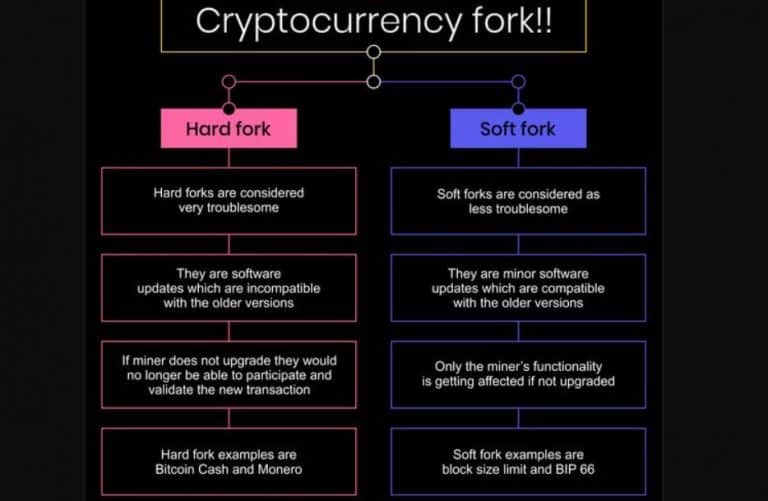
There are two versions of a fork, hard fork and the soft fork. The chances are that you will read more about a hard fork because you will see it around you more often. A soft fork is generally a lot less visible, as it is only an upgrade to the existing blockchain.
What Is A Soft Fork?
In the introduction, we talked about updating IT systems. Blockchain also needs to be updated now and then. The moment a group of developers decides to perform an update, they can start a soft fork. The updated blockchain is then copied and runs alongside the original blockchain.
Subsequently, the original blockchain will be transferred to the new blockchain. Nodes are constantly communicating continuously to reach a consensus. When a node sees that other nodes are using the latest blockchain protocol, they will adapt themselves and update their protocol. In this way, a blockchain switches from the old version to the new version.
But it can also go wrong. It has happened that not all nodes switch to the new version. In that case, they will continue to work together according to the old version. A hard fork is then created.
What Is A Hard Fork?
When you trade crypto, chances are you have come across the term “hard fork”. Several crypto coins originate from hard fork. To trade in these crypto coins, it is good to know what a hard fork is.
With a hard fork, you create a new cryptocurrency with certain similarities or differences from the old blockchain.
In hard fork there is always a difference between the original version and the newly formed version of the software. It’s not that the new version is always better than the old one.
An example of Bitcoin hard fork is Bitcoin Cash (BCH). Launched in August 2017, this BCH stands out with the benefits of faster transaction speeds and less decentralized. All Bitcoin holders received the same amount of BCH as they had BTC in their wallets.
The Bitcoin Cash fork arose because there was disagreement about the future of the Bitcoin. A group then decided to hard fork the Bitcoin to generate Bitcoin Cash.
How Does A Hard Fork Arise?
A hard fork can arise in different ways. One of these ways is the way Bitcoin Cash came to be. Blockchain developers are always discussing the future of the blockchain with each other and it can happen that they do not agree with each other about the future outcomes for a certain blockchain.
Often people vote on the future of a blockchain. Participants of blockchain community can vote on what should happen with the blockchain. There voting power is normally determined by the number of coins they hold of a particular blockchain. For example a in Vechain community a member holding 100,000 VET will have more voting power than a member holding 10,000 VET.
Even after voting, disagreements can still arise. A group could then decide to hard fork and implement their idea on their original blockchain version. That’s when the roads apart.
But there is also another way in which a hard fork could arise. And that’s from a soft fork. With a soft fork, there is a temporary separation from the existing blockchain so that developers can perform an update. The intention is that all nodes transfer to the new version of the blockchain after the update has been completed. Yet, it can all turn out differently.
Not everyone may switch to the new version. At that point, two versions of the blockchain remain, and without intentions a hard fork comes out from a soft fork because people refuse to switch to new updated blockchain.
The Difference Between A Soft Fork And A Hard Fork
A hard fork is a separation from the original blockchain. The most significant difference of Hard fork from a soft fork is that the newly created blockchain does not work together with the old blockchain. The old version continues itself without switching, and a new blockchain created works independently.
In a hard fork, two different versions of a blockchain are deliberately created. For example, blockchain developers can disagree with each other and decide to make their version and continue with it.
This is how Bitcoin Cash resulted from Bitcoin Hard fork, and Ethereum Classic were created after Ethereum Hard fork. Due to disagreements about the original blockchain’s future, developers decided to create their version and continue with it. Nodes could then choose in which blockchain they wanted to continue working.
Is A Soft Fork Better Than A Hard Fork?
It is impossible to say which variant is better. When an update is carried out or arguments arise within the blockchain about the future, a soft fork or hard fork can arise.
Can A Hard Fork Always Arise From A Soft Fork?
Even though blockchain is open source, it is not always possible that a hard fork will arise from a soft fork. There are enough private blockchains, which a company, government or institution control. They, therefore, determine the future of the blockchain, and thus the chance that a hard fork will arise from a soft fork in private blockchains is nil.
Who Decides Whether There Will Be A Soft Fork?
Blockchain is open source, so nobody owns the blockchain. Who then decides whether a soft fork is made? The answer to this is pretty apparent, given blockchain is open-source software. Anyone can make a soft fork. However, the support must be large enough. If there are not enough nodes that want to participate, the soft fork’s execution cannot be initiated.
Often votes are cast within the blockchain network about the future of the blockchain. Participants of the network can then vote on the plans, after which the program with the most votes will be executed. This also makes it immediately clear whether there is enough support for the projects of the blockchain.
However, events differs per blockchain because each blockchain has its consensus algorithm and stands for a different vision. There is no general plan for soft forks that is the same for every blockchain.
Socios.com and Chiliz CEO Alexandre Dreyfus announced that they had reached an agreement with Manchester City. Stating that they are in talks with two more clubs in the Premier League, Dreyfus said that a deal could be achieved with 3-4 teams in the next quarter.
Cooperating with Galatasaray, Trabzonspor, Juventus, and Paris Saint-Germain, Socios.com has added Manchester City to its partners. In a few weeks, Manchester City, like other clubs, will issue their fan token.
CHZ token, which gained value by 8.74% in 24 hours, is trading at $0.67.
Negotiations continue in the Premier League.
Manchester City became Socios.com’s first major partner in the Premier League.
“Nobody wants to be first, but nobody wants to be last,”
Dreyfus said that they are in talks with two more clubs after City and their goal for the next quarter is to reach an agreement with 3-4 Premier League clubs.
CITY fan token can be used with the Socios.com app; It will allow Manchester City fans to interact with the club digitally. It was reported that Locker Room users would receive four times more tokens than usual.
Socios.com having large followers in Turkey continues to work intensively on the local level. Dreyfus, “Our next Turkey”,
Socios.com efforts has accelerated Brazil and Chile’s trade volume in Bitcoin.
The company, which set foot in the American market with an investment of $50 million, announced that it started to meet with various USA officials. Saying that the USA rules are different compared to Europe, Dreyfus said, “More clubs means more users.” he said that the meetings with US officials are in progress.
Ripple hired Brooks Entwistle to accelerate its work across Southeast Asia. Entwistle, who previously held managerial positions with names such as Uber and Goldman Sachs, will be responsible for Southeast Asia’s work.
Brooks Entwistle, who has 30 years of experience in the finance industry, will serve as Ripple’s Southeast Asia Managing Director. The head of the Singapore office will direct partnership efforts across the region.
Investment bank Morgan Stanley is interested to buy South Korea’s largest cryptocurrency exchange Bithumb.
According to Asia Business Daily, Morgan Stanley started negotiations with Vident, the exchange largest shareholder, to buy shares in Bithumb. 10.3% of Bithumb Korea; 34.24% of Bithumb Holdings belongs to Vident.
On Wednesday Morgan Stanley revealed that they are planning to establish three cryptocurrency-focused funds. Morgan Stanley could be the first significant American bank to allow its clients to invest in Bitcoin.
Local news Naver reported that talks between Morgan Stanley and Vident have begun. While information regarding the bargain has not yet been shared with the public, it was stated that the investment amount could exceed 200 million dollars. Bithumb can be valued for $2 billion.
Bithumb, South Korea’s largest cryptocurrency exchange, has earned $1.7 million since the beginning of the year. The daily trading volume of the exchange has exceeded $5 billion in the past week.
Morgan Stanley could be the first global investment bank to invest in a significant crypto exchange if a deal is reached. Vident shares gained more than 5% after this news.
Commenting on the Morgan Stanley, Analyst Joseph Young said,
There is an unprecedented boom in the number of corporate companies interested in cryptocurrencies. Slowly but surely…”
Possible investment in Bithumb has also received support from Binance CEO Changpeng Zhao.
Pakistan’s Khyber Pakhtunkhwa province has made a move for cryptocurrency mining. The state plans to set up two pilot mining farms powered by hydropower.
KP Science and Technology Consultant Zia Ullah Bangash met with experts to create an environment where crypto mining can be done. According to Reuters the cost of the pilot project was not shared.
Mining will be under state control
Consultant Bangash said that cryptocurrency mining will be carried out under state control.
We want to do mining at the state level in accordance with the law so that everything can be controlled and frauds can be prevented.
Bangash mentioned that crypto mining and trading is already done in other states of the country. He stated that their goal is to grow and develop the province by moving cryptocurrencies mining to Khyber Pakhtunkhwa.
following all laws, We will be able to contact both local and international investors, So many investors will have the opportunity to invest.
Crypto and blockchain committee established
According to the Geo News report, KP Science and Technology Institute in Pakistan’s Khyber Pakhtunkhwa requested the establishment of a committee to conduct research on technologies such as cryptocurrency and blockchain.
As a result, three committees were established in which state institutions such as the State Bank of Pakistan and the Federal Board of Revenue will also take part.
Great news for Neo (NEO). Yesterday the new version of the NEO network was announced called N3 in a NEO blog post. The project wants to be the most complete blockchain solution on the market with N3.
The third version of Neo was announced in 2018 by Erik Zhang. Expectations have been high in recent years and finally the update is closer than ever. The announcement said:
Platform-native decentralized storage, oracles, and name services are just some of the features that will make Neo the most complete blockchain development platform available today.
The current network, Neo 2.x, will be called “Neo Legacy” from now on. This choice was made to make it clear that once Neo 3.0 is available, the old network will eventually no longer be supported by developers:
As most of you know by now, N3 has many new features that are not compatible with 2.x. So Neo will launch N3 on a new chain from a new genesis block. This means that we will have two versions of the Neo blockchain simultaneously.
Neo 2.x will therefore no longer be supported at some point. The team emphasizes that there will be enough time for users to transfer their data, including their NEO, to the new network.
Sometime at the end of this month, N3 will be launched on the testnet. This is a kind of test environment in which the code can be tested for bugs. Subsequently, a new website, funding’s, developer events and other initiatives will be launched to further stimulate the development of N3.
The team address potential concerns among NEO owners Saying:
We are aware that many token holders are probably wondering what to know about migration from Neo Legacy to Neo N3. For the foreseeable future, you don’t have to worry about this. We will be publishing information as the MainNet release gets closer regarding token migration, so for now it is just enough that you keep an eye on the official Neo channels for more details. When the new MainNet goes live, Neo Legacy will run in parallel with Neo N3 for an extended period of time to ensure everyone has enough time to migrate.
The manufacturer of graphics chips, Nvidia, admitted that it mistakenly released a driver that allow you to bypass the mining speed limit on the GeForce RTX 3060 graphics card.
An Nvidia spokesperson confirmed that the latest driver update 470.05 was mistakenly released with code intended for use only by Nvidia developers, removing the cryptocurrency mining speed limiter.
The developer version of the driver included code used for internal development that removes the hashrate limiter on the RTX 3060 in configurations.
In February, Nvidia announced that the GeForce RTX 3060 graphics card would be protected from miners. The driver halved performance if it noticed a typical mining load. The company said that the protocol cannot be hacked. This restriction was introduced in order to reduce the shortage of video cards in the market, caused by the increased popularity of cryptocurrency mining. The company explained that they want GeForce cards to be used by gamers.
But the protection was circumvented thanks to the specialists of Nvidia itself. The company posted a driver for developers with disabled protection from miners. The mistakenly released update was removed from open sources, but is already in full swing on the Internet. It turned out that the driver works without any modifications and allows you to increase the hashrate to 47-48 MH/s, against 20-25 MH/s, which occur when doing crypto mining.