Home Blog Page 2596

Nvidia Accidentally Unlocked Mining When Updating RTX 3060 Graphics Card Driver

0

The manufacturer of graphics chips, Nvidia, admitted that it mistakenly released a driver that allow you to bypass the mining speed limit on the GeForce RTX 3060 graphics card.

An Nvidia spokesperson confirmed that the latest driver update 470.05 was mistakenly released with code intended for use only by Nvidia developers, removing the cryptocurrency mining speed limiter.


The developer version of the driver included code used for internal development that removes the hashrate limiter on the RTX 3060 in configurations.

In February, Nvidia announced that the GeForce RTX 3060 graphics card would be protected from miners. The driver halved performance if it noticed a typical mining load. The company said that the protocol cannot be hacked. This restriction was introduced in order to reduce the shortage of video cards in the market, caused by the increased popularity of cryptocurrency mining. The company explained that they want GeForce cards to be used by gamers.

But the protection was circumvented thanks to the specialists of Nvidia itself. The company posted a driver for developers with disabled protection from miners. The mistakenly released update was removed from open sources, but is already in full swing on the Internet. It turned out that the driver works without any modifications and allows you to increase the hashrate to 47-48 MH/s, against 20-25 MH/s, which occur when doing crypto mining.

Last week, there was information that the mining restriction can be circumvented. Read More: Nvidia’s Hash Rate Limiter Cracked By Crypto Miners Within Two Weeks
Tron Developers Released Technical Documentation For The New NFT Standard TRC-721

0

Tron developers have published technical documentation for the new NFT standard. The TRC-721 can open up new possibilities for applications on Tron and is fully compatible with the ERC-721 of Ethereum.

According to Tron founder Justin Sun, the TRC-721 specification-the first standard for non-exchangeable tokens (NFT) on the Tron blockchain-has become publicly available.


According to the document, which contains technical descriptions of issuing tokens using the new standard, TRC-721 is a set of standard interfaces for issuing NFT on the Tron network and is fully compatible with ERC-721, used to create non-exchangeable tokens on the Ethereum blockchain.

NFTs can be issued on the Tron blockchain using the TronLink extension for Chrome, with users requiring a minimum balance of 350 TRX (about $18.3) in the account to issue the NFT.

Users can customize the token name and symbol when issued. The Tron NFT standard, first announced in December 2020, is designed to open up new opportunities for applications built on its blockchain.

In the long term, it may also increase the growing pressure on Ethereum from competing NFT platforms. While Ethereum remains a leader in the NFT industry, ETH transaction fees have skyrocketed amid the DeFi and NFT boom. Ethereum developers hope to solve this problem with roll-ups in the short term and with sharding after the full deployment of Ethereum 2.0.

According to Tron Developers, the network combines low transaction fees with almost instant payments. According to the Tron Foundation, the protocol has been running for almost three years without any incidents, although in November 2020 it was attacked, which led to a temporary halt in the creation of new blocks for two hours.

Recall that a painting by the artist Beeple was sold in the form of an NFT token for $69.3 million. Justin Sun also participated in the auction, but his bid was declined at the last moment.

CryptoQuant Data Shows Ethereum Reserves On Exchanges At Historical Bottom

0

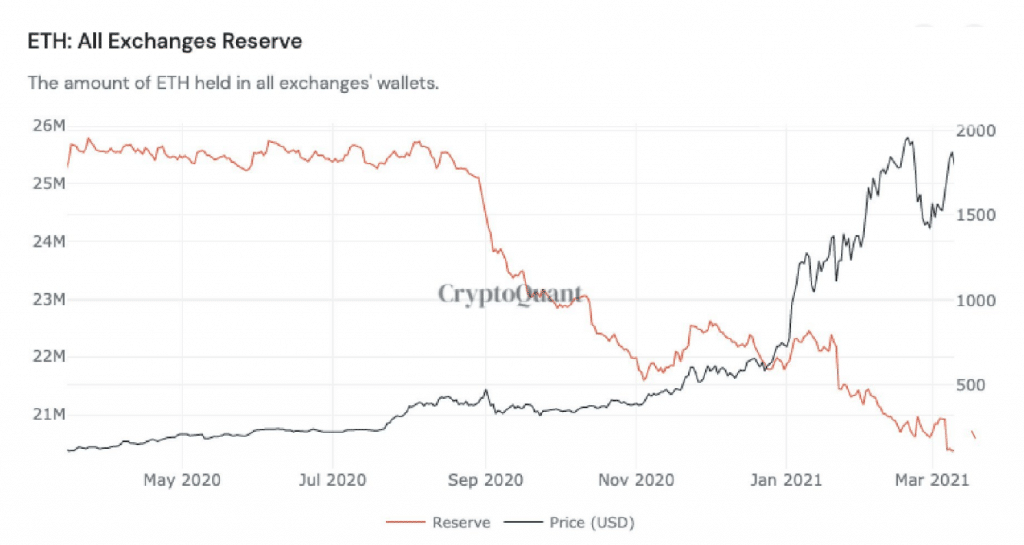
Today CryptoQuant announced that the amount of Ethereum (ETH) held on central exchanges goes lower than ever.

The total amount of Ethereum held in cryptocurrency exchanges has dropped to its lowest level in history. As investors are withdrawing ETH from exchanges it may have a positive impact on the price.

The cryptocurrency market fell by more than 3% during yesterday’s decline. According to CryptoQuant data, the ETH reserves on exchanges continue to shrink despite falling prices.

The amount of Bitcoin held in crypto exchanges has been fluctuating since the beginning of the year. Ethereum owners, on the other hand, started to withdraw Ethereum they held in exchanges to different addresses after the Beacon Chain was put into practice.

Today CryptoQuant announced that the total amount of ETH held on crypto platforms has dropped to an all-time low. More ETH withdrew from exchanges yesterday than ever since mid-January.

The decrease in the number of coins in the exchanges decreases the selling pressure and is bullish for ETH price. However, CryptoQuant data does not cover decentralized exchanges.

falling eth reserves

Ethereum Whales

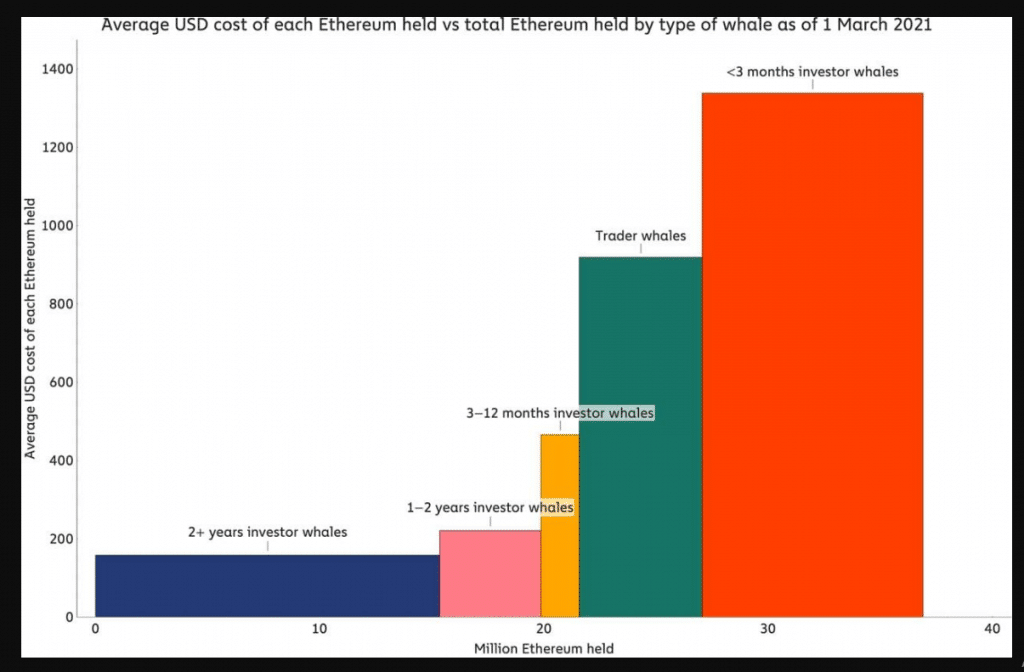
Some of these addresses withdrawing Ethereum from exchanges belong to ETH whales. According to Unfolded till 1st March, Ethereum whales control 37 million ETH, which corresponds to 32% of the total supply.

The largest whale community is made up of investors who have been Holding ETH for more than 2 years, managing 15.3 million coins in total.

ethereum whales reserves

5 Altcoin To Watch This Week

0

The five altcoins we are focusing on for the week of March 15-21 are Litecoin, Stellar Network, NEM, Celsius Network, and Holochain, respectively.

Litecoin (LTC)

News This week: MimbleWimble via Extension Blocks (MWEB) codes are expected to be completed on March 15th. Litecoin miners will decide if they support this update after the necessary code checking is made.

Why To Follow: MWEB was featured in a Litecoin Improvement Proposal in 2019. The goal of the project, which has been under development since then, is to enable Litecoin users to switch to L2 more secretly than usual. The number of transactions made during the transition can be kept confidential with MWEB.

Stellar Network (XLM)

News This Week: The Stellar test network reset is scheduled for 03/17/21 at 0900 UTC.


Why To follow: The Stellar test network is used to test existing applications and develop new projects. Thanks to the reset, the spam is cleaned, the adaptation time to the ledger is shortened and the system operates in a more sustainable way.

NEM (XEM)

News This week: Symbol, developed by NEM, will go live on March 15th.

Why To follow: Symbol, which has been in development for four years, will introduce the NEM ecosystem with new technical features. Symbol designed to be suitable for individual and corporate use is being promoted as a new generation blockchain at the corporate level. The developer team states that Symbol is an essential step for NEM.

Celsius Network (CEL)

News This Week: Celsius Network CEO Alex Mashinsky announced that the CEL token will be listed on three new exchanges.

Why To Follow: Founded by Alex Mashinsky and Daniel Leon, the Celsius Network first started trading on exchanges in June 2018. Mashinsky announced at the AMA event held on March 12 that Liquid, Bittrex, and Bitfinex exchanges will list CEL tokens this week.

Holochain (HOT)

News This Week: Holochain announced that the old messages in the Elemental Chat application will be deleted on March 15 and the application will be reset.


Why To Follow: Elemental Chat is the first Holochain application to cover all HoloPorts. HoloPort owners can communicate with each other instantly thanks to this application. Some bugs of Elemental Chat, which is still in the testing phase, will be fixed during the reset.

Binance Under CFTC Investigating Over Derivate Trading

0

US Commodity Futures Trading Commission (CFTC) began investigating Binance activities due to concerns that it allows US citizens to trade cryptocurrency derivatives in violation of the law.

CFTC is trying to find out if Binance allowed US residents to buy and sell cryptocurrency derivatives. If this is true, then Binance violates US laws since Binance is not registered with the CFTC, the agency said.

Binance CEO Changpeng Zhao said the exchange does not have an official headquarters in the US, so the investigation will not lead to enforcement action. The CFTC treats Bitcoin and Ethereum as exchange commodities, which is why futures contracts are under the jurisdiction of the CFTC. Platforms offering such products to US citizens are required to comply with strict regulatory requirements, regardless of their location.

Zhao stated that the exchange did not take any action that violates US law. Zhao said that he usually does not comment on interactions with regulators. According to him, this investigation does not mean that the department is trying to bring charges against the exchange.

The Binance founder suggested that his competitors might bribe or pressure journalists to publish abusive material containing false information. Zhao cited the example of Forbes, which last year published an article about the “Tai Chi organization” against Binance. Binance later sued Forbes but dropped the claim last month.

Zhao added that Binance takes regulatory compliance seriously and is implementing appropriate measures to combat money laundering. The exchange will continue to interact with international regulatory bodies to improve compliance with industry standards.

The head of Binance said that the exchange does not allow American traders from accessing its main website, and also uses advanced technologies to detect suspicious activities. However, users can always find clever ways to bypass restrictions. Zhao said regulators are enforcing too strict rules for cryptocurrency firms.

After this news, Bitcoin fell to $54,960, while the value of BNB fell to $247.5. Zhao tweeted that Fear, Uncertainty, and Doubt (FUD) is common in a bull market. Zhao urged users not to panic.


US regulators are stepping up measures against the cryptocurrency industry. In 2019, the BitMEX trading platform also came under close scrutiny from the CFTC. Last fall, Coinbase management reported that during the first half of 2020, the exchange received more than 1,900 queries from law enforcement agencies, including the CFTC.

New ETH, ADA, and DOT Forecast From Dubai-Based Company FD7 Ventures

0

Dubai-based investment firm FD7 Ventures has given a new price forecast for Ethereum (ETH) Cardano (ADA) and Polkadot (DOT). Prakash Chand, one of the company’s partners, explained that these three cryptocurrencies have the potential to surpass the Bitcoin market value.

Founded in partnership with Prakash Chand and Q Dhalla, FD7 Ventures has $1 billion in assets under its management. Prakash Chand said the market value of the Bitcoin market capitalization could increase to $10 trillion in the next few years. During this period, the difference between Bitcoin, Cardano, Ethereum, and Polkadot would decrease.

Expects the market to grow exponentially

Chand expects the cryptocurrency market to grow exponentially with the support of the younger generation.

When I was 21, I was spending my money on cars. The new generation is more advanced than ours. They like to invest in cryptocurrencies.

He said, In the short term, Bitcoin is expected to maintain its dominance in the market. Bitcoin is a great store of value, but there is nothing beyond that, and this balance could change over the next five to seven years.

Predicts 20-30 times growth

Chand said that he met with one of the Ethereum founders and started research on Cardano, Ethereum, and Polkadot. FD7 Ventures partner stated that each of these three coins has 20-30 times growth potential.

The Dubai-based investment company announced last month that it would sell $750 million worth of Bitcoin to buy Cardano and DOT.

Read Details: Dubai Firm FD7 To Sell $750 Million Of Bitcoin To Buy Cardano And Polkadot

New York State Department Of Financial Services Issued BitLicense To Bakkt

0

The New York State Department of Financial Services (NYDFS) has issued a BitLicense to the Bakkt trading platform, which will allow it to legally work with residents of New York.

NYDFS has been issuing BitLicense since 2015. Firms wishing to obtain a license must meet certain requirements. Obtaining BitLicense costs a large amount of up to $100,000. The head of NYDFS Linda Lacewell said that the department is ready to provide opportunities and conditions for the development of cryptocurrency firms in New York.

Bakkt has become the 29th organization to receive a BitLicense. A platform dedicated to trading cryptocurrency derivatives was launched by the Intercontinental Exchange (ICE) in September 2019. A few months after the launch, the first regulated options for Bitcoin and futures contracts with settlements in fiat currency were presented on the site. This served as a complement to existing Bakkt products.

In November 2019, Bakkt opened the Bakkt custody service for institutional investors to ensure the safety of client crypto assets. This service has also been approved by the NYDFS. Bakkt CEO Gavin Michael said that obtaining a license is an important milestone in the development of the platform, bringing digital assets closer to everyone.

The cryptocurrency industry is developing rapidly, so Bakkt mentioned the company’s ambitious plans for the upcoming launch of the Bakkt Cash app for retail P2P payments. With this application, users will be able to pay with cryptocurrencies for goods in various retail outlets.

Last year, Bakkt developers began testing the Bakkt Cash payment option with the largest coffee chain Starbucks. As part of testing, Starbucks customers were able to buy coffee with Bitcoin.

Romanian Barber Stole $620,000 Worth Of Crypto

0

A Romanian barber was arrested on suspicion of stealing $620,000 worth of cryptocurrency. Berber has been detained since March 5th.

A 38-year-old Romanian barber named Ionel Roman was arrested for crimes such as hacking, fraud, and money laundering. Roman is suspected of stealing crypto money by targeting a Cayman Islands-based company that is considered the seventh-largest crypto operator in the world.

How did the barber steal the cryptocurrencies?

Romanian Directorate for Investigating Organised Crime and Terrorism, DIICOT, said that between January 28 and 31, the suspect Ionel entered the Cayman Islands company’s computer using an illegal API. The suspect, who was reported to have made unauthorized access, gained access to the section where crypto accounts were checked.

DIICOT said that Ionel, that gained access to the crypto accounts of the firm, transferred $620,000 to several accounts belonging to different peoples, that paid him real money for buying cryptocurrencies. Ionel Roman withdrew 620 thousand dollars by dividing it into 10 thousand Romanian lei (about 25 thousand dollars) so that he does not have to prove his identity. All money was sent to various cryptocurrency addresses or platforms.

His house was raided

Romanian police raided the barber’s house twice on March 4th. 7 mobile devices, 3 laptops, 5 memory cards, 2 electronic wallets, and approximately 25 thousand dollars were seized along with the culprit.

Grayscale Is Looking For ETF specialists That show The Firm’s Intention To Launch Cryptocurrencies ETFs

0

Crypto-asset management company Grayscale has posted nine vacancies to develop its ETF business. This indicates the firm’s intention to launch exchange-traded funds for cryptocurrencies.

Grayscale tweeted a link to the company’s job openings page indicating that the firm is looking for ETF talent. Grayscale has never previously announced its intention to launch an ETF on Bitcoin or other cryptocurrencies and has not submitted relevant applications to the US Securities and Exchange Commission (SEC).

Grayscale is looking for an ETF Creation and Redemption Specialist who will be responsible for managing the pricing sources with an understanding of “how to create a basket of digital assets for inclusion in ETFs”. Another vacancy is for the ETF Market Maker Manager who will be tasked with developing new relationships with market makers while maintaining the existing ETFs for the channel.

Applicants for this position require experience with FINRA, SEC, NYSE, NYSE ARCA, CBOE, and other securities exchanges, either directly or in collaboration with the Compliance and Legal Department. Existing Grayscale Trusts are not traded on the NYSE/CBOE platforms, but are sold by investors in OTC markets.

Industry experts believe the Bitcoin ETF, which the SEC has repeatedly rejected applications for, could finally launch in the US this year. As a reminder, the first Bitcoin ETF was launched in Canada in February 2021.

Earlier, JPMorgan analysts warned that if US regulators approve the launch of exchange-traded funds for Bitcoin, this could lead to an outflow of funds from the Grayscale GBTC trust and negatively affect the rate of the BTC.

Nvidia’s Hash Rate Limiter Cracked By Crypto Miners Within Two Weeks
0

Recently announced that Nvidia would be limiting the mining efficiency of their Nvidia RTX card range. The mining efficiency would be reduced by as much as 50% through software. However, this software limitation has been circumvented by a number of Chinese cryptocurrency miners within two weeks.

Measures from Nvidia to reduce pressure on graphics cards

This restriction was initially imposed because there has been a huge stock shortage for a long time. This is because of the global corona measures that make the production and distribution of graphics cards difficult. Many of the graphics cards still available are bought by bots from cryptocurrency miners and scalpers. Scalpers are individuals or companies who buy up stocks of hard-to-obtain products and then sell them for a higher price. The regular gamers also try to get hold of one of the new graphics cards. This creates a very difficult situation.

However, to partially solve this, Nvidia has come up with a solution: limiting the hash rate when performing cryptocurrency-related activities. This by developing software and implementing it in the graphics cards. In addition, Nvidia also comes with a product specially developed for cryptocurrency, which should reduce the pressure on their regular graphics cards. However, it now turns out that Nvidia’s software can be bypassed relatively easily. This while Nvidia has previously indicated that end users would not be able to extract the hash limiter from the driver in any way. This now turns out to be untrue.

Stock Shortage

The software has been developed so that it can analyze what tasks are being performed. In this way, it can be checked whether cryptocurrency-related tasks have been performed or not. If it did, the hash rate would be reduced by 50%. An example: The new Nvidia GeForce RTX 3060 can normally output about 45 MH per second. This equates to about 45,000,000 hashes per second. When crypto-related tasks are subsequently recognized, this falls to around 20-22.5 MH per second, a significant decrease in the efficiency of the card.

Chinese groups along with Vietnam modders managed to circumvent those restrictions. This is not a positive sign for the global gaming community. This could possibly ensure that the stock shortages are far from being resolved. However, the upcoming product specially developed for cryptocurrency could provide some relief.