
Home Blog Page 2886

Crypto Start-Ups Paxos And Bitpay Have Applied To Become Federally Regulated Banks In The United States

0

Paxos and BitPay intend to get the status of national banks in the United States. 

Cryptocurrency company Paxos filed with The Office of the Comptroller of the Currency (OCC) The United States apply for a license of the national trust Bank. If approved, Paxos will become the first custodian of digital assets to be regulated as a” crypto bank ” at the Federal and regional levels.

Paxos is controlled by the New York state financial services Authority (NYDFS) as a trust company. Paxos expects to open its Bank in New York. The company specializes in issuing stable coins, storing cryptocurrency assets, and brokerage services. Paxos General counsel Dan Burstein said:

“The OCC license will allow us to realize our mission to modernize the financial market infrastructure and ensure reliable movement of any asset at any time.”

At the same time, Bitpay, which specializes in cryptocurrency payments, wants to open a bank in Georgia. The Company is Focused on the capitalization Of Its new enterprise of $ 12 million.

The Atlanta Journal-Constitution issued a public legal notice on December 8 revealing that BitPay had applied to the Office of the Comptroller of the Currency (OCC) to become a federally regulated bank. The bank is named BitPay National Trust Bank and is headquartered in Georgia.

According to the submission, there would be a 30-day period for comment, during which all comments to the OCC license director could be addressed. The BitPay application revealed that the national bank’s market capitalization would be about $12 million. If BitPay becomes a national bank, it can circumvent the state-by-state regime to apply for a license separately to operate in each state.

On the same day, the stable coin publisher and the crypto services company Paxos also applied as a federal regulated bank in America. In the public document published yesterday, Paxos announced her intention to establish the Paxos National Trust and submitted its application to the OCC.

The application showed that the Paxos National Trust would operate from New York. If Paxos gets the federal banking license, it will complement her New York trust charter and the various other financial licenses.

Paxos currently offers various financial services, including cryptocurrency services, cash custody, gold custody, commodity trading, issuance of digital assets, and securities clearing. Obtaining a banking license would increase the number of services it could offer to individuals and legal entities.

Dan Burstein, Paxos’ general counsel, said in a blog post from the company that obtaining the national charter would make it easier for them to do business in other US states. For Paxos, this means they can focus their resources on building great products, as they have the flexibility to operate anywhere in the United States while meeting the highest regulatory standards. As with BitPay, Paxos’ application has 30 days for commenting before the OCC can proceed.

BitPay and Paxos are applying for national banking licenses because of the positive steps taken by the OCC acting auditor Brian Brooks earlier this year. Several months ago, Brooks announced that he would set up a licensed framework for fintech start-ups, including cryptocurrency companies. This would allow them to streamline their activities within the United States.

Will Cardano Be The Game Changer For Defi? IOHK Bringing 250,000 USD Funding For Defi Projects

0

The IOHK is aiming to use the Cardano (ADA) cryptocurrency as a Funding program. The development company behind Cardano has considered the “Liqwid” project as a potential candidate for funding of up to the US $ 250,000.

Liqwid is a Defi credit protocol and is used as one of its so-called “idea catalysts” for Cardano.

On Twitter, the IOHK said that several promising ideas that have been chosen as idea catalysts would be revealed in the coming days on Tuesday. “Project Catalyst” is a public fund that aims to bring research, social experimentation, and community consent to creating an open, democratic culture within the Cardano community.


The first project to be announced is Liqwid, a Defi credit protocol that will allow members to deposit and borrow digital assets, earn interest on them, right on ADA blockchain.

In an October post on Medium, Liqwid architect Dewayne Cameron described his protocol as “an open-source automated liquidity protocol for lending.”

Liqwid Finance is not a bank. It is an open-source financial infrastructure. Liqwid does not have specific regions or users to target. The functional implementation of Liqwid is an open-source credit protocol on a distributed decentralized cloud; conceptually, this is a global strategy.

The decentralized finance market has seen a boom over the past six months. At the time of this writing, the Defi Projects (TVL) ‘s total value was $ 14.6 billion, spread across the credit, derivatives, asset, and DEXes markets.

Liqwid in the development phase: The Defi Gamechanger of 2021?

Liqwid begins its development phase next week, with tests scheduled for the end of Q1 2021. Although the official launch depends on the introduction of smart contracts at Cardano, Cameron is optimistic that Liqwid’s roadmap will coincide with the roadmap planned by the IOHK.

The Smart Contracts at Cardano are planned for the middle/end of Q1 2021 and should achieve full on-chain functionality by then.

Further funding from Cardano planned for 2021

On Tuesday, the IOHK named “Maybe Workshop,” a project-based learning platform, as a further candidate for the funding program. The best ideas selected by the Cardano community will receive ADA worth up to $ 250,000 to develop their projects.

The IOHK plans to issue millions of dollars in ADA in 2021 as part of future funding rounds for dApps and Defi protocols.

XRP Price Before A Trend Reversal-Ripple Threatens A Price Drop Of 50%

0

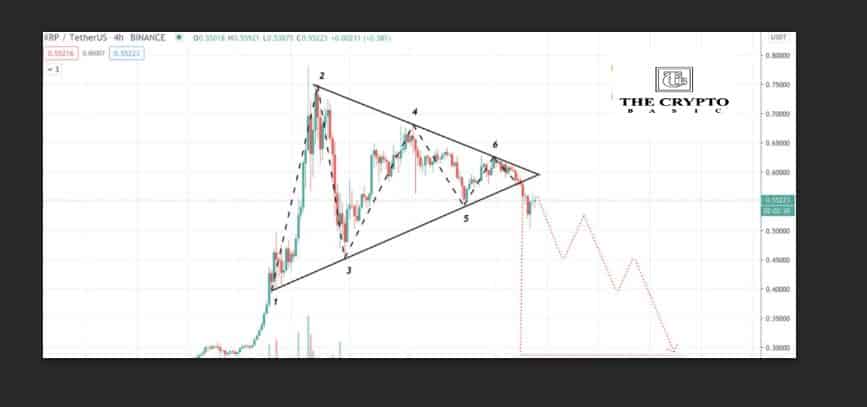
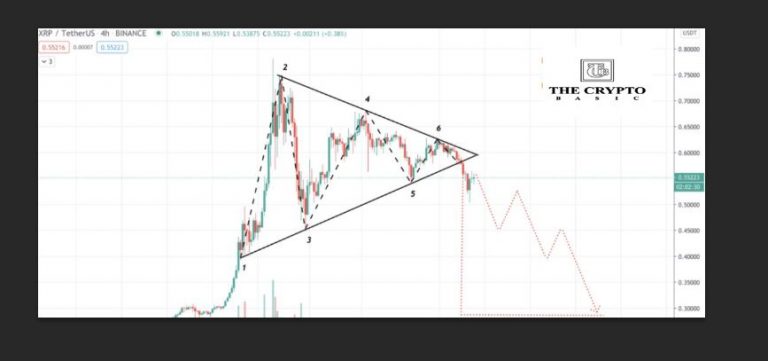
The XRP price broke out of a symmetrical triangle on Tuesday and could lead to the beginning of a trend reversal.

You can recognize a symmetrical triangle formation by the two trend lines. The upper trend line is inclined downwards, and the lower trend line upwards. 

As a result, both trend lines converge at the top of the formation and form the typical triangular shape. It is essential that both trend lines should touch the candles at least twice and that the price within the formation has at least four touching points. 

The volume is usually highest at the beginning of the formation and then steadily decreases. Only when there is an upward or downward breakout, then an increase in volume be recognized again.

XRP price could fall as low as $ 0.30

Ripple Threatens A Price Drop Of 50%

In the event of a trend reversal, the measurement rule for determining the minimum exchange rate is different from that for a continuation of the previous trend. To calculate the XRP price, we have to choose the difference between the high point and the low point within the formation and then project it down to the breakout point. 

This results in a minimum target price of just under $ 0.30. Around 50% below, this target is well below the current price of Ripple.

Achievement of the target on breakouts in the opposite direction is less reliable if the previous trend is continued. In trend reversal, the minimum price target is only achieved in 57-62 percent of cases.

Currently, the XRP price found support at $ 0.55. Additional Weekly support lines can be found at around $ 0.47 and just under $ 0.40.

Filecoin (FIL) Coming on Coinbase-What Will Be The Impact On FileCoin Price

0

Coinbase has announced that it will add support for Filecoin (FIL) on Wednesday. The exchange said support for Filecoin’s iOS and Android apps would follow soon.

Coinbase has been busy in the crypto market, as the best cryptocurrency exchange seeks to expand its coin offering so that users have more investment options. 

Protocol Labs launched Filecoin. The blockchain-based and decentralized marketplace is designed to allow users to perform storage transactions on the network through its currency FIL.

The project is best known as the blockchain version of Google Drive or Dropbox. It’s been in development for three years.

The project also enables miners to earn Filecoin tokens by offering open hard drive space to the network. At the same time, users can spend their Filecoin tokens to get space and storage for their encrypted files in a decentralized network.

The cryptocurrency and ICO hype in 2017 saw the protocol raised about $180 million within minutes of the ICO launch.

Last year, Filecoin was one of the tokens Coinbase was considering adding to its platform because the crypto exchange said it was doing a thorough investigation to add FIL. As the listing process requires regulatory approval and compliance control, the exchange did not specify a specific time when the listing will be possible.

Now that the listing is coming, it shows that Coinbase has completed the compliance check and received the nod from the authorities.

Coinbase has revealed in a blog post that the listing will take place in four main stages: only transfer, post-only, limit-only, and the mode for full trading in the final phase. The crypto exchange also said it would post updates on the phases in separate announcements.

Price Impact

After the news of Filecoin coming on Coinbase, FIL rushed sharply and rose by 15%. It went from 29.14 USD to 33.54 USD in hours, which is about a 15% price increase. If the overall crypto market was stable, it was sure that we could have seen more upside growth for Filecoin, but now, as BTC and other major coins are falling in price, we may not see a substantial price growth for Filecoin. If the market does not fall from here, We believe that FIL’s price will be back at 33.54 USD soon.

The best thing for Filecoin is that many interested US investors will now be able to buy FIL, which is an excellent success for Filecoin in the long term. 

MicroStrategy Is Planning To Buy Another 400 Million Worth Of Bitcoin

0

The world’s biggest openly traded Business company has announced plans to invest 400 million dollars in BTC.

On December 7, the company announced its plans to invest $ 400 million in convertible bonds.

The announcement stated, Microstrategy intends to invest the net proceeds from selling the bonds in Bitcoin. At the current Bitcoin rate, the 400 million USD would correspond to 20,833 BTC. This would increase the company’s Bitcoin holdings to almost 62,000 BTC.

Microstrategy will pay semi-annual interest to the holders of the bonds until December 2025. The company also reserves the right to redeem the bonds for cash till December 20, 2023.

The announcement states that MicroStrategy may also offer its first-time buyers bonds worth up to $ 60 million within 13 days of the offering’s commencement.

The securities are issued under Rule 144 of the Securities Act and are available only to qualify institutional investors. 

The company goes All-in BTC


MicroStrategy caused a stir in the crypto world in August when the company revealed that it had acquired Bitcoin as its primary reserve asset after buying 21,454 BTC for $ 250 million. The following month it bought another 16,796 BTC for 175 million dollars. 

The purchases were made via Coinbase’S OTC platform. On December 5, MicroStrategy announced that the company had obtained another 2,574 BTC at a price of $ 19,428 each for $ 50 million, bringing the total stock of Bitcoins to about 40,824 BTC.

At current market value, MicroStrategy’s BTC Portfolio is worth almost $ 784 million. The company has now generated a profit of 65%.

According To Snowden US Dollar loses 99% in value Since 2013 Against BTC

0

Bitcoin has hit a new all-time high this year. The year 2020 proved to be the driver of the BTC’s price. The combination of external factors such as US monetary policy, rising household debt, and global uncertainty caused by Covid-19 led to a real demand boom for Bitcoin.

Edward Snowden, the most prominent Whistleblower in history, referred to the trading pair Bitcoin/US Dollar in a recent Tweet. 

Snowden showed that the leading currency of the 21st century could record a massive loss against Bitcoin. 

BTC shows strength since 03.01.2009, the day when Bitcoin first came to birth.

Edward Snowden left his previous life and bears enormously psychological and financial consequences to educate people about a policy of obtaining information that knows no privacy, but only national interest.

Edward Snowden is also a defender of Bitcoin. Because the cryptocurrency, which Satoshi Nakamoto designed in response to the financial and banking crisis of 2007/2008, is a digital concept of money that function without governments.

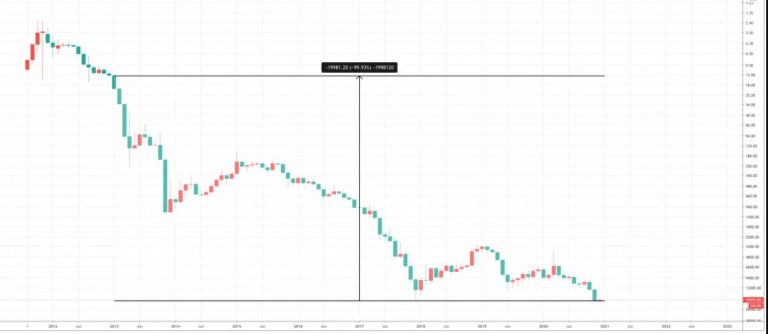
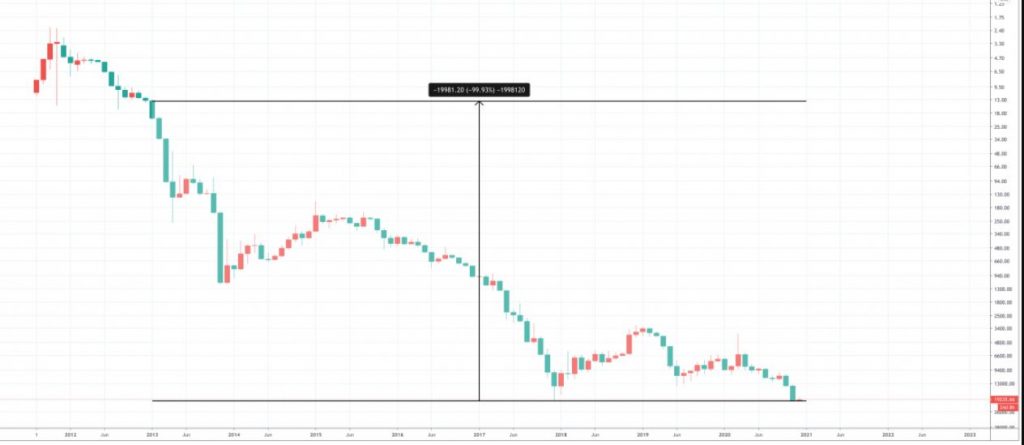
Snowden posted via Twitter on December 7 a Tweet about the dollar value in BTC. According to this, the US Dollar has lost more than 99% of its value relative to Bitcoin since 2013. In other words, Bitcoin has risen massively against the US Dollar.


Trading pair USD/BTC instead of BTC/USD

The US Dollar is the most dominant world currency. Whether Forex market, bond market, stocks, or commodities, all trading pairs are measured in dollars.

We measure the value of Bitcoin also in USD. If you look at the USD / BTC Chart, we see precisely the scenario Snowden described. The US Dollar has decreased by more than 99% in BTC terms.

According To Snowden US Dollar loses 99% in value Since 2013 Against BTC

Bitcoin benefits due to its deflationary concept or its falling inflation rate. While the overall supply is limited, and the Bitcoin quantity being produced decreases over time, the lesser Bitcoin’s supply, the more will be its price over time if the demand keeps increasing.

JD.com Chinese E-commerce Giant, Said It Would Be The First To Accept Digital Yuan

0

JD Digits, the company’s digital technology division, will accept the digital Yuan on its platform during the second “free lottery” in Suzhou, which will take place on December 12 at the Double 12 shopping festival. The purpose of the free lottery is to help citizens evaluate the state cryptocurrency’s convenience that is being prepared for launch.

The testing will be similar to the pilot program to promote the digital Yuan, implemented in Shenzhen in October. Then the city held a free lottery for 10 million digital Yuan. This time, 10,000 winners will be able to spend digital Yuan in stores equipped with terminals that can process digital Yuan.

JD.com has partnered with the digital currency Research Institute of the People’s Bank of China (PBOC) to develop a mobile app, wallet, and blockchain-based platform that will be used to operate the digital Yuan.

Ethereum 2.0 Staking on Kraken, 5 to 17% Return on ETH

0

Since 01.12.2020, Ethereum 2.0 is live with Phase 1. After months and years of preparation, investors can now look forward to the new era of Ethereum with the start of the Beacon Chain. 

One question that comes up, again and again, is Which platforms support staking and how much return can be achieved?

Ethereum 2.0 Staking on Kraken

With Kraken, one of the largest, oldest, and most well-known crypto exchanges, has now announced support for the Ethereum 2.0 Staking.

Last Friday, the crypto exchange released a statement on Twitter. The official start of the Ethereum 2.0 Staking on Kraken was on 04.12.2020 at 13:30 UTC.


According to the exchange, investors can achieve between 5 and 17% per year with ETH’s staking.

The advantages of Kraken are that the Staking-Rewards can be claimed weekly. Investors can also participate in the Ethereum 2.0 Staking with small sums.

Compared to Binance or OKEx, Kraken will open a dedicated market that allows investors to trade their Ethereum.

This means that investors can exchange their staked ETH for unstaked ETH. However, due to regulatory requirements, the offer will not be available to U.S. citizens and Canadians.

All major exchanges such as Binance, Coinbase, Kraken, or OKEx support Ethereum Staking.

1% Of All ETH Is In The Deposit Contract And Deposit Contract Reaches 1,000,000 ETH

0

Ethereum has now officially managed to launch Ethereum 2.0 with the Beacon Chain. Ethereum 2.0 Phase 1 started on time on 01.12.2020. And now it is clear that interest in Ethereum staking is growing steadily.

Ethereum 2.0 with more than 1,000,000 deposited ETH

The threshold required for the timely activation of Ethereum 2.0 has already been reached on 24.11.2020. After investors deposited the necessary minimum amount of 524,288 ETH on 24 November, new milestones have now been reached.

Within a few days, the deposited amount of ETH has almost doubled compared to the minimum quantity and now stands at more than 1,000,000 ETH for the first time.

The consequences of ETH staking on ETH price are easy to describe. 

The more ETH is being staked, the lesser it will be available for trading until the start of the next phase of ETH 2.0.

Depending on when the next phase of ETH 2.0 comes into play, it could take months or years to access the deposited Ethereum again.

If the number of deposited ETH continues to increase, this could undoubtedly impact the Ethereum price because of the demand/supply law.

The proportion of staked ETH has reached the 1% mark. Now 1% of all Ethereum is in the deposit contract. That is another significant achievement.

What is certain is that Ethereum is taking a huge step. A shift from an existing proof-of-work consensus mechanism to a proof-of-stake mechanism is like open-heart surgery.

The complete system is changing, and all the advantages and disadvantages of PoS systems will come into play.

Investors will likely see a high incentive to deposit their ETH in the new proof-of-stake mechanism. With an expected return that can also be in the double-digit range, this aspect of PoS is an exciting opportunity to invest in ETH staking.

MXC and Polkadot Team Up To Power Smart Cities

0

MXC Foundation has its visions set on delivering the new, revolutionary digital world of tomorrow. By sending data packets more efficiently, more frequently, and over longer distances, the German blockchain project thinks it has discovered the key to making Smart Cities a success.

Before the token of MXC becomes the most used token globally (the promise of all thousands of crypto projects), a few more hurdles need to be overcome.

Internet of Things

During the hectic 2017 crypto bull market, investors began to explore more possibilities. Data with the Internet of Things (IoT) was seen as a logical use case for tokens. Investors were attracted by the idea of, Live data streams that allow data to be traded 24 hours a day and within seconds, Token micropayments in exchange for tiny data packets, Transactions without costly currency exchanges, A reliable and secure protocol that minimizes the risk of financial exchange.

Dead promises from 2017

But as we all know, many of these tokens and technologies struggled with acceptance in the real world. No project could live up to the promises made in 2017. You may believe this was due to the complicated nature of crypto or a lack of user interest, but the real reason may lie much deeper than that. One of the main reasons is the lack of interoperability, or in simple terms, blockchains are not compatible with each other.

For example, if a city chooses to use a new blockchain solution for its Smart City needs, What if the city wants to add features that are not in line with their chosen blockchain. What if they need features from other blockchains to fulfill their smart city demands. This problem has led many cities, businesses, and institutions not to commit to a single-chain blockchain solution.

Polkadot Delivers Technology

Fortunately, recent developments in blockchain technology are beginning to offer solutions to these old problems. The MXC Foundation has signed several central Smart City deals with the Shanghai Yang-Pu government throughout South Korea. Polkadot provides advanced technical developments in Smart City technology. This next-gen blockchain protocol allows different specialized blockchains to connect in one unified system.

These are great times to enhance IoT interoperability, and MXC wants to be the engine of change within the data industry. Building on Polkadot’s technology, we believe we are finding our way for future data transmissions,” says Aaron Wagener, one of the founders of MXC.