
Home Blog Page 2541

Visa Is launching An NFT Program To Help Digital Artists

0

International bank card operator Visa has announced a partnership with NFT’s creator, artist Mika Johnson, to launch a new social project to help NFT creators.


According to the company’s press release, the collaboration aims to create a learning project that will help NFT creators better understand the non-fungible token industry and teach them how to use various public blockchain networks to develop and sell their digital works.

Visa will provide a link between the creators of the NFT and its network of payment partners. This will benefit digital artists as it expands their reach and drives business growth.

The decision to launch the training project was made two months after the company acquired NFT CryptoPunk #7610 for 49.5 ETH, which at the time of purchase was about $150,000.

Any author can apply for participation in the program. The American payment service is ready to sponsor the group and offer consulting services.


Visa’s new NFT education partner is former Major League Baseball (MLB) player Mika Johnson. After finishing his sports career in 2018, he became an artist.

Johnson created NFT Aku featuring an African American boy in a large space helmet who dreams of becoming an astronaut. NFT Aku was sold in February 2021 within 24 hours for more than $2 million.

Mika Johnson believes that the project’s mission is very important for the development of the NFT industry. “I am delighted to have the opportunity to work and learn from a trusted brand like Visa. Together, we want to give NFT creators the resources they need to stay at the forefront of this revolution.”

As a reminder, the Chinese company Alibaba recently launched an NFT marketplace. The American division of the FTX cryptocurrency exchange has created a platform for buying and selling NFTs. Recently Coinbase also announced to launch their NFT marketplace.

Read: In Less Than 24 Hours Coinbase NFT Waitlist Tops 1,000,000 Signups

Read: Coinbase Is launching Its Own NFT Marketplace
 

Ethereum User Paid $430,000 Transaction Fees In An Unsuccessful Attempt To Buy STRP Tokens

0

An Ethereum user attempting to participate in the Strips token sale on the MISO platform which is SushiSwap’s newly launched token sale platform paid a fee of $ 430,000 for a failed transaction.


According to The Block, because of the high competition, STRP tokens on the MISO platform were sold out in just a few seconds.

During the sale, the member tried to use Flashbots to gain priority. Flashbots allow you to send a transaction directly to a miner for prompt inclusion in a block. Flashbots transactions remain confidential until they are included in a block.

However, in this case, something went wrong, and the transaction ended up in a public mempool.  Since STRP tokens were sold out too quickly, the transaction was unsuccessful, and the potential buyer was left without tokens.

However, he still paid the transaction fee, which was 123 ETH (about $430,000).


Flashbots product development manager Robert Miller tweeted:


A few weeks ago, Bitfinex paid a fee of $23.7 million for a transaction in USDT stable coins worth $ 100,000. Fortunately, the miner who processed the transaction returned $22.1 million.

US Crypto Trading Voyager Digital Has Obtained A License To Trade In Europe

0

Voyager Digital has received final permission to trade digital assets from the French regulator and plans to launch a mobile trading app in the first quarter of 2022.


According to the statement, Voyager Digital has received official permission to trade digital assets in the French and EU markets under the control of LGO Europe SAS.


The license was issued by the French regulatory authorities Autorité des marchés (AMF) and Autorité de contrôle prudentiel et de résolution (ACPR).

In early August, Voyager Digital bought the payment company Coinify to accelerate its international expansion.

The company is currently developing a trading app that will launch in a number of European countries in the first quarter of 2022.

Lewis Bateman, director of global communications at Voyager Digital, said: “We have a long list of European clients who are eagerly awaiting the launch of the app. We are delighted that Voyager Digital will have access to a wide range of users. “

In Less Than 24 Hours Coinbase NFT Waitlist Tops 1,000,000 Signups

0

Coinbase, the largest cryptocurrency exchange in America, shared yesterday that they will step into the NFT market.

Read Details: Coinbase Is launching Its Own NFT Marketplace



It was thought Coinbase NFT platform would make a lot of Buzz and a strong impact on the NFT industry. The latest development is proof of this situation.

Coinbase, in a statement, stated that they have created a “waiting list” for their NFT platform and users can gain various advantages by signing up for this waiting list.


It seems that Coinbase’s waiting list has received much more attention than anticipated. More than 1,000,000 people signed up for Coinbase’s NFT waitlist in less than 24 hours.

At this point, the number of daily active users of OpenSea is around 500,000, it is understood how serious the Coinbase NFT marketplace waitlist figure is.


The non-fungible token ecosystem is growing in popularity day by day, and major cryptocurrency trading platforms want to get their share of the pie.

Previously, the world’s largest exchange in terms of trading volume, Binance launched the NFT platform, making a big impact on the NFT world.

Litecoin Has Flipped Ethereum In Term Of Address Activity

0

Based on recently released data by Santiment, Litecoin has overtaken the second-largest cryptocurrency Ethereum, by the number of active addresses.


Popular analytics service Santiment announced that the 15th-largest crypto, LTC has taken over the biggest DeFi and NFT platform Ethereum by active wallets.

Santiment analysts believe that activity within the Ethereum chain is being impacted by the high current fees.

Additionally, Santiment tweeted that the Litecoin payment count, which determines the number of wallets accepting LTC has reached a record high.


In September this year, word began to circulate that the retail giant Walmart was looking at accepting Litecoin. This gave Litecoin a boost initially; however, later on, the news turned out to be fake.

Litecoin Foundation chief Charlie Lee told the mainstream media that he was a victim of this unsubstantiated rumor. He tweeted it, not realizing that it was a hoax, and then promptly removed the tweet.

India’s Oldest Cryptocurrency Exchange Zebpay List Shiba Inu

0

Zebpay has become the latest crypto trading platform to add support for Shiba Inu.

Read: SHIB Becomes Most Discussed Crypto On Twitter As SHIB Gets More Mentions Than Bitcoin, Ethereum, And DOGE On Twitter


ZebPay, India’s oldest cryptocurrency exchange with over four million customers, has added support for Shiba Inu, the company announced Wednesday.

Last week, the Dogecoin rival started trading on Austrian fintech platform Bitpanda, which has been funded by PayPal co-founder Peter Thiel’s venture firm.


Prior to that, the Shiba Inu-inspired cryptocurrency also became available for trading on Coinbase Pro.

Binance, which listed SHIB back in May, remains the biggest market for the meme cryptocurrency, accounting for over 27% of its trading volume.

In a March interview, ZepPay CEO Rahul Pagidipati told The Economic Times that the Indian crypto market has plenty of potential for future growth due to its enormous investor base:

“India holds less than 1% of the world’s cryptocurrencies and its potential investor base is 100 million.”


While the future of cryptocurrencies remains murky in India due to regulatory uncertainly, Pagidipati is convinced that India will not go as far as banning cryptocurrencies since there is great demand for the new asset class.

A Morning Consult survey showed that 86% of Indians have trust in cryptocurrencies despite the government’s hawkish attitude toward them.

Read More On SHIB:

Binance To Stop Chinese Yuan Trading And Close Access To OTC Trading For Users In Mainland China

0

From December 31, 2021, cryptocurrency exchange Binance will remove the Chinese Yuan from the list of over-the-counter (OTC) markets and close access to OTC trading for users in mainland China.


Binance.com writes:

“In response to the regulatory requirements of the local government, Binance C2C will delist the CNY trading zone at 24:00 (East Eighth District Time) on December 31, 2021. At the same time, Binance will conduct an inventory of platform users. If the platform finds users in mainland China, their corresponding accounts will be switched to the ” withdrawal only ” mode, and users will only be able to withdraw, redeem, and close positions. Binance will notify the corresponding users by email 7 days before the account switch.”


Binance previously stopped the registration of new users from China. Such a step was joined by bitcoin exchanges Huobi, KuCoin, BitMart, and Biki. The decisions were made against the backdrop of new Chinese crackdowns on the crypto industry.

Huobi decided to leave China before Beijing once again tightened its digital asset regulation. The company also ruled out the possibility of further work in the country.


Read More On Binance regulations:

Data Shows U.S. Becomes Largest Bitcoin Mining Market

0

The U.S. is now the leading country for bitcoin mining, doubling its share in the energy-intensive activity in the four months since China began a cryptocurrency crackdown, according to researchers that track mining activity.


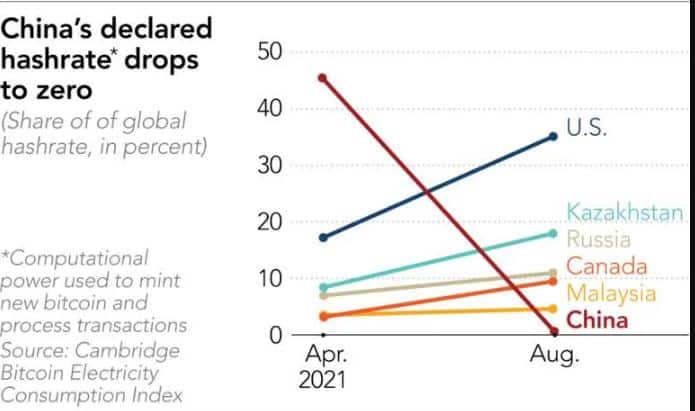
Researchers at the Cambridge Center for Alternative Finance found that the U.S. share of average monthly global hash rate — the computational power used to mint new bitcoin and process transactions — grew to 35.4% in August from 16.9% in April.

Chinese miners held 46% in April, before a ban on new mining in Inner Mongolia and the closure of 26 operations in Sichuan province brought the declared mining activity in China to zero.

The Cambridge bitcoin electricity consumption index, updated on Wednesday, showed Kazakhstan doubled its share to 18.1%, coming in second, followed by Russia with 11%. Electricity in the two countries, both major producers of fossil fuels, costs under 1 cent per kilowatt-hour.


“This confirms the hash rate trajectory identified in the last update (to end April 2021) which showed those three countries were already gaining market share prior to the crackdown in China,” wrote Michel Rauchs, digital assets lead at the CCAF.

The index is derived from the IP addresses of participating bitcoin mining pools.

usa on top of btc mining


The price of bitcoin dipped when Beijing’s crackdown culminated in a total ban on cryptocurrency transactions in September but has risen 24% in the past month to $56,007.40 as of Tuesday. As China tightened restrictions, market participants welcomed a decentralization of mining activity and a shift to renewable energy sources.

“The effect of the Chinese crackdown is an increased geographic distribution of hashrate across the world, which can be considered a positive development for network security and the decentralized principles of Bitcoin,” Rauchs wrote.

Pressure on Sichuan province to cut carbon emissions prompted the June crackdown, driving the global hashrate down by 38% that month, according to the researchers. But a “bounceback” was observed in July and August as Chinese mining operations moved overseas. Many moved to Malaysia, whose hashrate share grew from 3.44% in April to 4.59% in August.

Aside from Malaysia’s sizable Chinese-speaking population, miners are also drawn to resource-rich Malaysia’s cheap and stable electricity, priced at $0.05 per kilowatt-hour with a reserve margin as high as 52%.


Oil-rich Canada, Iran, and Norway ranked in the top 10 of the Cambridge index, and in the U.S., energy-producing states such as Texas, Wyoming, and New Mexico are becoming mining hotspots.

“The states that have the most surplus power capacity would be the most attractive, plus of course those that have large, cheap tracts of land,” said Yuriy Humber, founder of the energy analysis platform Japan NRG.

Responding to criticism of cryptocurrency’s carbon footprint amid energy shortages in Europe and China, some in the industry are looking to renewable energy sources or migrating to less energy-intensive mining.

For example, a software update may soon shift Ethereum, the second-biggest cryptocurrency by market capitalization, to proof of stake, which requires existing tokens instead of computing power to reap new tokens.

Bitcoin Futures ETF Approval Can Be Delayed Until 2022

0

Todd Rosenbluth, senior director of ETF and mutual fund research at CFRA, told CNBC that crypto-asset investors may have to wait longer for an exchange-traded bitcoin futures (ETF) product.


Speaking on CNBC’s “ETF Edge” on October 12, Rosenbluth stated that a Bitcoin futures ETF is likely to be the first crypto ETF to be approved, but warned that the current gloomy regulatory situation will cause further delays.


He told CNBC:

“We think we’re more likely to see a bitcoin futures ETF first.” 

“It’s a timing issue,” Rosenbluth said. “Does it happen in 2021 or does it move to 2022 so all of these products that … could meet the goals actually are approved and can launch at the same time instead of getting a first-mover advantage?”

“It’s possible — in fact, we think it’s likely — that we’re going to see a delay of a bitcoin futures ETF until 2022 until the regulatory environment is more clear.” 


Jan van Eck, CEO of Van Eck Associates, commented in the same interview that the SEC’s primary concern is the discrepancy between actual Bitcoin prices and the price of the futures contract, the potential for funds to get too large and push the limits on how many contracts they can own, and the risk of cross-border investment.

He said:

“In bitcoin rallies, bitcoin futures strategies can underperform by even up to 20% a year. The SEC wants to have some visibility into the underlying bitcoin markets.”

Watch Video:


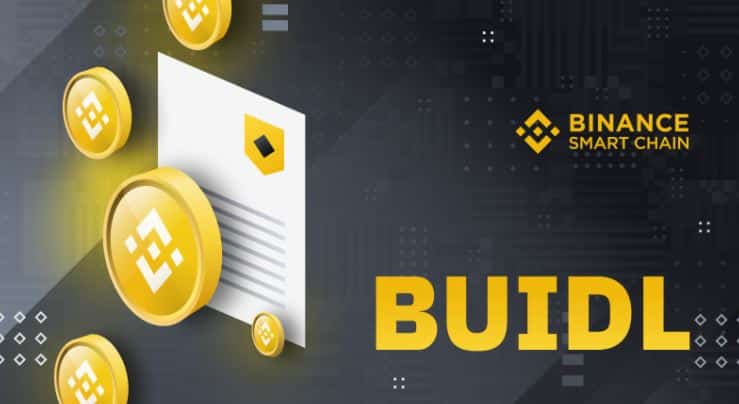
Binance Launches $1 Billion Fund to Develop Binance Smart Chain Ecosystem

0

Binance announced the launch of a $1 billion fund to develop educational programs, new projects and increase the liquidity of DeFi services on the Binance Smart Chain ecosystem.

Read: Edward Snowden: Government Digital Coins (CBDCs) Are A Conspiracy Against Society, And Will Ransom Our Future


The Binance blog states that the funds will be divided into four categories. The first category is aimed at developing talent, and $100 million will be reserved for it. It includes training for newcomers taking their first steps in the world of cryptocurrency, interacting with universities, conducting training, and supporting research and development in the field of blockchain, cryptography, and multilateral computing (MPC ). Binance executives said they intend to “nurture” a generation of cryptocurrency specialists who will accelerate the ubiquitous adoption of blockchain.

Read: Republican US Senate Candidate From Arizona Has Seven Figures Worth Of Cryptocurrency Holdings


The second program is focused on incentivizing liquidity providers that support Decentralized Finance (DeFi) protocols based on the Binance Smart Chain (BSC). The exchange is ready to contribute to the development of liquidity pools in automated market makers, lending, profitable farming, and profitable arbitrage trading. $100 million has also been allocated for this initiative.

Read: JPMorgan CEO Again Calls Bitcoin “Worthless”, Edward Snowden Respond


The third program “Builder & Incubation” is designed to support developers. $300 million has been allocated for this initiative, of which $100 million will be used to conduct hackathons at the regional and international level, reward white hackers for finding vulnerabilities, and organize developer conferences. The remaining $200 million will be used to implement the Most Valuable Builder (MVB) incubation program, in which about 100 decentralized applications based on BSC will be able to participate. They will be able to interact with Binance Smart Chain technicians and receive valuable guidance from them.

Read: Simón Bolívar International Airport in Venezuela Announces Acceptance of Bitcoin, Dash As Cryptocurrency Payments

In addition, Binance presented an investment program worth $500 million. These funds will be used to develop decentralized computing, games, metaverse, virtual reality, artificial intelligence, and financial services, which will not be limited to BSC only but other networks will also be included in this investment program. The program aims to bring blockchain technology closer to the technical and financial industries.

Read: Texas Senator Ted Cruz Proposes To Use Natural Gas For Bitcoin Mining

As a reminder, last year Binance launched a $100 million investment fund to develop DeFi projects based on the Binance Smart Chain blockchain.