
Home Blog Page 2617

Ethereum 2.0 Is Online, A New Milestone Achieved-But Why Ethereum Price Is Still Down By 11%?

0

The Ethereum 2.0 mainnet beacon chain, which is full of expectations, was finally launched yesterday night. Just as the crypto community was celebrating with joy, Bitcoin’s trend started to show downward momentum. And as always, the decline of Ethereum was even more significant than that of Bitcoin.

After Bitcoin hit an all-time high on Coinbase yesterday, Bitcoin’s price dropped sharply by more than 9% in just a few hours. 

With the Ethereum 2.0 network’s upgrade, which should be bullish for the ETH price, the Ethereum still fluctuates with the market, with a sharp correction of over 11%, which surprised many traders.

Ethereum 2.0 is the most significant upgrade in the history of the network. The ultimate goal is to solve network scalability issues through technologies such as sharding.

Before the upgrade, Ethereum processed about 15 transactions per second. According to Vitalik Buterin’s previous statement, if Ethereum 2.0 Phase 1 can be successfully launched in 2021, shard storage will be added by then, and DApps can use shared storage. Get the performance improvement of processing 100,000 transactions per second.

The shard chain will initially deploy 64 shards. The network at this stage is designed to be highly experimental. 

Phase 0 aims to test the proof-of-stake infrastructure without involving any other essential economic activities, and phase 1 intends to experiment the primary sharding model.

At this stage, there will essentially be 65 parallel blockchains, stage 0 beacon chains, and 64 new shard chains. There will be two-way communication and credit channels between Beacon Lian and all 64 shards.

At Implementation stage , major economic activities, not including pledges and smart contracts, will operate on the network. Sharding will no longer be just a basic data container but will have functions similar to Ethereum 1.0, such as virtual machines and smart contracts. 

Detailed specifications for this phase have not yet been finalized, and a lot of development work is required to make the network fully prepared for phase 2.

Since the market is more inclined to Buy on the rumor and sell on the news, Ether’s retracement may have long been traced. For example, at the end of last month, when there was news that Ethereum 2.0 is confirmed, Ethereum also dropped sharply from US$620.

Ether fell by 11% in just two hours last night, which surprised many traders. They believed that the importance and influence of this network upgrade should be given to Ethereum. 

After the release of the beacon chain, industry executives are also very optimistic about the medium and long-term growth trajectory of Ethereum and believe that this is expected to drive the overall market’s confidence in Ethereum. Joseph Lubin, the co-founder of Ethereum and founder of ConsenSys, believes that Ethereum 2.0 and Proof of Stake are milestone upgrades.

The Ethereum 2.0 beacon chain is a symbol of the spirit of open source. It first attracted many followers of Ethereum. Now, more than 27,000 validators from around the world are participating in the new Ethereum 2.0 consensus model. It proves that Stake’s implementation is a considerable upgrade to the encryption economic incentives and has made Ethereum an automated and objective trust foundation.

The analysis predicts that Ethereum will have a more substantial correction in the short term because when Bitcoin suddenly fell, the futures market suffers a huge impact, causing severe damage to the entire derivatives market. An anonymous trader named TraderKoz said it would become noticeable once Ether is consolidated above $620. If the correction continues, the short term’s fundamental support level will be at the $561 level.

Read Also:

Pizza Hut Now Accepts Bitcoin As A Payment Method.

0

Acceptance of Bitcoin as a payment method is growing in South America. After Burger King and Church’s Chicken, it is Pizza Hut’s that now accepts Bitcoin as a payment.

For a year now, the Venezuelan government is developing a real cryptocurrency economy. Due to the high inflation of the country, Bitcoin acts as a safe haven.

Bitcoin is increasingly becoming a means of payment. The acceptance of cryptocurrency in major international brands can attest to this. Burger King, Church’s Chicken, and now Pizza Hut are examples.

The move of Pizza Hut is a result of the partnership between CryptoBuyer, Mega Soft, and Pizza Hut. 

Richard ElKhouri, Senior Manager of Pizza Hut, said.

“Pizza Hut today cannot stay away from these technological advances and all those that incorporate new approaches to daily needs,” 

Pizza Hut does not directly collect Bitcoin or other cryptocurrencies from customers. Customers will make payment through, CryptoBuyer. Cryptobuyer will deal all crypto payments for Pizza Hut.

Crypto Buyer supports more than 20,000 stores and different cryptocurrencies. Bitcoin joins a list that also includes Litecoin (LTC), Dash (DASH), Binance Coin (BNB), Binance USD (BUSD), Ethereum (ETH), Tether (USDT), Dai (DAI). CryptoBuyer additionally offers its token, XPT.

Cryptobuyer offers a cryptocurrency payment platform with its headquarters in Panama. The startup also manages Bitcoin distributions in South and Central America.

Staking in Ethereum 2.0-How To Become Ethereum 2.0 validator-What To Do If You Cannot Buy 32 ETH

0

Ethereum 2.0 launched on December 1, 2020. How to become an ETH 2.0 validator, and what to do if you cannot buy 32 ETH?

On November 24, 524,288 ETH were collected in the Ethereum 2.0 deposit contract, which was necessary for staking and launching the first phase of Ethereum 2.0, known as the Beacon Chain.

The new version of the network automatically launched on December 1. After the launch, any participant in the cryptocurrency industry can become a validator.

We have prepared a guide on how to participate in Ethereum 2.0 staking.

What is Ethereum 2.0 Staking?

Staking in Ethereum 2.0 is depositing ETH in a smart contract to participate in the network as a validator and receive rewards for confirming blocks. Staking will become possible after launching a new version of the Ethereum network that will work on the new Proof-of-Stake (PoS) consensus algorithm.

Staking is a process similar to mining. In PoS-based networks, validators perform the same functions as miners. They are engaged in creating new blocks and confirming transactions for fees.

Instead of using computational resources, validators store coins in the wallet. To become an Ethereum 2.0 validator, you need to deposit at least 32 ETH for staking. At the time of writing, the cost of such a deposit is above $ 18 thousand.

Rewards of Validators

Only validators that actively stake their Ethereum are rewarded. Validators disconnected from the network are penalized. The penalties are equal to the rewards for active participation.

How To Participate In ETH 2.0 Staking?

Users wishing to become validators have two options to participate in staking.

Self-staking

Individually Depositing 32 ETH and independent launch of the validator node in compliance with the technical requirements. The staked ETH will not be available until the launch of Phase 1.5, which will happen in 12-24 months, depending on development speed. After the launch of Phase 1.5, a lock time will be set to prevent massive ETH withdrawal.

To become an independent ETH 2.0 validator, you must follow the instructions on the Ethereum.org website, which includes three main steps:

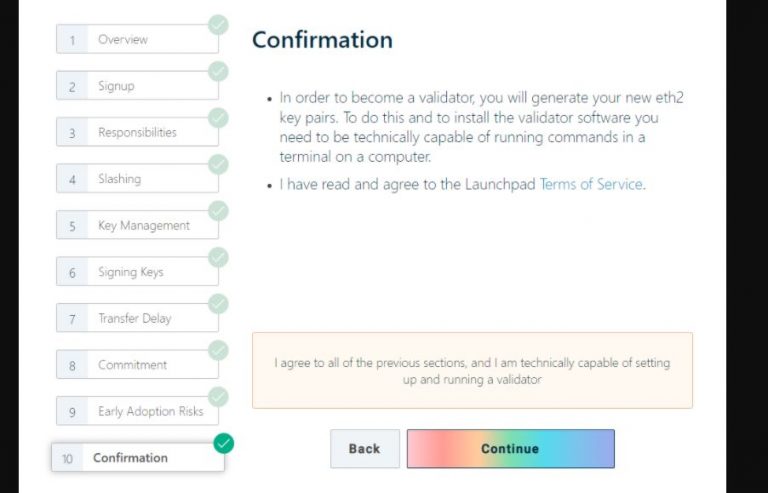
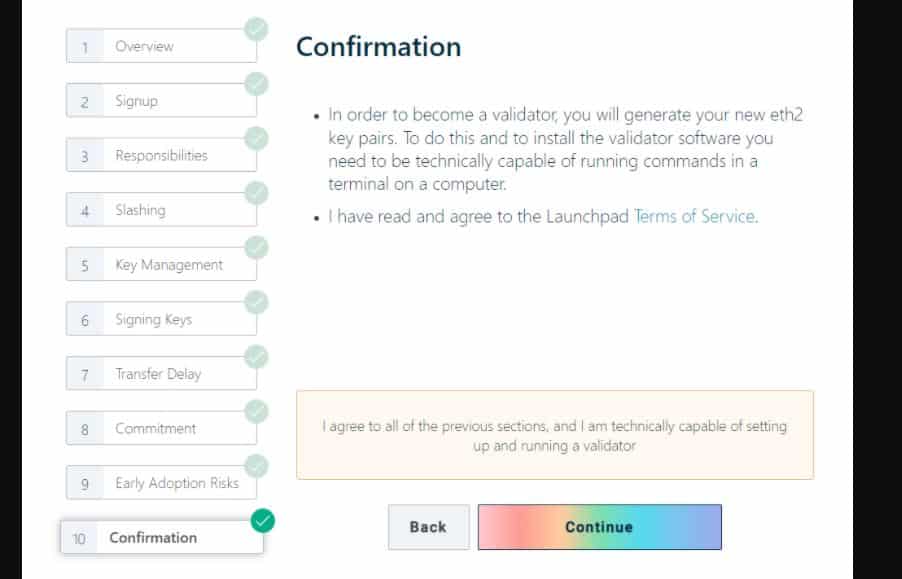
1. Acceptance of the terms and conditions of the network as a validator. The nine terms and conditions must be read and accepted, including acknowledging perceived risks, consequences of malicious and unfair behavior.

Staking in Ethereum 2.0

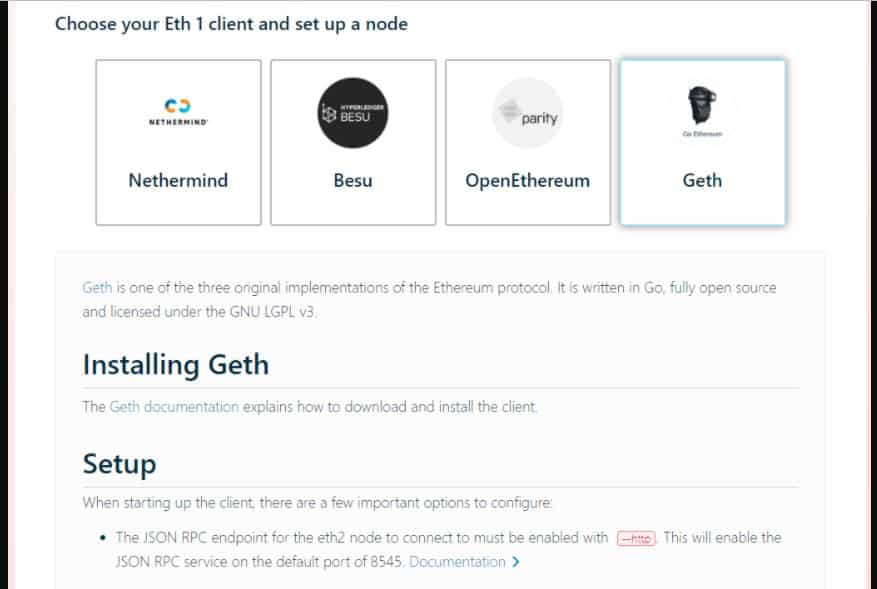
2. Creation of validator keys offline. To process incoming validator deposits from the ETH 1.0 chain, you need to run the ETH 1.0 client parallel with the ETH 2.0 client. At this point, you should select ETH 1.0 client and follow the installation instructions on the website.

Ethereum 2.0 Staking

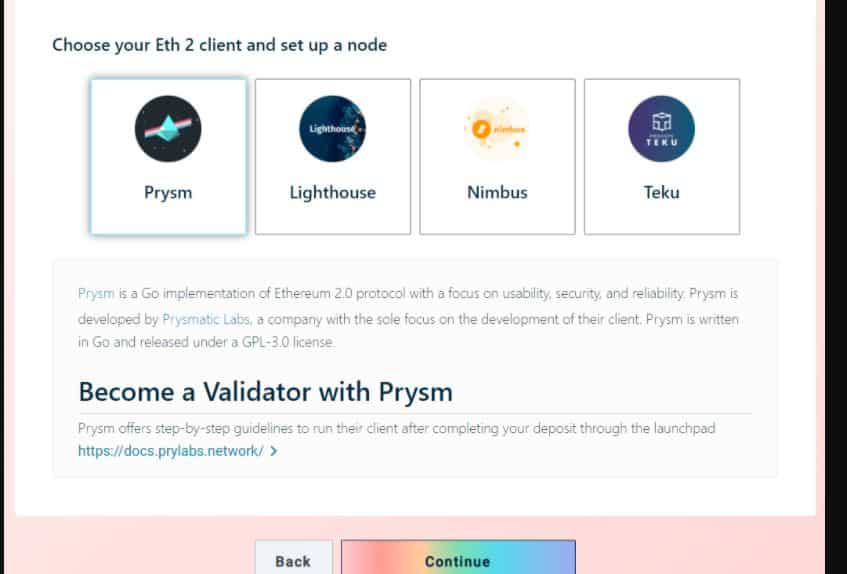
Then you need to select the ETH 2.0 client.

Staking in Ethereum 2

Next, you need to indicate the number of nodes that the user plans to manage and select the device’s operating system. Then download the CLI application from the GitHub Ethereum Foundation, or choose to build a client from a Python source.

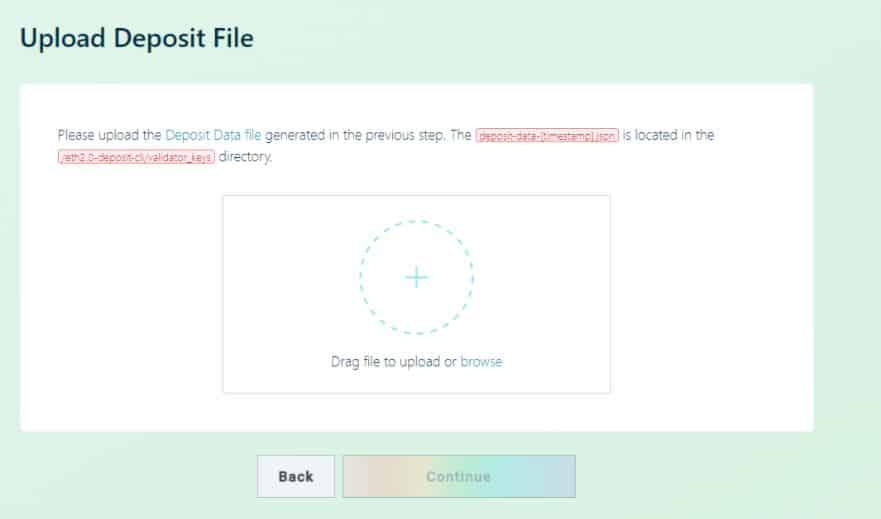
You must strictly follow the instructions and generate keys for the deposit. Validator key stores should be available in the new validator keys directory. Load the deposit data file Deposit-data- [timestamp] .json, which is located in the /eth2.0-deposit-cli/validator_keys directory, in the window provided.

Staking in Ethereum 2.0

3. Convert ETH to ETH 2.0. At this step, you need to transfer your ETH to the specified address of the smart contract as per the instructions.

In addition to starting the node yourself, you can use the Preconfigured Validator Nodes. This will save time and effort in the initial setup to run the validator. Simultaneously, maintaining the node’s operation is also user responsibility, and 32 ETH must be deposited for staking.

Another option is to use services and pay them to manage the node. This is suitable for large ETH holders and institutional investors. Examples of such services are Stakewise Solo, stakefish, Staked, Attestant, Blox Staking.

Joint staking

In Joint Staking, your deposit your Ethereum to a staking service provider like Staking pools, cryptocurrency exchanges, etc.

There are security risks associated when you are trusting the intermediaries. But with the help of these pools or exchanges, it is possible to participate in staking without having 32 ETH.

The validator’s reward is affected by the total number of ETH deposited for staking. The validator’s maximum annual return can range from 2 to 20%.

At the moment, 32 ETH is almost $ 18,000, so not everyone has that much to launch their validator node. To start staking with a small amount of Ethereum, you can use the services that offer joint staking in Ethereum 2.0.

Ethereum 2.0 developers have published a list of such services but emphasize that none of them has passed the developers’ unique verification. Users must independently assess the risks and opportunities of each service.

There are three options for joint staking.

Staking Pools

In staking pools, any amount of ETH can be deposited for staking. A pool work best for people with less than 32 ETH. In staking pools, crypto-assets of people are combined for staking purposes. Staking rewards earned are distributed among the pool members in proportion to their contributions. Staking pools are decentralized, transparent, and verifiable in any blockchain explorer.

With the pools’ help, you can combine your Ethereum with other participants to become an ETH 2.0 validator. Since most of the coordination will happen through smart contracts, you need to make sure the service has passed a security audit before sending ETH to the pool contract.

Most staking pools issue tokenized versions of staking, ETH like rETH. These ERC-20 tokens represent not only Ethereum but staking income as well. Tokens can have the same symbol or name, but they are different assets with different liquidity.

Pool validators are either managed by well-known staking service providers or by a dynamic set of contract users. The staking pool receives commissions from users or deducts fees from them to operate pools.

Advantages: The main advantage is that you can earn rewards by staking Ethereum even if you don’t have 32 ETH.

Disadvantages: There is a risk of smart contract vulnerabilities. There is a risk of pool frauds and loss of funds, hacks of pool assets.

Examples of Pool services: Rocket Pool, Stkr, Stafi Protocol, Stakewise Pool, Lido Finance, Etherchest, Stakehound, StakeDAO, CanEth Pool.

Lending Platforms

The ability to borrow tokens for ETH deposited in staking. Suitable for traders and investors looking to maximize profits.

Only one lending platform allows you to use deposited ETH for staking as collateral for obtaining a loan. LiquidStake from DHARMA Capital allows ETH holders to borrow USDC using staked ETH as collateral.

The user can benefit from the opportunity to generate income through staking and retain the ability to trade, invest, or hold their crypto assets. LiquidStake consolidates customer’s crypto assets and transfers them to major staking service providers. Credits can be obtained from the very beginning of ETH staking or later.

Advantages: Low capital requirement.

Disadvantages: Risk of intermediary, risk of the validator’s liquidation or liquidation penalty.

Crypto Exchanges

The easiest option is to transfer ETH to a crypto exchange that offers staking rewards.

Most exchanges have yet to launch co-staking products, but some have already announced plans to bring such solutions in the future. The situation is likely to change after the launch and testing of Beacon Chain.

It is not yet clear how the exchanges will deal with the indefinite lockout period. Exchanges may offer fixed income products in which coins are locked for a predetermined period without the possibility of withdrawal. Custodian wallets are likely to provide solutions with a more extended blocking period for assets. Exchange commission structures are often not transparent, so it is unclear at what intervals exchanges will accumulate rewards.

To participate in staking through an exchange, you must register with them and transfer ETH to their wallet. With your funds on exchanges you lose control over the private keys.

Advantages: Ease of use. You can stake any amount of Ethereum for staking, even if it is less than 32 ETH.

Disadvantages: Non-transparent reward structure, intermediary risk, loss of control over private keys, and crypto-assets.

Examples of Exchanges: Bitcoin Suisse, Coinbase, Binance, Kraken, CoinDCX, TokenPocket.

Conclusion

To become a validator, you need 32 ETH, without delegating your Ethereum to intermediaries. With the current value of ETH over $ 600, becoming a validator is impossible for most users.

It would be best if you kept in mind that the reward for validators’ will decrease as more and more Ethereum is deposited for staking. The earlier the validator node is deployed, the greater the rewards you get in the early stages. But after the full launch of Ethereum 2.0, you may get 2% annual returns or even less.

Staking profitability is low, and validators also bear financial risks. ETH deposited for self-staking cannot be withdrawn until Phase 1.5 rolls out, and that is 1-2 years away. In joint staking, all depends on the rules and guides of the service provider. Validators can be fined for poor performance or violation of protocol rules.

Users without technical knowledge who want to deposit Ethereum for staking can use preconfigured validator nodes or different validator services as described above.

For investors who want to stake but do not have sufficient capital to run their independent validator, joint staking solutions are developed that eliminate concerns associated with long holding Ethereum.

Despite the small number of services offering ETH joint staking, You can still take advantage of pools, cryptocurrency exchanges services.

When choosing a staking service operator, it is necessary to carefully study the proposed service, the size of the commission for services, liquidity, the reliability of smart contracts, and take into account the risks associated with the complete or partial loss of control over the keys.

Read Also:

Tezos Developers Are Planning To Implement Zcash Privacy Features 

0

Tezos Developers are planning a network update called Edo. The implementation of the Zcash Sapling library will allow you to hide transactions of Tezos blockchain.

According to the statement, Tezos developers Nomadic Labs, Marigold, and Meta state have submitted several proposals for Edo’s next network update. The update will bring privacy features and other improvements.

“No other major smart contract platform yet supports these features, but we can add these tools directly to the blockchain.” 

In mid-November, Tezos developers successfully activated the Delphi update, which significantly reduced fees for smart contracts. With this step, Tezos hopes to attract many Defi projects.

“We have wroked hard, on the core Tezos software and made significant improvements that we want to share with users of the network, ”  The developers said.

Edo’s first new feature will be the implementation of the Sapling library, initially developed by Electric Coin Company for the Zcash blockchain. As with Zcash, Sapling allows you to hide transactions. Tezos developers will be able to integrate this feature into their smart contracts and applications that value privacy.

The second addition to Edo will be the ticket system. According to the developers, this is a convenient mechanism for smart contracts to grant portable permissions to other smart contracts or to issue tokens. 

According to the statement, similar functionality can be achieved using existing methods, tickets should significantly simplify the process for third-party developers.

Edo also introduces the “fifth period,” which will simplify the deployment of updates in the future. It now takes about 60 seconds to launch new versions of the Protocol after voting is complete, making it difficult for some Tezos users to update their nodes smoothly. To fix this problem, Tezos developers suggested extending the update period so that users have more time to prepare.

Under the new system, instead of four periods of eight cycles during voting, we propose to use five periods of five cycles. The “fifth period” will be five cycles between the adoption of the new Protocol and the time of its launch, which, in our opinion, will help ensure a smooth transition between the protocols. The developers told.


Edo contains several minor bug fixes to improve performance further and reduce gas costs.

Read More:

Bitcoin Battle To Cross 20,000 USD-Touched 19,860 And Still Above 19k-Why Bitcoin Bulls Are So Strong

0

Bitcoin reached a three-year high, exceeding $19,860 on most exchanges, but has not yet been able to overcome 20,000 USD.

On the evening of November 30, 2020, Bitcoin again stormed the $20,000 level, which it reached as close as possible on November 18, 2017. 

That is not the time for holders to celebrate. Reaching $19,840 – $19,870 on various exchanges, Bitcoin did not hold the bar and fell to $19,000, but then rose again. Fluctuations in prices will continue. But the bulls are unlikely to retreat, and they will start pushing the price up also.

Reasons Of Bitcoin Bull Rally

The bull rally of Bitcoin began in August after analytical firm Micro Strategy and several other companies started to invest in Bitcoin.

Quantum Economics analyst Jason Deane said that large companies that buy Bitcoins are more likely to hold them for the long term rather than selling them on the crypto exchange because of price fluctuations. 

His assumptions are confirmed by the words of MicroStrategy CEO Michael Saylor, who believes that Bitcoin is the best means to preserve values. 

In October 2020, MicroStrategy investments were followed by Square, owned by Twitter founder Jack Dorsey. Square bought 4709 BTC for $50 million, after which the rate of crypto-asset rose to $10,935. 

Later, the payment giant PayPal entered the cryptocurrency arena, announcing cryptocurrency support for American users. Perhaps the rapid rise of bitcoin was influenced by statements from large companies’ heads commenting on investments in this Bitcoin.

American billionaire Stanley Druckenmiller believes that investing in bitcoin is much more profitable than investing in gold. 

A week ago, the Director of the investment company BlackRock, Rick Rieder, also said that Bitcoin is a reliable mechanism that can replace gold. 

According to Binance Research experts, several other factors explain the growth of the Bitcoin rate. 

First of all, many investors see bitcoin as a protection against inflation. Given that governments of various countries continue to print money during the crisis and pandemic, because of which value of even the most stable fiat currencies is falling. 

It is not surprising that people are beginning to perceive Bitcoin as a protective asset. Increased regulatory control and the futures market’s development have become another factor contributing to Bitcoin’s growth.

Today’s cryptocurrency market is significantly different from what it was in 2017. Over the past three years, many companies that comply with strict regulatory requirements have obtained a license to perform brokerage activities. This has significantly simplified companies’ access to cryptocurrencies. We can say that Bitcoin is in uncharted territory, and it is impossible to predict what highs lie ahead if BTC breaks the figure of $20,000.

Read Also:

Ethereum Is Skyrocketing 25% Off Its Recent Drop, Looking At $ 630 As The Bulls Come Back In Action

0

Ethereum bounces off last week’s support at $ 485 to the nearest resistance of $ 600. A break above $ 600 is expected to lift Ethereum above $ 630 and possibly send it to $ 700.

Ethereum has recovered significantly since its plunge last week towards support at $ 480. The weekend session was kind to other major cryptocurrencies as well. As Bitcoin surged above $ 18,000, Ether is trading at $ 580, showing a growing bullish momentum.

Ethereum on the verge of breaking through to $ 630

Ethereum Is Skyrocketing 25% Off Its Recent Drop, Looking At $ 630 As The Bulls Come Back In Action

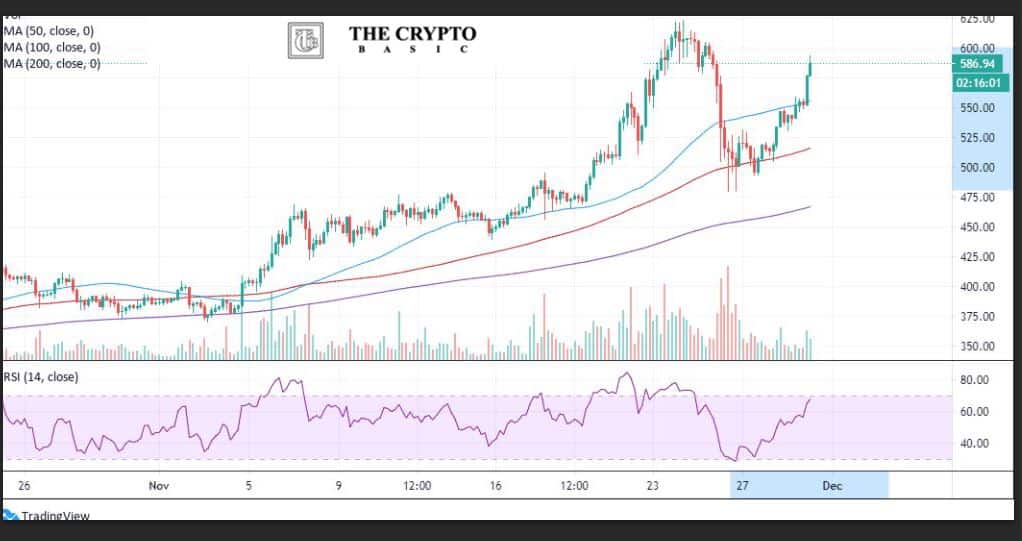
All technical indices indicate that Ethereum will soar to highs above $ 600. The relative strength index has strengthened its bullish grip as it approaches the overbought area. Consistent gains from around RSI 30 levels caused an increase in buy orders.

ETH is also trading above 4H, 50 moving average. Note that the last time Ethereum went below this moving average, the loss was 11.5%.

As long as the smart contract giant stays above this key moving average, the path to gain more high ward momentum will be increased with the least resistance.

On the other hand, the gap made by 50 SMA in 4 hours above 100 SMA and 200 SMA suggests that buyers have an edge.

Trading above $ 600 is likely to encourage more buyers to join the market. If enough bullish pressure is created, Ethereum is expected to break above the $ 625 target and focus on gains above $ 700.

On the other hand, some delays can occur at $ 600 before moving more up.

There may be enough selling pressure to stop the planned breakout at $ 630. A correction from the critical level could cause Ethereum to fall back to find a haven at the 50 SMA level. Other key support levels to keep an eye on are 100 SMA at $ 520, $ 485, and 200 SMA at $ 460.

Bitcoin Bulls Keep Pushing-Why $ 18.8K is a Crucial Breakout Zone-Detailed Bitcoin Technical Analysis

0

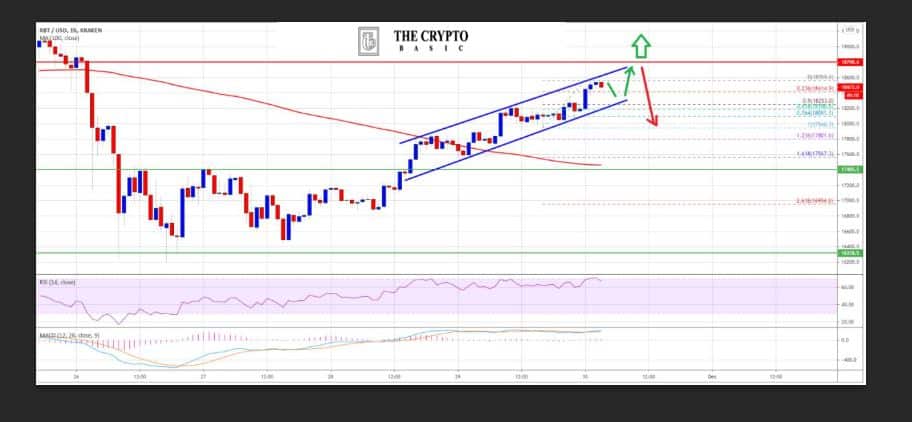
Bitcoin price rallied more than 4%, and it broke the $ 18,500 level against the US dollar. BTC is currently following an excellent bullish path, but the $ 18,800 level is strong resistance.

Bitcoin rallies and has broken through the critical resistance of $ 18,500.

The price is trading ar $ 18500 range and is now above the 100-hour simple moving average.

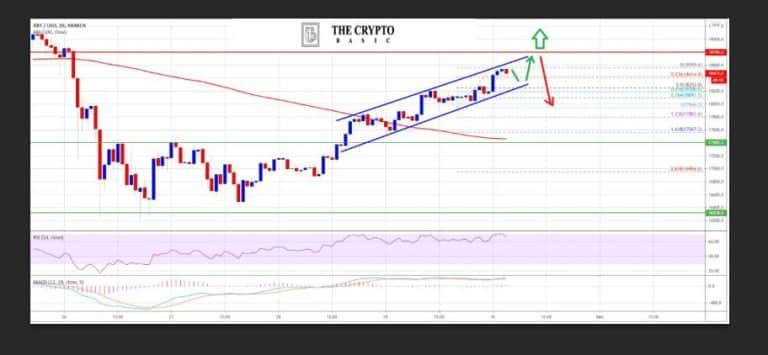
BTC/USD pair is forming a sizeable upward channel with support around $ 18,280 on the hourly chart. Bulls may face a massive resistance near the $ 18,800 zone. 

Bitcoin Price Is Approaching The Main Obstacle.

Bitcoin Bulls Keep Pushing-Why $ 18.8K is a Crucial Breakout Zone-Detailed Bitcoin Technical Analysis

In the weekly analysis, we saw a new rise in bitcoin price above the $ 18,000 level. BTC continued to rise above the $ 18,200 and $ 18,400 resistance levels.

There was also a break above the $ 18,500 resistance level. The price traded at $ 18,559 and is now above the 100-hour simple moving average. It is currently consolidating gains and is trading near the $ 18,450 level.

An initial support on the downside is near the $ 18,410 level. It is close to the 23.6% Fibonacci retracement level of the recent advance from the swing low of $ 17,950 to the high of $ 18,550. 

Moreover, on the BTC / USD pair’s hourly chart, a large upward channel is forming with support around $ 18,270. Channel support is close to the 50% Fibonacci retracement level of the recent advance from a swing low of $ 17,950 to a high of $ 18,550. On the other hand, channel resistance at $ 18,655 is short-term resistance.

The first serious resistance for the bulls lies near the $ 18,810 level. A successful break above the $ 18,810 level could trigger a strong upward move, and Bitcoin could rise above $ 19,000 and even $ 19,200.

Another drop in BTC?

If Bitcoin fails to overcome the breakout resistance at $ 18,800, there is a risk of another decline. An initial support on the downtrend is near the $ 18,250 level or the channel’s lower trendline.

A clear break below the channel support level could lead to a sustained decline to $ 18,000. The next significant support below the $ 18,000 level is near the $ 17,400 level and the 100-hour simple moving average.

Technical indicatos

The Hourly MACD is currently gaining momentum in a bullish zone. The Hourly RSI for BTC / USD is currently well above the 60 levels with bullish signs. Major Support Levels are $ 18,255 followed by $ 18,000. And Major resistance levels are $ 18,658, $ 18,810 and $ 19,000.

Are Defi And Cryptocurrency Indexes Diverse Enough? 

0

Over the prior ten years, the investment model in conventional financial markets has moved to passive investment. Since the beginning of 2020, index funds have managed over $ 10 trillion.

Why use an index?

An index fund is a kind of shared fund or an exchange-traded product (ETP) designed to provide direct exposure to a financial market index’s performance. 

Many investors are attracted to these instruments because they want to outsource the complexity of active management. This is the process of selecting shares to invest in.

They also want easy access to a particular market, which in turn provides a well-diversified portfolio. Besides, index funds tend to adopt a passive investment strategy that generates lower fees than actively managed funds. 

Decentralize The Financial World

Given the usefulness and popularity of index funds in traditional finance, it is no surprise to see the emergence of these services in the crypto ecosystem. Protocols such as Index Cooperative, Synthetix, and PieDAO have built up their respective Defi indices, allowing crypto investors to be easily exposed to the Defi sector without being a Defi expert.

Since the crypto ecosystem copies every conceivable financial product in traditional finance to crypto networks, you will also find tokens that function as indices for Defi assets. 

Risk of Excessive Concentration

Despite the advantages of index funds in traditional markets, there are also disadvantages, such as concentration risks. For example, in recent months, the S&P 500 Index has been more dependent on the top five technology shares Apple, Microsoft, Amazon, Facebook, and Google than during the dot-com bubble. The same can be said for the broadest Defi index of crypto.

The Defi Pulse Index (DPI) is a market capitalization-weighted index that follows the performance of Defi assets on Ethereum. The DPI is updated monthly and does not include token derivatives, synthetic assets, or tokens linked to physical assets.

The S & P 500 Index contains the prices of 500 companies. So many different Defi tokens are not there. Also, many Defi tokens must come and go. As a result, DPI also has concentration risks. Currently, 30% of the Defi Pulse Index consists of only two assets: UNI & AAVE.

Also, 77% of the DPI’s total risk is determined by only four tokens: UNI, YFI, SNX, and AAVE. As a result, the yield of the index is extremely sensitive to these four assets’ movements. 

What risk do you want to take?

If you want to invest in a Defi or cryptocurrency index, do a good study, and only after proper research should you invest. More than ninety percent of Defi tokens are scams. So be very careful with your investment.

Bitcoin price patterns suggest a new ATH at$ 160,000, XRP price Explosion, green light for Ethereum 2.0 & iota News 

0

Welcome to TheCryptoBasic weekly review. As usual, there was a lot to report this week, and it is not surprising that we offer a whole range of interesting News.

Our topics this week range from the patterns of past Bitcoin price bull runs and what they tell us about the future price potential of BTC to the XRP price Explosion, the green light for the launch of Ethereum 2.0 to the latest iota Update.

Bitcoin price patterns in previous Bull Runs suggest a Top of $ 160,000 with a correction to $ 25,000. 

The Crypto market has gained significantly in value. Many cryptocurrency enthusiasts are wondering where the Bitcoin price will peak in the next big bull run. Before and after the last three Bull Runs, there were different price peaks, and significant declines above 80% were recorded. The voices are getting louder and louder, which speaks of the fact that the next big Bull Run has already started. 

The only question most people are asking at the moment is about the new ATH and where that might lie. According to an influencer and analyst, if the Bitcoin price follows old patterns, it could be around$ 160,000. 

Read More

Ripple price explodes-XRP rises to over 100% in 7 days.

Ripple has been able to gain in the last few days. The XRP price has increased by 70% in the previous seven days and has also reached a new record high in daily trading volume. XRP overtakes Tether again and makes it to third place by market capitalization.

The XRP price was not impressive for a long time. Only Bitcoin and many Defi token prices exploded in the past, But now the Ripple Hype peaked like in 2017. 

Read More.

Ethereum 2.0 Launch can begin the starting signal for a new era.

The Ethereum 2.0 Launch can start as planned. In the first days after the Deposit Contracts’ official start for the Beacon Chain, only a fraction of the required ETH was deposited. However, the tide has now turned, and Ethereum 2.0 can inevitably start on December 1, 2020. 

Read More.

Bitcoin in the Mass Media.

BTC lands on Page 1 of the Wall Street Journal, while for many people, the year 2020 was considered relatively modest, crypto investors could rejoice with the rising prices this year. While Bitcoin initially marched towards an all-time high, a sharp increase in most Altcoins began in the last few days.

Bitcoin remains the top dog and most prominent representative of cryptocurrencies. BTC has now once again managed to attract the attention of the mass media. The cryptocurrency landed on the main page of the Wall Street Journal.

Iota Update on Chrysalis Phase 2 And Patnership With Australian Ministry.

IOTA is progressing. The development team conveyed this message last week in a blog post published on November 19. Jakub Chech, the director of Engineering, spoke about the steps of Phase 2 in the weekly Chrysalis Update as a significant partnership with the Australian Ministry. 

Read More.

Facebook May Launch Libra in January 2021

0

In January next year, Facebook could start Libra which is Facebook cryptocurrency, the Financial Times reported today.

The Libra coin would be backed 1 to 1 by the dollar. Facebook is still waiting for the green light from the Swiss regulator Finma. In October, the G7 reported that Libra Launch was against laws until officially approved.

In addition to the crypto coin, Facebook already has its payment system. The reports tells that coronavirus puts a lot of pressure on advertising revenue and that Facebook is, therefore, looking for new revenue models.

According to the analysts, over 2020, the company’s total revenue from Menlo Park will be 83,93 billion USD. This is really higher than 2019’s revenue of 70,7 billion USD.

According to the latest round of the analysts’ survey, the company is heading for a profit per share of 9,33 USD. This brings the price/earnings ratio to 29.54.

Analysts do not expect the company to pay dividends. On average, a share in the internet companies delivers a limited dividend yield of approximately 0,32 percent.

Analyst estimates Facebook Shares around $ 325

BMO Capital Markets, Wells Fargo, and Wedbush Morgan Securities recently provided recommendations for the stock.

The company’s market capitalization is based on the current number of outstanding shares, around 657,28 billion USD. The stock was the past 12 months quite unstable. A year ago, the share was no less than 36 percent in the plus. The stock traded between $ 137 and $ 305 in the past year.